The Ministry of Youth Affairs and Sports announced the National Sports Awards 2025 on 18 August 2026, honouring 17 athletes with the Arjuna Award, five coaches with the Dronacharya Award and the Army Paralympic Node in Pune with the Rashtriya Khel Protsahan Puraskar. The selection was made on the recommendations of a committee headed by former Supreme Court Judge Justice (Retd.) Arun Kumar Mishra. No sportsperson was selected for the Major Dhyan Chand Khel Ratna, India’s highest sporting honour, making 2025 only the third year since 1991 when the award has remained vacant.
What Are the National Sports Awards?
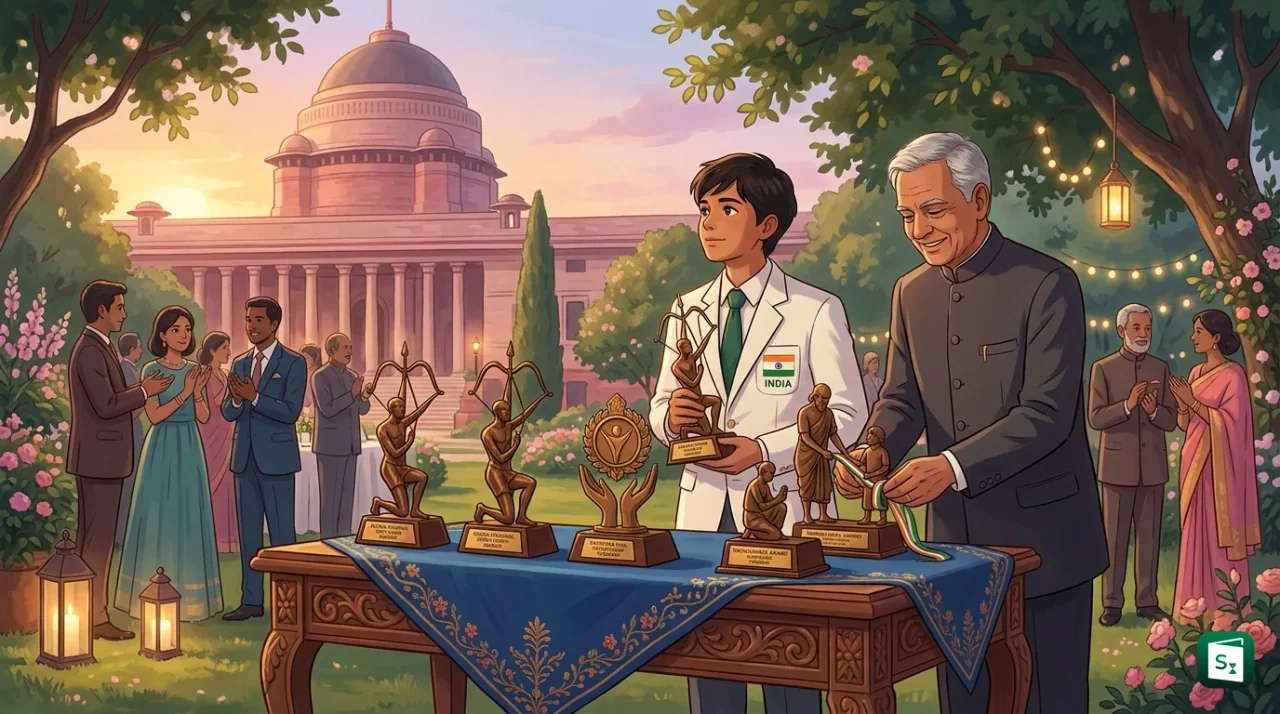
The National Sports Awards are the highest sporting honours given by the Government of India to recognise outstanding achievement and contribution in sports. They are administered by the Ministry of Youth Affairs and Sports, with the Department of Sports handling nominations, scrutiny and the ceremony. The awards are conferred by the President of India at Rashtrapati Bhavan in New Delhi, traditionally on National Sports Day, which is observed on 29 August to mark the birth anniversary of hockey legend Major Dhyan Chand.
The awards framework has grown since independence. The Maulana Abul Kalam Azad (MAKA) Trophy was instituted in 1956-57 for the top performing university in inter-university tournaments. The Arjuna Award, named after the archer Arjuna from the Mahabharata, was instituted in 1961 and is the oldest and second highest sports honour. The Dronacharya Award for coaches was introduced in 1985, with separate Regular and Lifetime categories added later, in 2011 the Lifetime category was formalised. The Major Dhyan Chand Khel Ratna, originally instituted as the Rajiv Gandhi Khel Ratna in 1991-92, became the highest honour and was renamed on 6 August 2021 after Major Dhyan Chand. The Rashtriya Khel Protsahan Puraskar was instituted in 2009 to recognise corporate entities, public sector undertakings, non governmental organisations and sports control boards for promotion and development of sports over three years. The Major Dhyan Chand Award for lifetime achievement, instituted in 2002, was restructured in 2024 into the Arjuna Award (Lifetime) category.
Cash prizes were revised in 2020. At present, the Khel Ratna carries ₹25 lakh, the Arjuna Award carries ₹15 lakh along with a bronze statuette of Arjuna, a certificate and ceremonial dress, the Dronacharya (Regular) carries ₹10 lakh and the Dronacharya (Lifetime) carries ₹15 lakh with a bronze statuette of Dronacharya. The Rashtriya Khel Protsahan Puraskar carries a trophy and citation, while the MAKA Trophy is a rolling trophy with cash grants for the top three universities. Funding comes from the annual budget of the Ministry, which received ₹3,794 crore in 2025-26, and nominations are now invited through an online portal at dbtyas-sports.gov.in that allows self nomination since 2022.
How the 2025 Winners Were Selected
The Ministry announced the 2025 winners on 18 August 2026 based on the recommendations of a Selection Committee headed by Justice (Retd.) Arun Kumar Mishra, a former judge of the Supreme Court of India. Justice Mishra served on the Supreme Court and later as Chairperson of the National Human Rights Commission of India from 2021 to 2024. The committee also included eminent sportspersons, experienced sports administrators and persons with expertise in sports journalism. Members are drawn from diverse disciplines and no single sport is allowed more than one representative, which is intended to ensure balance and limit bias.
Applications were invited online through a dedicated portal, and sportspersons, coaches and organisations were allowed to self nominate. A large number of entries were received this year. The committee evaluated performances over the preceding four years for the Arjuna and Khel Ratna categories and over 20 years for lifetime contributions, with weight given to medals at the Olympics, Paralympics, Asian Games, Commonwealth Games, World Championships and other equivalent international events. Qualities of leadership, sportsmanship and discipline were also considered, and nominees facing doping or ethical violations are disqualified. The committee’s recommendations were submitted to the Union Minister for Youth Affairs and Sports for final approval. Although the selection panel had recommended 24 names for the Arjuna Award in December 2025 and had initially proposed hockey vice captain Hardik Singh for the Khel Ratna, the final government list approved 17 Arjuna awardees and left the Khel Ratna vacant. The awards will be presented by President Droupadi Murmu at a special function at Rashtrapati Bhavan.
Arjuna Award 2025: Seventeen Sportspersons Honoured
The Arjuna Award, officially the Arjuna Awards for Outstanding Performance in Sports and Games, is given for consistent outstanding performance over the previous four years, along with demonstrated leadership, sportsmanship and discipline. It was the highest honour before the Khel Ratna was introduced, and today it remains the second highest with more than 900 recipients since 1961 across over 40 disciplines. The 2025 list is notable for its diversity, covering eleven disciplines from athletics and badminton to para sports and deaf shooting.
Seventeen athletes were selected this year:
| Athlete | Discipline |
|---|---|
| Tejaswin Shankar | Athletics |
| Muhammed Ajmal V | Athletics |
| Priyanka Goswami | Athletics |
| Treesa Jolly | Badminton |
| Pullela Gayatri Gopichand | Badminton |
| Narender Berwal | Boxing |
| Vidit Santosh Gujrathi | Chess |
| Divya Jitendra Deshmukh | Chess |
| Dhanush Srikanth | Deaf Shooting |
| Lalremsiami | Hockey |
| Rajkumar Pal | Hockey |
| Surjeet Singh Narwal | Kabaddi |
| Pooja | Kabaddi |
| Rudransh Khandelwal | Para Shooting |
| Ekta Bhyan | Para Athletics |
| Arvind Singh | Rowing |
| Akhil Sheoran | Shooting |
Among the most prominent names is Tejaswin Shankar, born 21 December 1998 in Delhi. He is a decathlete and high jumper who holds the national decathlon record of 8,057 points set at Ranchi in 2026, the first time an Indian breached the 8,000 point barrier, and a high jump best of 2.29 metres from 2018. He won bronze in high jump at the 2022 Commonwealth Games in Birmingham with 2.22 metres, India’s first ever medal in that event, and silver in decathlon at the 2022 Asian Games in Hangzhou. He added bronze in decathlon at the 2026 Commonwealth Games in Glasgow, becoming the first Indian to win Commonwealth medals in two different athletics disciplines, and silver at the 2025 Asian Athletics Championships in Gumi, South Korea.
Divya Jitendra Deshmukh, aged 19 and from Nagpur, won the FIDE Women’s World Cup 2025 in Batumi, Georgia, on 28 July 2025, defeating compatriot Koneru Humpy 1.5 to 0.5 in rapid tiebreaks. With that victory she became India’s 88th Grandmaster and only the fourth Indian woman to earn the Grandmaster title after Humpy, Harika Dronavalli and R Vaishali, and the third ever winner of the Women’s World Cup after Alexandra Kosteniuk and Aleksandra Goryachkina. She had already been Woman Grandmaster in 2021 and International Master in 2023, and played a key role in India’s team gold at the 45th Chess Olympiad in Budapest in 2024.
Vidit Santosh Gujrathi, a leading Grandmaster from Maharashtra, has been a mainstay of the Indian open team and was also part of the Olympiad gold winning squad. His inclusion along with Divya underlines the depth now present in Indian chess after D Gukesh became world champion as the youngest ever Khel Ratna recipient at age 18.
Treesa Jolly and Pullela Gayatri Gopichand are India’s leading women’s doubles pair. Gayatri is the daughter of former All England champion and chief national coach Pullela Gopichand. Their recognition reflects growing strength in doubles, a discipline where India has traditionally been stronger in singles. From athletics, Muhammed Ajmal V and Priyanka Goswami, the race walker who represented India at the Tokyo and Paris Olympics, were also honoured. Hockey recognition went to Lalremsiami, a forward in the women’s team, and Rajkumar Pal from the men’s team. Kabaddi, one of India’s traditional sports, was represented by Surjeet and Pooja. Para sports featured through Rudransh Khandelwal in para shooting and Ekta Bhyan in para athletics, while Dhanush Srikanth was recognised in deaf shooting and Arvind Singh, a lightweight rower, and Akhil Sheoran, a rifle shooter, completed the list.
Arjuna Award (Lifetime) for I Arumainayagam
The Arjuna Award (Lifetime) honours sportspersons who delivered outstanding performances during their active careers and continued to promote sports after retirement. This year it was conferred on I Arumainayagam, also referred to as Isaiah Arumainayagam, a former Indian football winger.
Arumainayagam was part of the Indian team that won the gold medal at the 1962 Asian Games in Jakarta under coach Syed Abdul Rahim, a triumph regarded as Indian football’s greatest international achievement and India’s second and last Asian Games gold in football after 1951. He made his India debut against Thailand on 28 August 1962 at the Asian Games and earned 18 caps, scoring three goals. He also helped India finish runners up at the 1964 AFC Asian Cup in Israel and placed third at the Merdeka Cup in 1966.
At domestic level, he represented Madras or Tamil Nadu, Bengal and Railways in the Santosh Trophy between 1958 and 1971, winning the Trophy with Bengal in 1962. At club level he spent eight seasons with Mohun Bagan from 1961 to 1968, scoring 56 goals, winning the Calcutta Football League in 1962, 1963, 1964 and 1965, the IFA Shield in 1961 and 1962, the Durand Cup in 1963, 1964 and 1965 and the Rovers Cup in 1966, and later played for Southern Railway in 1969 and 1970. He was conferred the Mohun Bagan Ratna in 2014. All India Football Federation President Kalyan Chaubey described the lifetime award as recognition of both his playing achievements and enduring contribution to football.
Dronacharya Award 2025: Five Coaches Recognised
The Dronacharya Award, officially the Dronacharya Award for Outstanding Coaches in Sports and Games, is named after Dronacharya, the teacher of the Pandavas in the Mahabharata. It honours coaches who have produced medal winners at major international events through consistent and meritorious work. The first recipients in 1985 were Bhalchandra Bhaskar Bhagwat in wrestling, Om Prakash Bhardwaj in boxing and O M Nambiar in athletics, the coach of P T Usha. Hansa Sharma in weightlifting in 2000 and Renu Kohli were among the early women to receive the honour.
For 2025, five coaches were selected across two categories:
| Category | Coach | Discipline |
|---|---|---|
| Regular | Parveer Singh | Athletics |
| Regular | Chhote Lal Yadav | Boxing |
| Regular | Neha Nandkumar Chavan | Shooting |
| Lifetime | Dharmendra Singh Yadav | Boxing |
| Lifetime | Virender Kumar | Wrestling |
The Regular category recognises outstanding work over the preceding four years that has enabled athletes to excel internationally, while the Lifetime category recognises contribution over 20 years or more. Regular awardees receive ₹10 lakh, a bronze statuette of Dronacharya, certificate and ceremonial dress, while Lifetime awardees receive ₹15 lakh with the same statuette and citation. The selection underscores the often unseen role of coaching in building India’s recent gains in athletics, boxing and shooting, where technical preparation and long term athlete development have become decisive.
Rashtriya Khel Protsahan Puraskar: Army Paralympic Node, Pune
The Rashtriya Khel Protsahan Puraskar, instituted in 2009, is given to corporate entities in the public and private sector, non governmental organisations, sports control boards and other institutions that have played a visible role in sports promotion and development over the last three years. It is awarded in four segments, which are identification and nurturing of budding and young talent, encouragement of sports through corporate social responsibility, employment of sportspersons and sports welfare measures, and sports for development. Recipients receive a trophy and citation.
For 2025, the sole recipient is the Army Paralympic Node, Pune. The Node operates under the Indian Army within the Mission Olympic Wing and is based at the College of Military Engineering campus in Pune. It was established to identify, train and support para athletes, many of them soldiers who acquired disabilities in service, and to prepare them for international multi sport competitions including the Paralympics and Asian Para Games. Through structured coaching, sports science support and access to army infrastructure, the Node has created a pathway for para sport at a time when India’s para athletics and para shooting programmes have grown rapidly. The Indian Army said the honour reflects its commitment to nurturing sporting talent and inspiring excellence. Recent parallels include the Army Rowing Node in Pune, which was named World Rowing’s Best Programme of the Year at Lausanne in January 2026, showing the army’s wider sports promotion footprint.
Why No Khel Ratna in 2025 and What It Means
The Major Dhyan Chand Khel Ratna Award is India’s highest sporting honour, given for the most outstanding performance by a sportsperson over four years at the international level. Instituted in 1991-92, it was first won by chess Grandmaster Viswanathan Anand. It carries ₹25 lakh, a medallion and a certificate. In August 2021, it was renamed from the Rajiv Gandhi Khel Ratna to honour Major Dhyan Chand, who won three Olympic gold medals for India and gave his name to National Sports Day.
For 2025, no athlete was selected. This is the third time the award has been left vacant, after 2008 and 2014. In 2024, four athletes shared the honour, which were D Gukesh in chess, Harmanpreet Singh in hockey, Praveen Kumar in para athletics and Manu Bhaker in shooting. The gap in 2025 does not reflect a lack of talent but rather the high bar of spectacular and most outstanding performance over four years that the Khel Ratna demands. The selection committee had recommended hockey vice captain Hardik Singh as the sole Khel Ratna nominee in December 2025, but the final government announcement did not include any recipient.
The broader message of the 2025 awards is balance and breadth. Eleven disciplines are represented among Arjuna winners, with strong representation for women athletes such as Divya Deshmukh, Treesa Jolly, Gayatri Gopichand, Priyanka Goswami, Lalremsiami, Pooja and Ekta Bhyan. Inclusion of deaf shooting, para athletics and para shooting shows that the honours system now spans Olympic, Paralympic and specialised categories. Recognition of coaches and an institutional para sports programme alongside athletes also signals that success is seen as a complete ecosystem of talent identification, coaching, support systems and organisational backing, rather than individual triumph alone.
Key Takeaways
- National Sports Awards 2025 were announced on 18 August 2026 by the Ministry of Youth Affairs and Sports, with selection based on recommendations of a committee headed by Justice (Retd.) Arun Kumar Mishra.
- 17 athletes received the Arjuna Award for outstanding performance over four years, including Tejaswin Shankar, Muhammed Ajmal V, Priyanka Goswami, Treesa Jolly, Gayatri Gopichand, Vidit Gujrathi, Divya Deshmukh, Dhanush Srikanth, Lalremsiami, Rajkumar Pal, Surjeet, Pooja, Rudransh Khandelwal, Ekta Bhyan, Arvind Singh and Akhil Sheoran, with boxing’s Narender Berwal.
- I Arumainayagam, football winger and member of India’s 1962 Asian Games gold medal winning team who earned 18 caps and later won the Mohun Bagan Ratna in 2014, received the Arjuna Award (Lifetime).
- Dronacharya Award (Regular) went to Parveer Singh (Athletics), Chhote Lal Yadav (Boxing) and Neha Nandkumar Chavan (Shooting), while Dronacharya Award (Lifetime) went to Dharmendra Singh Yadav (Boxing) and Virender Kumar (Wrestling).
- The Rashtriya Khel Protsahan Puraskar 2025 was conferred on the Army Paralympic Node, Pune, which functions under the Indian Army’s Mission Olympic Wing to identify and train para athletes.
- No sportsperson was selected for the Major Dhyan Chand Khel Ratna in 2025, the third time the highest honour has been left vacant since its institution in 1991-92, after 2008 and 2014, the first winner was Viswanathan Anand and it was renamed from Rajiv Gandhi Khel Ratna in August 2021.
- The Arjuna Award was instituted in 1961 and carries ₹15 lakh with a bronze statuette, while the Dronacharya Award was instituted in 1985 and carries ₹10 lakh (Regular) and ₹15 lakh (Lifetime).