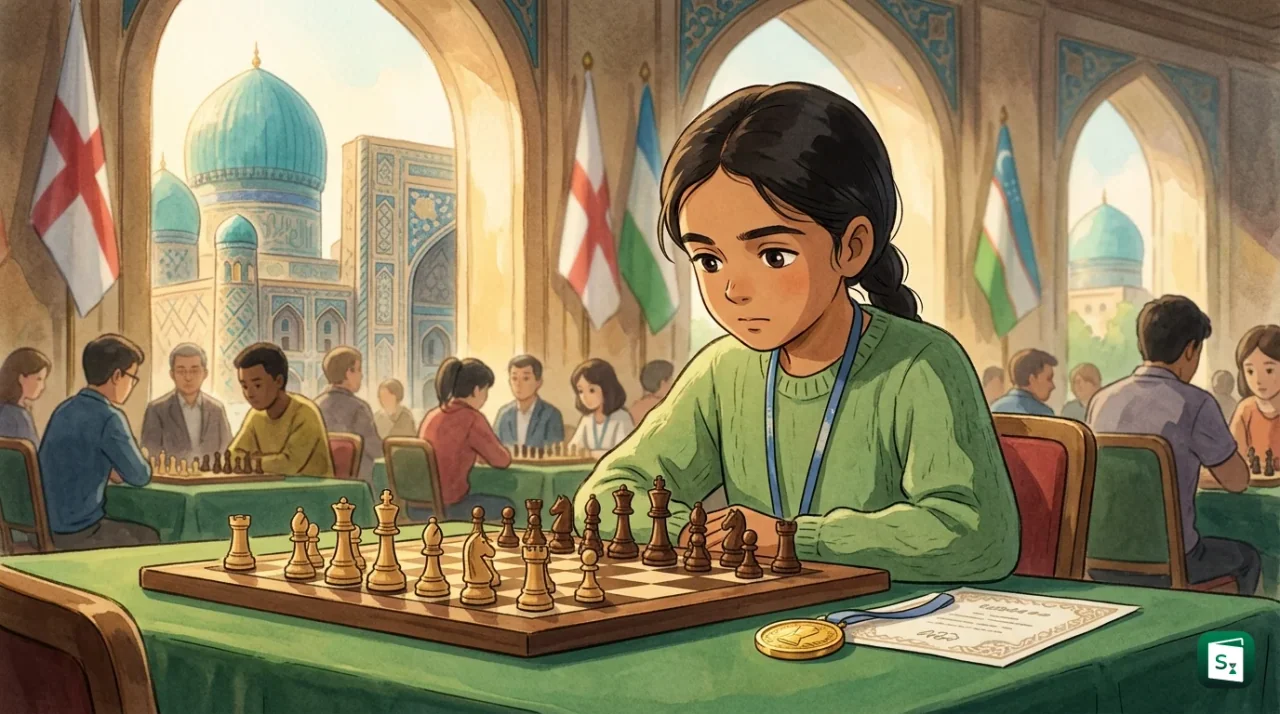
Bodhana Sivanandan, an 11 year old schoolgirl from Harrow in north west London, became the youngest Woman Grandmaster in chess history at the 46th Chess Olympiad in Samarkand. Representing England on the top board, she completed her third and final WGM norm on 27 September 2026 with 8 points from 11 games. The result broke a record that had stood for more than two decades and moved her a step closer to the open International Master title.
Who Is Bodhana Sivanandan?
Bodhana Sivanandan is an 11 year old English chess player born on 7 March 2015 in London who represents England and holds the FIDE Master (FM) and Woman International Master (WIM) titles. She learned chess at age five during the lockdown period and rose rapidly through junior and national events to become Britain’s top ranked woman player in April 2026.
The International Chess Federation (FIDE), the world governing body for chess founded in 1924 and headquartered in Lausanne, Switzerland, confirmed Bodhana’s WGM result after the Samarkand Olympiad. FIDE awards all official chess titles and maintains the international Elo rating system, which measures playing strength from game results. A player’s FIDE rating rises with wins against strong opponents and falls with losses, so crossing rating limits is itself proof of steady high level play.
Bodhana’s rise has been unusually fast even by prodigy standards. She played her first tournament at Harrow Chess Club in July 2021 at age six. At seven, she won all 24 games at the European Schools Championship. In 2023, at age eight, she drew against a grandmaster at the European Rapid and Blitz Championship in Croatia, becoming the youngest player to avoid defeat against a grandmaster in a competitive game at that time.
Is Bodhana Sivanandan Indian? Family Background and Early Rise
Bodhana Sivanandan is British by nationality and represents England, though her family origin is Indian. Her parents moved from Tiruchirappalli in Tamil Nadu to the United Kingdom in 2007, and Bodhana was born and raised in London where she lives in Harrow with her parents and younger twin sisters.
Her father, Sivanandan Velayutham, studied engineering and works in the information technology sector, while her mother is Lakshmy Priya. Neither parent played chess competitively. The family has said Bodhana found a chess set at home at age five when a family friend gave away toys and books before moving back to India. She first used the pieces as toys and then learned how each piece moves through online videos and the learning site ChessKid.
The lockdown period gave her time to practise daily. Her parents noticed her talent when she won a silver medal in the under 8 girls group at the European Youth Rapid and Blitz Championship at age six. She continues full time schooling alongside chess and also learned piano and violin. Coaches have often noted her calm manner at the board, as she searches for the best move without showing excitement or disappointment.
What Happened at the 46th Chess Olympiad in Samarkand?
The 46th Chess Olympiad took place in Samarkand, Uzbekistan, from 15 to 27 September 2026, with games played from 16 September at the Silk Road International Exhibition Centre. The Chess Olympiad, organised by FIDE every two years, is the largest team event in chess where national teams compete in Open and Women’s sections. The 2026 edition set a record with 400 teams playing 11 rounds under the Swiss system, in which teams with similar scores are paired in each round and each match is played on four boards.
Bodhana played every round on board one for England Women, the position given to the strongest player in the team. She scored 8 points from 11 games, a performance strong enough to secure her third and final WGM norm. The same result also gave her a second International Master (IM) norm, which is a higher open title performance, and took her close to the 2400 rating level needed for the IM title.
This was her second Olympiad. At the 45th Chess Olympiad in Budapest in 2024, she had played on board five at the age of nine. The English Chess Federation, the national body for chess in England, said that selection made her the youngest person to represent England internationally in any sport. In Samarkand, two years later, she returned not as the youngest member of the squad but as its leader on the top board.
The overall team medals in Samarkand went to other nations. In the Open section, hosts Uzbekistan won gold, India won silver and Germany won bronze. In the Women’s section, China won gold with its seventh Women’s Olympiad title, Kazakhstan won silver and defending champions India won bronze on tiebreak. The table below gives the final podium.
| Section | Gold | Silver | Bronze |
|---|---|---|---|
| Open | Uzbekistan (20 match points) | India (18 match points) | Germany (18 match points) |
| Women | China (20 match points) | Kazakhstan (18 match points) | India (17 match points) |
What Is WGM in Chess?
WGM stands for Woman Grandmaster, the highest chess title reserved only for women players. FIDE introduced the WGM title in 1976 and awards it for life. It requires three WGM norms plus a published classical rating of at least 2300, with at least 30 rated games.
A norm is a certified high level performance in a FIDE approved tournament. It is not a single win. To earn a WGM norm, a player must achieve a performance rating of at least 2400 over a minimum of nine games against opponents with an average rating of at least 2180. The player must score at least 35 percent of the points, and at least one third of the opponents, with a minimum of three players, must hold titles of WGM, IM or GM level. These checks ensure the result comes against strong and varied opposition rather than in one easy event.
Bodhana completed this full set in stages. She became the youngest player to earn a WGM norm at age ten in July 2025, added her second norm at the Dole Open in France in July 2026, and closed the set with her third norm at Samarkand. She had already crossed the 2300 rating mark before Samarkand, so the third norm completed all conditions for the title. FIDE’s Qualification Commission, which administers titles, then confirms the award.
Woman Grandmaster vs Grandmaster: How Chess Titles Are Ordered
FIDE awards eight main over the board titles. Four are open to all players, while four are reserved for women players. Women players can earn any title, open or women only. Many leading women players hold both an open title and a women’s title and choose which one to use.
The open path is led by Grandmaster (GM), which is the highest title after World Champion. Below it are International Master (IM), FIDE Master (FM) and Candidate Master (CM). The women’s path is led by Woman Grandmaster (WGM), followed by Woman International Master (WIM), Woman FIDE Master (WFM) and Woman Candidate Master (WCM). Once awarded, all these titles are held for life except in cases of fraud or cheating.
The table below shows the usual rating and norm route for the main titles in classical chess, which uses long time controls.
| Title | Open to all | Minimum rating | Norm requirement |
|---|---|---|---|
| Grandmaster (GM) | Yes | 2500 | Three GM norms at 2600 performance level |
| International Master (IM) | Yes | 2400 | Three IM norms at 2450 performance level |
| FIDE Master (FM) | Yes | 2300 | No norms needed |
| Woman Grandmaster (WGM) | Women only | 2300 | Three WGM norms at 2400 performance level |
| Woman International Master (WIM) | Women only | 2200 | Three WIM norms at 2250 performance level |
This structure explains why Bodhana’s Samarkand result carried double value. Her performance met the WGM norm level and also met the higher IM norm level for the second time. Bodhana already holds the FM and WIM titles, earned the WGM title at Samarkand at 11 years, 6 months and 18 days, and now needs one more IM norm plus a 2400 rating to earn the open IM title.
Youngest Woman Grandmaster Record: How History Changed
Bodhana broke a record that had stood since the early 2000s. The previous youngest WGM was Kateryna Lagno, who earned the title at 12 years and 4 months in 2002 and later represented Ukraine and Russia. Former women’s world champion Hou Yifan of China earned the WGM title at 12 years and 3 months in 2006 and remains the youngest woman to earn the open Grandmaster title, which she achieved at age 14 in 2008.
The table below places Bodhana’s age record in context with other early WGM achievers.
| Player | Federation | Age at WGM title | Year |
|---|---|---|---|
| Bodhana Sivanandan | England | 11 years, 6 months, 18 days | 2026 |
| Hou Yifan | China | 12 years, 3 months, 8 days | 2006 |
| Kateryna Lagno | Ukraine | 12 years, 4 months, 2 days | 2002 |
| Harika Dronavalli | India | 13 years, 0 months, 7 days | 2004 |
| Anna Muzychuk | Ukraine | 13 years, 4 months, 17 days | 2003 |
Bodhana’s path to this record included a series of age firsts. In August 2025, she defeated GM Peter Wells at the British Chess Championship in Liverpool at 10 years, 5 months and 3 days, becoming the youngest girl to defeat a grandmaster in a rated classical game and completing the WIM title at the youngest age on record. In July 2026, she defeated 2628 rated GM Marc’Andria Maurizzi at the Dole Open in France, becoming the youngest girl to beat a player rated above 2600, and earned her first IM norm at 11 years and 4 months, passing a mark earlier held by Judit Polgar. In August 2026, she became the youngest winner of the British Women’s Championship after a rapid playoff against WGM Trisha Kanyamarala. She also crossed 2300 to earn the open FM title in 2026 and became Britain’s top ranked woman player on 1 April 2026.
Why This Record Matters Beyond the Title
The Samarkand result matters because it came on the top board against senior international opposition, not in a junior event. Board one seats a team’s strongest player against the strongest players of other nations over eleven rounds. Scoring 8 out of 11 in that setting showed stable form across two weeks, which is why the same score counted for both a WGM norm and an IM norm.
The record also links two chess cultures. Bodhana represents England and trains within the English system, while her Tamil Nadu roots connect her story to India, a country with a deep chess base that won silver in the Open section and bronze in the Women’s section at Samarkand. Indian interest in young achievers is high because India’s own Harika Dronavalli features among the youngest WGMs and India produced world champion Gukesh D in the open cycle. Bodhana’s progress is therefore followed closely in both countries.
The next target is clear. Bodhana has said she wants to keep making history and aims for the full Grandmaster title. With two IM norms already secured and her rating moving toward 2400, the immediate goal is the open IM title. For women’s chess, her rise shows a pathway from early junior success to senior team leadership before the teenage years, built on classical time control results that FIDE rates and verifies through its public rating database.
Key Takeaways
- Bodhana Sivanandan became the youngest Woman Grandmaster in history at 11 years, 6 months and 18 days at Samarkand in 2026.
- She secured her third and final WGM norm with 8 points from 11 games on board one for England at the 46th Chess Olympiad.
- The 46th Chess Olympiad was held in Samarkand, Uzbekistan, from 15 to 27 September 2026 with a record 400 teams.
- The WGM title, introduced in 1976, needs three WGM norms and a 2300 rating and is the highest women only title.
- The previous youngest WGM record belonged to Kateryna Lagno at 12 years and 4 months, while Hou Yifan remains the youngest open Grandmaster at age 14.