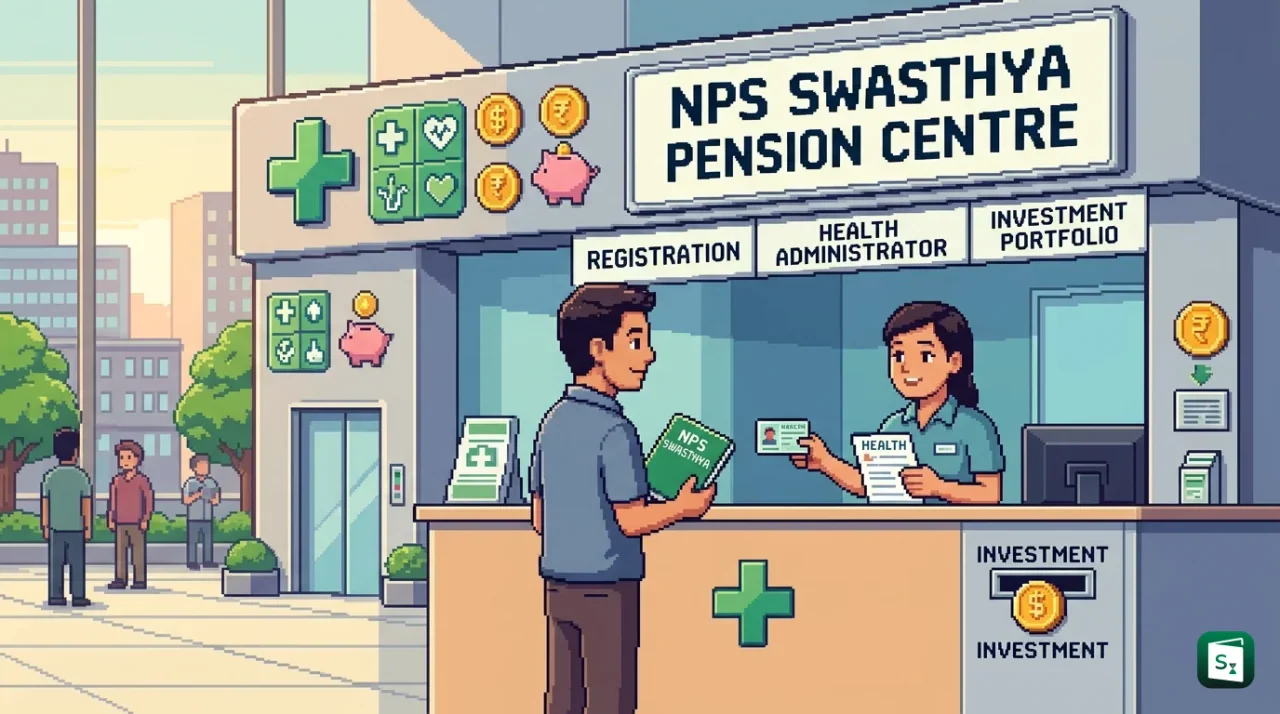
The Pension Fund Regulatory and Development Authority (PFRDA) issued the Operational Guidelines for NPS Swasthya under the National Pension System (NPS), 2026 on 18 September 2026. The NPS Swasthya Pension Scheme combines a market linked retirement account with a mandatory super top-up health insurance policy in a single framework. The framework is set for formal launch on 1 October 2026, observed as NPS Diwas, and creates the first NPS option that can be used directly for medical expenses during the working life.
What Is NPS Swasthya?
The NPS Swasthya Pension Scheme is a specific purpose option under the National Pension System that pairs long term retirement savings with health protection. It has an NPS Swasthya investment account and a compulsory super top-up health insurance policy for the family.
The two parts stay legally and operationally distinct even though a subscriber holds them together. The investment account builds a market linked corpus owned by the individual subscriber. The insurance policy pays eligible hospital expenses after the subscriber has borne a fixed annual amount called the deductible. In addition, the subscriber can draw a limited part of the investment corpus itself for eligible outpatient and inpatient care. This design responds to a basic problem in old age planning in India, where rising health costs often force families to break long term savings.
What Is the National Pension System?
The National Pension System (NPS) is a voluntary defined contribution pension system in which a subscriber builds an individual pension account during working life and draws a pension from the accumulated corpus after retirement. The Central Government introduced NPS on 1 January 2004 for new central government recruits and opened it to all citizens on 1 May 2009.
The Pension Fund Regulatory and Development Authority, the statutory regulator for pensions in India, regulates NPS under the PFRDA Act, 2013. The Authority was first set up as an interim body in 2003, received statutory powers through the Act passed on 18 September 2013, and functions from New Delhi. The assets of subscribers are held by the NPS Trust, set up on 27 February 2008 under the Indian Trusts Act, 1882, for the benefit of subscribers. Pension Funds manage the money, Central Recordkeeping Agencies maintain records, and the Trustee Bank handles fund flows. As of March 2026, NPS and the Atal Pension Yojana (APY) together had about 9.64 crore subscribers with assets of about ₹16.55 lakh crore.
NPS works through two accounts. Tier I is the main pension account with restrictions on withdrawal and with tax benefits under the Income Tax Act, 1961. Tier II is an optional savings account available only to a person who holds an active Tier I account, and it allows free withdrawals but gives no pension tax benefits. The table below captures the distinction in simple form.
| Feature | Tier I Pension Account | Tier II Savings Account |
|---|---|---|
| Purpose | Retirement pension | Voluntary savings |
| Withdrawal | Allowed only as per exit rules | Allowed at any time |
| Tax benefit | Available on contribution and partial withdrawal as per law | No pension tax benefit |
| Eligibility | Any citizen aged 18 to 70 years | Only if Tier I is active |
NPS does not offer a fixed interest rate. Returns are market linked and depend on the performance of equity, government securities, corporate debt and alternative assets chosen by Pension Funds. A subscriber can use the NPS pension calculator offered through official portals to estimate the likely corpus and monthly pension based on contribution, age and assumed return.
Operational Guidelines Issued Under Section 14 of the PFRDA Act
The PFRDA issued the new framework through Circular No. PFRDA/2026/49/NPS-SWASTHYA/01 dated 18 September 2026. The Authority acted under Section 14 of the PFRDA Act, 2013, read with Regulation 4A of the PFRDA (Exits and Withdrawals under the National Pension System) Regulations, 2015. Section 14 gives the Authority the power to issue directions for orderly growth of NPS and protection of subscribers, while Regulation 4A permits the creation of a pension scheme for a specific purpose.
The guidelines apply to all registered intermediaries working on NPS Swasthya, to Health Benefit Administrators (HBAs) and to the Association of NPS Intermediaries (ANPI). The Authority has directed these bodies to put systems, processes and controls in place for enrolment, premium flow, recordkeeping and claim settlement. The circular came into force with immediate effect, and the Authority can issue further clarifications for smooth rollout.
The guidelines also close the earlier pilot phase. NPS Swasthya schemes run under the regulatory sandbox will stop once the new guidelines operate, and existing sandbox subscribers will get an option to migrate to a scheme under the new guidelines in the manner specified by the Authority. Contributions under NPS Swasthya will follow the Multiple Scheme Framework (MSF), the standard structure under which Pension Funds offer distinct schemes within NPS.
Entry Age, Renewal Rules and Family Coverage
Any individual who is eligible to join NPS can enrol under NPS Swasthya subject to the scheme conditions. The entry age for the insurance part is 18 to 70 years based on completed age at first entry. Once enrolled, the health policy can be renewed up to and including 85 years, subject to payment of premium, policy terms and law. This matches the general NPS entry window of 18 to 70 years, which was raised from 65 to 70 years in 2021 to allow longer accumulation.
The standard cover is a family floater. The unit covered is the subscriber, the spouse and up to two dependent children under one policy. Parents are not covered under the standard family floater. The deductible applies on the aggregate eligible expenses of all covered family members in a policy year.
Insurers will not charge a single uniform premium. The PFRDA requires insurers registered with the Insurance Regulatory and Development Authority of India (IRDAI) to quote premiums separately for three entry age cohorts. The cohort is fixed by age at first entry and makes early enrolment important for cost.
| Entry Age at First Enrolment | Premium Cohort |
|---|---|
| 18 to 40 years | First cohort |
| Above 40 to 60 years | Second cohort |
| Above 60 to 70 years | Third cohort |
The actual premium for each cohort and each cover level is set by the insurer under the IRDAI framework to allow comparison between Pension Fund offerings. All charges must be disclosed to the subscriber before enrolment and whenever they change, and no charge beyond what PFRDA permits can be collected.
Minimum Contribution and How NPS Swasthya Works
To apply for NPS Swasthya, an eligible person opens an NPS Swasthya account through a registered Point of Presence (PoP), a bank or other authorised distributor, or through online NPS platforms linked to a Central Recordkeeping Agency (CRA). A person who does not already hold an NPS account under the All Citizen Model opens the common account alongside the Swasthya account. The CRA issues a Permanent Retirement Account Number (PRAN), the unique account number that stays with the subscriber across jobs and cities, and records both the investment and insurance legs.
The first payment has three parts. The subscriber pays the first year insurance premium with taxes, pays ₹200 with taxes as the annual maintenance charge for the Health Benefit Administrator routed through the Pension Fund, and invests at least ₹1,000 in the NPS Swasthya account. After enrolment, every later contribution can be as low as ₹10. The premium for renewal can be paid from the Swasthya corpus under the mandate given by the subscriber, subject to scheme rules.
A subscriber with an existing NPS account under the All Citizen Model can transfer a limited amount to the Swasthya account to meet the deductible requirement under the health policy. The transfer does not allow a full shift of the old corpus. A subscriber can also change from one NPS Swasthya scheme to another at the time of insurance renewal, and such a change can involve a change of Pension Fund and the linked insurance policy.
Health Cover, Deductible Structure and Medical Withdrawals
The insurance part is a super top-up health insurance policy offered under a master policy taken by the Pension Fund from an IRDAI registered insurer. A super top-up pays eligible expenses only after the yearly deductible is crossed. The deductible is the amount the family bears first in a policy year, after which the insurer pays the balance up to the sum insured as per policy terms. The PFRDA has standardised four combinations to keep comparison simple.
| Annual Aggregate Deductible | Family Floater Sum Insured |
|---|---|
| ₹10,000 | ₹1 lakh |
| ₹50,000 | ₹5 lakh |
| ₹1 lakh | ₹10 lakh |
| ₹3 lakh | ₹30 lakh |
The standard policy is designed to cover inpatient hospitalisation, eligible day care procedures, domiciliary hospitalisation, AYUSH treatment, prescribed modern treatments and organ donor medical expenses as per final policy terms. The published benefit structure provides for a single private room for normal hospitalisation, actual Intensive Care Unit (ICU) charges, 30 days of pre hospitalisation expenses, 60 days of post hospitalisation expenses and road ambulance up to ₹2,500. Waiting periods and exclusions apply as per the insurance contract.
Separately from insurance, the investment corpus itself can be used for care. A subscriber can make a partial withdrawal for eligible healthcare expenses, including eligible outpatient and inpatient expenses. The total of such withdrawals cannot exceed 25 percent of the subscriber contributions to the Swasthya account. There is no limit on the number of withdrawals and no minimum waiting period for the first or later withdrawal. The amount is not paid to the subscriber in cash. It is settled directly with the hospital or other eligible provider through the prescribed process.
If eligible inpatient expenditure in a single instance is higher than the amount available through partial withdrawal, the subscriber can opt for premature exit. On such exit the accumulated corpus is first used for the eligible inpatient expense. Any balance moves to an NPS scheme under the All Citizen Model, and the Swasthya account closes. If the subscriber holds no such account, the Swasthya account is converted into one. The Swasthya account also closes on normal exit, on death of the subscriber, or if the insurance lapses because the renewal premium is not funded even after advance alerts at 90, 60 and 30 days and the grace period ends. Closure of the Swasthya account does not affect any other NPS account of the subscriber.
Investment Pattern, Fees and Institutional Framework
Contributions to the NPS Swasthya account are invested as per the investment pattern prescribed for the Central Government Scheme under PFRDA investment guidelines. Each Pension Fund maintains a separate scheme account for Swasthya, and the Authority can revise the pattern from time to time. The structure therefore follows the conservative mix used for government employees rather than a high equity retail mix. The Pension Fund can levy up to 0.08 percent per annum of assets as management fee, along with the ₹200 annual HBA charge routed through the Pension Fund.
Three sets of institutions make the scheme work. Pension Funds invest the corpus and tie up with insurers for the master policy. Health Benefit Administrators provide the health technology platform, verify eligibility and limits, mark liens, enable redemption and settle payments with hospitals through cashless pre authorisation within 1 hour and final discharge within 3 hours, while keeping platform uptime at 99.5 percent a month. Central Recordkeeping Agencies, the Trustee Bank, the NPS Trust and Points of Presence handle accounts, fund flow, custody and distribution. Pension Funds cannot receive insurance commission or claim linked payments, and health data can be used only for authorised purposes. Grievances across stakeholders can be raised on the PFRDA Pension Sahayak portal (as of October 2026).
Significance and the Way Forward
NPS Swasthya matters because it links two needs that usually pull in opposite directions. Households need long term savings for old age, but a single hospital bill can wipe out those savings. By pairing a pension corpus with a deductible based super top-up of up to ₹30 lakh, the scheme lets a subscriber keep retirement money invested and market linked while still meeting medical needs. The 25 percent withdrawal window for outpatient care is also unusual, since traditional NPS locks money till exit.
The next steps are operational. Pension Funds must complete tie ups with insurers and Health Benefit Administrators and integrate with CRA systems for enrolment, premium remittance and direct settlement to hospitals. The PFRDA has said it will issue clarifications and operational instructions as needed. For readers, the practical checks before enrolment are entry age cohort, deductible and sum insured choice, premium and renewal funding, and the rule that medical withdrawals go to the provider and not as cash in hand.
Key Takeaways
- The Operational Guidelines for NPS Swasthya, 2026 were issued on 18 September 2026 under Section 14 of the PFRDA Act, 2013.
- NPS Swasthya pairs an NPS Swasthya investment account with a mandatory super top-up health insurance policy.
- Entry is allowed at 18 to 70 years with renewal up to and including 85 years for subscriber, spouse and up to two dependent children.
- The minimum first payment covers the first year premium, ₹200 HBA charge and at least ₹1,000 investment, with later contributions from ₹10.
- Partial medical withdrawals are capped at 25 percent of subscriber contributions and are settled directly with the hospital or provider.