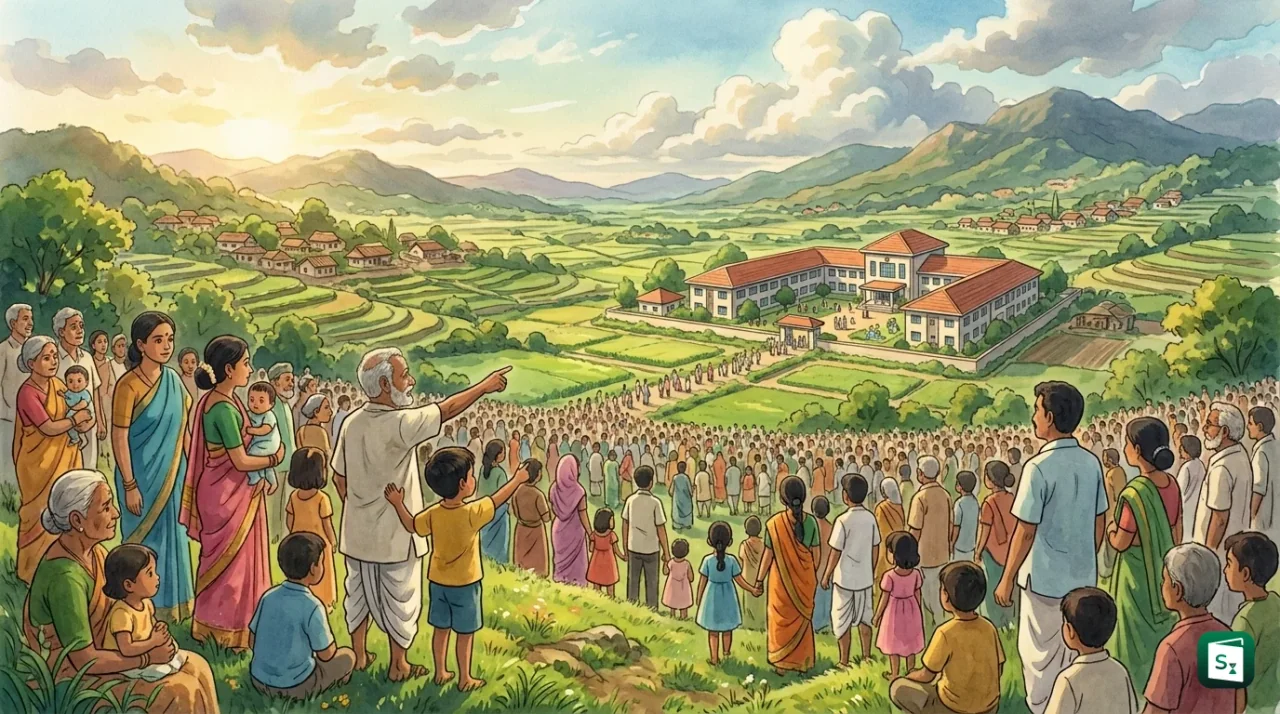
The Ayushman Bharat Pradhan Mantri Jan Arogya Yojana (AB PM-JAY) has crossed coverage of more than 60 crore people, completing eight years since its launch on 23 September 2018. The scheme gives cashless cover of up to ₹5 lakh per family per year for secondary and tertiary hospital care across public and private empanelled hospitals. The milestone makes AB PM-JAY the world’s largest government funded health assurance scheme and a central pillar of India’s push for universal health coverage.
What Is Ayushman Bharat PM-JAY?
Ayushman Bharat Pradhan Mantri Jan Arogya Yojana (AB PM-JAY) is India’s flagship public health assurance scheme that gives cashless hospital cover up to ₹5 lakh per family per year. It covers secondary and tertiary care in empanelled public and private hospitals for poor and vulnerable families.
The Prime Minister launched AB PM-JAY on 23 September 2018 in Ranchi, Jharkhand. The Ministry of Health and Family Welfare is the nodal ministry for the scheme. The aim was to protect families from high medical bills and move India toward universal health coverage, which means every person can get quality health care without facing financial hardship.
AB PM-JAY was earlier known as the National Health Protection Scheme. It merged the earlier Rashtriya Swasthya Bima Yojana (RSBY), which had started in 2008 with a much smaller cover of ₹30,000 per family. AB PM-JAY raised the cover to ₹5 lakh and removed the cap on family size, age and gender. Pre-existing diseases are covered from the first day of enrolment.
Secondary care means treatment by specialists that usually needs short hospital stay, such as minor surgery or severe infection. Tertiary care means advanced treatment in specialised hospitals, such as heart surgery, cancer care or joint replacement. AB PM-JAY covers both on a family floater basis, which means one or all members of a family can use the ₹5 lakh limit in a year.
The 60 Crore Milestone in Numbers
AB PM-JAY completed eight years in September 2026. The National Health Authority data for this anniversary shows that more than 60 crore people are now covered under the scheme and more than 48.54 crore Ayushman Cards have been created as on 21 September 2026. The scheme started with about 10.74 crore poor and vulnerable families identified from the Socio-Economic Caste Census 2011 (SECC 2011). In January 2022 the target base was revised to 12 crore families to account for population growth, and many states later added more groups at their own cost.
The use of hospital care under AB PM-JAY has grown sharply. About 13.25 crore hospital admissions have been authorised with treatment worth ₹2.03 lakh crore as on 31 August 2026. These services were delivered through a network of more than 38,000 empanelled public and private hospitals. The current Health Benefit Package covers 1,961 procedures across 27 medical specialties, including general medicine, general surgery, orthopaedics, cardiology and oncology.
| Indicator under AB PM-JAY | Achievement |
|---|---|
| People covered | More than 60 crore |
| Ayushman Cards created | More than 48.54 crore (as on 21 September 2026) |
| Hospital admissions authorised | About 13.25 crore (as on 31 August 2026) |
| Value of treatment provided | ₹2.03 lakh crore |
| Empanelled hospitals | More than 38,000 public and private hospitals |
| Procedures covered | 1,961 procedures across 27 specialties |
The wider Ayushman Bharat framework has also expanded primary care. More than 500 crore visits have been recorded at Ayushman Arogya Mandirs, which are primary health centres that provide free check-ups, medicines and screening close to people’s homes. Together, hospital cover and neighbourhood clinics have reduced the need for families to pay large sums from their own pockets during illness.
Who Is Covered and What Benefits Are Offered?
AB PM-JAY mainly covers poor and vulnerable families that form the bottom 40 percent of India’s population. In rural areas families were first selected using deprivation criteria from SECC 2011, such as living in a single room with mud walls or having no adult earner. In urban areas families were selected using occupational criteria, such as street vendors, construction workers, domestic workers and sanitation workers. Families covered under RSBY but missing from the SECC list were also included.
Is Ayushman Bharat Free and Can It Be Used in Private Hospitals?
Yes. AB PM-JAY is fully funded by the government and treatment is cashless and paperless at the point of care for eligible families up to ₹5 lakh per year. Beneficiaries can take treatment in any empanelled public hospital and in empanelled private hospitals across India.
The cover includes hospital stay, doctor fees, surgery, medicines, diagnostic tests, food and room charges. It also pays for three days of pre-hospitalisation expenses and 15 days of post-hospitalisation expenses, such as follow-up visits and medicines. There is no charge or premium for eligible families, and hospitals cannot ask for extra payment for covered treatment within the limit.
Where Is the Ayushman Card Valid?
The Ayushman Card is valid across India through portability. A migrant worker from Bihar can use the same card in an empanelled hospital in Delhi, Maharashtra or any other state. As of 2026 the scheme is implemented in all 36 states and Union Territories after Odisha joined as the 34th state and Delhi joined later. Only West Bengal remained outside the scheme for a long period, which limited portability for its residents.
Over time many states have merged their own health schemes with AB PM-JAY and added more families at their own cost. The Union Cabinet has also approved special expansions. These include 37 lakh ASHAs, anganwadi workers and helpers with their families, construction workers, road accident victims, transgender persons under the SMILE initiative, waste pickers, sanitation workers and Particularly Vulnerable Tribal Groups (PVTGs). This convergence has raised the total covered families from about 12 crore to more than 15 crore family units in several state records.
How Is the Scheme Funded and Implemented?
AB PM-JAY is implemented as a Centrally Sponsored Scheme. This means the Union government and the state governments share the cost as per norms issued by the Ministry of Finance. The Union government fixes a national ceiling per family, and the actual premium found through open tender or the fixed ceiling, whichever is lower, is shared between the Centre and the states.
| Category of State or Union Territory | Centre share | State or UT share |
|---|---|---|
| General states and UTs with legislature | 60 percent | 40 percent |
| North-Eastern states, Himachal Pradesh, Uttarakhand, Jammu and Kashmir | 90 percent | 10 percent |
| UTs without legislature | Up to 100 percent | Nil (case to case basis) |
The Union Budget for 2026-27 has allocated ₹9,500 crore for PM-JAY, up from ₹9,000 crore in the revised estimates for 2025-26. The money flows through the Pradhan Mantri Swasthya Suraksha Nidhi (PMSSN) and is released to states based on use and demand. States must first place their share in a separate escrow account of the State Health Agency, after which the Centre releases its share.
The National Health Authority (NHA) implements the scheme at the national level. NHA was created as an attached office of the Ministry of Health and Family Welfare. It was formed on 2 January 2019 as the successor to the National Health Agency, which had worked as a registered society from 23 May 2018. NHA is led by a Chief Executive Officer of the rank of Secretary to the Government of India and is guided by a Governing Board chaired by the Union Health Minister (as of September 2026).
At the state level, State Health Agencies (SHAs) act as the nodal bodies. Each SHA can extend cover to more people, empanel hospitals, manage claims and check fraud. Districts have District Implementation Units chaired by the District Collector or Magistrate to coordinate hospitals and field workers. States can run the scheme in trust mode, where the SHA pays hospitals directly, or in insurance mode, where an insurance company is selected through tender, or in a mixed hybrid mode.
How Can Beneficiaries Access Care Through the Ayushman Card?
What Is the Ayushman Card?
The Ayushman Card, earlier called the Golden Card, is the identity document that proves a family’s right to free hospital care under AB PM-JAY. It carries the family details and individual ID after eKYC verification with Aadhaar. The card allows cashless admission without depositing cash at the hospital counter.
Families can check their names through the Ayushman Bharat beneficiary portal at beneficiary.nha.gov.in. The portal supports beneficiary search, eligibility check and card download using Aadhaar number or mobile number. People can also use the Ayushman App from the Google Play Store, visit the nearest empanelled hospital help desk or approach a Common Service Centre (CSC). The national helpline 14555 and the missed call number 1800110770 give information on eligibility and the card.
How Does the Ayushman Card Work in a Hospital?
A patient shows the Ayushman Card at the AB PM-JAY help desk in an empanelled hospital for identity verification through biometric or OTP check. The hospital registers the case on the NHA portal and selects the relevant treatment package from the Health Benefit Package list. Treatment then starts without advance payment, and the hospital sends the claim online to the SHA or insurer for settlement.
Beneficiaries can find the list of empanelled hospitals on the portal and on the NHA website pmjay.gov.in. Both public hospitals and selected private hospitals are included, and the list is updated as new hospitals join or as action is taken against rule violations. NHA uses artificial intelligence based triggers to flag doubtful claims within 24 hours, and hospitals found violating norms face suspension, de-empanelment, penalty or police cases.
Expansion to Senior Citizens and the Wider Ayushman Bharat Framework
The biggest recent expansion of AB PM-JAY covers all senior citizens aged 70 years and above, irrespective of income. The Union Cabinet approved this move on 11 September 2024, and the Prime Minister rolled out the distinct Ayushman Vay Vandana Card on 29 October 2024. The expansion aims to cover about 6 crore senior citizens in 4.5 crore families.
Seniors in families already covered under AB PM-JAY get an additional top-up cover of up to ₹5 lakh per year for themselves, which they do not have to share with younger members. All other seniors aged 70 and above get family cover of up to ₹5 lakh per year. More than 1.36 crore Vay Vandana Cards had been created as on 21 September 2026, while more than 44.81 lakh cards had been created for ASHAs, anganwadi workers and helpers. Seniors using the Central Government Health Scheme (CGHS), Ex-Servicemen Contributory Health Scheme (ECHS) or Ayushman Central Armed Police Force (CAPF) scheme must choose either their existing scheme or AB PM-JAY. Seniors with private health insurance or Employees State Insurance (ESI) remain eligible for AB PM-JAY.
AB PM-JAY is only one pillar of Ayushman Bharat. The full framework rests on four linked missions that connect local clinics, hospitals, digital records and public health infrastructure.
| Pillar | Launch | Main role |
|---|---|---|
| AB PM-JAY | 23 September 2018 | Cashless hospital cover up to ₹5 lakh per family for secondary and tertiary care |
| Ayushman Arogya Mandirs | First centre opened 18 April 2018 in Bijapur, Chhattisgarh | Free primary care, screening, medicines and diagnostics near homes |
| Ayushman Bharat Digital Mission | Pilot August 2020, national rollout 27 September 2021 | Digital health IDs called ABHA, facility registries and linked health records |
| PM Ayushman Bharat Health Infrastructure Mission | 25 October 2021, outlay ₹64,180 crore for 2021 to 2026 | Critical care blocks, public health labs and surveillance network |
Together these pillars aim to ensure that a person can get tested at a local centre, carry digital records through ABHA, and get free hospital treatment under PM-JAY without delay.
Significance for Universal Health Coverage and the Way Forward
The 60 crore mark shows a shift from small insurance pilots to large scale health assurance. Earlier central schemes covered ₹30,000 to ₹3 lakh per family and left many families exposed to loans or sale of assets during serious illness. A uniform ₹5 lakh family cover with portability across states gives migrant workers, elderly people and vulnerable groups a stronger safety net.
The scheme still faces practical tasks. Hospitals have raised concerns about package rates and timely payment of claims. NHA has responded with standard treatment guidelines, auto-adjudication pilots, the National Health Claims Exchange (NHCX) for uniform claims, and a zero tolerance policy on fraud that has saved ₹676.14 crore as on 31 July 2026. The focus for the next phase is faster claim settlement, stronger primary care referral, wider use of digital records and full coverage of left out seniors and workers through village level outreach.
Key Takeaways
- AB PM-JAY was launched on 23 September 2018 in Ranchi by the Ministry of Health and Family Welfare to advance universal health coverage.
- AB PM-JAY has covered more than 60 crore people with over 48.54 crore Ayushman Cards and funded about 13.25 crore admissions worth ₹2.03 lakh crore.
- The scheme gives cashless cover up to ₹5 lakh per family per year for secondary and tertiary care with portability across empanelled hospitals in all 36 states and UTs.
- AB PM-JAY is a Centrally Sponsored Scheme with funding of 60:40 for general states, 90:10 for North-Eastern and Himalayan states, and 100 percent central funding for UTs without legislature.
- The National Health Authority, formed on 2 January 2019, implements the scheme with State Health Agencies, with ₹9,500 crore allocated in the Union Budget 2026-27.
- The Ayushman Vay Vandana Card, rolled out on 29 October 2024, gives ₹5 lakh annual cover to all senior citizens aged 70 years and above irrespective of income.