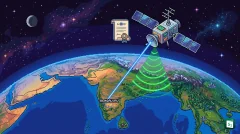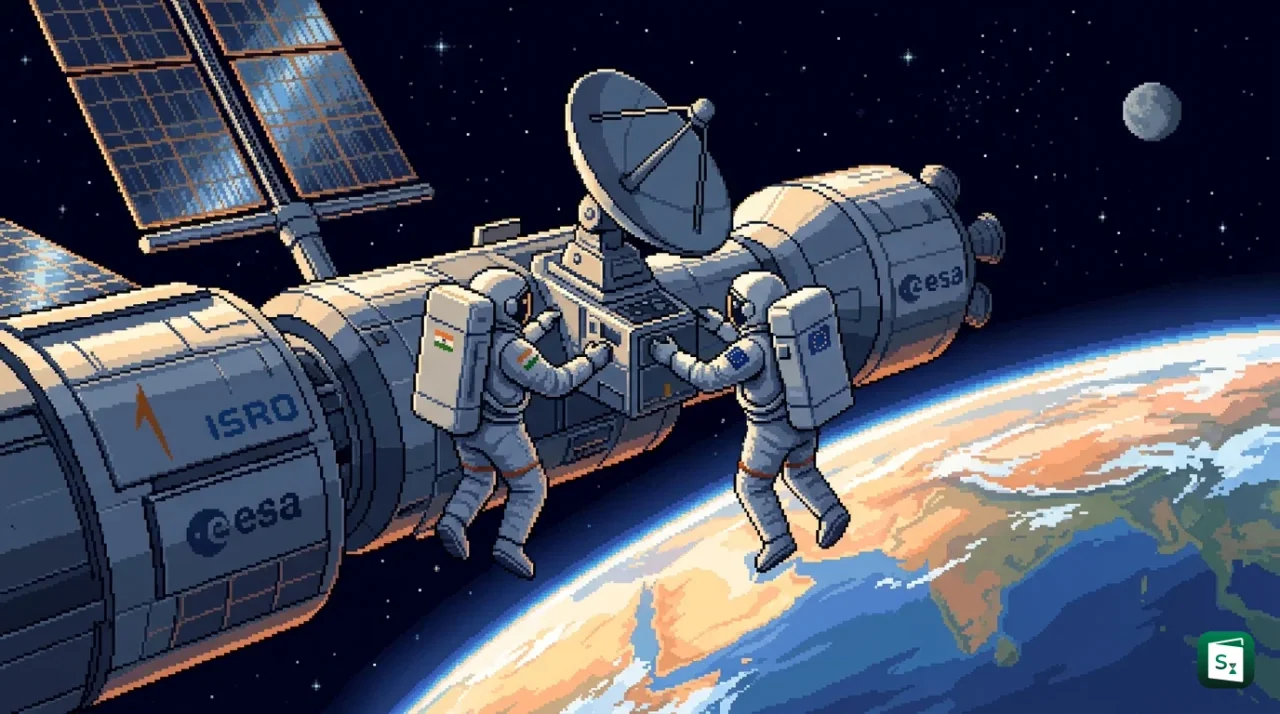
The Indian Space Research Organisation (ISRO) and the European Space Agency (ESA) extended their long standing Cooperative Agreement for five more years until 8 January 2032. ISRO Chairman V. Narayanan and ESA Director General Josef Aschbacher formalised the extension through an exchange of letters on 10 September 2026 in Paris on the margins of the International Space Summit. The renewed pact keeps existing cooperation in Earth observation and mission operations while adding human and robotic exploration, space weather and sustainability of outer space activities.
What Is ISRO?
ISRO stands for the Indian Space Research Organisation. It is the national space agency of India, responsible for space science, launch vehicles, satellites for communication, navigation and Earth observation, and interplanetary missions. ISRO operates under the Department of Space of the Government of India.
ISRO was formed on 15 August 1969, succeeding the Indian National Committee for Space Research (INCOSPAR) set up in 1962 on the vision of Vikram Sarabhai. The Department of Space was created in 1972, and ISRO was brought under it the same year. ISRO has its headquarters at Antariksh Bhavan in Bengaluru, Karnataka.
ISRO builds and launches satellites from the Satish Dhawan Space Centre at Sriharikota in Andhra Pradesh, designs satellites at the U R Rao Satellite Centre in Bengaluru and develops rockets at the Vikram Sarabhai Space Centre in Thiruvananthapuram. Its major programmes include the Polar Satellite Launch Vehicle (PSLV), the Geosynchronous Satellite Launch Vehicle (GSLV), the Chandrayaan Moon missions, the Mars Orbiter Mission, Aditya L1 for solar study and the Gaganyaan human spaceflight programme.
What Is the European Space Agency?
ESA stands for the European Space Agency. It is an intergovernmental organisation of European states that designs the European space programme and carries it out for peaceful purposes, covering space science, Earth observation, navigation, launchers and human and robotic exploration.
ESA was established on 30 May 1975 and has its headquarters in Paris, France, at 8 to 10 rue Mario Nikis. The ESA Director General is Josef Aschbacher (as of September 2026). ESA has 23 Member States, including France, Germany, Italy, Spain and the United Kingdom, while Canada also takes part in some programmes under a cooperation agreement. Slovakia, Latvia, Lithuania and Cyprus hold associate member status.
ESA operates major centres across Europe, including mission control at ESOC in Darmstadt in Germany, research and technology at ESTEC in Noordwijk in the Netherlands and Earth observation at ESRIN in Frascati in Italy. Launches take place mainly from the Guiana Space Centre in Kourou, French Guiana. The ESA budget was around 7.68 billion euro in 2025 and rose to about 8.26 billion euro in 2026, funded by national contributions linked to economic size and by optional programme subscriptions.
What Exactly Was Extended in Paris?
The ISRO ESA Cooperative Agreement is the umbrella framework that sets the legal and administrative rules for joint work, including data sharing, ground station support and joint missions. The agreement first came into force in January 2002. The ESA Council approved its extension and amendment at its 347th meeting held on 16 and 17 June 2026 at ESA headquarters in Paris.
The extension was formalised on 10 September 2026 when ISRO Chairman V. Narayanan visited ESA headquarters in Paris and met ESA Director General Josef Aschbacher. The two leaders signed and exchanged letters that amend the agreement to add new cooperation areas and extend its validity for five years until 8 January 2032.
The meeting took place on the margins of the first International Space Summit held in Paris on 9 and 10 September 2026. The summit was hosted at the invitation of the President of France and brought together nearly 120 foreign delegations, including heads of agencies, scientists, astronauts and private industry, to discuss security of space operations, the space economy, exploration of the Moon and Mars, and responsible management of space as a shared resource. Narayanan also delivered a keynote address on the future of human spaceflight in low Earth orbit and joined a panel on exploration after the International Space Station.
Two Decades of ISRO ESA Cooperation
ISRO traces cooperation with Europe to 1978, when early scientific and technical exchanges began. The two sides then put the partnership on a formal footing with the Cooperative Agreement that entered into force in January 2002. Since then the partnership has grown from ground station support to joint science and human spaceflight work.
A cross support arrangement signed in July 2021 allowed the two agencies to exchange tracking, navigation and data handling support for selected missions. This arrangement proved its value when ESA stations helped monitor Chandrayaan 3 in 2023 and became the main provider of ground station support for the Aditya L1 solar mission. ISRO, in return, has launched European payloads, including the ESA Proba 3 mission on PSLV C59 from Sriharikota on 5 December 2024.
| Year | Milestone in ISRO ESA partnership |
|---|---|
| 1978 | Early long term cooperation begins between ISRO and European space entities |
| January 2002 | Umbrella ISRO ESA Cooperative Agreement enters into force |
| July 2021 | Cross support arrangement for tracking and operations support signed |
| December 2024 | Technical Implementing Plan signed for ESA ground station support to Gaganyaan missions |
| December 2024 | ISRO ESA agreement signed on astronaut training, experiment integration and use of International Space Station facilities |
| May 2025 | Joint Statement of Intent signed on cooperation for human space exploration in low Earth orbit and later the Moon |
| March 2026 | ESA ISRO arrangement signed on joint calibration and validation for Earth observation missions |
| September 2026 | Cooperative Agreement extended until 8 January 2032 with broadened scope |
On 4 March 2026, ISRO Scientific Secretary M. Ganesh Pillai and ESA Director of Earth Observation Simonetta Cheli signed a separate arrangement on joint calibration and validation activities and scientific studies for Earth observation missions. The arrangement supports better use of current and future sensors, including work linked to vegetation and climate studies, and builds on cooperation in navigation, ground stations and human spaceflight discussions.
New Frontiers Added to the Agreement
The September 2026 exchange of letters keeps the older areas of Earth observation, satellite navigation, space science and mission operations support. It adds three clear frontiers that reflect how global space priorities have changed.
First, the agreement now covers human and robotic exploration. Heliophysics is the study of the Sun and how solar wind and magnetic activity affect planets, satellites and power systems in space and on Earth. This builds on the Joint Statement of Intent of May 2025, under which ISRO and ESA plan to work on docking system compatibility so that spacecraft can work together in low Earth orbit, plus astronaut training, analogue missions on the ground that simulate space conditions and parabolic flights that create short periods of weightlessness for training and tests. A December 2024 ISRO ESA agreement already opened ESA facilities on the International Space Station for Indian experiments, including work linked to the Axiom 4 mission that carried an Indian crew member and a European astronaut.
Second, the agreement now lists space weather as a separate field. Space weather means disturbances that start at the Sun, such as solar flares and coronal mass ejections, and then travel through space to disturb satellites, navigation signals, communication links and power grids. Joint study of space weather links directly to solar missions described in the next section.
Third, the text recognises the sustainability of outer space activities. This refers to safe operation in increasingly crowded orbits, including tracking of space debris, responsible disposal of satellites at the end of life and rules that prevent collisions in low Earth orbit. The focus matches the Paris summit priority of keeping space operations safe and ensuring that space remains usable for future generations.
Joint Science in Focus: Aditya L1, Heliophysics and TRISHNA
The ESA network of deep space antennas has become central to Indian solar science. Aditya L1, launched on 2 September 2023 by PSLV C57 from Sriharikota, is the first Indian space based observatory to study the Sun. The spacecraft travels about 1.5 million km from Earth to a halo orbit around Lagrange Point 1, a gravitationally stable spot between the Sun and Earth where the pull of both bodies balances. From that point Aditya L1 gets an uninterrupted view of the Sun. Four of its seven payloads look directly at the Sun while three measure particles and magnetic fields in place.
ESA provides deep space communication for Aditya L1 from its three 35 metre antennas in Australia, Spain and Argentina, plus support from Kourou in French Guiana. ESA teams also worked with ISRO teams from April to December 2022 to test and improve new flight dynamics software for operating at a Lagrange point for the first time. ESA stations support the mission from launch and early orbit through the cruise to L1 and now receive science data for several hours each day.
The science link deepened at the joint ISRO ESA Heliophysics Workshop held from 19 to 23 January 2026 in Thiruvananthapuram. The workshop was organised with the Indian Institute of Space Science and Technology and brought together about 50 European and international experts and about 150 Indian researchers. Sessions combined data from Aditya L1, the ESA Solar Orbiter and the ESA Proba 3 mission, which create eclipses in space using two spacecraft to study the faint outer atmosphere of the Sun. Hands on sessions trained researchers to access, process and combine data sets from all three missions.
A separate strand of India Europe space science moves through France. TRISHNA, which stands for Thermal Infra Red Imaging Satellite for High Resolution Natural Resource Assessment, is a joint ISRO and French space agency CNES mission for detailed mapping of surface temperature, water stress, coastal waters, urban heat and glacier melt. CNES stands for Centre National dEtudes Spatiales, the national space agency of France headquartered in Paris. During the same Paris visit, the ISRO delegation visited the CNES Toulouse space centre on 11 September 2026 and reviewed progress on the TRISHNA payload at the Airbus facility. The delegation also exchanged an ISRO and EUMETSAT Implementing Arrangement for scientific cooperation with European weather satellite chief Phil Evans. EUMETSAT stands for the European Organisation for the Exploitation of Meteorological Satellites and is headquartered in Darmstadt in Germany.
Why This Extension Matters for India and Europe
The extension gives both sides planning certainty for five years. Space missions take many years to design, build and fly, so a stable legal framework helps teams start joint studies, share ground stations and order instruments without repeated approvals.
For India, ESA ground support directly lifts the Gaganyaan programme, which aims to send two uncrewed missions followed by one crewed mission with up to three crew members to an orbit of about 400 km for up to three days. Under the December 2024 Technical Implementing Plan, the network operations centre at ESOC in Darmstadt will coordinate Estrack antennas, starting with the 15 metre antenna at Kourou and later antennas linked through German and Spanish agencies, to track and command the crew module and keep data flowing. ESA and ISRO are also exploring docking compatibility, which matters for future work linked to the planned Bharatiya Antariksh Station and operations after the International Space Station.
For Europe, partnership with ISRO brings cost effective launch options, access to Indian science data from the Sun and Moon, and a wider tracking network through ISRO stations. For both sides, cooperation on space debris and sustainable operations reduces collision risk in low Earth orbit, where commercial satellites are growing fast.
| Feature | ISRO | ESA |
|---|---|---|
| Full form | Indian Space Research Organisation | European Space Agency |
| Founded | 15 August 1969 | 30 May 1975 |
| Headquarters | Bengaluru, India | Paris, France |
| Nature | National agency under Department of Space | Intergovernmental organisation with 23 Member States |
| Main launch site | Satish Dhawan Space Centre, Sriharikota | Guiana Space Centre, Kourou |
| Flagship strengths | Low cost launchers, Chandrayaan, Aditya L1, Gaganyaan | Ariane launchers, Galileo navigation, Copernicus Earth observation, deep space science |
The broader value lies in shared standards. When Indian and European spacecraft use common docking interfaces, common data formats and common tracking protocols, they can support each other during emergencies, combine science data more easily and keep missions working even when one ground station faces bad weather or maintenance.
Key Takeaways
- ISRO and ESA extended their Cooperative Agreement until 8 January 2032 through an exchange of letters signed on 10 September 2026 in Paris.
- The original umbrella agreement entered into force in January 2002 and now adds human and robotic exploration, space weather and sustainability of outer space activities.
- ISRO stands for the Indian Space Research Organisation, formed on 15 August 1969 and headquartered in Bengaluru, while ESA stands for the European Space Agency, established in 1975 and headquartered in Paris.
- ESA provides deep space tracking for Aditya L1 from antennas in Australia, Spain, Argentina and Kourou, and will provide ground station support for the Gaganyaan human spaceflight missions.
- The joint ISRO ESA Heliophysics Workshop was held from 19 to 23 January 2026 in Thiruvananthapuram to combine data from Aditya L1, Solar Orbiter and Proba 3.