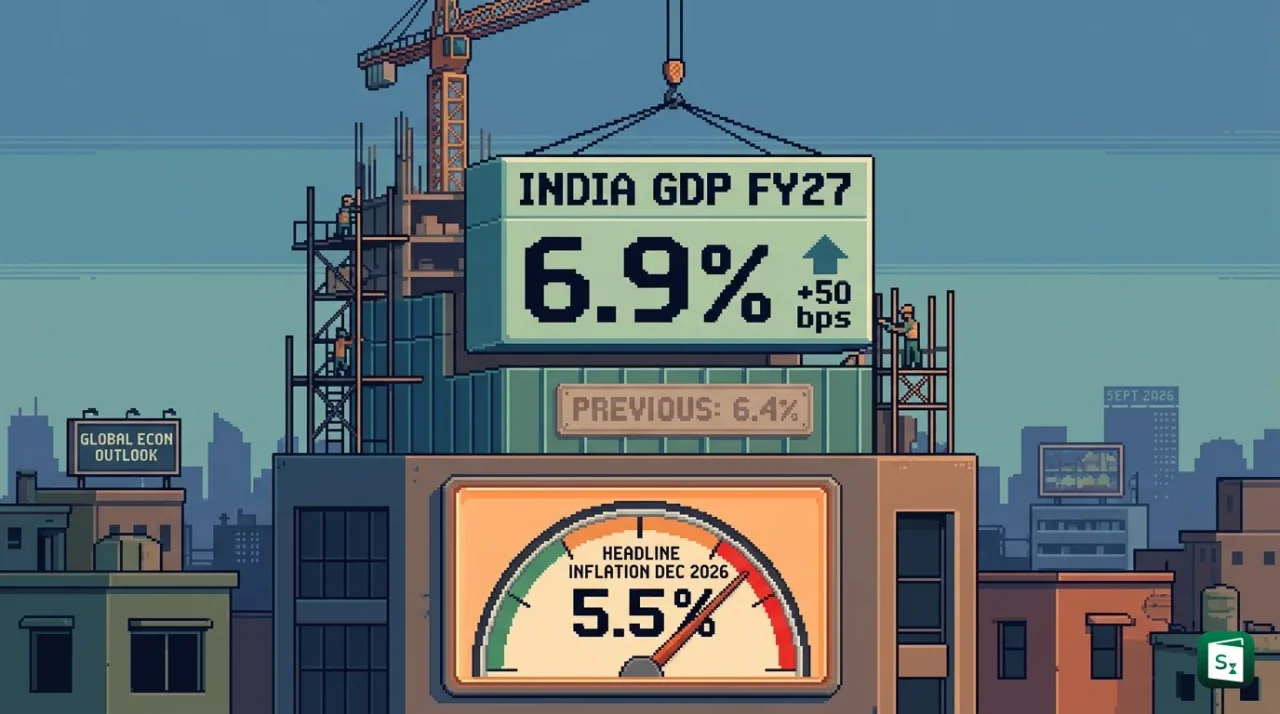
Fitch Ratings raised India’s GDP growth forecast for FY27 to 6.9 percent from 6.4 percent in its Global Economic Outlook released in September 2026. The upgrade of 50 basis points came after stronger than expected activity in the April to June quarter and resilience to the energy price shock from the West Asia conflict. At the same time, Fitch warned that headline inflation in India will rise to 5.5 percent by December 2026.
What Did Fitch Announce for India in September 2026?
Fitch Ratings published its Global Economic Outlook for September 2026 on 22 September 2026. For India, Fitch raised the FY27 GDP growth forecast to 6.9 percent from 6.4 percent projected in the June 2026 outlook. FY27 refers to the financial year from 1 April 2026 to 31 March 2027, so the forecast covers the current financial year in India.
The revision is an increase of 50 basis points. One basis point equals one hundredth of a percentage point, so 50 basis points equal 0.50 percentage point. Fitch also gave its first projections for the next two years. Fitch expects India to grow by 6.5 percent in both FY28 and FY29, driven by consumer spending and investment, with net exports adding a smaller positive push.
In the same outlook, Fitch raised its forecast for global growth in 2026 to 2.6 percent from 2.4 percent. Fitch said world growth is holding up well despite the energy price shock linked to the conflict in West Asia, but real interest rates are rising as central banks stay cautious on inflation.
Why Was the FY27 Forecast Raised to 6.9 Percent?
Fitch Ratings said India’s economy performed better than it had expected and showed resilience to the shock from the United States-Iran conflict and the sharp rise in energy prices in the first half of 2026. Growth in the January to March quarter of 2026, which was the fourth quarter of FY26, accelerated to 8.6 percent from 7.7 percent in the previous quarter. Fitch had expected a slowdown in that period, but the data moved in the opposite direction.
The momentum continued into FY27. India’s real GDP grew by 7.8 percent in the April to June 2026 quarter, which is the first quarter of FY27. The Ministry of Statistics and Programme Implementation released this estimate in August 2026. Real GDP means the value of all final goods and services produced in the country after removing the effect of price rises, while nominal GDP includes price rises. In that quarter, real GDP stood at ₹81.36 lakh crore and nominal GDP stood at ₹88.27 lakh crore, up 10.3 percent from a year earlier.
Fitch pointed to strong domestic demand behind this performance. Private investment prospects look more buoyant, and Fitch estimates investment will rise by more than 10 percent. Non-food bank credit grew by 19 percent year on year in July 2026, which supports business expansion and consumer purchases. Industrial production rose by 6.7 percent in July, and cumulative merchandise and services exports during April to July rose by 13.16 percent year on year.
Fitch also expects growth to cool in the rest of FY27. Survey data on purchasing managers, known as the Purchasing Managers Index (PMI), points to slower expansion in manufacturing and services. A PMI is a monthly survey of company managers on output, orders and hiring, and a reading above 50 signals expansion. Fitch said below normal monsoon rain will weigh on farm output and rural demand, while higher inflation will reduce real incomes and household spending.
What Is the Headline Inflation Outlook Till December 2026?
Fitch Ratings expects India’s headline inflation to reach 5.5 percent in December 2026 before easing to 4.2 percent by end 2027 and 4.0 percent by end 2028. Headline inflation means the change in prices of the full consumer basket measured by the Consumer Price Index (CPI). The CPI tracks retail prices paid by households for food, fuel, housing, clothing, health, education and other daily items.
Price pressures have built up steadily in 2026. Headline CPI inflation rose from 1.2 percent in December 2025 to 4.8 percent in August 2026. Food inflation, measured by the Consumer Food Price Index (CFPI), rose to 5.95 percent in August from 5.52 percent in July. Core inflation, which excludes food and fuel to show underlying price trends, rose from 3 percent to 4.2 percent over the same period. The CPI series now uses 2024 as the base year, which is the reference year against which current prices are compared.
This path matters for monetary policy. The central government has set an inflation target of 4 percent CPI inflation with a tolerance band of plus or minus 2 percent for the Reserve Bank of India (RBI). The RBI is India’s central bank, established in 1935 under the RBI Act, 1934 and headquartered in Mumbai. Because inflation is moving toward the upper part of the band, Fitch expects the RBI to raise its policy repo rate by 25 basis points to 5.5 percent in October 2026. The repo rate is the rate at which the RBI lends short term money to banks, and a rise makes loans costlier and cools demand. Fitch projects a further rise to 5.75 percent in early 2027, followed by a cut back to 5.5 percent in 2028 as oil prices ease.
What Is GDP and How Is It Calculated in India?
India’s GDP is the total market value of all final goods and services produced within India’s borders during a financial year. India is the world’s fourth largest economy in nominal terms (as of September 2026), with real GDP growth of 7.8 percent in FY26 and 7.8 percent in Q1 FY27.
Gross Domestic Product, or GDP, measures the size of an economy in a given period. In India, GDP is estimated for each quarter and each financial year, which runs from April to March. Nominal GDP measures output at current market prices, while real GDP measures output at constant prices of a base year to remove the effect of inflation. The growth rate that Fitch forecasts is the change in real GDP.
GDP is compiled by the National Statistics Office (NSO) under the Ministry of Statistics and Programme Implementation (MoSPI), which was formed in 1999 and is based in New Delhi. The NSO uses two main methods. The production approach adds Gross Value Added (GVA) across farming, industry and services, then adds taxes on products and subtracts subsidies to reach GDP. GVA is the value of output minus the value of inputs used. The expenditure approach adds private consumption, government spending, investment and net exports, which is exports minus imports.
The table below clears three related terms that often appear with GDP data.
| Term | Full Form | What It Measures |
|---|---|---|
| GDP | Gross Domestic Product | Output produced within India’s borders, including output by foreign firms in India |
| GNP | Gross National Product | Output by Indian residents and firms, including income earned abroad and excluding income sent out by foreigners in India |
| GVA | Gross Value Added | Output value minus input costs at the sector level, before adding product taxes |
In Q1 FY27, real GVA rose by 8.2 percent, led by manufacturing and services. Private consumption grew by 7.1 percent and investment grew by 11.9 percent, which shows that both households and businesses drove growth.
What Is the Global Economic Outlook Report?
The Global Economic Outlook discussed here is published by Fitch Ratings, one of the world’s three major credit rating agencies. Fitch releases the outlook every quarter to give forecasts for GDP growth, inflation, interest rates and oil prices for major economies.
Fitch Ratings was founded in 1913 by John Knowles Fitch as the Fitch Publishing Company in New York. Fitch is jointly headquartered in New York and London and is part of the Fitch Group, which is wholly owned by the Hearst Corporation of the United States. Fitch is counted among the Big Three credit rating agencies along with S and P Global Ratings and Moody’s Ratings. A credit rating agency assesses the ability of governments and companies to repay debt, using a letter scale from AAA to D, which Fitch introduced in the 1920s. India’s sovereign rating work by Fitch is supported in India through India Ratings and Research, its Indian arm.
Fitch’s Global Economic Outlook should not be mixed with the World Economic Outlook, which is a different report published by the International Monetary Fund (IMF). The IMF is headquartered in Washington D C and was set up in 1944. The IMF releases its World Economic Outlook twice a year, in April and October, with updates in January and July. Both reports are widely tracked because banks, investors and governments use their forecasts to plan borrowing, investment and policy.
How Do Fitch Forecasts Compare With RBI and Other Agencies?
Fitch Ratings forecasts 6.9 percent growth for FY27, which is higher than the Reserve Bank of India projection of 6.7 percent but slightly lower than the 7 percent and above projected by several other global agencies after the strong June quarter data. The RBI raised its FY27 forecast to 6.7 percent from 6.6 percent in its August 2026 monetary policy review. For the quarters, the RBI expects 7.0 percent in Q1, 6.4 percent in Q2, 6.5 percent in Q3 and 6.8 percent in Q4. The RBI kept the repo rate unchanged at 5.25 percent in August with a neutral stance.
The September 2026 round saw a cluster of upgrades tied to the same Q1 outcome of 7.8 percent growth. The table below places these forecasts side by side for easy recall.
| Agency | FY27 Forecast Now | Earlier Forecast | Note |
|---|---|---|---|
| Fitch Ratings | 6.9 percent | 6.4 percent in June 2026 | Raised by 50 basis points in September outlook |
| S and P Global Ratings | 7.0 percent | 6.6 percent | Expects average CPI inflation of 5.1 percent in FY27 |
| Moody’s Ratings | 7.0 percent | 6.0 percent | Sharpest upgrade among the Big Three |
| Asian Development Bank (ADB) | 7.0 percent | 6.6 percent | Manila based lender, founded in 1966 |
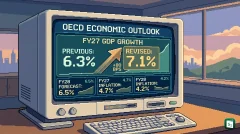
| Organisation for Economic Cooperation and Development (OECD) | 7.1 percent | 6.3 percent | Highest forecast in this round, Paris based body |
| Reserve Bank of India (RBI) | 6.7 percent | 6.6 percent | India’s central bank, FY27 CPI seen at 5.0 percent |
The Asian Development Bank, headquartered in Manila and established in 1966, and the OECD, headquartered in Paris and established in 1961, both cited resilient domestic demand and industrial activity. The bunching of forecasts between 6.9 percent and 7.1 percent signals broad agreement that India will remain the fastest growing major economy in FY27, even as monsoon shortfalls and oil prices remain risks.
The Way Forward
Fitch Ratings expects private investment to carry growth even if consumption cools in the second half of FY27. Continued growth in bank credit, execution of infrastructure projects and stable tax collection will decide whether the 6.9 percent forecast holds. A normal end to the monsoon season and softening of global crude prices from the assumed $87 per barrel in 2026 to $70 in 2027 would ease both food and fuel inflation.
On prices, the path toward the RBI target of 4 percent depends on food supply and core price behaviour. If headline inflation stays near 5.5 percent in the October to December quarter, the RBI is likely to raise rates to protect price stability, even though higher rates raise borrowing costs for homes, vehicles and small firms. Over 2027 and 2028, Fitch sees inflation drifting back to 4.2 percent and then 4 percent as energy costs fall and past rate rises take effect. For households and businesses, the next signals to watch are the RBI policy decision in October 2026, monthly CPI releases from MoSPI and quarterly GDP data for Q2 FY27.
Key Takeaways
- Fitch Ratings raised India’s FY27 GDP growth forecast to 6.9 percent from 6.4 percent in its Global Economic Outlook September 2026.
- The upgrade followed 7.8 percent real GDP growth in Q1 FY27 and 8.6 percent growth in Q4 FY26 despite the West Asia energy shock.
- Fitch expects India’s headline inflation to reach 5.5 percent by December 2026, up from 4.8 percent in August 2026.
- Fitch projects the RBI will hike the repo rate by 25 basis points to 5.5 percent in October 2026 to contain inflation.
- The RBI forecasts 6.7 percent growth for FY27, while S and P, Moody’s and ADB project 7.0 percent and OECD projects 7.1 percent.
- GDP is compiled by the NSO under MoSPI, while Fitch’s Global Economic Outlook is distinct from the IMF’s World Economic Outlook.