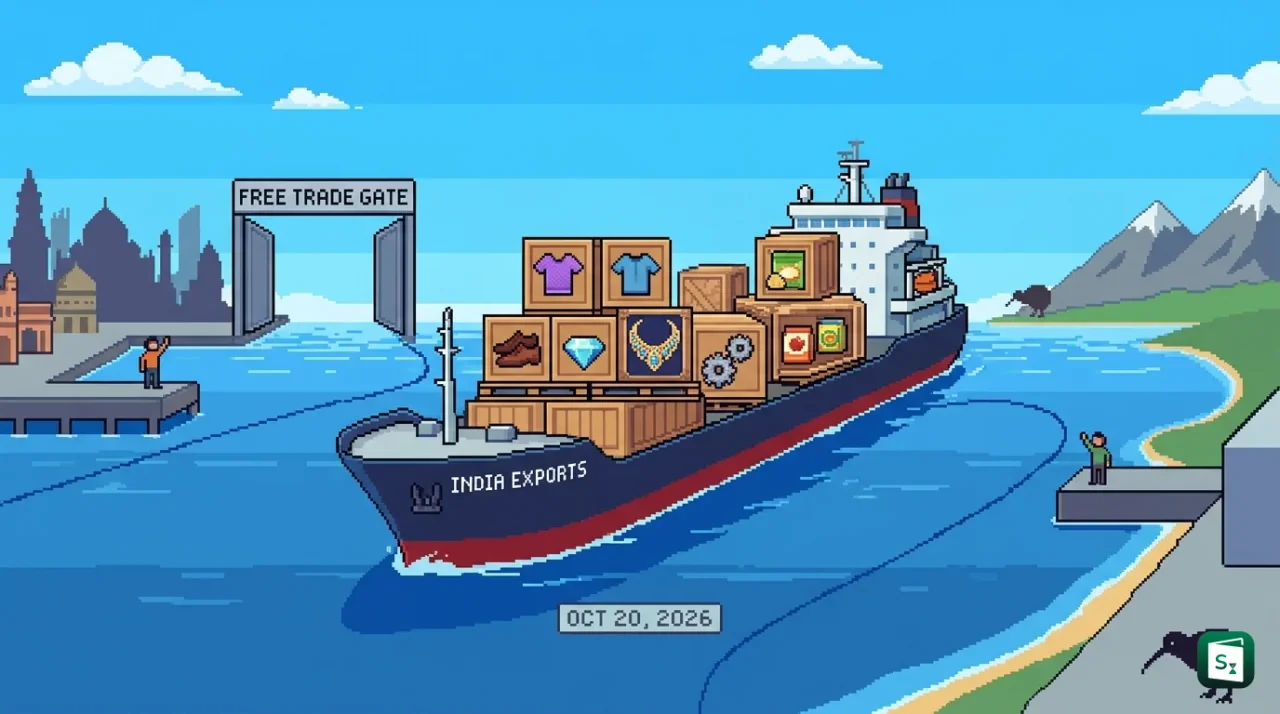
The India New Zealand Free Trade Agreement will enter into force on 20 October 2026, Union Commerce and Industry Minister Piyush Goyal announced on 21 September 2026 along with New Zealand Trade and Investment Minister Todd McClay. From that date, 100 percent of Indian exports will get duty free access to New Zealand, covering all tariff lines. The move is expected to double two way trade and open new doors for jobs, investment and student mobility.
What Is a Free Trade Agreement and What Does the India New Zealand FTA Cover?
A Free Trade Agreement (FTA) is a deal between two or more countries to reduce or remove duties and other barriers on goods and services traded between them. It also sets clear rules on customs, investment, movement of professionals and cooperation in areas like technology and education. The India New Zealand Free Trade Agreement is such a full scope deal that covers goods, services, investment, mobility and farm productivity.
The India New Zealand FTA gives 100 percent duty free access for all Indian exports to New Zealand from the day it starts. This means every tariff line from India will face zero customs duty in New Zealand. Before the deal, tariffs of up to 10 percent applied on many Indian labour intensive goods such as textiles, apparel, ceramics, leather and auto parts. With zero duty, Indian products will now compete on equal terms with other trade partners of New Zealand.
The deal is wider than tariff cuts. The Ministry of Commerce has presented it as a partnership based on tariffs, talent and farm productivity. It includes a $20 billion investment commitment from New Zealand over 15 years, a services package across 118 sectors, a first time annex on health and traditional medicine, and a mobility package for students and professionals. A rebalancing clause is included to review progress if investment flows fall short, which keeps the focus on real outcomes.
Is the India New Zealand FTA Signed and When Will It Come Into Effect?
Yes, the India New Zealand FTA is signed and ratified, and it will come into effect on 20 October 2026. The deal was signed on 27 April 2026 in New Delhi and both sides have now completed domestic approval, with New Zealand passing its law on 16 September 2026 and exchanging ratification documents on 21 September 2026.
The India New Zealand trade deal moved fast. The two sides announced talks on 16 March 2025 and concluded negotiations in December 2025 after a call between Prime Minister Narendra Modi and New Zealand Prime Minister Christopher Luxon. This nine month timeline makes it one of the fastest concluded trade deals for India. The formal signing took place at Bharat Mandapam in New Delhi on 27 April 2026 by Minister Piyush Goyal and Minister Todd McClay.
Ratification means each side completes its internal legal steps to make the deal active. In New Zealand, Parliament passed the India Free Trade Agreement Legislation Amendment Bill on 16 September 2026. On 21 September 2026, Minister McClay exchanged formal documents with Indian High Commissioner Muanpuii Saiawi in Parliament, which confirmed completion. On the same day, the two ministers announced in a virtual meeting that the date of entry into force will be 20 October 2026, which falls on Dussehra.
| Stage in India New Zealand Trade Agreement | Date and Detail |
|---|---|
| Launch of negotiations | 16 March 2025 |
| Conclusion of negotiations | December 2025 |
| Signing in New Delhi | 27 April 2026 at Bharat Mandapam |
| New Zealand law passed | 16 September 2026 |
| Ratification completed | 21 September 2026 in Wellington |
| Entry into force | 20 October 2026 |
What Does India Export to New Zealand?
India exports aviation turbine fuel, medicines, textiles and clothing, machinery, gems and jewellery, leather goods and processed foods to New Zealand. Merchandise exports rose to $711 million in 2024-25, up 32 percent over the previous year, while services exports reached $634 million in 2024, up 13 percent led by travel, IT and business services.
Bilateral trade remains small but is growing quickly. Total trade in goods and services was $2.4 billion in 2024. Merchandise trade alone was $1.3 billion in 2024-25, up nearly 49 percent from the year before. In the year ended December 2025, total two way trade was NZ$3.95 billion. India now keeps a positive goods balance with New Zealand, as exports have risen 130 percent in ten years since 2015-16 while imports rose only about 7 percent.
The full text of the India New Zealand FTA removes duty on every Indian tariff line from day one. This helps micro, small and medium enterprises (MSMEs), women led firms, artisans and youth led startups the most, because these firms lead in labour intensive sectors where even a small duty decides the final price.
| Indian Export Basket Under Duty Free Access | India Position and Opportunity |
|---|---|
| Textiles and apparel | Global exports of $36.9 billion in 2024-25, exports to New Zealand of $103.14 million, zero duty replaces peak duty up to 10 percent, New Zealand imports about $2.2 billion worth from the world |
| Leather and footwear | Global exports of $5.5 billion in 2024-25, exports to New Zealand of $8.52 million across 181 tariff lines, zero duty replaces peak duty up to 10 percent |
| Engineering goods | Global exports of $153.4 billion in 2024-25, exports to New Zealand of $136.34 million, zero duty replaces peak duty up to 10 percent |
| Gems and jewellery | Duty removed in New Zealand, which improves price edge for Indian makers |
| Processed foods and marine products | Ready to eat foods and shrimp get zero duty, exports to New Zealand were $15.89 million for marine products in 2024-25 |
| Pharma and chemicals | Packaged medicines are among the top exports to New Zealand |
India will also get cheaper inputs for its own factories. The deal gives duty free sourcing of items such as wooden logs, coking coal and metal waste and scrap. Lower input cost will help Indian makers cut production cost and compete better in world markets. Faster customs steps such as authorised economic operators, automation and paperless single window clearance will also cut delays at ports.
What Does India Import From New Zealand?
India imports coal, scrap iron, rough wood, forestry products, wool, apples, kiwifruit, aluminium and education linked travel services from New Zealand. New Zealand goods exports to India were $771 million in the year to June 2025, led by forestry, horticulture, aluminium, iron and steel and wool, while travel services linked to students and tourism were the largest services import.
India has opened 70.03 percent of its tariff lines to New Zealand and kept 29.97 percent in the exclusion list. The exclusion list fully protects sensitive farm and other items such as milk, cream, whey, yoghurt, cheese, many animal products other than sheep meat, onions, chana, peas, corn, almonds, sugar, artificial honey, fats and oils, arms and ammunition, and parts of gems, jewellery and copper. This design keeps protection for small dairy farmers and food growers while giving choice to consumers.
For a few farm goods, India has used a Tariff Rate Quota (TRQ). A TRQ is a system that allows a fixed quantity to enter at a lower duty, while any quantity above that limit pays the normal higher duty. All TRQs in this deal are paired with farm productivity plans and a Joint Agriculture Productivity Council to track results. Centres of excellence for apples, kiwifruit and honey will train Indian growers in quality, grading and beekeeping.
| New Zealand Access in India Under TRQ and Phase Down | How Protection Works |
|---|---|
| Apples | Duty cut from 50 percent to 25 percent for 32,500 tonnes rising to 45,000 tonnes in six years, only from 1 April to 31 August with minimum import price of $1.25 per kg, India is first to give such apple access in any deal |
| Kiwifruit | Zero duty for 6,250 tonnes rising to 15,000 tonnes in six years, duty outside quota halved from 33 percent to 16.5 percent |
| Manuka honey | Duty cut from 66 percent to 16.5 percent over five years |
| Albumins including milk albumin | Quota of 3,000 tonnes where duty is halved from 22 percent to 11 percent |
| Wine | Steep duty of 150 percent cut to 25 to 50 percent over ten years based on value, with promise of equal treatment if India gives a better wine deal later |
| Sheep meat, wool, coal, most forestry | Zero duty from day one, which meets New Zealand interest in raw and natural products |
| Bulk infant formula and dairy preparations | Duty of 33 percent removed over seven years, peptones duty of 22 percent also phased over seven years |
New Zealand exporters get phased gains too. About 57 percent of New Zealand exports will be duty free from day one, rising to over 80 percent when fully phased in, while the average duty on its current exports will fall to just 3 percent. This balanced structure explains why India could protect dairy while New Zealand could still claim new access in fruit, wine, forestry, seafood and industrial goods.
How Will the India New Zealand FTA Change Bilateral Trade and Visa Rules?
The India New Zealand FTA will lift two way trade by cutting duties, easing customs and opening services, while new visa paths will help Indian professionals, students and youth work and study in New Zealand. The two sides aim to double goods and services trade to NZ$7 billion by 2030, or about ₹35,000 crore in the next four to five years.
On services, New Zealand has given its best ever offer to India. It has bound access in 118 sectors and Most Favoured Nation (MFN) promise in 139 sectors. MFN in services means New Zealand will automatically extend to India any better treatment it gives to any other country in those sectors in future. Key sectors for India include computer services, professional services, audio visual services, telecom, construction, distribution, education, finance, tourism and other business services.
Health and traditional medicine get special space. For the first time, New Zealand has signed an annex to support trade in AYUSH systems. AYUSH stands for Ayurveda, Yoga and Naturopathy, Unani, Siddha, Sowa Rigpa and Homeopathy. The annex also links Indian wellness practices with Maori health practices of the indigenous people of New Zealand. This will support medical value travel, wellness centres and jobs for women and small firms in the wellness sector.
Mobility is the most direct gain for people. The deal creates a new Temporary Employment Entry (TEE) visa for skilled Indians, with a quota of 5,000 visas at any given time for stay up to three years. It covers iconic Indian roles such as AYUSH practitioners, yoga instructors, Indian chefs and music teachers, along with IT, engineering, healthcare, education and construction. Within the quota, about 600 visas are set for iconic roles, 1,000 for IT roles like software engineers and programmers, and 1,000 for engineers.
For students, New Zealand has signed an annex on student mobility and post study work for the first time with any country. There is no cap on student numbers. Students can work up to 20 hours per week during study, with protection even if domestic policy changes. After study, work rights run up to three years for science, technology, engineering and mathematics (STEM) bachelor and master graduates and up to four years for doctoral scholars. In addition, 1,000 young Indians each year can get a multiple entry Working Holiday Visa for 12 months to gain exposure and skills. Around 300,000 people of Indian origin live in New Zealand, which is nearly 5 percent of its population, so stronger people links will deepen business and cultural ties.
India Free Trade Agreement Network in Context
The India New Zealand FTA is the seventh to ninth recent deal in a fast expanding trade network that now spans 38 developed countries. India has moved from long pending talks to quick delivery, with deals becoming active in back to back months in 2025 and 2026.
India has active deals with Mauritius from April 2021, the United Arab Emirates from May 2022 and Australia under the Economic Cooperation and Trade Agreement from December 2022. The pact with the European Free Trade Association (EFTA), which groups Iceland, Liechtenstein, Norway and Switzerland, entered into force on 1 October 2025. The pact with the United Kingdom was signed in July 2025 and became active in July 2026, while the pact with Oman was signed in December 2025 and became active on 1 June 2026. The deal with the European Union was concluded on 27 January 2026 and work with the United States on a bilateral trade pact is under discussion (as of September 2026).
Early results from this network give confidence. Exports to the United Arab Emirates rose from $16.7 billion in 2021-22 to $37.4 billion in 2025-26, while exports to Australia rose from $4 billion to $7.3 billion in the same period. In June 2026 alone, exports to Oman jumped to $622.8 million within weeks of that deal starting. The New Zealand deal follows the same template of full or near full duty access for Indian labour intensive goods such as textiles, leather, gems, marine products and engineering, while keeping calibrated guardrails for sensitive farm goods. If firms use certificates of origin well and build links with buyers, the October start can turn a small trade lane into a gateway to the wider Oceania and Pacific region.
Key Takeaways
- The India New Zealand Free Trade Agreement will enter into force on 20 October 2026 after signing on 27 April 2026 in New Delhi.
- 100 percent of Indian exports get zero duty access to New Zealand from day one across all tariff lines.
- India kept 29.97 percent of tariff lines in exclusion to protect dairy, key farm goods and sensitive products, with only apples, kiwifruit, Manuka honey and albumins under quota based access.
- New Zealand committed $20 billion investment over 15 years and opened 118 services sectors with MFN promise in 139 sectors.
- The deal creates a 5,000 quota TEE visa for up to three years and 1,000 annual Working Holiday Visas, plus assured post study work up to four years for doctoral scholars.