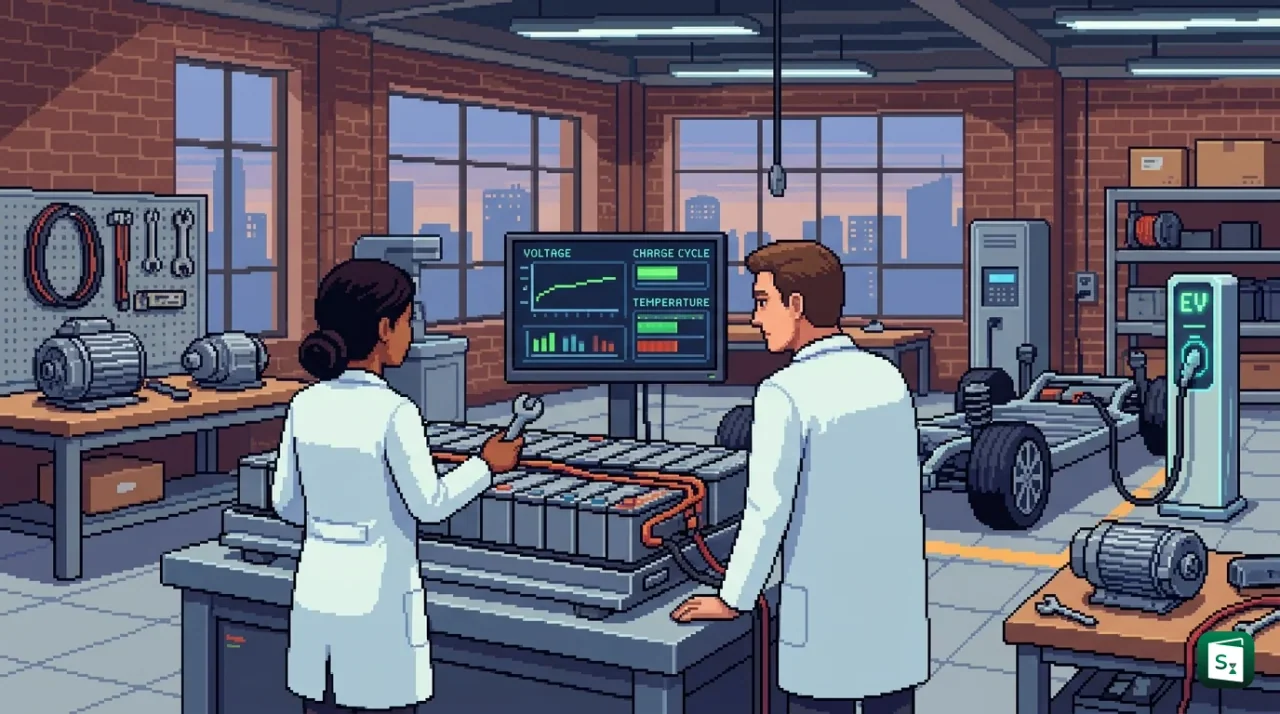
The Indian Institute of Technology (Banaras Hindu University) in Varanasi signed a Memorandum of Understanding with the University of Michigan, Ann Arbor on 8 September 2026 to jointly research electric vehicles and sustainable mobility. The pact was signed at the Electric Vehicle Centre (EVC) in Michigan by IIT BHU Director Amit Patra and Michigan Associate Dean for Research Todd Allen. It will support joint projects, faculty and student exchange, and innovation in batteries, materials and EV systems.
What Is Electric Mobility?
Electric mobility means the use of vehicles that run on electricity instead of petrol or diesel. It includes electric two wheelers, three wheelers, cars, buses and trucks, along with batteries, motors and charging stations. The goal is cleaner air, lower fuel imports and lower carbon emissions from transport.
The term electric mobility covers the full system around these vehicles. It includes battery chemistry and design, power electronics that control the motor, charging networks, battery swapping and recycling, and software that manages range and safety. Sustainable mobility is the wider idea. It means moving people and goods in a way that cuts pollution, saves energy and remains affordable over time.
For India, this shift has high stakes. Transport accounts for a large share of oil use and city air pollution. India imports most of its crude oil, so every kilometre shifted to electricity charged from domestic power helps energy security. The central government has therefore backed demand support for electric vehicles in India, charging stations and domestic battery manufacturing through schemes such as FAME II and the PM E-DRIVE Scheme.
What Did the IIT BHU Michigan Agreement Cover?
The IIT BHU Michigan agreement is a Memorandum of Understanding (MoU), which is a written document where two institutions record their plan to work together. The IIT BHU delegation visited the Electric Vehicle Centre (EVC) at the University of Michigan to finalise the pact. The MoU was signed on 8 September 2026 at the EVC in Ann Arbor, Michigan.
Professor Amit Patra, Director of IIT BHU Varanasi, signed for the Indian side. Professor Todd Allen, Associate Dean for Research at the University of Michigan, signed for the American side. Professor Patra said the two institutions have complementary strengths. IIT BHU brings experience in e-mobility research in Indian conditions, while Michigan brings depth in vehicle systems, batteries and manufacturing research.
Professor Rajeev Kumar Singh, Head of Electrical Engineering at IIT BHU and Coordinator of the Centre for Transportational E-Mobility (CTEM), presented two sanctioned projects already approved under the collaboration. Faculty members from both sides discussed these projects in detail and also reviewed other ongoing and proposed work at IIT BHU. Talks on advanced materials led to a decision to form a joint Materials Research Team. This team will carry out collaborative research and prepare a long term white paper that maps future research directions.
| Side | Key members present |
|---|---|
| IIT BHU Varanasi | Director Amit Patra, Rajeev Kumar Singh, Hiralal Pramanik (Dean, Resource and Alumni), distinguished alumnus Vish Narayanan and senior alumnus Sri Mirle |
| University of Michigan | EVC Director Alan Taub, EVC Managing Director Christophe Mangin, Todd Allen, Jason Siegel, Heath Hofmann and Amit Misra |
The visit also covered student and faculty exchange, joint guidance, shared laboratory use and stronger alumni links. Faculty members Debdip Bhandary, Abir Ghosh, Udita Ghosh and Prodyut Dhar joined the technical talks online from India.
Where Is IIT BHU Located and What Is Its Full Form?
IIT BHU stands for Indian Institute of Technology (Banaras Hindu University). It is located inside the Banaras Hindu University campus in Varanasi, Uttar Pradesh. It is a separate Institute of National Importance and not the same as BHU, though it retains academic links with the university.
IIT BHU traces its roots to Banaras Engineering College (BENCO), started in 1919 by BHU founder Madan Mohan Malaviya. Later colleges of technology and mining were added. In 1968, these units merged to form the Institute of Technology, Banaras Hindu University (IT-BHU). Admission through the Joint Entrance Examination (JEE) system began in 1972. Parliament granted IIT status on 29 June 2012, and the institute became IIT (BHU) Varanasi. Unlike most IITs named only after a city, it keeps BHU in its name to reflect its history and link with the university.
The institute has 14 departments and three interdisciplinary schools and offers BTech, dual degree, MTech, MPharm and PhD programmes. It ranked 10th in engineering and 30th overall in NIRF 2024. To focus its EV work, IIT BHU set up the Centre for Transportational E-Mobility (CTEM) and, in July 2026, created the Centre for Sustainable E-Mobility. These centres anchor its battery, power electronics and transport research.
What Is the University of Michigan Known For?
The University of Michigan is a public research university founded in 1817 and based in Ann Arbor, Michigan in the United States. It is known for top ranked engineering, medicine, business and social sciences, and for leadership in automotive, mobility and battery research through its College of Engineering.
The university operates from its main campus in Ann Arbor, a city near Detroit, the historic centre of the American car industry. Its campus spreads over 3,279 acres and it follows an academic calendar based on trimesters. In recent national rankings (as of September 2026), the university has placed around 20th among national universities and 3rd among public universities, with undergraduate engineering ranked 5th and graduate engineering ranked 12th. Its strengths include aerospace, industrial, environmental, electrical and nuclear engineering.
For this pact, the key unit is the Electric Vehicle Centre (EVC) within the College of Engineering. The Michigan Department of Labor and Economic Opportunity backed the centre with $130 million. The centre was launched in April 2023 and is led by Director Alan Taub, a professor of materials science and mechanical engineering and a former senior executive at General Motors and Ford. Its work rests on four pillars of technology and innovation, education, workforce development and facility expansion. The centre builds on older assets such as the Battery Lab, the first university based battery pilot line in the United States started in 2015, along with Mcity, the public private test ground for connected and driverless vehicles, and the U-M Transportation Research Institute.
Why This Partnership Matters for India’s EV Push
The IIT BHU Michigan partnership connects Indian field needs with American laboratory depth at a time when India is scaling up electric transport. Indian two wheelers, three wheelers, buses and small commercial vehicles are leading the shift because they run high daily distances and their fuel savings quickly offset battery costs. Research on longer battery life, faster charging, safer cells and lower cost materials can therefore speed up adoption in the exact segments India wants to electrify first.
Policy support gives this research a ready market. The central government closed the second phase of the Faster Adoption and Manufacturing of Electric Vehicles (FAME II) Scheme on 31 March 2024 after supporting more than 16 lakh vehicles and sanctioning thousands of buses and charging stations. It then notified the PM Electric Drive Revolution in Innovative Vehicle Enhancement (PM E-DRIVE) Scheme on 29 September 2024 with an outlay of ₹10,900 crore. The scheme runs up to 31 March 2028 and supports e-two wheelers, e-three wheelers, e-trucks, e-buses and e-ambulances, along with ₹2,000 crore for public charging stations and ₹780 crore for upgrading testing agencies.
| Scheme | Period | Outlay | Main focus |
|---|---|---|---|
| FAME II | 1 April 2019 to 31 March 2024 | ₹11,500 crore | Demand support for e-two, e-three and e-four wheelers, buses and charging stations |
| PM E-DRIVE | 1 April 2024 to 31 March 2028 | ₹10,900 crore | e-two and e-three wheelers, e-trucks, e-buses, e-ambulances, charging network and test labs |
Joint work on batteries and advanced materials is central to self reliance. India still depends on imports for lithium cells and key minerals such as lithium, cobalt and nickel. A joint Materials Research Team that studies solid state cells, better anodes and cathodes, recycling and second life use can help cut costs and import dependence. Common standards for safety, testing and charging can also help Indian makers sell in global markets.
The human link matters as much as the hardware. The pact opens paths for joint supervision of doctoral work, short research stays, joint papers and shared courses. Michigan aims to train more than 1,200 students a year through its EV network, while IIT BHU brings a large pool of engineering talent from Varanasi. Alumni who studied in both systems helped shape the talks, and that network can keep the projects moving after the signing.
The Way Forward
The immediate test for the IIT BHU Michigan pact is execution of the two sanctioned projects presented by the Centre for Transportational E-Mobility. Joint teams will need clear timelines, shared data rules and division of work between Varanasi and Ann Arbor. The planned white paper on materials research can then turn early results into a longer roadmap for cells, power electronics and manufacturing methods suited to Indian heat, dust, roads and driving cycles.
In the next stage, the partners are expected to add more projects, link laboratories and involve industry for pilot testing in buses, three wheelers and charging systems. Success will be measured by patents, publications, trained researchers and technologies that reach factories and fleets. If the collaboration delivers on these fronts, it can support India’s goals of cleaner city air, lower oil imports and progress toward net zero emissions by 2070.
Key Takeaways
- IIT BHU Varanasi signed an MoU with the University of Michigan, Ann Arbor on 8 September 2026 at the Electric Vehicle Centre for joint EV research.
- The pact was signed by IIT BHU Director Amit Patra and Michigan Associate Dean Todd Allen and covers two sanctioned projects led by the Centre for Transportational E-Mobility.
- IIT BHU stands for Indian Institute of Technology (Banaras Hindu University), located in Varanasi, Uttar Pradesh, and received IIT status on 29 June 2012.
- The University of Michigan, founded in 1817 and based in Ann Arbor, runs the $130 million Electric Vehicle Centre led by Director Alan Taub.
- India’s PM E-DRIVE Scheme, notified on 29 September 2024 with an outlay of ₹10,900 crore, supports e-two and e-three wheelers, e-buses, e-trucks and charging stations up to 31 March 2028.
- The collaboration will form a joint Materials Research Team to prepare a white paper on batteries and advanced materials for sustainable mobility.