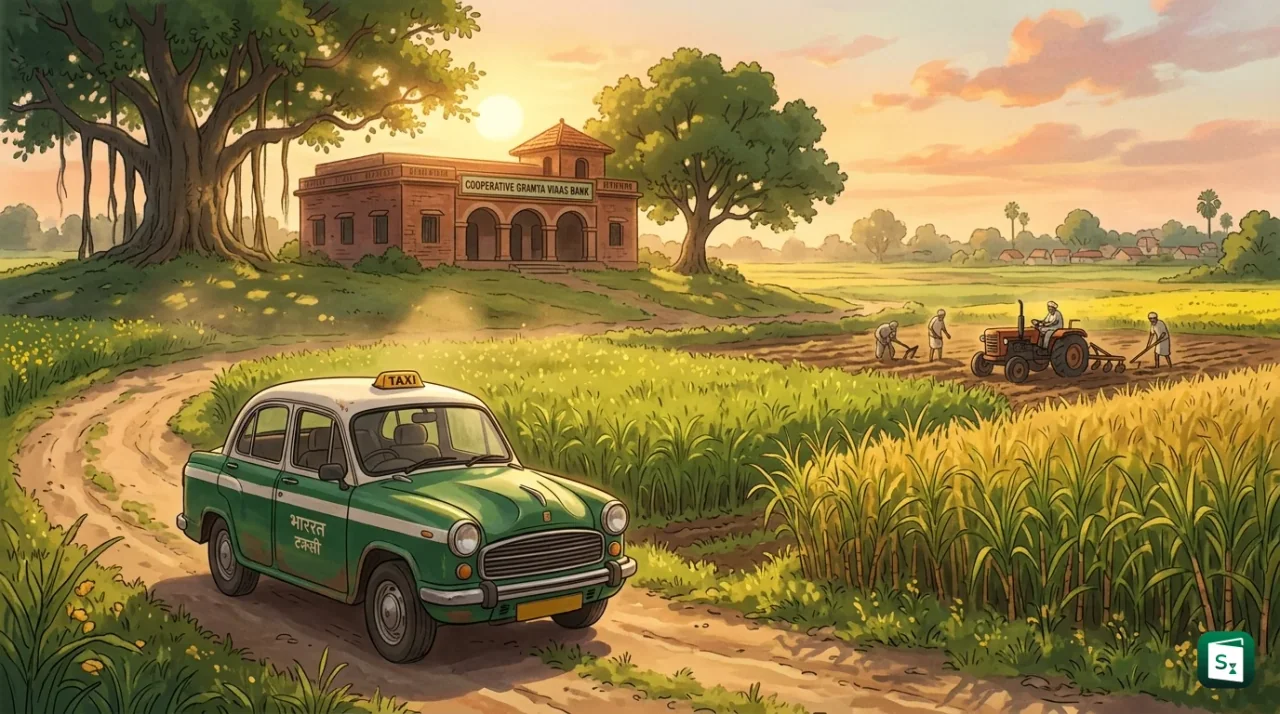
Uttar Pradesh Chief Minister Yogi Adityanath launched the Bharat Taxi service and the Mukhyamantri Krishak Samriddhi Yojana in Lucknow on 23 September 2026. Bharat Taxi brings the national cooperative ride hailing platform to transport workers in cities such as Lucknow, Gorakhpur, Varanasi and Prayagraj, while the farm scheme cuts long term farm loan interest from 11 percent to 6 percent through the Cooperative Gramya Vikas Bank. Together, the two moves use the cooperative sector to raise incomes of drivers and small farmers in the state.
What Is Bharat Taxi?
Bharat Taxi is India’s first cooperative led ride hailing platform for cars, autos and bike taxis. It is operated by Sahakar Taxi Cooperative Limited and promoted by the Ministry of Cooperation. Drivers join as member owners called Sarathis, keep full fares under zero commission, and share profits.
The Bharat Taxi app allows passengers to book cars, auto rickshaws and bike taxis through one mobile application. The passenger application and the driver application are both available on the Google Play Store and the Apple App Store. The platform works within the Open Network for Digital Commerce (ONDC) framework, which is India’s open system that lets buyers and sellers connect across different apps instead of depending on one closed company app.
Bharat Taxi was established on 6 June 2025 as a Multi State Cooperative Society. It is registered under the Multi State Cooperative Societies Act, 2002 with registration number MSCS/CR/1629/2025. The registered head office is at the National Cooperative Development Corporation building at Hauz Khas in New Delhi. Union Home and Cooperation Minister Amit Shah formally launched the national service on 5 February 2026 at Vigyan Bhavan in New Delhi after a two month pilot in Delhi National Capital Region and Gujarat.
| Bharat Taxi Fact | Detail |
|---|---|
| Full operator name | Sahakar Taxi Cooperative Limited (STCL) |
| Type of body | Multi State Cooperative Society |
| Parent law | Multi State Cooperative Societies Act, 2002 |
| National launch | 5 February 2026, New Delhi |
| Services offered | Car, auto rickshaw, bike taxi |
| Fare model | Zero commission, no surge pricing |
Is Bharat Taxi Government or Private?
Bharat Taxi is neither a private company nor a government department. It is a driver owned cooperative supported by the Ministry of Cooperation. Eight national cooperative institutions promoted it, no government equity was invested, and drivers own shares and receive dividends as members.
The Ministry of Cooperation was created in July 2021 to strengthen cooperatives, and it guides the Bharat Taxi idea under its vision of prosperity through cooperation. The Ministry does not run daily operations and has stated that no financial assistance, equity support or incentive was given by the government to build or expand the platform. Daily management rests with Sahakar Taxi Cooperative Limited, which follows its registered bye laws and the Multi State Cooperative Societies Act.
Eight leading cooperative bodies support the platform through outreach and mobilisation of members. These are the National Cooperative Development Corporation (NCDC), Indian Farmers Fertiliser Cooperative (IFFCO), Gujarat Cooperative Milk Marketing Federation or Amul (GCMMF), Krishak Bharati Cooperative (KRIBHCO), National Agricultural Cooperative Marketing Federation (NAFED), National Bank for Agriculture and Rural Development (NABARD), National Dairy Development Board (NDDB) and National Cooperative Exports Limited (NCEL). NABARD is India’s apex development bank for agriculture and rural development, established in 1982 and headquartered in Mumbai. This backing follows the Amul pattern, where milk producers collectively own the brand and share the gains.
How Bharat Taxi Works: Cooperative Model and Zero Commission System
Bharat Taxi works on a zero commission model in which the driver keeps the full fare and pays no share to the platform. Drivers register on the Bharat Taxi driver app, become members of the cooperative by taking a share, receive trip payments directly in their bank accounts, and later receive a share of profits.
A driver is called a Sarathi on the platform, which means charioteer or driver in Hindi. Registration is open to taxi, auto and bike drivers who hold valid driving licences and vehicle permits. On joining, the Sarathi gets a share certificate of the cooperative. There is no exclusivity rule, so a driver can also work with other ride platforms at the same time. At airport prepaid booths run by Bharat Taxi, a 7 percent service charge is added to meet counter costs, but no platform fee or commission is taken inside the app.
Driver welfare is built into the design. Registered Sarathis in Uttar Pradesh get social security cover of up to ₹5 lakh. At the national launch, top performing Sarathis were given personal accident cover of ₹5 lakh and family health cover of ₹5 lakh. The app has an SOS alert button for emergency help, verified ride data, and a three level grievance system through the app, the website and a toll free helpline. Help centres have been opened in Delhi National Capital Region, and more centres are planned in each state. A special window called Sarathi Didi and the Bike Didi initiative support women drivers, with more than 150 women drivers already on the platform.
Bharat Taxi in Uttar Pradesh: Launch and Service Coverage
The Uttar Pradesh rollout of Bharat Taxi took place in Lucknow on 23 September 2026. Chief Minister Yogi Adityanath flagged off the service with Union Minister of State for Cooperation and Civil Aviation Murlidhar Mohol (as of September 2026). Bharat Taxi services had already started in Lucknow, Gorakhpur, Varanasi and Prayagraj before the formal state launch.
Bharat Taxi in Uttar Pradesh covers cars, three wheelers and two wheelers. The state government signed memorandums of understanding with Lucknow Airport, Lucknow Metro and Lucknow Police to give drivers access to high demand points and improve last mile connectivity. Last mile connectivity means easy transport from a main station or airport to the final home or office. At the launch event, five Sarathis received share certificates, and the service was linked to the wider national network.
The national scale of the platform is growing fast. As on 28 July 2026, about 8.27 lakh Sarathis had registered across India. The platform reported more than 40 lakh riders and direct transfer of about ₹77 crore to driver accounts by July 2026. Pilot operations had begun on 2 December 2025 in Delhi National Capital Region and the Saurashtra region of Gujarat. By early 2026, the service was active in Delhi, Gurugram, Noida, Ahmedabad, Rajkot, Somnath and Dwarka. It later expanded to Mumbai, Chandigarh, Jaipur, Kanpur, Pune and Lucknow. The stated goal is to reach all states within two years and achieve national presence by 2029.
What Is Mukhyamantri Krishak Samriddhi Yojana?
Mukhyamantri Krishak Samriddhi Yojana is Uttar Pradesh’s farm support scheme for small and marginal farmers. It provides long term agricultural loans through the Cooperative Gramya Vikas Bank. The state pays part of the interest so farmers pay only six percent instead of eleven percent.
The word Krishak means farmer in Hindi, so the scheme name means Chief Minister Farmer Prosperity Scheme. It focuses on long term credit, which is money borrowed for several years to buy equipment, build farm assets, install tube wells or develop land. This is different from short term crop loans, which are taken for one season to buy seeds and fertiliser. The state launched an e-portal for the scheme on 23 September 2026 so farmers can apply, track approvals and receive sanction letters in a clear way.
The launch also included two digital tools for the cooperative system. The Urvarak Setu mobile app of the Cooperation Department helps farmers get fertilisers and related inputs on time. The UPCDC mobile app of the Uttar Pradesh Cooperative Database Centre builds a digital record of cooperative societies and members. At the Lucknow event, five farmers received loan sanction letters under the new farm scheme.
Cooperative Credit in Uttar Pradesh: From 11 Percent to 6 Percent Interest
The Uttar Pradesh Cooperative Gramya Vikas Bank earlier charged about 11 to 11.5 percent interest on long term farm loans. Under the new decision, the farmer pays 6 percent, and the state government bears the remaining interest burden. This cut lowers the monthly cost of borrowing for machinery and land development.
The Uttar Pradesh Cooperative Gramya Vikas Bank, also called the Land Development Bank, gives long term loans for farming and rural needs. The state first announced the cut in December 2025 at the Yuva Sahakar Sammelan and UP Cooperative Expo in Lucknow, and formally rolled out the scheme portal in September 2026. The target is to reach 5 lakh small and marginal farmers in the coming years. Small farmers hold one to two hectares of land, while marginal farmers hold less than one hectare.
The cut matters because Uttar Pradesh has about 2.86 crore farmers, and nearly 92 percent of them are small or marginal. About 1.25 crore to 1.4 crore farmers are linked to the cooperative banking system in some form, including district cooperative banks and Primary Agricultural Credit Societies (PACS). PACS are village level cooperative societies that give short term credit and inputs to members. The state has raised interest free cash credit for PACS from ₹10 lakh to ₹15 lakh and added 54 lakh new members to cooperatives. The state says 15 of the 16 district cooperative banks that had turned weak before 2017 have returned to profit.
| Feature | Before the Scheme | Under Mukhyamantri Krishak Samriddhi Yojana |
|---|---|---|
| Lending body | Cooperative Gramya Vikas Bank | Same bank, with state interest support |
| Interest paid by farmer | About 11 to 11.5 percent | 6 percent |
| Extra interest | Borne by farmer | Borne by state government |
| Target group | General farm borrowers | Small and marginal farmers |
| Goal | Short revival of cooperative credit | 5 lakh farmers to get long term loans |
How Bharat Taxi Compares With Ola and Uber
Private ride platforms such as Ola, Uber and Rapido run on a commission model in which the company keeps 20 to 30 percent of each fare. Bharat Taxi keeps no commission and follows fixed, transparent rates with no surge pricing during peak hours. Drivers can vote on fare changes through the cooperative, while riders are promised lower fares and SOS safety support.
The difference is clearest on short city trips. In Jaipur, the platform said rides up to 11 km cost about ₹25 less than market rates, with fares 10 to 15 percent lower than private aggregators. Private apps often raise prices sharply when demand is high. Bharat Taxi says it will not add such surge charges. Like Namma Yatri in Bengaluru and Yatri Sathi in West Bengal, Bharat Taxi tries to give drivers a larger share, but it is different because drivers are legal owners of the cooperative and not just app users.
| Feature | Bharat Taxi | Private Aggregators such as Ola and Uber |
|---|---|---|
| Ownership | Drivers are member owners | Investors own the company |
| Commission | Zero commission | About 20 to 30 percent per trip |
| Surge pricing | No surge pricing | Prices rise in peak hours |
| Profit share | Dividend to drivers | Profits go to company |
| Right to work elsewhere | Allowed | Often linked to incentives and ratings |
The Way Forward
The Uttar Pradesh government plans to link Bharat Taxi with airports, railway stations and metro systems for smooth last mile links. The Transport Department has been asked to study a rural bus service on the same cooperative lines to create jobs for young drivers. The state will also strengthen driver help centres, digital payments through partners, and integration with DigiLocker, UMANG and API Setu for safe identity checks.
On the farm side, the test will be quick loan disbursal and recovery through the cooperative chain. The state has completed long pending irrigation works such as the Saryu Canal National Project and expanded irrigation to 24 lakh hectares in the past nine years, while giving free electricity to more than 16 lakh private tube well users. If cheap long term credit reaches fields on time, it can support machines, warehouses of 50,000 metric tonne capacity, and food processing units.
The new credit scheme should not be confused with the older Nandini Krishak Samriddhi Yojana. The Nandini scheme, started in 2023 under the Nand Baba Milk Mission, supports dairy units of 25 indigenous cows of Sahiwal, Gir, Tharparkar and Gangatiri breeds with 50 percent subsidy up to ₹31.25 lakh. The Mini Nandini version supports 10 cow units costing ₹23.6 lakh with ₹11.8 lakh as subsidy. The new Mukhyamantri Krishak Samriddhi Yojana is broader and focuses on interest relief on long term loans through the cooperative bank.
Key Takeaways
- Bharat Taxi was rolled out in Uttar Pradesh on 23 September 2026 in Lucknow after starting in Lucknow, Gorakhpur, Varanasi and Prayagraj.
- Sahakar Taxi Cooperative Limited, registered on 6 June 2025 under the Multi State Cooperative Societies Act, 2002, operates Bharat Taxi on zero commission.
- The national Bharat Taxi service was launched on 5 February 2026 by the Ministry of Cooperation and had about 8.27 lakh Sarathis by 28 July 2026.
- Mukhyamantri Krishak Samriddhi Yojana cuts long term farm loan interest from 11 percent to 6 percent through the Cooperative Gramya Vikas Bank.
- The farm scheme targets 5 lakh small and marginal farmers, with the state government paying the remaining interest burden.