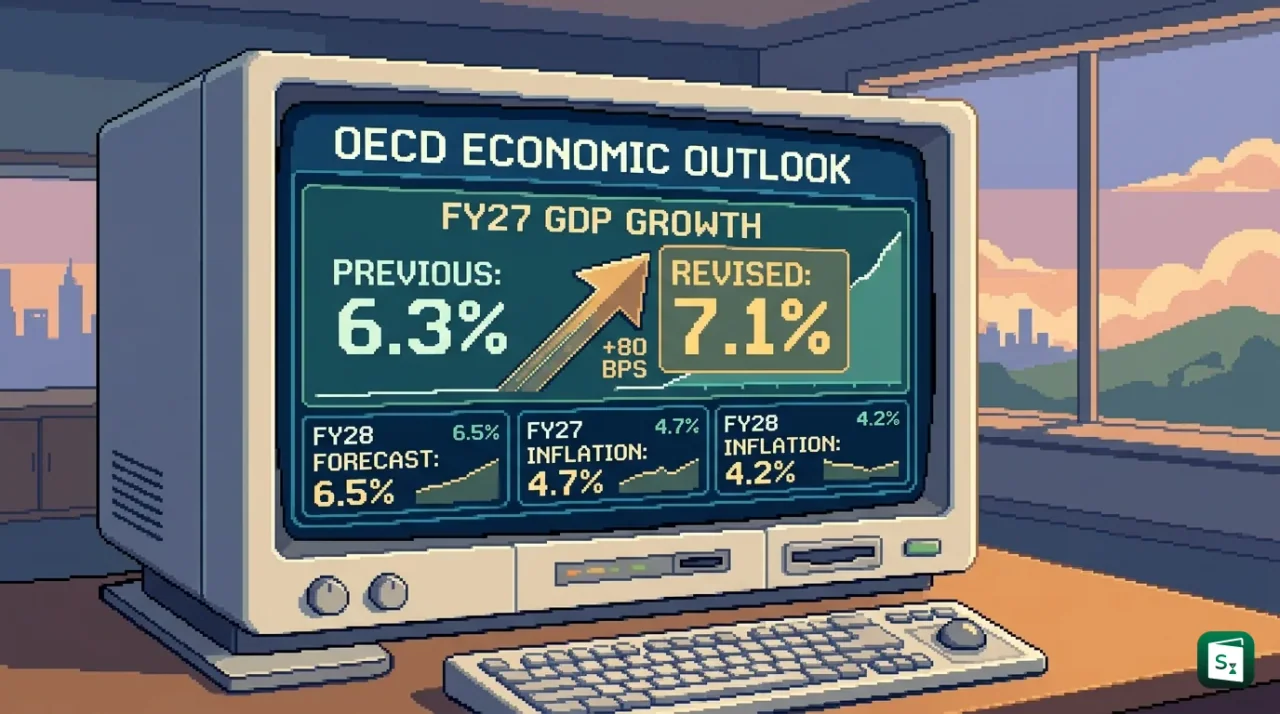
The Organisation for Economic Cooperation and Development (OECD) raised its India GDP forecast for FY27 to 7.1% in the OECD Economic Outlook, Interim Report September 2026. The new forecast is 80 basis points higher than the 6.3% projected in June 2026, with growth for FY28 placed at 6.5%. The upgrade keeps India as the fastest growing major economy even as high energy prices and global uncertainty weigh on world growth.
What Is GDP and How Is It Measured in India?
Gross Domestic Product (GDP) is the total value of all final goods and services produced within a country during a specific period. It is the most widely used measure of the size of a national economy and its growth rate shows whether economic activity is expanding or slowing.
The Ministry of Statistics and Programme Implementation (MoSPI) calculates India GDP growth every quarter and every year. MoSPI releases two main measures. Real GDP measures output at constant prices after removing the effect of inflation, while nominal GDP measures output at current prices including inflation. The difference between the two helps readers understand how much growth comes from higher production and how much comes from higher prices.
India also tracks Gross Value Added (GVA), which measures value created by different sectors before adding taxes and subtracting subsidies. In the first quarter of FY27 (April to June 2026), India recorded real GDP growth of 7.8% and nominal GDP growth of 10.3%. Real GVA grew by 8.2% in the same quarter, with services growing by 10%, manufacturing by 9.2% and agriculture and allied activities by 3.6%. On the spending side, private consumption grew by 7.1% while investment in factories, machinery and infrastructure, called Gross Fixed Capital Formation, grew by 11.9%.
What Is OECD and Its Economic Outlook Report?
The Organisation for Economic Cooperation and Development (OECD) is an international group of 38 member countries that works on economic policy, trade, jobs and living standards. The OECD was established in 1961 and is headquartered in Paris, France. India is not a member of the OECD but works closely with the OECD as a key partner economy.
The OECD publishes its Economic Outlook twice a year with interim updates in March and September. The latest edition, titled OECD Economic Outlook, Interim Report September 2026: Weathering Successive Shocks, was released on 23 September 2026 and is based on information available up to 16 September 2026. The report covers the world economy and all Group of Twenty (G20) countries. In the June 2026 edition, the OECD had projected India growth of 6.3% for FY27 and 6.4% for FY28. The September report revises both numbers upward after stronger than expected quarterly data.
OECD Revises India Growth Forecast for FY27 and FY28
The OECD now expects India real GDP to grow by 7.1% in FY27 and 6.5% in FY28. FY27 means the financial year from April 2026 to March 2027, while FY28 means April 2027 to March 2028. For India, the OECD uses financial years, while for most other countries it uses calendar years.
A basis point is a small unit used to describe changes in growth rates and interest rates. One basis point equals 0.01%, so 80 basis points equal 0.80%. The move from 6.3% to 7.1% is therefore an increase of 80 basis points. The FY28 forecast moved up by 10 basis points, from 6.4% to 6.5%.
| Indicator for India | June 2026 OECD Forecast | September 2026 OECD Forecast | Change |
|---|---|---|---|
| Real GDP growth FY27 | 6.3% | 7.1% | Up 80 basis points |
| Real GDP growth FY28 | 6.4% | 6.5% | Up 10 basis points |
| Inflation FY27 | 4.8% | 4.7% | Down 10 basis points |
| Inflation FY28 | Not the headline focus in June | 4.2% | Easing path |
The OECD said stronger recent activity explains the upgrade. India grew by 7.8% in Q1 FY27, which was higher than the 6.9% recorded in Q1 FY26 and higher than the central bank estimate of 7% for the quarter. Investment, consumption, manufacturing and services all showed strength, along with strong growth in bank credit. The OECD still expects full year FY27 growth of 7.1% to remain below the 7.8% recorded in FY26, which points to some slowing in the coming quarters.
India Inflation Estimates for FY27 and FY28
The OECD estimates India inflation at 4.7% in FY27, easing to 4.2% in FY28. Inflation means a rise in the general level of prices over time. In India, inflation is measured mainly through the Consumer Price Index (CPI), which tracks the prices paid by households for food, fuel, housing, clothing and services.
The Reserve Bank of India (RBI) has a target of keeping CPI inflation at 4%, with room for movement between 2% and 6%. The OECD forecast of 4.7% for FY27 is therefore above the target but inside the upper limit, while the 4.2% forecast for FY28 is much closer to the target. The OECD links higher inflation in FY27 to higher costs for food, energy and fertilisers, along with pressure from currency movement.
Food prices need close tracking because a very strong El Nino weather pattern could weaken the monsoon and affect farm output. The OECD notes that weak farm output along with high fuel and fertiliser costs would put extra pressure on household budgets. For the world as a group, the OECD expects G20 inflation of 4.1% in 2026, easing to 3.6% in 2027, which shows that price pressure is a shared global concern and not limited to India.
Why Growth Is Expected to Moderate After a Strong Start
The OECD describes the global setting as weathering successive shocks. The conflict in West Asia disrupted oil and gas supply and pushed up energy prices. The stoppage of shipments through the Strait of Hormuz and damage to energy infrastructure raised costs for fuel, transport, fertilisers and other inputs. India imports a large share of its oil needs, so higher crude prices raise import costs, widen the current account deficit and reduce the spending power of households.
The OECD expects reduced purchasing power to soften growth in India through the second half of 2026, before a gradual recovery in 2027. Its baseline assumes that energy prices start easing in line with market futures from mid 2027 and that production and exports from the Gulf region return closer to normal. If supply disruption lasts longer, growth could weaken further and inflation could stay higher for longer.
External trade pressure also plays a role. The OECD places India among the major economies facing one of the largest increases in effective import duty rates in the United States after accounting for affected goods. Higher duties can raise costs for exporters and weigh on orders for manufacturing. On the domestic side, the OECD expects fiscal policy to turn more supportive in FY27 through subsidies that cushion households from energy costs. The Union Budget targeted a fiscal deficit of 4.3% of GDP in FY27, down from 4.4% in FY26, but energy support steps could widen the deficit by around 0.4% of GDP. The OECD advises moving from broad price support to targeted cash help with a clear end date to limit the burden on public finances.
India Growth Forecast by Different Organisations in 2026
The OECD upgrade is part of a wider round of upward revisions after India reported 7.8% growth in Q1 FY27. Strong domestic demand, gains in manufacturing and services, and double digit growth in investment helped lift forecasts across agencies. At the same time, most agencies expect growth to cool in the second half of FY27 as the effect of tax relief fades and high energy costs pass through to buyers.
| Organisation | FY27 India GDP Forecast | FY28 India GDP Forecast | Revision Context |
|---|---|---|---|
| OECD September 2026 | 7.1% | 6.5% | Up from 6.3% and 6.4% in June 2026 |
| Reserve Bank of India August 2026 | 6.7% | Not released as full year target in this round | Up from 6.6% in June 2026 |
| International Monetary Fund July 2026 | 6.4% | 6.7% | FY27 cut from 6.5% in April, FY28 raised from 6.5% |
| World Bank April 2026 | 6.6% | 6.5% range for next year | Up from 6.3% on strong domestic demand |
| Moody’s Ratings September 2026 | 7.0% | Not the focus of this update | Up from 6.0% on resilient activity |
| S and P Global Ratings September 2026 | 7.0% | Moderation expected later in FY27 | Up from 6.6% |
| Fitch Ratings September 2026 | 6.9% | Moderation expected later in FY27 | Up from 6.4% |
The table shows that the OECD forecast of 7.1% is now the highest among the major trackers for FY27, slightly above Moody’s and S and P at 7%. The International Monetary Fund (IMF), established in 1944 and headquartered in Washington D C, remains more cautious at 6.4% for FY27. The RBI, which is India’s central bank and the authority for monetary policy, places FY27 growth at 6.7%. Differences arise because each agency uses different cut off dates, oil price assumptions and views on how long the West Asia energy shock will last. For the world economy, the OECD projects global GDP growth of 2.9% in 2026 and 3.0% in 2027, which underlines why India growth above 7% stands out.
India Economy Ranking and Size in 2026
India remains the fastest growing major economy in 2026. China growth is expected to ease from 5% in 2025 to around 4.4% in 2026 and 4.3% in 2027 as consumer support ends and property adjustment continues. The United States, the Euro Area and Japan are all projected to grow at much slower rates, mostly between 1% and 2%. This gap explains why global investors track India quarterly GDP data and India GDP growth by quarter so closely.
In terms of size, India GDP in trillion dollars is now above $4 trillion in nominal terms, which places India among the five largest national economies in the world. Total GDP in rupees crossed ₹88.27 lakh crore in Q1 FY27 alone in nominal terms. Yet income per person remains modest compared with advanced economies. GDP per capita in India and income per capita in India are still far below OECD averages, so fast real GDP growth matters for jobs, incomes and living standards. Sustained growth near 7% helps raise tax collection, supports public investment and creates room for salary and pension revisions expected in FY28.
The Way Forward
The OECD expects India growth to ease from 7.1% in FY27 to 6.5% in FY28 as energy costs and tighter financial conditions work through the economy. A temporary rise in the policy rate of around 25 basis points by early FY27 could help keep inflation near the target band, with easing possible in FY28 as price pressure cools. The RBI had earlier reduced the policy rate from 6.5% in January 2025 to 5.25% in February 2026 to support activity, so any fresh tightening would be a careful pause rather than a long cycle.
Faster rollout of renewable energy, simpler regulations and targeted fiscal help can lower risks. Renewable power reduces dependence on imported oil and gas, while clear and simple business rules lift investment and productivity. The OECD also warns of a combined shock test in which longer energy disruption, weak farm output and high borrowing costs together could cut global growth in 2027 by 0.7% and lift inflation by 1.1%. For India, steady monsoon rains, stable crude prices and continued strength in services and manufacturing will decide whether the 7.1% path holds or moderates.
Key Takeaways
- The OECD Economic Outlook, Interim Report September 2026 raised India GDP growth for FY27 to 7.1% from 6.3%, an increase of 80 basis points.
- India GDP growth for FY28 is projected at 6.5%, up by 10 basis points from the June forecast of 6.4%.
- The OECD estimated India inflation at 4.7% in FY27 and 4.2% in FY28, against the RBI target of 4% with a 2% to 6% band.
- India recorded real GDP growth of 7.8% in Q1 FY27, with nominal GDP at ₹88.27 lakh crore and investment growth of 11.9%.
- The OECD, established in 1961 and headquartered in Paris with 38 members, projects global growth of 2.9% in 2026 and 3.0% in 2027.