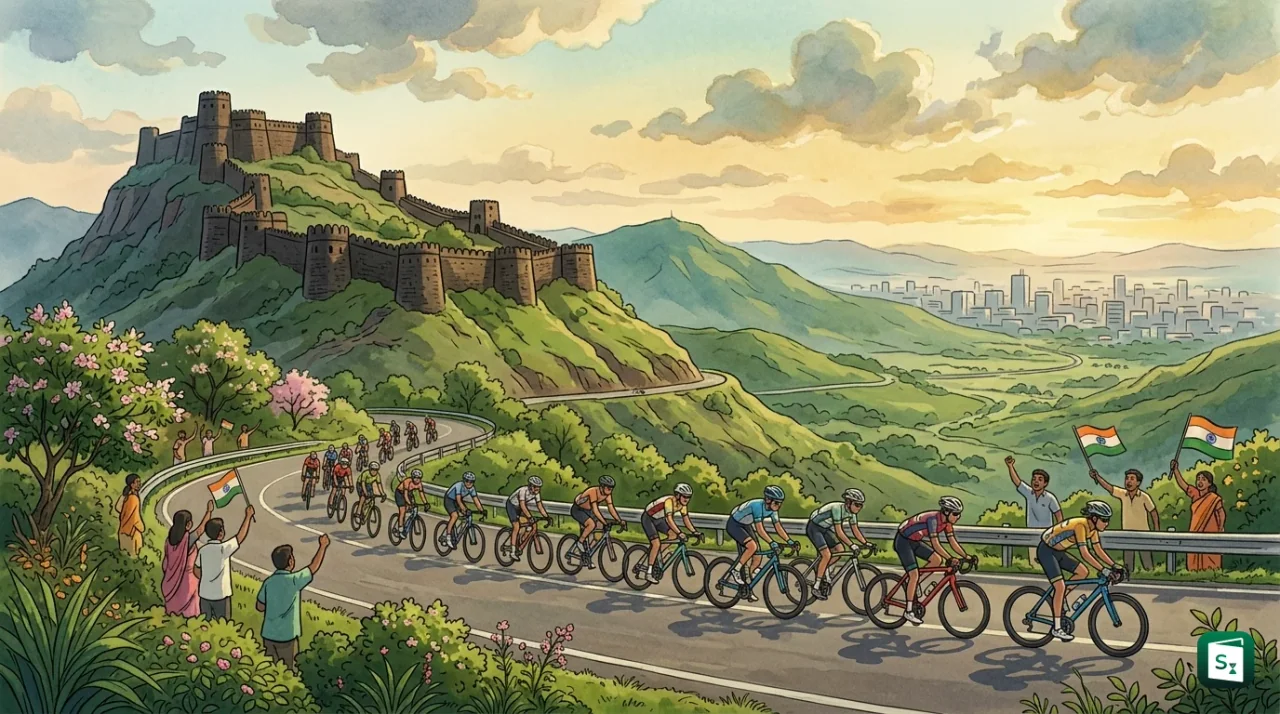
Pune will host the UCI Road World Championships 2032, bringing road cycling’s biggest annual world title event to India for the first time. The Union Cycliste Internationale (UCI) awarded the event to India at its 195th UCI Congress in Montreal on 24 September 2026. The bid, led jointly by the Government of Maharashtra and the Cycling Federation of India (CFI), beat the Netherlands in the final round and marks India as only the fourth Asian country to stage the championships.
What Is UCI Cycling and What Does UCI Stand For?
UCI cycling means competitive cycle sport governed by the Union Cycliste Internationale, the world body for cycling. UCI stands for Union Cycliste Internationale, which is French for International Cycling Union. It sets rules, calendars, rankings and safety standards for road, track and other cycling disciplines worldwide.
The Union Cycliste Internationale (UCI) was founded on 14 April 1900 in Paris by the national cycling bodies of Belgium, the United States, France, Italy and Switzerland. The UCI is recognised by the International Olympic Committee as the sole world governing body for cycle sport. Its headquarters are located at the UCI World Cycling Centre in Aigle, Switzerland. The centre, opened in 2002, works both as an office and as a high level training and education hub that hosts about 300 young athletes and coaches each year.
The UCI Congress is the supreme body of the organisation. It brings together National Federations from five continental confederations and decides on membership, finances and the award of world championships. The UCI Management Committee executes Congress decisions and awards the organisation of UCI World Championships. In September 2026, the UCI had 207 member National Federations after the Congress in Montreal admitted Kiribati. The UCI President is David Lappartient of France (as of September 2026), who has held the post since 2017.
The UCI manages ten disciplines. These are road, track, mountain bike, BMX Racing, BMX Freestyle, cyclo-cross, trials, indoor cycling, cycling esports and gravel. Five of these feature in the Olympic Games (road, track, mountain bike, BMX Racing and BMX Freestyle) and two feature in the Paralympic Games (road and track).
What Are the UCI Road World Championships?
The UCI Road World Championships are the annual world title races for road bicycle racing, organised by the UCI for national teams. Winners in each category receive the rainbow jersey, which they wear for one full year. The 2032 edition in Pune is expected to be the 105th edition.
Road cycling is racing on paved roads in two main formats. The road race is a mass start event over a long distance where tactics, teamwork and endurance decide the winner. The individual time trial is a race against the clock where riders start one by one and the fastest time wins. Since 2019, the championships also include a mixed team relay time trial with men and women riding together for their country.
A key feature of the championships is that riders compete for their country, not for their professional trade teams. Squad sizes are fixed on the basis of UCI road rankings and points. Selection by a national federation is itself a major honour for a rider. The winner of each event earns the right to wear the rainbow jersey, a white jersey with five coloured bands, in that discipline until the next championships. Former champions can wear small rainbow bands on the collar and sleeves for life.
The event began in 1921 for amateurs and opened to professionals in 1927, when Italian Alfredo Binda won the first professional rainbow jersey. The programme now awards 13 world titles across Elite men and women, Under 23 men and women, and Junior boys and girls, plus the mixed relay. The 2025 edition in Kigali in Rwanda was the first Road Worlds held in Africa. It drew 734 riders from 113 countries, about two million roadside spectators and a cumulative global television audience of nearly 300 million.
| Edition | Host City and Country | Note |
|---|---|---|
| 2022 | Wollongong, Australia | |
| 2023 | Glasgow, United Kingdom | First combined super Worlds |
| 2024 | Zurich, Switzerland | |
| 2025 | Kigali, Rwanda | First edition in Africa |
| 2026 | Montreal, Canada | Held from 20 to 27 September 2026 |
| 2027 | Haute-Savoie, France | Combined Cycling Worlds with 20 disciplines |
| 2028 | Abu Dhabi, UAE | |
| 2029 | Denmark | |
| 2030 | Brussels, Belgium | |
| 2031 | Trentino, Italy | |
| 2032 | Pune, India | First edition in India |
| 2034 | Groningen and Drenthe, Netherlands | Road and Para cycling Road Worlds |
How Pune Won the 2032 Bid at the Montreal Congress
The 195th UCI Congress met on 24 September 2026 in Montreal in Canada during the 2026 UCI Road World Championships. The Montreal Worlds ran from 20 to 27 September 2026 and brought about 1,000 riders from 100 nations to Canada. The Congress brought together representatives of 117 member National Federations from five continents.
At the Congress, members learned the hosts for 19 UCI World Championships for the 2027 to 2034 period, already approved by the UCI Management Committee at its meeting from 20 to 22 September in Montreal. In a special ceremony, the UCI unveiled Pune as host of the 2032 UCI Road World Championships and the Dutch provinces of Groningen and Drenthe as hosts of the 2034 UCI Road and Para Cycling Road World Championships.
Pune won after a two way final contest against Groningen and Drenthe. Colombia and Mexico were removed earlier in the candidature process. UCI President David Lappartient described the two final bids as very solid bids. The Dutch bid was then awarded the 2034 combined road and para cycling event, so both finalists secured a future Worlds.
The bid was jointly developed by the Government of Maharashtra and the Cycling Federation of India (CFI) with support from the Union government. Pune district collector Jitendra Dudi led the final presentation along with CFI secretary general Maninder Pal Singh. The presentation linked elite racing with mass participation, global broadcast, tourism and city branding.
A three member UCI inspection team visited Pune from 4 to 6 September 2026 before the vote. The team checked the Shree Shiv Chhatrapati Sports Complex at Balewadi, Savitribai Phule Pune University (SPPU), proposed race routes, start and finish points, hotels, hospitals and traffic operations. Officials also showed the team the race routes and convoy systems tested during the Pune Grand Tour. The UCI later approved Balewadi and the Pune University circuit as venues for 2032.
Pune Grand Tour 2026: The Precursor That Proved Readiness
The strongest support for the Pune bid was the Bajaj Pune Grand Tour, held in January 2026. The Pune Grand Tour was India’s first UCI sanctioned multi stage road race. It was classified as a UCI 2.2 stage race, which is an international class for stage races that allows continental and national teams to earn UCI ranking points.
The race was organised across Pune district, a region on the Deccan Plateau known for hills, grasslands, forts and farm landscapes. Pune is often called the City of Cycles because of its long link with bicycle use and manufacture. The 2026 race covered 437 km over four stages plus a prologue. More than 170 elite men took part, including foreign pro teams invited through their national bodies and two Indian teams selected by the CFI. New Zealand rider Luke Mudgway won the first edition.
| Stage | Date in 2026 | Route | Distance |
|---|---|---|---|
| Prologue | 19 January | Urban Pune circuit | Short opening time trial |
| Stage 1 | 20 January | Mulshi and Maval Miles via Hinjewadi | 87.2 km |
| Stage 2 | 21 January | Purandar to Baramati | About 134 km |
| Stage 3 | 22 January | Saswad to Baramati via Purandar | 134 km |
| Stage 4 | 23 January | Balewadi to central Pune | 95 km |
The scale of organisation impressed the UCI. More than 25 government departments worked together on roads, police, health, power and traffic control. Over 400 km of roads were repaired to UCI standards with the help of more than 1,200 engineers and 10,000 workers. The organisers reported 2.5 million spectators over five days, including about 1.5 million for the final stage in the city. That crowd was described as among the largest for any sporting event in India.
In June 2026, a delegation led by Jitendra Dudi, Maninder Pal Singh and Bajaj Auto presented the race report to the UCI Management Committee in Lake Garda in Italy. The UCI praised the quality of racing, crowd discipline and the fact that such a large event was planned and held within six months. The committee approved the upgrade of the race to UCI 2.1 status, a higher class that allows more top level WorldTeams, offers more points and prize money and needs stricter standards. The UCI also backed the long term aim to grow the Pune Grand Tour into a leading international stage race. The 2027 edition is planned from 26 to 31 January to use three national holidays.
Cycling Federation of India and the Institutional Framework
The Cycling Federation of India (CFI) is the national governing body for cycle racing in India. CFI is a member of the Union Cycliste Internationale and the Asian Cycling Confederation, the continental body for Asia. This membership allows Indian riders to enter UCI races, earn ranking points and qualify for world championships, the Olympic Games, the Commonwealth Games and the Asian Games.
Cycle sport came to India in the mid 1930s through the work of actor and sportsman Jankidas, who with manager Swami Jagan Nath took part in the 1938 British Empire Games in Sydney. In 1946, Jankidas and Sohrab H. Bhoot of Bombay formed the National Cyclists Federation of India and secured affiliation with the UCI. The body later became the Cycling Federation of India. The federation has since sent Indian teams to the London Olympics in 1948, the Asian Games and major international road and track events.
The CFI selects national teams, issues racing licences, frames selection rules and works with state units such as the Maharashtra Cycling Association to run events. The CFI secretary general is Maninder Pal Singh (as of September 2026). Pankaj Singh, legislator from Noida, became CFI president in 2023 after serving in other sports bodies. The federation’s current plan focuses on track cycling progress, new road pathways, training of coaches and technical officials, and exposure of Indian riders to international standards with an eye on the 2030 Commonwealth Games and the 2036 Olympic and Paralympic Games.
For Pune 2032, the CFI is the sporting partner while the Government of Maharashtra is the host partner. The state handled land, roads, venues, police, health and city services. The Union government supported the bid through clearances and international guarantees. This three layer model of federation plus state plus centre is the same model used for other global events in India and helped convince the UCI inspection team about delivery capacity.
Road to 2032: Venues, Significance and What Comes Next
The proposed core venues for 2032 are the Balewadi sports complex and the Savitribai Phule Pune University circuit. Balewadi offers a large stadium base for team areas, media, start and finish structures and crowd control. The university loop offers a closed technical circuit for time trials and city road stages. Final road race routes will use a mix of city streets and district highways around Purandar, Baramati, Mulshi and Maval to test climbing, speed and bike handling. Full route maps, race schedules and ticket details will be announced by the UCI and organisers closer to 2032. Global television and live streaming details are also shared only in the final year, as with past Worlds.
The significance for India is large. India will become only the fourth Asian country to host the Road Worlds. The UCI noted that India accounts for nearly a fifth of world population, so a home Worlds can push both elite cycling and daily bicycle use. For Maharashtra, the event strengthens Pune’s image as a global sports and education city. It also supports sports tourism, as the bid plans to showcase the district’s forts, ghats, farm landscapes, heritage temples and religious sites to foreign teams, media and fans.
The six year run up will focus on four tasks. First, the Pune Grand Tour will be expanded year by year to give Indian riders regular racing against foreign professionals. Second, permanent cycling routes, training tracks and safety systems will be built to UCI standards. Third, clear pathways will be created for junior, Under 23, women and para cyclists, along with training for Indian coaches, referees and race drivers. Fourth, grassroots programmes on school cycling, urban mobility and road safety will be linked to the event so that the Worlds leave behind more riders, not just memories.
The timing also helps India’s wider sports plan. The 2032 Worlds will come four years before India’s proposed bid for the 2036 Olympic Games. Managing accreditation, volunteers, athlete villages, anti doping, broadcast operations and large crowds in Pune will give Indian administrators direct experience of running an Olympic scale event.
Key Takeaways
- Pune will host the UCI Road World Championships 2032, the first time India will stage the event.
- The decision was taken at the 195th UCI Congress in Montreal on 24 September 2026, during the 2026 Road Worlds.
- The winning bid was led jointly by the Government of Maharashtra and the Cycling Federation of India, with Union government support.
- The Union Cycliste Internationale, founded on 14 April 1900 in Paris and headquartered in Aigle, Switzerland, is the world governing body for cycle sport.
- The Bajaj Pune Grand Tour of January 2026, a UCI 2.2 race over 437 km, proved Pune’s readiness with 2.5 million spectators and 400 km of upgraded roads.
- A UCI inspection team assessed Balewadi Sports Complex and Savitribai Phule Pune University from 4 to 6 September 2026 before approving Pune for 2032.