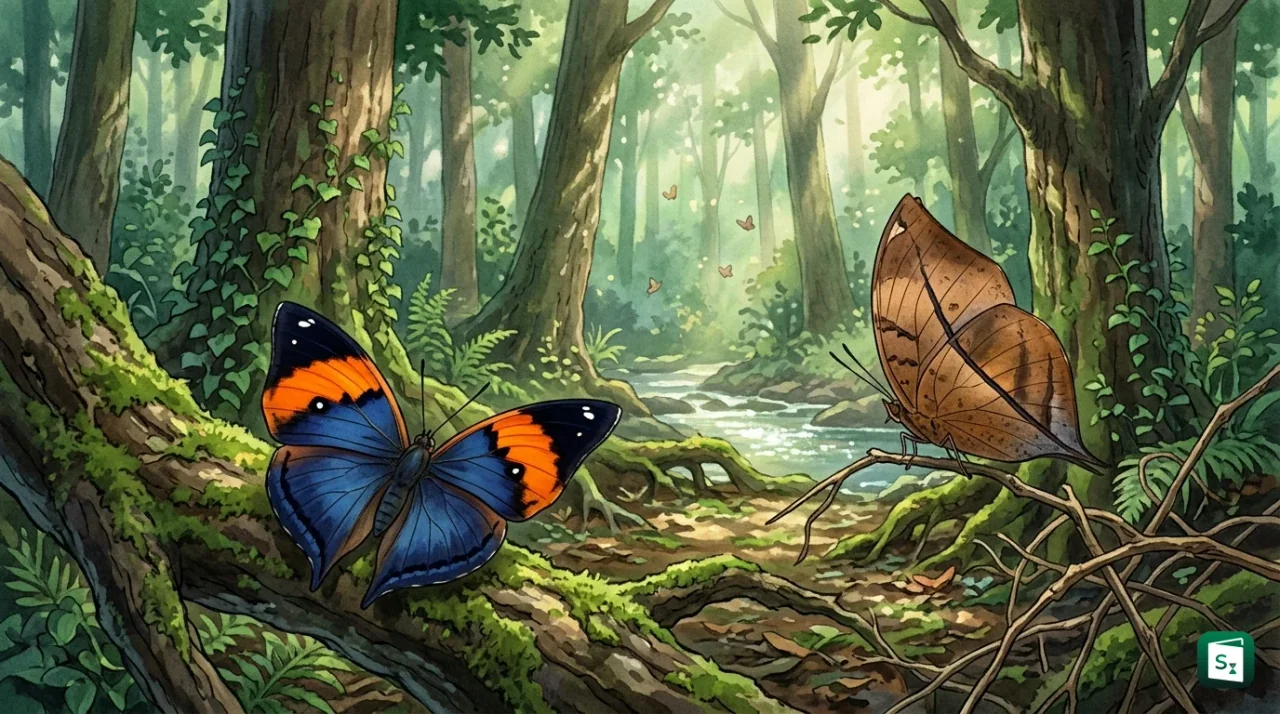
The Chhattisgarh government has approved the Orange Oakleaf (Kallima inachus) as the first state butterfly of Chhattisgarh. The State Wildlife Board cleared it after the species won 3,000 of 5,813 votes in an online poll. Chhattisgarh now joins the state butterfly list, eleven years after Maharashtra chose the Blue Mormon in 2015.
What Is the Orange Oakleaf Butterfly?
The Orange Oakleaf is a large forest butterfly with the scientific name Kallima inachus. It is also called the Indian Oakleaf or Dead Leaf butterfly. It belongs to the family Nymphalidae, the brush footed butterflies, and has a wingspan of 85 to 110 mm.
Its fame comes from leaf mimicry. When the wings are closed, the underside looks exactly like a dry dead leaf, complete with a dark midrib, side veins and brown patches that resemble fungal spots. Birds hunting in the forest floor often fail to spot it in this resting pose. The moment it opens its wings or takes flight, the upper side flashes deep velvety blue with a broad bright orange band and black borders.
The Orange Oakleaf is a powerful and fast flier with an erratic flight. When threatened, it dives into undergrowth and snaps its wings shut. It lives in damp, shaded evergreen and semi evergreen forests, near ravines, stream beds and dense undergrowth. In India it is found along the Himalayan foothills from Jammu and Kashmir to the northeast, and across central India including Madhya Pradesh, Chhattisgarh, Jharkhand, Odisha and Andhra Pradesh. Globally its range extends from Pakistan and Nepal to Myanmar, Thailand, southern China, Taiwan and southern Japan, usually between 300 and 2,100 metres in elevation.
Its caterpillars feed mainly on soft forest herbs of the acanthus family Acanthaceae, especially Strobilanthes, along with plants such as Pseuderanthemum, Hygrophila and Girardinia. Adults rarely visit flowers. They feed on fallen overripe fruit, tree sap, damp soil and dung. The final stage caterpillar is velvety dark with branched reddish spines and pale hairs.
How Chhattisgarh Selected Its First State Butterfly
The Department of Forest and Climate Change ran an online public vote through a Google Form from 31 July to 31 August 2026. Citizens, researchers and wildlife lovers could choose among three finalists shortlisted by an expert panel. The panel judged the contenders on ecological significance, presence across the state, ease of identification, conservation value, distinctiveness and public appeal.
The Orange Oakleaf won clearly with 3,000 of the 5,813 votes. The Common Banded Peacock (Papilio crino) received 1,606 votes and the Spot Swordtail (Graphium nomius) received 1,207 votes. The result was placed before the Chhattisgarh State Wildlife Board. The Board approved the proposal at its meeting held on 10 October 2026 at Nava Raipur, chaired by Forest Minister Kedar Kashyap. The proposal was then sent to the state government for formal notification.
The selection rests on strong field data. A six year biodiversity survey in Chhattisgarh recorded 201 butterfly species native to the state. Researchers added 19 species that had no earlier official record in Chhattisgarh, taking the documented total from 182 to 201. India is estimated to have about 1,500 butterfly species. The same Wildlife Board meeting also approved shifting 50 blackbuck from Barnawapara Wildlife Sanctuary to Gomarda Wildlife Sanctuary and setting up a wildlife transit treatment centre at Sanjay Park in Ambikapur.
Which States in India Have Declared State Butterflies?
Maharashtra was the first Indian state to declare a state butterfly. The Maharashtra State Wildlife Board chose the Blue Mormon (Papilio polymnestor) on 22 June 2015. The Blue Mormon is a large swallowtail with velvet black wings and bright blue spots. It is found mainly in Sri Lanka, the Western Ghats and the coastal belts of India. Maharashtra is home to about 225 butterfly species, which is roughly 15 percent of the national total.
Chhattisgarh will become the tenth state or union territory with an official butterfly once the notification is issued. Madhya Pradesh has also adopted the Orange Oakleaf as its state butterfly, so the same species will represent two central Indian states.
| State or Union Territory | State Butterfly | Scientific Name | Year Notified |
|---|---|---|---|
| Maharashtra | Blue Mormon | Papilio polymnestor | 2015 |
| Karnataka | Southern Birdwing or Sahyadri Birdwing | Troides minos | 2016 |
| Uttarakhand | Common Peacock | Papilio bianor | 2016 |
| Kerala | Malabar Banded Peacock | Papilio buddha | 2018 |
| Tamil Nadu | Tamil Yeoman | Cirrochroa thais | 2019 |
| Tripura | Common Birdwing | Troides helena | 2019 |
| Arunachal Pradesh | Kaiser-i-Hind | Teinopalpus imperialis | 2021 |
| Goa | Malabar Tree Nymph | Idea malabarica | 2021 |
| Sikkim | Blue Duke | Bassarona durga | 2022 |
| Jammu and Kashmir | Blue Pansy | Junonia orithya | 2023 |
| Madhya Pradesh | Orange Oakleaf | Kallima inachus | Notified earlier |
| Chhattisgarh | Orange Oakleaf | Kallima inachus | Approved 2026, notification awaited |
The Blue Mormon and the Orange Oakleaf show two different survival strategies. The Blue Mormon warns predators with its large size and bold black and blue pattern. The Orange Oakleaf hides from predators by looking like a dead leaf when at rest and startles them with a sudden flash of orange and blue in flight.
What Are Chhattisgarh’s Other State Symbols?
Chhattisgarh was formed on 1 November 2000 from Madhya Pradesh, with Raipur as its capital. The state has the third largest forest cover in India, with tropical moist deciduous and tropical dry deciduous forests dominated by Sal (Shorea robusta) and teak. This forest base supports tiger reserves such as Indravati and Udanti Sitanadi, along with sanctuaries such as Barnawapara and Gomarda.
The new state butterfly will sit alongside the existing state symbols:
| Symbol | Species |
|---|---|
| State animal | Wild water buffalo (Bubalus arnee), called Van Bhainsa, protected under Schedule I of the Wildlife Protection Act |
| State bird | Common hill myna (Gracula religiosa), with the Bastar hill myna as a well known local population |
| State tree | Sal (Shorea robusta) |
The wild water buffalo is now found in the wild mainly around the Indravati river landscape in Bastar. The hill myna is known for its glossy black plumage, yellow wattles and ability to mimic human speech. Conservation work for the bird continues in the Kanger Valley National Park, where local youth work as Maina Mitra volunteers to track nests. A state butterfly adds an insect symbol to this list and draws public attention to smaller wildlife that indicates forest health.
What Is the Status of India’s National Butterfly?
India has no notified national butterfly yet. The national animal is the tiger, the national bird is the Indian peafowl, the national tree is the banyan and the national flower is the lotus. A butterfly has not joined this list so far.
In 2020 the National Butterfly Campaign Consortium, a group of about 50 butterfly experts and enthusiasts, held a citizen poll from 11 September to 8 October to propose a national butterfly. The poll received 59,754 votes. The organisers set clear filters. The species had to be charismatic, easy to identify, ecologically and culturally significant, non pest in its caterpillar stage, neither too rare nor too commonplace, and not already a state butterfly at that time.
Seven finalists were placed before the public. These were the Indian Jezebel, Krishna Peacock, Orange Oakleaf, Five bar Swordtail, Indian Nawab, Northern Junglequeen and Yellow Gorgon. Three species secured the highest votes. The Krishna Peacock (Papilio krishna) finished first, followed by the Indian Jezebel (Delias eucharis) and the Orange Oakleaf. The list was submitted to the Ministry of Environment, Forest and Climate Change for a final decision. The choice remains pending with the central government.
The Orange Oakleaf featured in that national shortlist because it is widely distributed, instantly recognisable and famous for seasonal polyphenism, which means it shows different shades and sizes in wet and dry seasons. Its selection by Chhattisgarh now gives fresh visibility to a species once considered for national status.
Key Takeaways
- The Orange Oakleaf (Kallima inachus) was approved in 2026 as the first state butterfly of Chhattisgarh.
- The species won 3,000 of 5,813 votes in an online poll held from 31 July to 31 August 2026.
- The Chhattisgarh State Wildlife Board cleared the proposal on 10 October 2026 at Nava Raipur under Kedar Kashyap, with formal notification still awaited.
- Maharashtra was the first state to declare a state butterfly, choosing the Blue Mormon in 2015.
- India has no notified national butterfly yet, though the Krishna Peacock topped a 2020 citizen poll that also shortlisted the Orange Oakleaf.