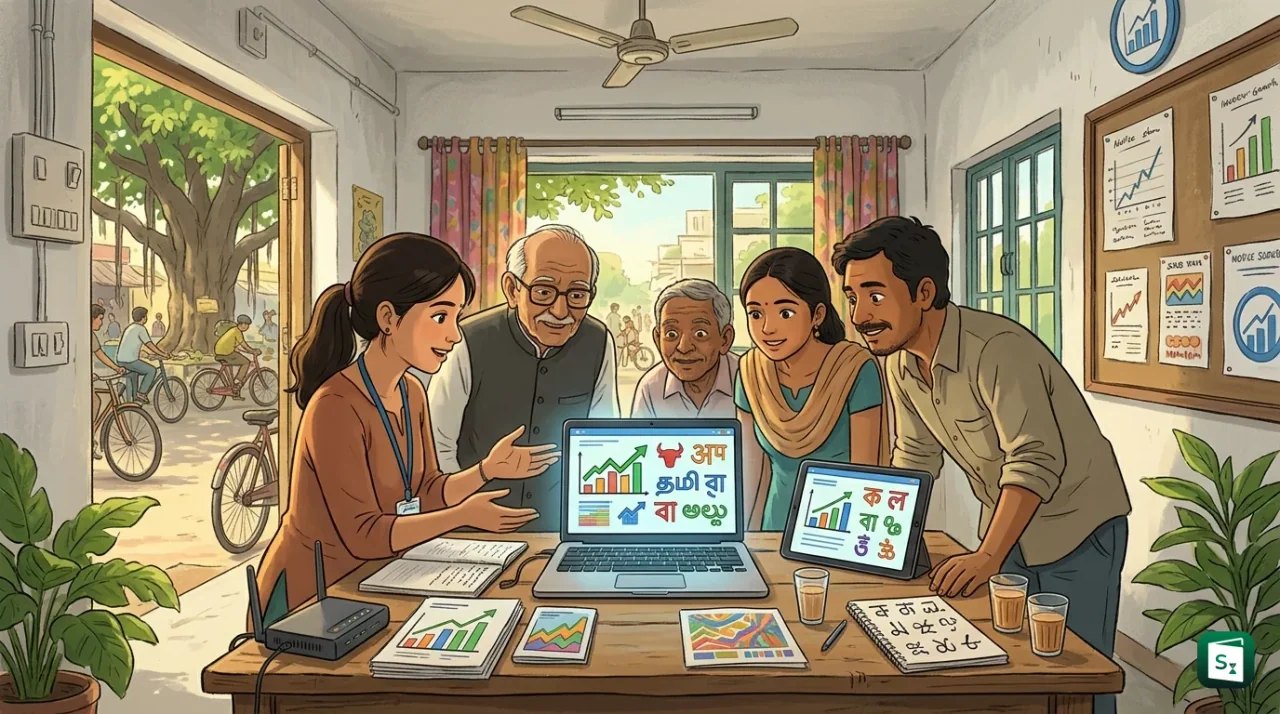
The Securities and Exchange Board of India (SEBI) signed a Memorandum of Understanding (MoU) with the Digital India BHASHINI Division on 3 November 2026 in Mumbai. The pact will use multilingual artificial intelligence to deliver investor education, financial information and SEBI services in regional Indian languages. It aims to help nearly 13 crore demat account holders and 8 crore mutual fund investors who understand money matters best in their mother tongue.
What Did SEBI and BHASHINI Agree On?
The MoU was signed by Amitabh Nag, Chief Executive Officer of the Digital India BHASHINI Division, and Sandip Pradhan, Whole Time Member of SEBI. Senior officers from both organisations were present. The MoU came into force on the same day, 3 November 2026.
Under the pact, SEBI will use BHASHINI language translation tools to offer its website, mobile services, forms and investor awareness material in regional languages. BHASHINI will also add securities market words and phrases to its language models, so translations of financial terms become more accurate. The two sides described this as the start of deeper cooperation.
The signing was followed by a joint workshop in Mumbai. Officials from SEBI and BHASHINI discussed where language gaps hurt investors most, especially in rural areas and Tier 2 and Tier 3 cities. The focus was on making awareness resources and day to day services usable for people from different language backgrounds.
What Is BHASHINI?
BHASHINI stands for Bhasha Interface for India. It is an artificial intelligence powered language translation platform built under the National Language Translation Mission. Prime Minister Narendra Modi launched the mission on 4 July 2022 at Digital India Week in Gandhinagar, Gujarat.
The Digital India BHASHINI Division (DIBD) runs the platform. DIBD works as an independent division under the Digital India Corporation, which is a Section 8 not for profit company set up by the Ministry of Electronics and Information Technology (MeitY). Its chief executive is Amitabh Nag. Its goal is to give every Indian easy access to the internet and digital services in their own language, including voice based access.
BHASHINI already works at large scale. It powers more than 800 government websites, has completed over 9 billion language inferences and handles more than 24 million inferences every day. It supports 36 Indian languages for text, 23 Indian languages for voice and 35 international languages, and hosts more than 300 AI language models built with IITs, IIITs, startups and research groups.
Four Language Tools SEBI Will Use
| Tool | Simple Meaning | How SEBI Can Use It |
|---|---|---|
| Automatic Speech Recognition (ASR) | Converts spoken words into written text | Voice queries and speech to speech help in local languages |
| Text-to-Speech (TTS) | Converts written text into spoken audio | Audio versions of guides and alerts for low literacy users |
| Machine Translation | Converts text from one language to another | Website, app, circulars and videos in regional languages |
| Optical Character Recognition (OCR) | Reads text from scanned papers and images | Faster reading of identity papers and forms for digital services |
BHASHINI offers these tools through open APIs listed on API Setu, so government departments and developers can add them to their own apps without building language systems from scratch.
What Is SEBI and Why Investor Education Matters Now?
SEBI stands for the Securities and Exchange Board of India. It is the regulator for the securities and commodity markets in India and works under the Ministry of Finance. Its job is to protect investors, help the market grow and regulate stock exchanges, brokers, mutual funds, listed companies and foreign investors.
SEBI was first set up as a non statutory body on 12 April 1988 through a government resolution. It became a statutory body on 30 January 1992 when the SEBI Act, 1992 came into force. It replaced the earlier Controller of Capital Issues, which worked under the Capital Issues (Control) Act, 1947. SEBI is headquartered at Bandra Kurla Complex in Mumbai, with regional offices in New Delhi, Kolkata, Chennai and Ahmedabad.
The SEBI Board is led by Chairperson Tuhin Kanta Pandey, who took charge on 1 March 2025. The Board includes Whole Time Members, nominees from the Finance Ministry and Corporate Affairs Ministry, and a Deputy Governor of the Reserve Bank of India. SEBI acts as a quasi legislative, executive and judicial body. It frames rules, inspects and investigates, and passes orders. Appeals against its orders go first to the Securities Appellate Tribunal and then to the Supreme Court.
Investor numbers explain the urgency. India now has close to 13 crore demat accounts and 8 crore mutual fund investors. Yet a SEBI study shared at the launch of Project Jagrook found that 63 percent of households knew at least one securities market product but only 9.5 percent actually invested. Participation was 15 percent in urban India and only 6 percent in rural India, and only 36 percent of investors had moderate or high market knowledge.
To close this gap, SEBI launched Project Jagrook on 5 October 2026 at Panjab University in Chandigarh during World Investor Week observed from 5 to 11 October. Its theme, Samajh Se Investing Simple, teaches seven simple lessons from budgeting and goal setting to mutual funds, direct shares, tax and fraud protection. The campaign runs in English, Hindi and 11 regional languages till March 2027 with stock exchanges, depositories, the Association of Mutual Funds in India (AMFI) and the National Institute of Securities Markets (NISM). SEBI has also started MUST for college mentoring and an official WhatsApp channel to spread verified guidance.
How the Pact Will Change the Investor Journey
The workshop listed practical ways BHASHINI tools can support a first time investor. SEBI website pages and mobile services can appear in the language a user selects. Investor videos, circulars and key documents can be translated quickly. Real time speech to speech translation can help people speaking different languages talk to each other without an interpreter.
Access to forms and applications can also become simpler. Multilingual forms, voice based help on phone calls and chat assistants can guide users who find English forms hard. Document reading tools can pull details from identity papers and reduce errors during onboarding. These steps matter most for new investors in small towns and villages.
Language quality was a central theme. Direct word for word translation often fails for terms like bull market, bear market, profit, loss or risk. The workshop stressed the use of familiar local phrases and daily life examples to explain market ups and downs. SEBI will share market terminology so BHASHINI models learn correct financial meanings in each language.
Citizens can help improve the system through BhashaDaan, the crowdsourcing arm of BHASHINI. People can donate voice samples through Bolo India, type what they hear through Suno India, submit translations through Likho India and label images through Dekho India. Validated entries build open datasets that train better models. A guided digitisation workbench will also capture financial wisdom stored in books, local stories and traditional sayings, so regional expressions enter digital resources.
Key Takeaways
- SEBI and the Digital India BHASHINI Division signed an MoU on 3 November 2026 in Mumbai to offer investor services in regional languages.
- BHASHINI means Bhasha Interface for India and was launched on 4 July 2022 under the Ministry of Electronics and Information Technology.
- SEBI became a statutory body on 30 January 1992 under the SEBI Act, 1992 and is headquartered in Mumbai.
- SEBI Chairperson Tuhin Kanta Pandey took charge on 1 March 2025 and launched Project Jagrook on 5 October 2026.
- BHASHINI supports 36 languages for text and 23 languages for voice and powers more than 800 government websites.