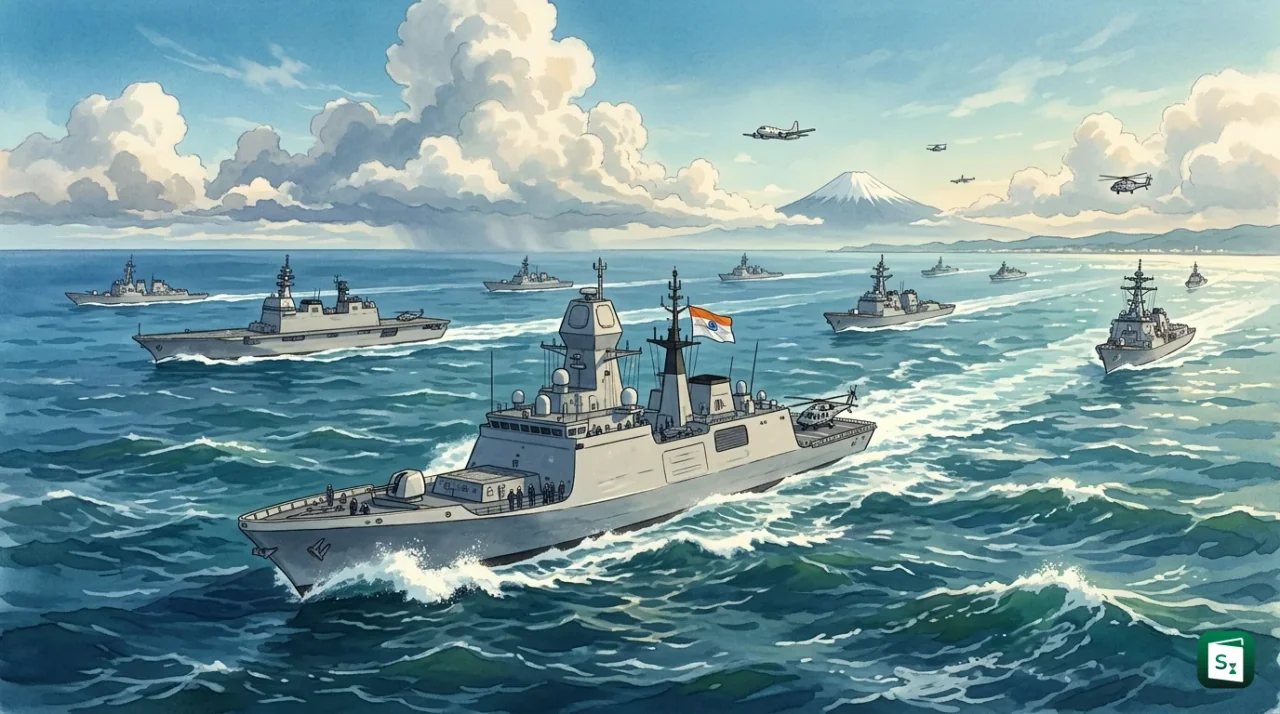
The 30th edition of Exercise Malabar 2026 began on 5 November 2026 in waters south of the Kanto region of Japan and will run till 12 November. Japan is hosting this year’s edition, with India, Japan, the United States and Australia fielding warships, submarines and patrol aircraft. India is represented by the stealth frigate INS Sahyadri, joining the drill days after its port call at Yokosuka Naval Base.
What Is Exercise Malabar?
Exercise Malabar is an annual multilateral maritime field training exercise led by the Indian Navy and involving the United States Navy, the Japan Maritime Self-Defense Force (JMSDF) and the Royal Australian Navy. The exercise focuses on high end warfighting skills such as anti-submarine warfare, anti-surface warfare, air defence, maritime interdiction and aviation operations. Its stated aim is to build interoperability, which means the ability of different navies to plan, communicate and operate together as one team at sea.
Malabar Exercise Between Which Countries?
Exercise Malabar 2026 is conducted between the four Quad countries, India, Japan, the United States and Australia. The Indian Navy, the JMSDF, the United States Navy and the Royal Australian Navy, along with the Royal Australian Air Force, take part in this edition. The grouping reflects the present permanent structure of the exercise, with India and the United States as the original partners and Japan and Australia as later entrants.
The overlap between Malabar and the Quad often causes confusion. The Quadrilateral Security Dialogue (Quad) is a diplomatic grouping of the same four countries for cooperation across areas such as maritime security, technology and disaster relief. Malabar is the naval exercise where the four navies train together. In other words, Quad is the forum and Malabar is one of its most visible operational tools at sea.
Japan Hosts the 30th Edition: Dates, Venue and Participating Ships
Exercise Malabar 2026 is the 30th edition of the exercise and the sixth edition in which all four countries take part together. Japan is the host for 2026. The exercise runs from 5 to 12 November 2026 in waters south of the Kanto region on the main island of Honshu. The opening ceremony was held on 5 November in the Funakoshi area near Yokosuka, with senior officers from all four navies present on board the Japanese ship JS Ise.
The planning and hosting role rotates among the participants each year, along with the exercise location. The 29th edition in 2025 was hosted by the United States in and around Guam from 10 to 18 November. The 2026 move to Japanese waters shows the combined ability of the four navies to deploy and operate across both the Western Pacific and the Indian Ocean.
| Country and Service | Main Assets in Malabar 2026 |
|---|---|
| Japan (JMSDF) | Helicopter destroyer JS Ise (DDH-182), frigate JS Mogami (FFM-1), one submarine, one P-1 maritime patrol aircraft |
| India (Indian Navy) | Stealth frigate INS Sahyadri (F49) of the Eastern Fleet |
| United States (US Navy) | Two amphibious transport docks USS Anchorage (LPD-23) and USS John P. Murtha (LPD-26), one P-8A Poseidon patrol aircraft |
| Australia (RAN and RAAF) | Frigate HMAS Stuart (FFH-153), one P-8A Poseidon patrol aircraft |
Harbour and Sea Phases: Drills Planned Off Kanto
The exercise has two clear parts. The harbour phase at Yokosuka includes professional interactions, subject expert exchanges and coordinated operational planning. The sea phase then tests that planning in real conditions.
The sea phase focuses on anti-submarine warfare, anti-surface warfare and joint manoeuvres with information sharing across surface, sub-surface, air and information domains. The United States 7th Fleet describes the goal as building real world skill in detecting, locating, tracking and engaging targets at sea, in the air and in cyberspace. Training of this type helps ships from different countries use common communication procedures, common tactical pictures and common safety rules during a crisis.
INS Sahyadri: India’s Stealth Frigate in Japan
INS Sahyadri (F49) is an indigenously built guided missile stealth frigate of the Shivalik class. The ship belongs to the Eastern Fleet, which is headquartered at Visakhapatnam under the Eastern Naval Command. Stealth in this context means shaped hull and superstructure features that reduce radar, noise, heat and magnetic signatures, making the ship harder to detect.
The ship was built by Mazagon Dock Limited in Mumbai and was commissioned on 21 July 2012. It is the third and last ship of Project 17, after INS Shivalik (F47) and INS Satpura (F48). The ship displaces about 6,200 tonnes at full load, is 142.5 metres long and can reach speeds of around 30 to 32 knots. It carries a crew of 257, including 35 officers, and can embark two helicopters such as the HAL Dhruv or Sea King.
Sahyadri reached Yokosuka Naval Base on 4 November 2026 after taking part in the India-Republic of Korea Navy bilateral exercise at Busan. The ship received a formal welcome from the JMSDF in the presence of Vice Admiral Yagi Koji, Commandant of Yokosuka District, and R. Madhu Sudan, Deputy Chief of the Indian Mission in Japan. The same ship also took part in Malabar 2025 off Guam, so its crews carry recent experience of Quad drills into the 2026 edition.
From 1992 Bilateral Drill to Quad Naval Exercise
Malabar began in 1992 as a bilateral naval exercise between India and the United States along the Malabar Coast off Kochi. The first drills were basic, with passing exercises and simple manoeuvres by a small number of ships. The exercise was suspended after the nuclear tests by India in 1998 and was restored as an annual feature from 2002.
A major change came in 2007, when Japan, Australia and Singapore joined one edition in the Bay of Bengal. Japan became a permanent partner in 2015, following the joint statement by India and the United States to upgrade the exercise and the rise of the India-Japan Special Strategic and Global Partnership. Australia had earlier taken part in 2007, stayed away for several years and rejoined permanently in 2020. Since 2020, Australia has taken part every year, which is why Malabar is now described as the Quad naval exercise.
| Year | Milestone |
|---|---|
| 1992 | First India-United States edition off the Malabar Coast |
| 1998 to 2001 | Pause after nuclear tests, exercise resumes in 2002 as annual event |
| 2007 | Japan, Australia and Singapore join one expanded edition |
| 2015 | Japan becomes permanent member |
| 2020 | Australia rejoins, all four Quad navies train together |
| 2025 | 29th edition hosted by the United States at Guam |
| 2026 | 30th edition hosted by Japan off Kanto |
Why Malabar 2026 Matters for the Indo-Pacific
The central objective of Malabar is interoperability for a free, open and rules based Indo-Pacific. Anti-submarine drills improve the ability to find quiet submarines. Anti-surface and air defence drills improve the ability to protect ships and sea lanes. Joint planning in the harbour phase ensures that crews speak the same operational language before they sail together.
For India, Malabar 2026 fits two stated frameworks. The first is the vision of MAHASAGAR, short for Mutual and Holistic Advancement for Security and Growth Across Regions, announced by Prime Minister Narendra Modi in Mauritius in March 2025 as the successor to the 2015 SAGAR vision of Security and Growth for All in the Region. The second is the India-Japan defence partnership. The participation of senior Indian officers, including Deputy Chief of Naval Staff Vice Admiral A. N. Pramod, and the deck reception on board INS Sahyadri to mark 75 years of India-Japan diplomatic ties underline that link.
The exercise also carries strategic weight. The four navies routinely operate across the Indian Ocean and the Western Pacific, through which a large share of Indian trade passes via the Malacca Strait and the South China Sea. Regular drills help the four countries respond faster to contingencies, from submarine threats to humanitarian relief, and signal a shared commitment to secure sea lanes and international maritime rules.
Key Takeaways
- The 30th edition of Exercise Malabar is hosted by Japan from 5 to 12 November 2026 south of the Kanto region.
- Malabar 2026 brings together the navies of India, Japan, the United States and Australia, the four Quad countries.
- India is represented by the stealth frigate INS Sahyadri (F49), which reached Yokosuka on 4 November 2026.
- Exercise Malabar began in 1992 as an India-United States bilateral drill, with Japan joining permanently in 2015 and Australia rejoining in 2020.
- INS Sahyadri is a Shivalik class frigate built by Mazagon Dock Limited and commissioned on 21 July 2012.