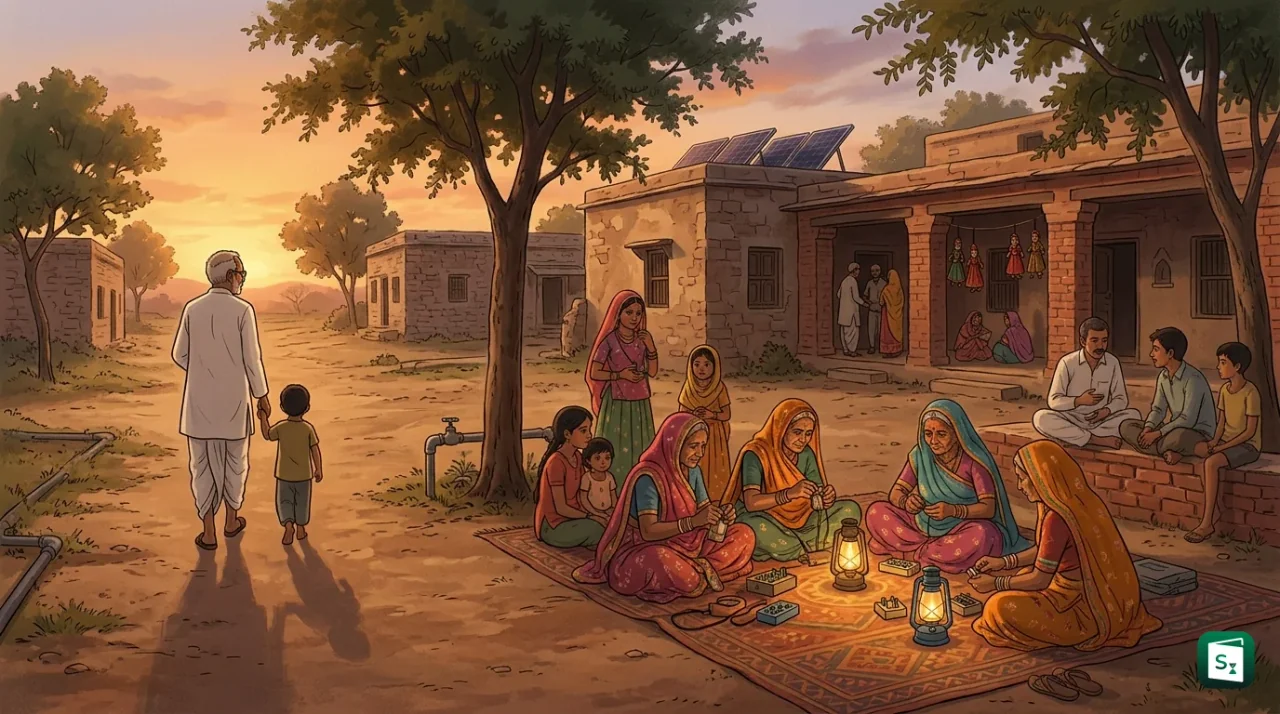
Sanjit Bunker Roy, founder of Barefoot College in Tilonia, Rajasthan, passed away at his home in Tilonia on the morning of 10 November 2026. He was 81 and died in the presence of his wife, social activist Aruna Roy. His five decades of work trained villagers with little formal schooling to solve their own problems in solar power, water and education.
Who Was Sanjit Bunker Roy?
Sanjit Bunker Roy was an Indian social activist and educator who founded Barefoot College in Rajasthan and spent more than five decades in rural development. He was born as Sanjit Roy on 30 June 1945 in Burnpur, now in West Bengal, and was widely called Bunker. He died on 10 November 2026 at the age of 81.
Roy grew up in a privileged upper middle class Bengali family. He studied at The Doon School in Dehradun from 1956 to 1962 and at St. Stephen’s College in Delhi from 1962 to 1967, where he earned a postgraduate degree in English literature. He was a talented sportsperson and became the national squash champion in 1965. He also represented India in three world squash championships.
A visit to famine hit areas of Bihar in 1966 changed his direction. Roy had gone to Palamu, now in Jharkhand, to help during the Bihar famine of 1966 to 1967. He later said the experience showed him that his degrees alone could not help him adjust to village life. Inspired by Jayaprakash Narayan and the ideas of Mahatma Gandhi on self reliance and dignity, he chose grassroots work over a career in the city.
Roy spent time travelling across India to study voluntary groups. He worked as an unskilled labourer digging open wells to test his own commitment. In 1970, he married Aruna Roy, his classmate at Delhi University who later left the Indian Administrative Service to join grassroots activism.
What Is Barefoot College in Tilonia?
Barefoot College is a grassroots rural development institution located in Tilonia in Ajmer district, Rajasthan. Its formal name is the Social Work and Research Centre (SWRC). Bunker Roy set it up in 1972 after a survey of water supply in drought prone areas of Rajasthan.
Roy began with a simple task. He worked with local farmer Meghraj to recharge open wells in a water stressed region. That effort grew into a larger experiment. The aim was to stop migration to city slums by giving villagers jobs with dignity, safe drinking water and schools near their homes.
The college works on the Gandhian belief that knowledge found in villages should be used for village development. Its method is often called a bottom up model. There is no urban solution to a rural problem, Roy often said. Villagers identify the problem and learn the skill to fix it.
The rules of Barefoot College turned normal schooling upside down:
- No entrance test and no degrees are given.
- People with formal university degrees were not preferred as teachers.
- Skill and community trust mattered more than certificates. When Solar Mamas electrify a village, the community certifies their work.
- Children in its night schools elect their own prime minister and cabinet to learn democratic practice.
The campus at Tilonia was built in 1986 by local barefoot architects who could not read or write. It later won the Aga Khan Award for Architecture.
Over 50 years, the work spread from water to solar energy, education, health, livelihoods and crafts. Its night schools helped more than 90,000 working children who could not attend day classes. Its health programme treated more than three lakh patients. Its water work created rainwater tanks, ponds and small dams that harvested billions of litres of water and supplied drinking water to more than 1,650 schools across 20 states. TIME magazine noted in 2010 that the college had trained more than three million people as solar engineers, teachers, midwives, weavers, architects and health workers.
How Solar Mamas Lit Up Villages Across the World
The Solar Mamas programme is the best known work of Barefoot College. It trains rural women, often grandmothers with little or no formal schooling, to become solar engineers. These engineers assemble, install, repair and maintain solar home lighting systems in villages without electricity.
Training lasts about six months in Tilonia. The method does not depend on reading or writing. Trainers use colour codes, sign language and repeated practical work to teach how to join wires, fix circuits and maintain panels. After training, the women return to their villages and electrify homes, schools and community centres. They also train others.
Roy believed women were the best keepers of community systems. He said investment in women pays back, since trained mothers stayed in the village and served for years. One Afghan trainee, on returning home, told men who objected to her sitting with them that she was not just a woman but an engineer.
The programme started in India and later expanded with support from the Ministry of External Affairs. Women from Africa, Asia, Latin America and the Pacific came to Tilonia for training. Centres linked to the model later came up in other regions, including Zanzibar.
The scale is large. By its 50th year in 2022, the college reported training 1,708 women and electrifying more than 75,000 households, saving about 45 million litres of kerosene. Later accounts place the wider network at more than 3,500 Solar Mamas, 175,000 solar systems and work across 93 countries, touching more than 2.4 million lives. The programme drew global attention, with leaders such as former United States President Bill Clinton and French President Emmanuel Macron meeting the Solar Mamas.
Awards and Global Recognition Won by Bunker Roy
Bunker Roy received national and global honours for rural development and environment work. The citation for his Padma Shri in 1986 called his work the Tilonia Movement. It praised the effort to demystify technology and make it simple, low cost and accessible.
| Honour | Year | Given For |
|---|---|---|
| Jamnalal Bajaj Award | 1985 | Application of science and technology for rural development |
| Padma Shri | 1986 | Social work through the Tilonia Movement, the fourth highest civilian award of India |
| Tyler Prize for Environmental Achievement | 2004 | Work on environment and sustainable development |
| Skoll Award for Social Entrepreneurship | 2005 | Barefoot College model of social change |
| TIME 100 Most Influential People | 2010 | Grassroots action that redefined the fight against poverty |
| Blue Planet Prize | 2011 | Contribution to solving global environmental problems |
| Clinton Global Citizen Award | 2013 | Leadership in civil society |
| Honorary Doctor of Laws, Princeton University | 2017 | Service to poor communities through innovation |
Roy was also named among 50 environmentalists who could save the planet by a leading British daily in 2008. His TED Talk, titled Learning from a Barefoot Movement, carried his message to a global audience. The Barefoot College campus won the Aga Khan Award for Architecture, and the institution received the Indira Gandhi Paryavaran Puraskar in 1998.
Family, Legal Battle and Role in Public Life
Bunker Roy is survived by his wife Aruna Roy. She left the Indian Administrative Service in the mid 1970s to join work in Tilonia. She later became a central figure in the movement for transparency in public records. She was a key voice in the grassroots campaign that led to the Right to Information Act, 2005. She also worked with the Mazdoor Kisan Shakti Sangathan along with Nikhil Dey.
Roy also shaped law through the courts. In 1983, he filed Sanjit Roy versus State of Rajasthan. The issue was an emergency famine relief order in Rajasthan that allowed women workers to be paid less than men. The Supreme Court of India struck down the unequal pay rule. The bench led by Justice P. N. Bhagwati held that equal pay for equal work is part of the right to equality.
Roy served in government as well. Prime Minister Rajiv Gandhi appointed him to the Planning Commission. Roy wrote the voluntary sector statement for the Seventh Five Year Plan in 1984. For the first time, ₹150 crore was set aside for civil society groups. He also proposed a code of conduct and a national council for non governmental organisations. Many voluntary groups opposed the idea. They feared it could be used to favour some groups and control others.
Roy died peacefully at 6.15 a.m. on 10 November 2026 at his home in Tilonia, with family and close colleagues present. His funeral was held the same evening at 4 p.m. in Tilonia, the village he had made his home for more than 50 years.
Key Takeaways
- Sanjit Bunker Roy, founder of Barefoot College, passed away on 10 November 2026 at the age of 81 in Tilonia, Rajasthan.
- Roy founded the Social Work and Research Centre in Tilonia, Ajmer in 1972, which became known as Barefoot College.
- The Solar Mamas programme trained rural women with little schooling as solar engineers to electrify homes in India and more than 90 countries.
- Roy received the Padma Shri in 1986 for the Tilonia Movement on rural development.
- Roy was named among TIME 100 Most Influential People in 2010 and won the 1983 case Sanjit Roy versus State of Rajasthan on equal pay for women relief workers.