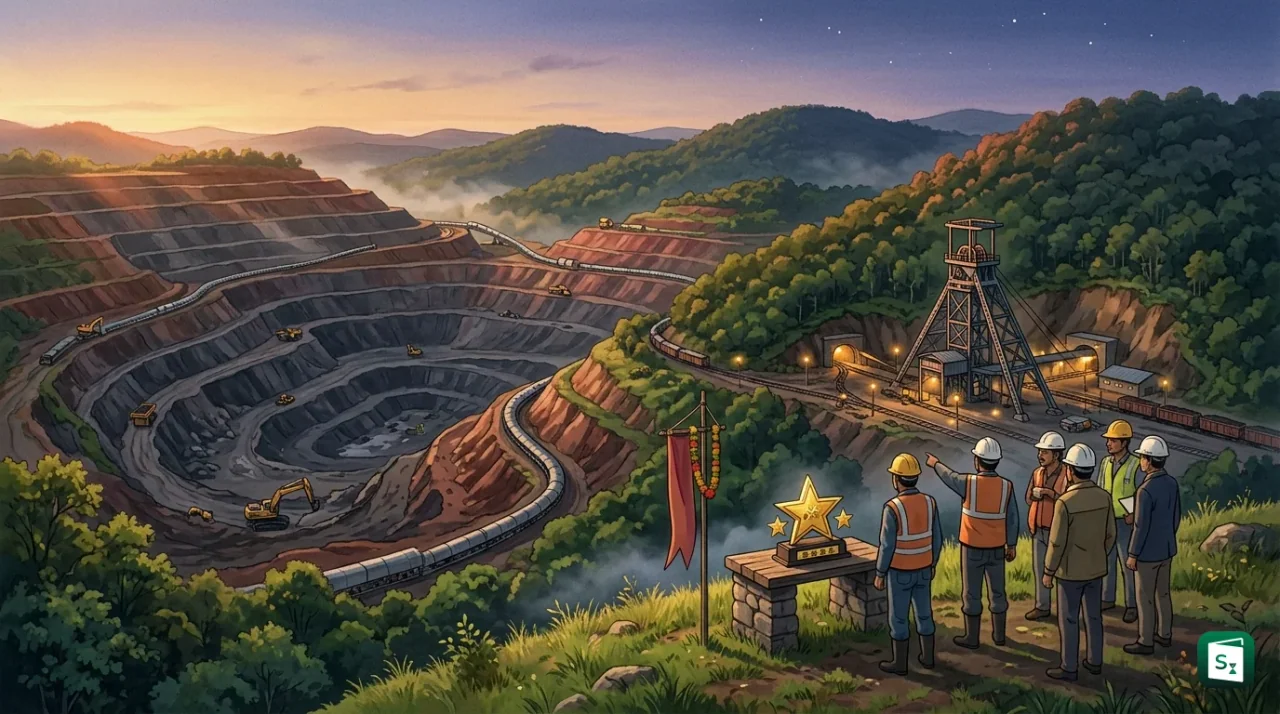
The Ministry of Coal hosted its Annual Star Rating Awards Ceremony for FY25 in Raipur, Chhattisgarh, on 2 November 2026. Fifty coal and lignite mines received the Five Star rating for their performance in 2024-25. NTPC and Northern Coalfields Limited (NCL) shared the first prize for opencast mines, while Singareni Collieries Company Limited (SCCL) won the first prize for underground mines.
Annual Star Rating Awards for FY25 Held in Raipur
The Ministry of Coal organised the ceremony at Mayfair Lake Resort in Raipur on 2 November 2026 to honour performance during 2024-25. Union Minister of State for Coal and Mines Satish Chandra Dubey attended as chief guest and presented the awards. Senior officials present included Additional Secretary Manoj Kumar Jha, Coal India Chairman B. Sai Ram and Coal Controller Satish Kumar, along with representatives of Coal India Limited (CIL), NLC India Limited and SCCL.
A total of 50 mines received Five Star ratings for FY25. Among them, 10 mines secured the first, second and third positions in their categories with scores above 93 percent. Western Coalfields Limited (WCL) received special praise for recording the highest number of Five Star mines among Coal India subsidiaries. Northern Coalfields Limited (NCL) and Mahanadi Coalfields Limited (MCL) were also praised for steady high scores and strong production.
In his address, Dubey described the star rating programme as a tool to build healthy competition among mines. He asked companies to use it for self review, learning and steady improvement. He also called for wider participation in the rating process for FY26. The Coal Controller said the ceremony recognises work in safety, environmental care, scientific mining, productivity and community welfare.
How Coal and Lignite Mines Are Star Rated
The Star Rating Policy for coal and lignite mines started in 2018-19. The Ministry of Coal runs it to push mines toward safe, green and efficient working. A dedicated portal, starrating.coal.gov.in, was launched in February 2020. Every working mine files a self assessment on the portal. The Coal Controller Organisation (CCO), the Ministry agency that checks coal quality and records, then verifies the claim.
Mines are judged in three groups: opencast, underground and mixed. Opencast mines are checked on 50 parameters and underground mines on 45 parameters. These parameters sit under seven broad modules.
- Mining operations
- Environmental parameters
- Adoption of technology and best mining practices
- Economic performance
- Rehabilitation and resettlement
- Worker related compliance
- Safety and security
Scores are given as a percentage of total marks. The rating bands are fixed.
| Score | Star rating |
|---|---|
| 91 to 100 percent | Five Star |
| 81 to 90 percent | Four Star |
| 71 to 80 percent | Three Star |
| 61 to 70 percent | Two Star |
| 41 to 60 percent | One Star |
| 0 to 40 percent | No Star |
Verification has three stages. First, the mine uploads marks and proof documents. Next, the top 10 percent of scorers in each category face physical inspection by a four member validation committee set up by CCO headquarters. The remaining 90 percent face online document checks by CCO officers from other regions. Last, the Coal Controller holds a final review at CCO headquarters, and the Ministry declares the result.
Participation has risen sharply. Only 357 mines joined in 2018-19, while 382 mines joined in 2024-25. Five Star mines rose from 8 in 2018-19 to 50 in 2024-25. For 2023-24, 42 mines had earned Five Star. The process for 2025-26 began on 14 July 2026, with self assessments due by 15 August 2026.
Top Winners in Opencast and Underground Categories
NCL and NTPC shared the first prize in the opencast group. SCCL took the first prize in the underground group. The final marks, verified by CCO, show how close the contest was.
| Category | Top mine | Company | Score |
|---|---|---|---|
| Opencast | Krishnashila | NCL | 98 percent |
| Opencast | Pakri Barwadih Coal Mining Project | NTPC Limited | 98 percent |
| Opencast | Barsingsar Lignite Mine | NLC India Limited | 97 percent |
| Underground | Ravindrakhani New Tech Mine | SCCL | 99 percent |
| Underground | Bangwar Underground Mine | South Eastern Coalfields Limited (SECL) | 94 percent |
| Underground | Ravindrakhani No. 6 Incline | SCCL | 94 percent |
NCL is a Coal India subsidiary headquartered at Singrauli in Madhya Pradesh. It was formed on 28 November 1985. Four NCL mines earned Five Star status in FY25. They are Krishnashila, Bina, Khadia and Jhingurda. Krishnashila ranked first among opencast mines in the country.
NTPC Limited, headquartered in New Delhi, is India’s largest power producer. It was incorporated in 1975. Its Pakri Barwadih mine in Jharkhand and Dulanga mine in Odisha both earned Five Star ratings. Pakri Barwadih scored 98 percent and Dulanga scored 95 percent.
SCCL is a joint venture of the Telangana government, which holds 51 percent, and the central government, which holds 49 percent. It is headquartered at Kothagudem in Telangana. Five SCCL mines earned Five Star ratings. They include Ravindrakhani New Tech and Ravindrakhani No. 6 Incline in the Srirampur area, JVR OC II in Sattupalli, Khairagura opencast in Bellampalli and Ramagundam OC I in Ramagundam. SCCL Chairman Buddhaprakash Jyoti received the awards.
SECL, headquartered at Bilaspur in Chhattisgarh, won five Five Star awards. Four were underground mines at Bangwar, Khairaha, Baherabandh and Vijay West, and one was the Jagannathpur opencast mine. Telangana Power Generation Corporation’s Tadicherla I opencast mine also won a Five Star award.
What Is Lignite Coal and Where Is It Found in India?
Lignite coal is a soft, brown, low grade coal with high moisture and low heat value. It is also called brown coal and forms at an early stage of coal formation, just above peat. It is used mainly to generate power in pithead stations built next to mines, since it is costly to carry far.
Lignite is geologically young. It holds 30 to 55 percent moisture and contains 45 to 60 percent volatile matter on dry basis. Fixed carbon is only about 20 to 35 percent. So it gives less heat than bituminous coal, which is hard black coal used widely in industry. It also catches fire easily when exposed to air. For this reason, power plants are placed at the pithead, which means right at the mine mouth, and electricity is sent out instead of fuel.
Lignite is used mainly for power generation. NLC India burns Neyveli lignite in its thermal stations in Tamil Nadu and Rajasthan to supply southern states and Rajasthan. Small quantities support other uses such as briquetting and carbonisation.
India’s total lignite resource stands at about 46,018 million tonnes as on 1 April 2021, as estimated by the Geological Survey of India (GSI). Tamil Nadu holds the largest share.
| State | Share of total resource | Main fields |
|---|---|---|
| Tamil Nadu | About 79 percent, 36,489 million tonnes | Neyveli, Mannargudi, Ramanathapuram in Cuddalore region |
| Rajasthan | About 14 percent, 6,349 million tonnes | Barmer, Bikaner, Barsingsar, Kapurdi, Jalipa |
| Gujarat | About 6 percent, 2,722 million tonnes | Kutch, Bhavnagar, Vastan, Khadsaliya |
| Puducherry | 416 million tonnes | Puducherry field |
| Others | Small quantities | Jammu and Kashmir, Kerala, West Bengal |
Tamil Nadu is also the largest producer, with about 50 percent of output, followed by Gujarat and Rajasthan. Neyveli in Cuddalore district is India’s largest lignite deposit. The Neyveli Lignite Mine is the largest opencast lignite mine in the country. NLC India Limited, earlier called Neyveli Lignite Corporation, mines it. The company was registered on 14 November 1956 and earned Navratna status in 2011. Its registered office is in Chennai and its corporate office is at Neyveli. It operates three mines at Neyveli and one at Barsingsar in Bikaner, with a combined capacity of 30.60 million tonnes per annum, and runs lignite power stations with total capacity of 3,640 MW.
What Is Opencast Mining and How Is It Different from Underground Mining?
Opencast mining is a surface method where layers of soil and rock above the coal, called overburden, are removed to expose the seam in an open pit. Underground mining removes coal through shafts and tunnels while leaving the surface largely intact. The choice depends on depth, shape of the seam and cost.
An opencast coal mine works like a large terraced pit. Heavy machines such as draglines, shovels, bucket wheel excavators and dumpers strip the overburden and haul coal out. Recovery is high, about 80 to 90 percent of the seam. Output per worker is also high. Underground mines use methods such as room and pillar, where pillars of coal are left to hold the roof, and longwall, where a moving cutter slices a long coal face held by hydraulic supports.
| Feature | Opencast mining | Underground mining |
|---|---|---|
| Location of coal | Shallow seams near surface | Deep seams |
| Method | Open pit after removing overburden | Shafts, slopes and tunnels |
| Share in India output | More than 94 percent | About 3.44 percent in 2023-24 |
| Cost and output | Lower cost, higher output | Higher cost, lower output |
| Land and environment | Large surface footprint, dust and land change | Small footprint, less dust but risks of roof fall, fire and gas |
India depends heavily on opencast output because it is cheaper, easier to mechanise and gives faster production. Underground output has fallen over time. Its share in total coal output dropped from 5.54 percent in 2019-20 to 3.44 percent in 2023-24. Yet about 70 percent of extractable reserves lie deep and will need underground methods in future. Underground mining also disturbs less forest and farm land and creates less dust and noise on the surface.
To revive deep mining, the government amended the auction rules in April 2025. Mines reserved for underground working now pay a floor revenue share of only 2 percent and get a full waiver of the upfront amount. Such mines cannot later convert to opencast or mixed working. This is why the star rating scheme judges opencast and underground mines in separate groups.
Key Takeaways
- The Annual Star Rating Awards for FY25 were presented in Raipur on 2 November 2026 by Minister of State Satish Chandra Dubey.
- Fifty mines earned Five Star ratings for 2024-25, and 10 mines took first, second and third places with scores above 93 percent.
- NCL and NTPC shared the first prize in the opencast category, while SCCL won the first prize in the underground category.
- The Star Rating Policy, in force since 2018-19, grades mines on seven modules and awards Five Star for scores from 91 to 100 percent after verification by the Coal Controller Organisation.
- Neyveli in Tamil Nadu is India’s largest lignite deposit, and Tamil Nadu holds about 79 percent of India’s total lignite resource of 46,018 million tonnes.