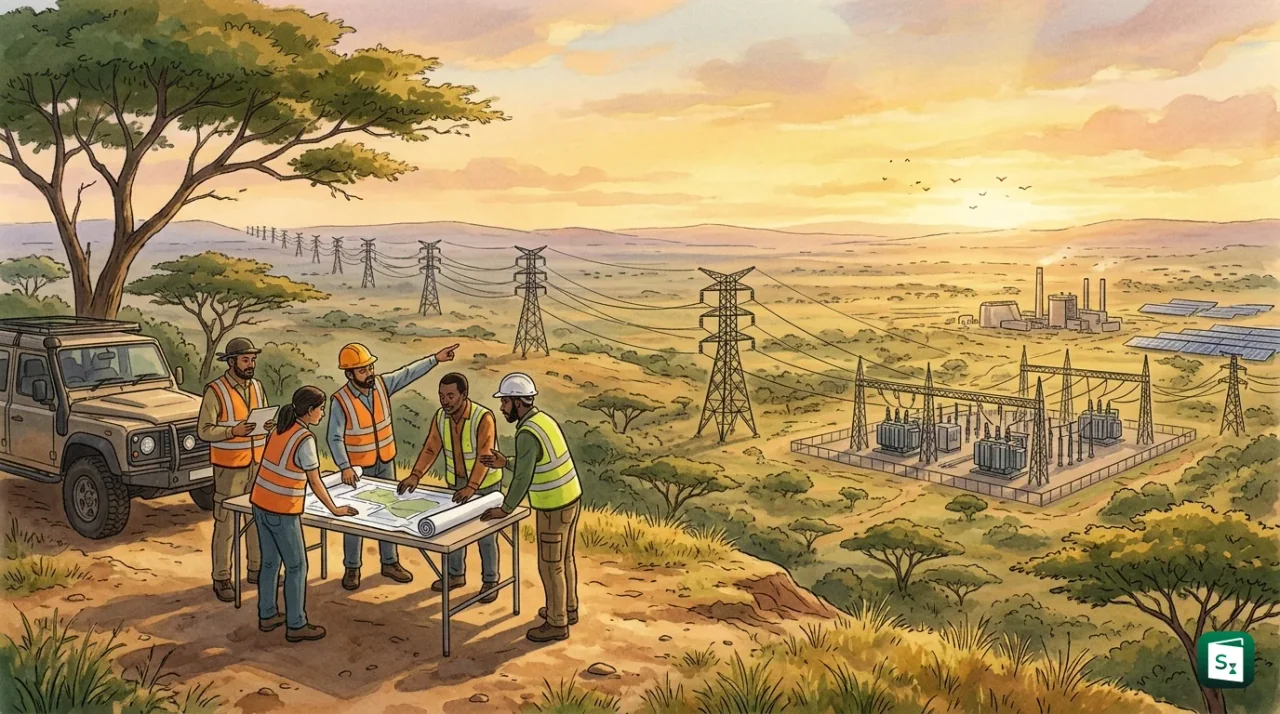
NTPC Limited signed a Cooperation Agreement with Africa50 on 15 October 2026 in New Delhi to identify, assess and develop power generation projects across Africa. The partnership will also explore cross border electricity trading opportunities to move surplus power between African countries. It brings together Indian engineering strength and African investment access at a time when reliable power remains central to Africa’s industrial growth.
What Is NTPC?
NTPC Limited, which expands to National Thermal Power Corporation Limited, is India’s largest power utility and a central public sector undertaking. The company was set up in 1975, is based in New Delhi and works under the Ministry of Power. NTPC holds Maharatna status, the top category for public firms.
NTPC generates electricity from coal, gas, hydro, solar and wind plants. It also works in coal mining, power trading, consultancy and newer areas such as green hydrogen, battery storage and nuclear power. NTPC was first set up only for thermal power. Its name was changed from National Thermal Power Corporation Limited to NTPC Limited in 2005 to reflect its wider work in hydro and other sources.
NTPC Group has an installed capacity of more than 91 GW (as of October 2026). The company supplies about one fourth of India’s electricity. It has set a target to reach 149 GW of total capacity by 2032, including 60 GW from renewable sources.
What Is Africa50?
Africa50 is a pan African infrastructure investor and asset manager set up to close Africa’s infrastructure funding gap. The platform was created by African governments and the African Development Bank and is headquartered in Casablanca, Morocco. Africa50 develops projects and brings in public and private money to complete them.
The idea for Africa50 came from a call by African leaders at the 18th African Union Summit in 2012 for a new financing vehicle for infrastructure. Its charter was approved in 2013, offices opened in Casablanca in 2014 and the first meeting of founding shareholders took place in July 2015. Africa50 works through two arms for project development and project finance, with a focus on power, transport, digital infrastructure and midstream gas.
Africa50 has 34 African country shareholders along with the African Development Bank and African central banks. The Group Chief Executive Officer is Alain Ebobisse. In about eight years of operation, Africa50 has invested in 32 projects across 30 countries with a combined value of more than $8 billion. Its method is to develop projects, reduce risks for investors and deliver bankable assets that can attract long term capital.
What Does the NTPC Africa50 Cooperation Agreement Cover?
The NTPC Africa50 Cooperation Agreement was signed on 15 October 2026 to identify, assess and develop power generation projects and cross border electricity trading chances across Africa. The stated goal is to build commercially viable power projects that can attract investment and expand steady supply for homes and firms. The agreement does not announce any fixed investment amount, project capacity or completion timeline.
NTPC will lead on the technical side. The company will use its experience in engineering, project development, construction management and plant operation to test if a project is feasible, design workable solutions and help move shortlisted chances toward construction. Africa50 will lead on development and finance. The platform will use its continent wide project pipeline and close links with governments and regulators to pick priority projects, shape them for investment and guide them through the project cycle.
| Partner | Core Contribution | Practical Task |
|---|---|---|
| NTPC Limited | Technical and operational strength | Feasibility checks, engineering design, construction and operation support |
| Africa50 | Development and financing strength | Project sourcing, government liaison, deal structuring and capital mobilisation |
NTPC Chairman and Managing Director Gurdeep Singh said the combination of NTPC’s plant experience with Africa50’s development reach creates a strong base for steady supply and regional power trade. Africa50 Group Chief Executive Officer Alain Ebobisse said steady and fairly priced power is central to Africa’s industrial change and the tie up will help turn public plans into private investment in generation, trade and jobs.
Why Cross Border Electricity Trading Matters for Africa
Cross border electricity trading means sending power generated in one country to users in another country through linked transmission lines. The sale is usually backed by a power purchase agreement, which is a long term contract between a power producer and a buyer that fixes price, quantity and supply period. Trade lets a country with surplus hydel or solar power sell to a neighbour facing peak demand instead of letting the energy go waste.
Africa has set up five regional power pools to manage such trade. These pools link national grids, set common technical rules and run joint planning for new lines.
| Power Pool | Region Covered | Status |
|---|---|---|
| Southern African Power Pool (SAPP) | Southern Africa, formed in 1995 | Most advanced, runs a live regional market |
| West African Power Pool (WAPP) | West Africa | Growing trade, held back by missing links and payment delays |
| Eastern Africa Power Pool (EAPP) | Eastern Africa | Expanding through large interconnection works |
| Central Africa Power Pool (CAPP) | Central Africa | Least developed, very low trade |
| North Africa Pool (COMELEC) | North Africa | Strong grids, but trade is mostly bilateral or Europe bound |
Studies show that wider regional trade can cut the money Africa must spend on new plants by sharing reserves and using existing hydel capacity fully. Trade also lifts reliability, widens consumer choice and helps absorb solar and wind power, which varies by time and place. The African Union’s plan for an African Single Electricity Market by 2040 aims to join these pools into common rules for planning, tariffs and settlement. The NTPC Africa50 focus on trading fits directly into this push, since new generation in Africa gains full value only when transmission and markets can carry it across borders.
India Africa Energy Cooperation: The Larger Context
The NTPC Africa50 agreement strengthens a wider India Africa energy partnership that has grown sharply in 2026. At the India Africa Strategic Partnership Meet held during the Bharat Electricity Summit in March 2026, Power Minister Manohar Lal listed renewable energy, grid modernisation, storage and skill building as the four pillars of joint work. The meeting underlined access to low cost and steady power as the base for growth in two regions that together hold nearly one third of world population.
India has pitched its One Sun, One World, One Grid vision and the International Solar Alliance as shared platforms for this work. The International Solar Alliance is a treaty based body headquartered in Gurugram and launched by India and France in 2015 to scale up solar power. Indian officials have described the partnership as transformational rather than aid led, with stress on bankable projects, private capital and local jobs.
Power links already show this model in action. In January 2026, the Kenya Electricity Transmission Company (KETRACO) signed a $311 million public private partnership with a consortium of Africa50 and Power Grid Corporation of India (PGCIL) to build two high voltage lines of 180 km and 72 km in Kenya. The tie dates back to a 2019 cooperation pact between PGCIL and Africa50 for transmission work in Kenya. India has also backed African grids in the past through concessional lines of credit from the Export Import Bank of India and through training slots under the Indian Technical and Economic Cooperation (ITEC) programme. The NTPC entry adds generation strength to a partnership that so far has centred largely on transmission.
Key Takeaways
- NTPC Limited and Africa50 signed a Cooperation Agreement on 15 October 2026 to develop power projects and cross border trading across Africa.
- NTPC, expanded as National Thermal Power Corporation Limited, was set up in 1975 and is a Maharatna firm under the Ministry of Power based in New Delhi.
- Africa50, created by African governments and the African Development Bank, is headquartered in Casablanca, Morocco and has 34 African country shareholders.
- NTPC Group has more than 91 GW of installed capacity and targets 149 GW by 2032, including 60 GW of renewable energy.
- Africa’s five power pools are led by the Southern African Power Pool formed in 1995, while the African Union plans an African Single Electricity Market by 2040.