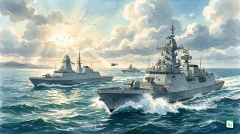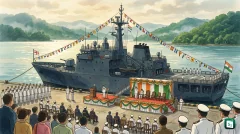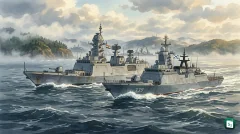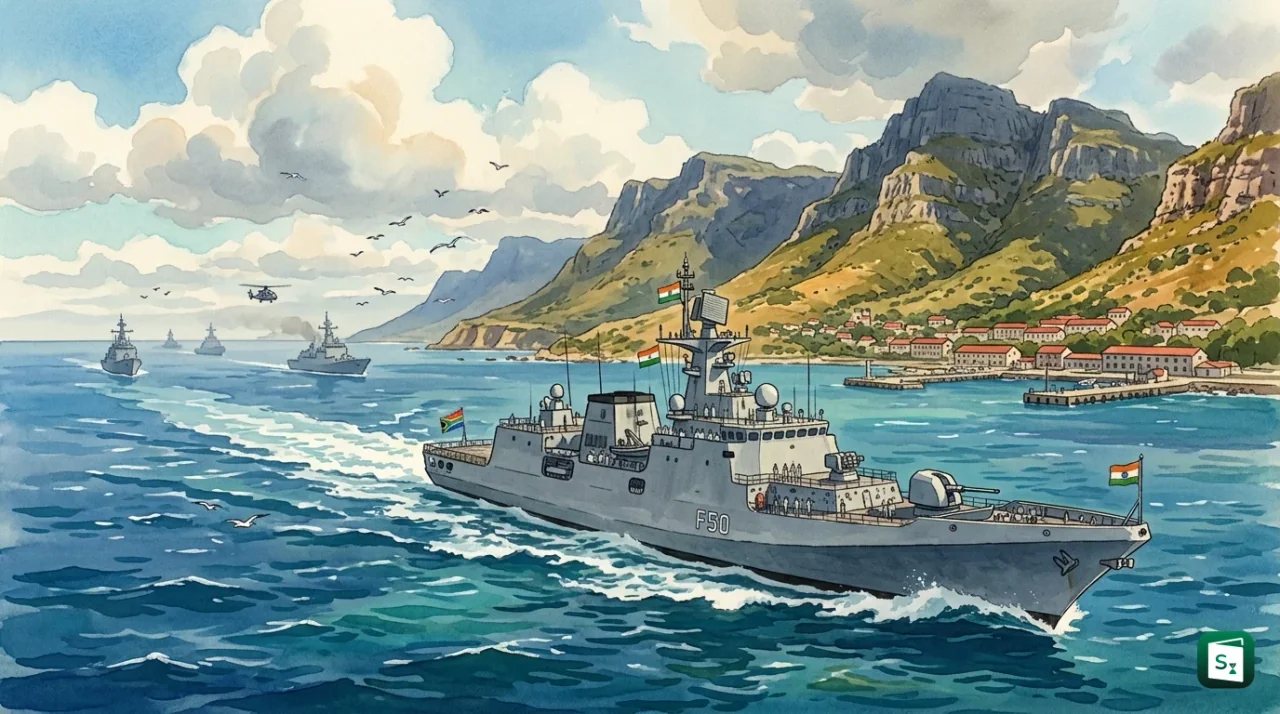
INS Tarkash, a frontline guided-missile stealth frigate of the Indian Navy, represented India at the ninth edition of the India-Brazil-South Africa Maritime (IBSAMAR IX) Exercise 2026, which concluded at Simon’s Town in South Africa’s Western Cape on 20 October 2026. South Africa hosted the drill, while India served as the lead nation, bringing the three navies together for joint training in one of the world’s busiest maritime corridors. The exercise underscored New Delhi’s effort to turn long-standing diplomatic partnerships into practical naval cooperation across the Indian and Atlantic oceans.
What Is IBSAMAR and What Does Its Full Form Mean?
IBSAMAR stands for India-Brazil-South Africa Maritime. It is a trilateral naval exercise of the Indian, Brazilian and South African navies, conducted under the IBSA Dialogue Forum and focused on interoperability, maritime security and mutual understanding.
IBSAMAR began in 2008 and is held every two years. South Africa, because of its position at the southern tip of the continent, has hosted most editions, while the role of lead nation rotates among the three countries. India was the lead nation for the 2026 edition.
The name combines the initials of the three participating countries with the word maritime, which points to the sea as the operating domain. In practice, IBSAMAR is a naval drill. Its purpose is to teach three navies from three continents to plan, communicate and operate together, a quality that matters when ships from different countries must work side by side during a rescue, an evacuation or a security crisis at sea.
India’s participation is handled by the Ministry of Defence, with the Indian Navy releasing the operational details. Ships are drawn from the navy’s fleets, and this year the representative vessel came from the Western Fleet, which is headquartered in Mumbai.
IBSAMAR IX 2026 at a Glance
The ninth edition followed the familiar two-part format. Warships first gathered in harbour for planning, briefings and ceremonial engagements, then sailed into the bay for live drills at sea. The closing ceremony on 20 October 2026 marked the end of ten days of joint activity.
| Parameter | Detail |
|---|---|
| Edition | Ninth (IBSAMAR IX) |
| Exercise window | 8 to 21 October 2026 |
| Host | South Africa |
| Lead nation | India |
| Venue | Simon’s Town, Western Cape, South Africa |
| Harbour phase | 8 to 14 October 2026 |
| Sea phase | 15 to 21 October 2026 |
| Theme | Stronger Together Towards a Shared Future in the Maritime Domain |
| Indian asset | INS Tarkash with an integral Chetak helicopter |
| Closing ceremony | 20 October 2026 at Simon’s Town |
The wider window covered the arrival and departure of the foreign warships, while the closing ceremony took place on 20 October. The Indian Navy described the edition as significant for advancing maritime cooperation and security in the Indian Ocean Region. The Indian Ocean carries a large share of global energy and container traffic, and the sea lanes around southern Africa serve as a backup when the Suez Canal route becomes risky or too shallow for very large vessels.
Inside the Harbour and Sea Phases
INS Tarkash arrived at Simon’s Town on 11 October 2026, joining the Brazilian corvette BNS Barroso, which had reached the base a few days earlier. During the harbour phase that followed, the three navies agreed on signals, formations, communication channels and safety procedures for the drills ahead.
A joint pre-sailing conference on 14 October 2026 brought together the command teams of the Indian, Brazilian and South African navies to finalise how the sea phase would be run. During the harbour stay, the Chief of the South African Navy, Vice Admiral Monde Lobese, visited INS Tarkash and met its commanding officer and crew. India’s High Commissioner to South Africa, Prabhat Kumar, attended a cultural evening hosted on board the Indian warship, along with South African and Brazilian military officials.
INS Tarkash sailed on 15 October 2026 for the sea phase, which was conducted in and around False Bay. The closing ceremony was held at Simon’s Town on 20 October. Speaking at the event, the commanding officer of INS Tarkash said exercises of this kind convert long-standing diplomatic ties into concrete naval cooperation, and that their value lies as much in the relationships built between sailors as in the manoeuvres performed at sea.
What Operations Did IBSAMAR IX Cover?
IBSAMAR IX covered surface warfare, anti-air warfare, anti-submarine warfare, naval air operations, maritime interdiction, Visit Board Search and Seizure drills, anti-piracy operations, search and rescue, and damage control and firefighting. The harbour phase added professional exchanges and planning conferences.
The drills were designed to mirror real tasks that navies face in the Indian Ocean. Maritime interdiction and Visit Board Search and Seizure (VBSS) involve stopping a suspect vessel, boarding it, searching for contraband or weapons and, if needed, taking control. The same skills are used in anti-piracy patrols, drug seizures and enforcement of arms embargoes.
With the South African submarine SAS Manthatisi in the water, the surface ships could practise anti-submarine procedures against an actual underwater target rather than a simulated one. The Chetak and Lynx helicopters added a naval air dimension, while the South African Air Force’s Gripen aircraft supported the exercise from the air.
Damage control and firefighting drills test how crews respond to flooding or a fire at sea, when outside help may be days away. Search and rescue serials test coordination between ships and helicopters in locating and recovering people. These are the kinds of operations that matter most in peacetime, when navies are called on to help civilians rather than fight.
The Three Navies and Their Assets
Each navy sent a different mix of platforms, which is normal for a drill designed to test how dissimilar forces work together. India sent a stealth frigate, Brazil a corvette, and South Africa a frigate, two patrol vessels and a submarine.
| Participant | Assets Deployed | Role |
|---|---|---|
| Indian Navy | INS Tarkash (F50), guided-missile stealth frigate; one Chetak helicopter; special forces team | Lead nation |
| Brazilian Navy | BNS Barroso (V34), Inhauma-class corvette; one Lynx helicopter | Participating navy |
| South African Navy | SAS Amatola (F145) frigate; SAS King Sekhukhune I and SAS Adam Kok III, Warrior-class inshore patrol vessels; SAS Manthatisi (S101) submarine | Host navy |
| South African Air Force | Gripen fighter aircraft support | Air support |
INS Tarkash carried India’s main strike capability, supported by a Chetak helicopter for search, liaison and utility roles, and a team of marine commandos for boarding and interdiction drills. The Brazilian corvette BNS Barroso brought its own Lynx helicopter, a naval variant used for anti-submarine work and surface surveillance.
South Africa deployed the widest mix of platforms. SAS Amatola is the lead ship of the South African Navy’s Valour-class frigates. The two Warrior-class inshore patrol vessels are smaller craft suited to coastal surveillance and boarding operations. SAS Manthatisi is a Type 209 submarine, giving the exercise an undersea dimension that is often missing from multilateral drills.
There is an Indian connection to that submarine. In August 2025, SAS Manthatisi became the first submarine of a friendly foreign navy to receive the Indian Navy’s rescue seat certification, under a bilateral submarine rescue agreement signed in September 2024. The same submarine was therefore training alongside the navy that has promised to send a deep submergence rescue vehicle if it ever needs help.
INS Tarkash: Inside India’s Talwar-Class Stealth Frigate
INS Tarkash is the second ship of the second batch of Talwar-class guided-missile frigates, which are modified Krivak III-class vessels built in Russia under an Indo-Russian arrangement. The name Tarkash means quiver, a fitting label for a warship that carries a mixed set of missiles, guns and torpedoes.
The ship was built at the Yantar Shipyard in Kaliningrad, Russia. It was launched on 23 June 2010 and commissioned on 9 November 2012, before joining the Indian Navy’s Western Naval Command later that year.
| Feature | Detail |
|---|---|
| Class | Talwar-class (Batch 2, also called Teg-class) guided-missile frigate |
| Pennant number | F50 |
| Builder | Yantar Shipyard, Kaliningrad, Russia |
| Commissioned | 9 November 2012 |
| Displacement | About 4,035 tonnes at full load |
| Length and beam | 124.8 metres and 15.2 metres |
| Speed | About 30 knots |
| Range | 4,850 nautical miles at 14 knots |
| Main strike weapon | Eight BrahMos supersonic cruise missiles in vertical launch cells |
| Air defence | 24 Shtil-1 medium-range surface-to-air missiles |
| Guns | One 100 mm A-190E naval gun and AK-630 close-in weapon systems |
| Anti-submarine fit | Torpedo tubes, RBU-6000 rocket launcher and a hull-mounted sonar |
| Aviation | One helicopter, typically a Chetak, Ka-28 or Ka-31 |
The frigate’s design uses angled surfaces and a special hull shape to reduce its radar cross-section, along with measures to lower its infrared and acoustic signatures. These features give it a degree of stealth, which makes it harder to detect and track at long range compared with older warships of the same size.
INS Tarkash has a busy service record. It took part in Operation Raahat in 2015, when India evacuated its citizens from war-torn Yemen. In March 2024, it intercepted the hijacked Bangladeshi merchant vessel MV Abdullah off Somalia. In April 2025, while supporting the multinational Combined Task Force 150, it helped seize more than 2,500 kg of suspected narcotics from a dhow. The ship also took part in the International Fleet Review 2026 at Visakhapatnam.
This was not its first IBSAMAR. INS Tarkash represented India at the sixth edition in 2018, the seventh edition in 2022 and now the ninth edition in 2026.
Why Simon’s Town Matters for Global Shipping
Simon’s Town sits on the False Bay side of the Cape Peninsula in South Africa’s Western Cape province, close to Cape Town. It is the country’s largest naval base and the home port of its frigate and submarine fleets.
The location has been prized for centuries. The Dutch East India Company set up a dockyard at Simon’s Bay in the 1740s to repair and supply ships sailing between Europe and Asia. The British Royal Navy took over the facility in the 1790s and expanded it, opening a large dry dock in 1910. Under the Simon’s Town Agreement of 1955, the base was handed over to the South African Navy in 1957.
The reason is geography. The Cape of Good Hope is where the Atlantic and Indian oceans meet, and every ship rounding southern Africa passes through this narrow corridor. The Cape route is the fallback when the Suez Canal is disrupted, and it remains the only practical all-weather route for very large crude carriers that are too big for the canal. A naval base here gives South Africa, and its partners, a foothold on one of the world’s most important sea lanes.
Hosting IBSAMAR at this base is therefore more than a matter of convenience. It places the exercise directly on a route that carries energy, food and manufactured goods between Asia, Africa, Europe and the Americas.
The IBSA Dialogue Forum Behind IBSAMAR
IBSAMAR is the naval arm of the IBSA Dialogue Forum, a grouping of India, Brazil and South Africa that was formalised on 6 June 2003 in Brasilia. On that day, the foreign ministers of the three countries, Yashwant Sinha of India, Celso Amorim of Brazil and Nkosazana Dlamini-Zuma of South Africa, adopted the Brasilia Declaration and gave the forum its name.
The three countries are large democracies and major developing economies located on three different continents. The forum was built to promote South-South cooperation, coordinate positions on global issues and push for reform of institutions such as the United Nations Security Council.
IBSA works along three tracks. The first is political consultation on regional and global issues. The second is practical trilateral cooperation through working groups in areas such as agriculture, energy, health, science and defence. The third is development assistance to other poor countries through the IBSA Fund, which was established in 2004 and became operational in 2006. By 2025, the fund had allocated more than $53.27 million to 46 projects in 34 partner countries, most of them least developed countries.
South Africa assumed the IBSA chairship for 2026-27 and hosted the 14th IBSA Trilateral Ministerial Commission meeting in New York on 24 September 2026, on the sidelines of the 81st session of the UN General Assembly. India’s External Affairs Minister S. Jaishankar, Brazil’s Foreign Minister Mauro Vieira and South Africa’s International Relations Minister Ronald Lamola attended.
IBSA is often confused with BRICS. All three IBSA members are also part of BRICS, but the two groupings are separate. BRICS is larger and includes countries such as Russia, China, Egypt, Ethiopia, Indonesia, Iran and the United Arab Emirates, while IBSA remains a three-country forum created specifically to give the Global South a stronger voice.
Nine Editions of IBSAMAR
IBSAMAR has now run for 18 years, but it has not been held every year. Nine editions since 2008 amount to roughly one every two years, with some long gaps in between.
| Edition | Year | Venue | Indian Navy Ships |
|---|---|---|---|
| I | 2008 | South Africa | Not specified |
| II | 2010 | Durban, Port Elizabeth and Cape Town, South Africa | INS Mysore, INS Tabar, INS Ganga, INS Aditya |
| III | 2012 | South Africa | INS Delhi, INS Deepak |
| IV | 2014 | Simon’s Town, South Africa | Not specified |
| V | 2016 | Goa, India | INS Mumbai, INS Trishul, INS Shalki |
| VI | 2018 | Simon’s Town, South Africa | INS Tarkash, INS Kolkata |
| VII | 2022 | Gqeberha, South Africa | INS Tarkash |
| VIII | 2024 | Simon’s Town, South Africa | INS Talwar |
| IX | 2026 | Simon’s Town, South Africa | INS Tarkash |
Two features of this record stand out. South Africa has hosted eight of the nine editions, with India hosting only the 2016 exercise off Goa. The arrangement reflects South Africa’s position on the Cape sea route and the difficulty smaller navies would face in hosting a drill so far from home.
The other feature is the size of India’s contribution. India has usually sent a single frigate, which is large enough to show the flag and practise complex manoeuvres but too small to simulate a full fleet engagement. The exercise is therefore a test of coordination between ships and aircraft rather than a large-scale war game.
The gaps between editions also matter. Interoperability improves through repeated contact, and the four-year break between 2018 and 2022 meant crews changed and procedures had to be relearned. No edition was held in 2025, since the exercise runs on a two-year cycle. Keeping to that cycle is one of the practical challenges the three navies face.
INS Tarkash has now appeared in three editions: 2018, 2022 and 2026. INS Talwar represented India in 2024.
India’s Wider Maritime Diplomacy in the Indian Ocean
IBSAMAR IX was one stop in a longer deployment, not an isolated event. Before reaching South Africa, INS Tarkash called at Mombasa in Kenya from 29 September to 2 October 2026 and held a passage exercise with the Kenya Navy ship Jasiri. It was the second Indian Navy ship to visit Kenya in 2026, after INS Trikand in April.
This pattern reflects India’s broader maritime outreach. The SAGAR vision, short for Security and Growth for All in the Region, was announced in 2015 to guide cooperation with Indian Ocean littoral states. The Navy now describes its approach as MAHASAGAR, or Mutual and Holistic Advancement for Security and Growth Across Regions, which places greater weight on sustained engagement and partner-led capacity building.
Several institutions support this work. The Indian Ocean Naval Symposium (IONS) was launched in February 2008 to bring regional navies onto a common platform. The Information Fusion Centre for the Indian Ocean Region (IFC-IOR), set up at Gurugram in 2018, shares maritime domain awareness and tracks vessels of interest. The AIKEYME initiative, or Africa India Key Maritime Engagement, was held in 2025 with Tanzania as co-host and brought in navies from across eastern and southern Africa.
India has also built bilateral defence ties with both IBSA partners. With South Africa, the submarine rescue agreement of 2024 and the joint submarine training at Simon’s Town in 2025 have added a technical layer to a relationship that was earlier limited to port calls and exercises. With Brazil, India shares a strategic partnership that covers defence, trade, energy and space.
The wider context is a crowded Indian Ocean. China has expanded its naval presence and port infrastructure across the region, and several countries are hedging between competing partners. India’s answer has been to position itself as a consistent security provider, offering training, patrol vessels, surveillance support and disaster relief rather than demanding exclusive alignment.
The Way Forward
The next edition is expected in 2028, again with South Africa as host under the current arrangement. The more interesting question is whether the exercise can move beyond a single frigate and a short sea phase. Adding more ships, maritime patrol aircraft or a larger special forces component would give the three navies a harder test of joint planning.
Holding an edition off Brazil is another option that has not yet been tried. All nine editions have been held in South Africa or India, which means the South Atlantic side of the partnership has never hosted the drill. A Brazilian edition would spread the operational load and give the exercise a genuinely three-ocean character.
On the political side, South Africa has outlined plans for a senior officials’ meeting in October 2026, a possible virtual IBSA leaders’ meeting in 2027 and a full leaders’ summit at a mutually agreed time. No full leaders’ summit was held in 2026. If one takes place next, defence cooperation and maritime security are likely to be on the agenda.
For India, IBSAMAR works best when it is read alongside IONS, IFC-IOR and AIKEYME. Each platform does a different job. IBSAMAR builds habits between three specific navies, while the others widen the circle of partners and improve the flow of information across the Indian Ocean. Keeping all of them active is what turns naval diplomacy into lasting maritime capacity.
Key Takeaways
- The ninth edition of IBSAMAR concluded at Simon’s Town, South Africa, on 20 October 2026, with the theme Stronger Together Towards a Shared Future in the Maritime Domain.
- INS Tarkash (F50) represented India at IBSAMAR IX 2026. It is a Talwar-class guided-missile stealth frigate built at the Yantar Shipyard in Kaliningrad, Russia, and commissioned on 9 November 2012.
- South Africa hosted IBSAMAR IX and India was the lead nation. Brazil deployed the corvette BNS Barroso, while South Africa deployed SAS Amatola, two Warrior-class patrol vessels and the submarine SAS Manthatisi.
- IBSAMAR has been held biennially since 2008 under the IBSA Dialogue Forum, which was formalised through the Brasilia Declaration on 6 June 2003. The IBSA Fund, operational since 2006, had allocated more than $53.27 million to 46 projects in 34 partner countries by 2025.
- India hosted IBSAMAR V in 2016 off Goa, the only edition held outside South Africa. INS Tarkash took part in the 2018, 2022 and 2026 editions, while INS Talwar represented India in 2024.
- Simon’s Town is South Africa’s largest naval base and lies near the Cape of Good Hope, the meeting point of the Atlantic and Indian oceans. The base was handed over to the South African Navy in 1957 under the Simon’s Town Agreement of 1955.