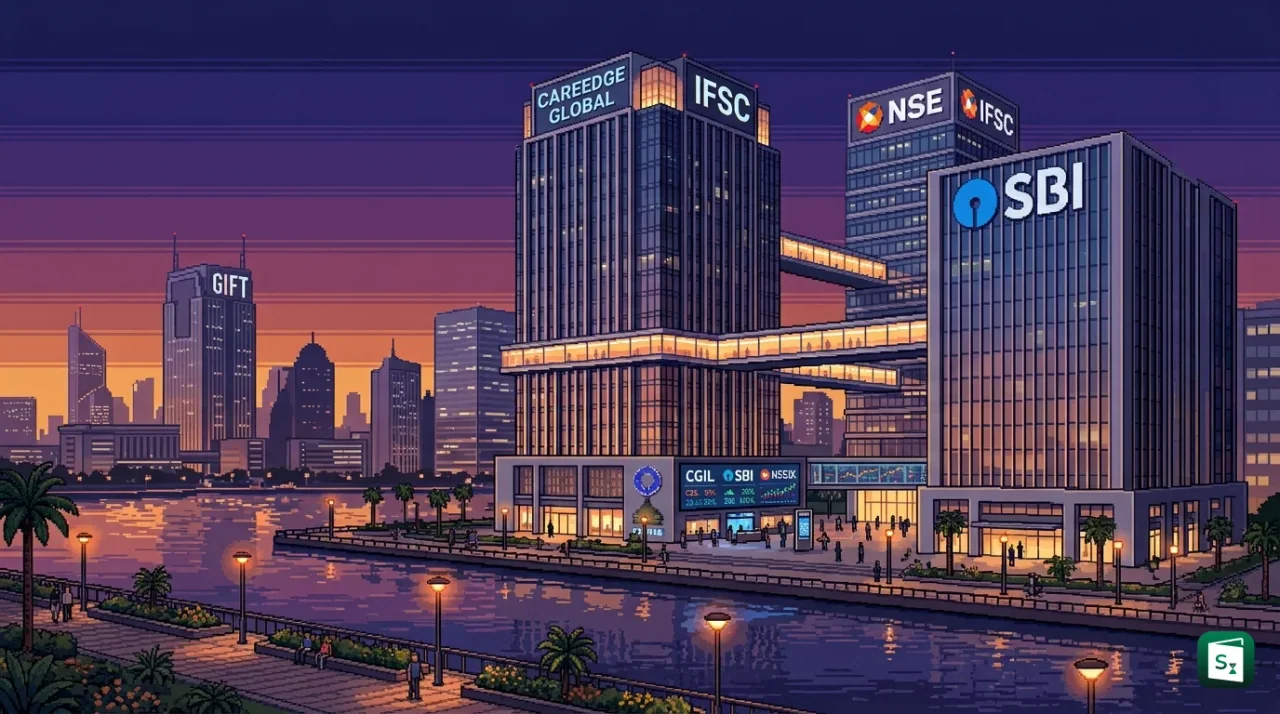
CARE Ratings has signed share purchase and shareholders agreements to sell a 19.8% stake in its subsidiary, CareEdge Global IFSC Limited (CGIL), to the State Bank of India and NSE IFSC. Each buyer will pick up 9.9%, leaving CARE Ratings with 80.2% of the rating agency based at Gujarat International Finance Tec-City (GIFT City) once the transfer is completed. The deal puts a large bank and India’s dominant international exchange on the share register of the country’s first credit rating agency registered with the International Financial Services Centres Authority (IFSCA).
What Exactly Has CARE Ratings Announced?
On 19 October 2026, CARE Ratings executed share purchase agreements and a shareholders’ agreement to sell a 19.8% stake in CareEdge Global IFSC Limited, split equally between SBI and NSE IFSC. CARE will retain 80.2% after the transfer, so CGIL will remain a subsidiary but stop being wholly owned.
| Particulars | Detail |
|---|---|
| Seller | CARE Ratings Ltd (CareEdge Ratings) |
| Buyers | State Bank of India (SBI) and NSE IFSC Ltd (NSEIX) |
| Stake sold to each buyer | 9.90% |
| Total stake sold | 19.80% |
| CARE Ratings’ holding after transfer | 80.20% |
| Agreements signed | Share purchase agreements and a shareholders’ agreement |
| Date of execution | 19 October 2026 |
| Expected completion | Within two months |
| Consideration | Not disclosed |
A share purchase agreement is the contract that fixes the price, conditions and mechanics of the share transfer. A shareholders’ agreement governs how the owners will run the company after the sale, including board composition and matters that need their consent.
The company disclosed the execution in a regulatory filing to the stock exchanges, as required by the Securities and Exchange Board of India (SEBI) for listed companies. The sale had been flagged in earlier intimations dated 12 November 2025 and 13 May 2026, so the agreements formalise a plan that has been under discussion for nearly a year.
Completion depends on the closing actions listed in the share purchase agreements and approval by the CGIL board for the transfer of shares. CARE expects this to be wrapped up within two months. It has not disclosed the consideration, so the valuation at which SBI and NSE IFSC are buying in is not public.
Since CARE keeps 80.2%, CGIL remains a subsidiary and CARE continues to consolidate its accounts in its financial statements.
Why Are SBI and NSE IFSC Investing in a Rating Agency?
Both buyers sit on opposite sides of GIFT City’s debt market. SBI lends to issuers and arranges their bonds, while NSE IFSC runs the platform where those bonds list. A strong local rating agency lowers their cost of doing cross-border business and gives them a stake in setting the market’s standards.
SBI is India’s largest public sector bank. It opened its first International Financial Services Centre (IFSC) Banking Unit at GIFT City in 2016, offering corporate credit, trade finance, deposits, remittances and treasury products in foreign currency. For a bank of that size, credit ratings decide how much capital must be set aside against cross-border exposures. The Reserve Bank of India (RBI) recognised CareEdge Global as an External Credit Assessment Institution in July 2025, allowing banks to use its ratings for computing risk weights on claims on non-resident corporates originating at the IFSC.
NSE IFSC, or NSEIX, is a wholly owned subsidiary of the National Stock Exchange of India. It was set up at GIFT City on 5 June 2017 and runs an international multi-asset exchange. NSEIX holds over 99.7% market share at GIFT IFSC and operates GIFT Nifty, the dollar-denominated Nifty derivatives contract that shifted from the Singapore Exchange to GIFT City on 3 July 2023 under the NSE IX-SGX Connect. The exchange also lists debt securities, depositary receipts and global stocks.
The regulatory link is direct. Under the IFSCA (Listing) Regulations, 2024, issuers listing debt securities on IFSC exchanges must obtain a rating from an IFSCA-registered credit rating agency from 1 April 2025. That rule makes a local rating agency part of the exchange’s basic infrastructure. A stake in CGIL gives NSEIX a closer view of rating capacity and turnaround time as more foreign currency bonds are listed in GIFT City.
What Each Partner Brings to the Table
| Partner | Role in the ecosystem | Why the stake matters |
|---|---|---|
| SBI | Lender, bond arranger and IFSC banking unit | Can use CareEdge Global ratings for risk weights on IFSC-originating credit |
| NSE IFSC | International exchange and listing venue | Needs ratings from an IFSCA-registered agency for listed debt |
| CARE Ratings | Parent and controlling shareholder | Keeps 80.2% and operational control of CGIL |
The arrangement does create overlapping interests. SBI is a large borrower and issuer whose debt is rated by agencies, and NSEIX runs a venue whose issuers need ratings. How the shareholders’ agreement handles these conflicts will matter for the agency’s credibility. The financial terms are undisclosed, so the price cannot be judged from outside.
What Is CARE Ratings?
CARE Ratings, branded CareEdge Ratings, is one of India’s oldest credit rating agencies. It was incorporated on 21 April 1993 as Credit Analysis and Research Limited and renamed CARE Ratings Limited in February 2017. It is listed on the Bombay Stock Exchange (BSE) and the National Stock Exchange (NSE).
The agency was promoted by Industrial Development Bank of India (IDBI), Canara Bank, Unit Trust of India (UTI) and other banks and financial institutions. It has no promoter group today and is professionally managed. CARE was listed in 2012, is registered with SEBI as a credit rating agency and is recognised by the RBI as an External Credit Assessment Institution. It rates bank loans, bonds, commercial paper, structured finance and other instruments, and says it has rated about $2.5 trillion of debt since inception.
In financial year 2025-26 (FY2025-26), CARE Ratings reported consolidated revenue from operations of ₹473.07 crore, up 18%, and profit after tax of ₹174.39 crore, also up 18%. Its PAT margin stood at 39%. The group also runs CARE Ratings Nepal, CARE Ratings Africa, CARE Ratings South Africa and CARE ESG Ratings, giving it a presence in India, Nepal, Mauritius and Africa.
SEBI had eight registered credit rating agencies as of 31 March 2026, of which CARE Ratings, ICRA and CRISIL are listed. CareEdge describes itself as India’s second-largest credit rating agency. That domestic base funds and anchors CGIL, the group’s global ratings arm.
What Is CareEdge Global IFSC Limited?
CareEdge Global IFSC Limited is CARE Ratings’ subsidiary at GIFT City, created to rate issuers and debt on a global scale. It was incorporated on 29 April 2024 and became the first credit rating agency registered with IFSCA, receiving its licence on 18 July 2024.
The agency began operations in October 2024 by publishing sovereign ratings for 39 countries, making it the first Indian credit rating agency to enter the global sovereign ratings space. That market has long been dominated by S&P (Standard & Poor’s), Moody’s and Fitch. CareEdge Global completed ratings on 45 sovereigns in FY2025-26 and says it is among the top 10 global agencies by country coverage.
Its services cover sovereign, corporate, bank loan, issuer and structured finance ratings, along with capital market instruments, environmental, social and governance (ESG) ratings, second-party opinions on ESG bonds and bond valuation. It received a separate IFSCA registration as an ESG ratings and data products provider on 11 March 2026.
The RBI Recognition That Made Its Ratings Usable
A rating is only useful to a bank if the regulator allows it to be used for capital calculations. The RBI gave CareEdge Global that status on 10 July 2025, when it permitted banks to use the agency’s ratings for risk-weighting their claims on non-resident corporates originating at the IFSC.
| CareEdge Global rating | Risk weight for bank claims |
|---|---|
| AAA | 20% |
| AA | 30% |
| A | 50% |
| BBB | 100% |
| BB and below | 150% |
During FY2025-26, the recognition was widened to cover non-resident corporates outside the IFSC framework, and the risk weights were aligned with those applied to global rating agencies. That change matters commercially, because it allows banks to use CareEdge Global ratings for a wider set of cross-border exposures.
Who Else Rates Debt in GIFT City?
As of July 2026, only two credit rating agencies were registered in GIFT City: CareEdge Global and S&P Global Ratings Singapore, which received IFSCA registration in June 2025 to open a branch. CareEdge Global had rated about $4 billion of debt by October 2025. It is the incumbent local player, and its new shareholders give it deeper ties to the issuers and the venue it serves.
What Is GIFT City and Why Does It Matter?
GIFT City is India’s first operational International Financial Services Centre, located in Gandhinagar, Gujarat. It is a greenfield smart city with a multi-service special economic zone at its core, where banks, exchanges, insurers and fund managers conduct foreign currency business under IFSCA, India’s unified regulator for such centres.
The city was conceptualised in 2007, and the IFSC became operational in April 2015. It is divided into a Domestic Tariff Area and the GIFT SEZ, which is a multi-service special economic zone notified under the Special Economic Zones Act, 2005. The idea was to bring India-linked offshore financial business back home instead of letting it flow to Singapore, Dubai or London.
The International Financial Services Centres Authority was established on 27 April 2020 under the IFSCA Act, 2019, and is headquartered inside GIFT City. Before IFSCA, the RBI, SEBI, the Pension Fund Regulatory and Development Authority (PFRDA) and the Insurance Regulatory and Development Authority of India (IRDAI) separately regulated different parts of the IFSC. IFSCA replaced them with a single regulator for banking, capital markets, insurance, pensions and fund management.
How Large Is GIFT City Now?
| Indicator | Latest figure |
|---|---|
| IFSCA registrations and authorisations | 1,336 (June 2026) |
| Banking assets | About $120 billion (June 2026) |
| Monthly turnover on IFSC exchanges | About $111 billion (June 2026) |
| Fund management entities and schemes | 235 entities and 401 schemes (June 2026) |
| Rank in the Global Financial Centres Index | 46th of 120 (March 2026) |
| Area | About 886 acres, with expansion under way |
For a rating agency, the number that matters most is the debt listed and traded here. Every new foreign currency bond adds to the pool that CareEdge Global can rate.
Is GIFT City a Tax-Free Zone?
Not in a blanket sense. Units in the IFSC get a 10-year income tax exemption within a 15-year block, and specified transactions such as qualifying foreign currency business get concessional treatment. The benefits are tied to the nature of the activity and to registration with IFSCA, not to the address alone. A domestic firm operating outside the IFSC does not become tax-free merely by being in GIFT City.
The tax design is meant to make offshore deals cheaper than routing them through Singapore or Dubai. It explains why foreign currency bond issuance in the city has grown quickly, and why the supporting infrastructure, including rating agencies, has become more valuable.
How the Deal Fits India’s Offshore Bond Market Ambitions
Why Foreign Currency Bonds Need a Local Rating Agency
Fundraising through foreign currency bonds on GIFT City’s two international exchanges, NSE IX and India International Exchange (India INX), crossed $4 billion in 2025. Infrastructure companies seeking long-term money and non-banking finance companies tapping overseas investors have been active issuers. A concessional 9% withholding tax on interest paid to non-resident investors, against 15% on the Singapore route, has made the city cost-competitive.
Every one of those bonds needs a rating. IFSCA’s listing rules make that requirement explicit: from 1 April 2025, debt securities listed on an IFSC exchange must carry a rating from an agency registered with IFSCA. For NSEIX, whose exchange depends on a steady pipeline of listed paper, and for SBI, which lends to and arranges for many of these issuers, a healthy local rating agency is now essential to the market’s functioning.
The Bigger Goal: Breaking the Big Three’s Grip
Global credit ratings are dominated by S&P, Moody’s and Fitch. Their assessments influence borrowing costs for sovereigns and companies across emerging markets, and their methodologies have often been criticised for a developed-market bias. CareEdge Global’s sovereign coverage, which reached 45 countries in FY2025-26, is an attempt to offer an alternative view from India.
That ambition needs more than analytical capability. It needs a steady flow of mandates from issuers and investors who trust the agency’s name. Bringing SBI and NSEIX on board gives CareEdge Global a major lender and the dominant exchange as shareholders, with an agreement that ties their interests to the agency’s growth. Distribution and credibility follow from that relationship far more easily than they would from a standalone marketing effort.
What to Watch
Completion is the immediate test. The closing actions and the CGIL board’s approval must be wrapped up within the stated two months, and any regulatory conditions attached to the transfer will shape the final structure.
The harder question is independence. A rating agency owned partly by a bank and an exchange has to convince the market that its opinions are not influenced by its owners. IFSCA’s rules require a board-approved code of conduct drawn from the fundamentals of the International Organization of Securities Commissions (IOSCO), and prior regulatory approval for any change of control. CARE’s 80.2% holding keeps control with the parent, which helps, but the shareholders’ agreement will determine how much say the minority owners actually get.
Competition adds pressure. S&P Global Ratings Singapore has an IFSCA-registered branch in GIFT City, and its brand carries weight with foreign investors. CareEdge Global’s advantage is local knowledge and cost. Its challenge is convincing issuers that an Indian agency can price global risk as well as a global name.
Key Takeaways
- CARE Ratings signed share purchase agreements and a shareholders’ agreement on 19 October 2026 to sell a 9.9% stake each in CareEdge Global IFSC Limited to SBI and NSE IFSC, a combined 19.8%.
- CARE Ratings will retain 80.2% of CareEdge Global IFSC, which will cease to be a wholly owned subsidiary but remain a subsidiary, with closing expected within two months.
- CareEdge Global IFSC Limited was incorporated on 29 April 2024 and became the first credit rating agency registered with IFSCA, with licence dated 18 July 2024.
- The RBI recognised CareEdge Global as an External Credit Assessment Institution on 10 July 2025, enabling banks to use its ratings for risk-weighting claims on non-resident corporates at the GIFT City IFSC.
- NSE IFSC (NSEIX), a wholly owned subsidiary of the National Stock Exchange of India, was set up at GIFT City on 5 June 2017 and holds over 99.7% market share in GIFT IFSC.
- GIFT City had 1,336 IFSCA registrations and authorisations and banking assets of about $120 billion as of June 2026.
- IFSCA was established on 27 April 2020 under the IFSCA Act, 2019 as the unified regulator for International Financial Services Centres in India.