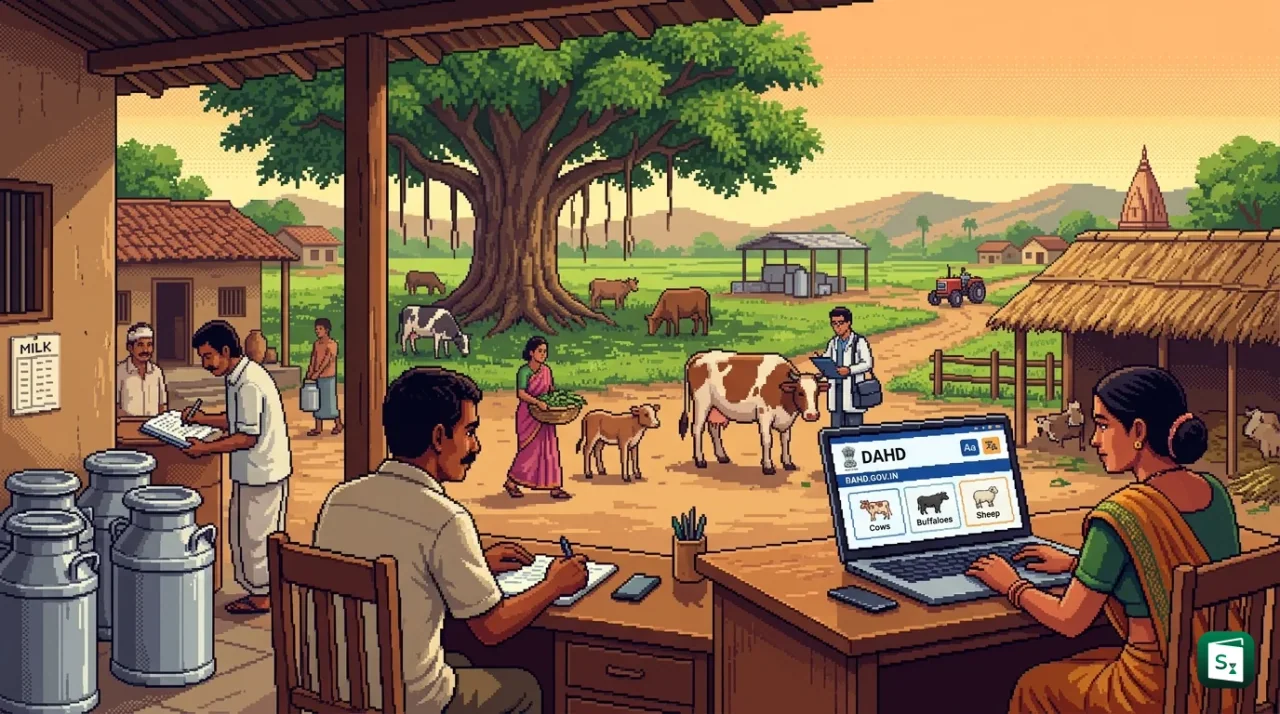
Union Minister Rajiv Ranjan Singh launched the revamped website of the Department of Animal Husbandry and Dairying (DAHD) on 13 October 2026, built to the Digital Brand Identity Manual (DBIM) Version 3.0 issued by the Ministry of Electronics and Information Technology (MeitY). The portal at www.dahd.gov.in now offers multilingual, persona-based access to livestock and dairy schemes and marks a visible step in the harmonisation of central government websites. For a sector that supports crores of rural livelihoods, easier access to scheme rules and animal health information carries direct economic value.
What Is the Department of Animal Husbandry and Dairying?
The Department of Animal Husbandry and Dairying (DAHD) is a central department under the Ministry of Fisheries, Animal Husbandry and Dairying. It frames policy and runs livestock, poultry and dairy schemes from its New Delhi headquarters, largely supplementing State government efforts.
Animal husbandry covers the breeding, rearing and management of cattle, buffaloes, sheep, goats, pigs, poultry and other farm animals for milk, meat, eggs, wool and draught power. Dairying is the part of this activity concerned with milk production, procurement and processing.
The department has a longer history than the ministry that now houses it. It came into existence on 1 February 1991, when two divisions of the Department of Agriculture and Cooperation, namely Animal Husbandry and Dairy Development, were merged into a separate department. It was later renamed the Department of Animal Husbandry, Dairying and Fisheries after the fisheries portfolio was added. The present ministry was carved out in June 2019 through a Cabinet Secretariat notification, and the department was renamed accordingly.
| Attribute | Detail |
|---|---|
| Full form | Department of Animal Husbandry and Dairying (DAHD) |
| Parent ministry | Ministry of Fisheries, Animal Husbandry and Dairying |
| Department established | 1 February 1991 |
| Present ministry created | June 2019 |
| Headquarters | New Delhi |
| Union Minister | Rajiv Ranjan Singh alias Lalan Singh |
| Minister of State | Prof. S. P. Singh Baghel |
DAHD oversees a wide network of institutions and programmes. The National Dairy Development Board (NDDB), set up in 1965 and based in Anand, Gujarat, is the anchor of India’s cooperative dairy model. The department also handles the Veterinary Council of India, the Delhi Milk Scheme, livestock statistics, animal disease control and breed improvement. Its reach matters because livestock is often the most reliable source of cash income for small and marginal farmers, landless labourers and women in rural India.
What Is DBIM 3.0?
DBIM 3.0 is the Government of India’s official digital design code, released by MeitY in February 2025. It gives every ministry website, mobile app and social media channel a common visual and verbal identity so that citizens recognise official platforms instantly.
The full form is Digital Brand Identity Manual. MeitY’s Digital Governance Division prepared it as part of the Gov.In Harmonisation of Digital Footprint programme. The manual was formally released on 18 February 2025 at the first Chief Information Officer Conference in New Delhi, along with a DBIM-compliant version of the MeitY website. The document itself is dated January 2025.
The manual states two broad aims. It seeks to guide departments by setting out colours, typography, icons, imagery, headers, footers and tone of voice. It also seeks to preserve the integrity of the government’s digital brand so that official information is not diluted by inconsistent design.
| Element | What DBIM 3.0 Standardises |
|---|---|
| Colours | Approved primary and secondary palettes for government platforms |
| Typography | Noto Sans as the main typeface, chosen for readability and Indian language support |
| Logo | Lockups using the State Emblem, with rules on proportion and colour |
| Header and footer | Fixed layouts, ownership statements and mandatory citizen links |
| Icons and imagery | A shared visual library and rules against misleading visuals |
| Content and voice | Consistent tone, messaging and multilingual presentation |
DBIM also governs the use of the State Emblem of India, which is protected under the State Emblem of India (Prohibition of Improper Use) Act, 2005. A department cannot stretch the emblem, recolour it or place it beside an unofficial logo.
How DBIM and GIGW Work Together
DBIM is a design and branding layer, not a standalone compliance standard. The manual must be implemented along with the latest Guidelines for Indian Government Websites and Apps (GIGW), which cover quality, accessibility, cybersecurity and lifecycle management.
GIGW was first formulated by the National Informatics Centre (NIC) in 2009. Its third version, GIGW 3.0, was prepared jointly with the Standardisation Testing and Quality Certification (STQC) directorate and the Indian Computer Emergency Response Team (CERT-In). It aligns with Level AA of the Web Content Accessibility Guidelines (WCAG) 2.1 and adds 17 new success criteria, including better support for low-vision users and people with cognitive disabilities.
STQC offers a separate DBIM compliance certification, which gives departments an audit trail for their design choices. The new DAHD website is presented as DBIM-compliant, and its footer carries the standard ownership line naming NIC as the developer and host.
Key Features of the New DAHD Website
The redesigned portal is built around discovery rather than mere display. Instead of leaving visitors to hunt through menu trees, it groups information by who the user is and what the user needs, while a stronger search engine pulls up scheme guidelines, reports and circulars from across the site.
The website was developed by the DAHD IT team with support from NIC, the government’s technology organisation that designs and hosts most central ministry portals. The live site carries the familiar NIC footer, a web accessibility certificate and links to grievance and feedback systems.
Multilingual Access Through Bhashini
The most visible change is language access. The portal uses Bhashini, the government’s AI-based language translation platform, to serve content beyond English and Hindi. Bhashini is a Digital India initiative that provides speech and text translation across Indian languages through open APIs.
For a livestock owner in a rural district, this matters in practice. Scheme eligibility rules, vaccination advisories and application steps are easier to act on when they appear in the local language rather than in administrative English. The same logic applies to the department’s field staff, who can point farmers to a page instead of translating it themselves.
Navigation Built Around User Personas
The website uses persona-led navigation, which means the home page offers separate entry points based on the type of user, such as a farmer looking for a scheme or an entrepreneur seeking a loan. This reduces the number of clicks needed to reach a relevant scheme or service.
A centralised content management system sits behind the front end. It allows the department to publish and update content from one place, which keeps guidelines and notices consistent across pages. The site also acts as a single digital hub for flagship programmes, scheme brochures, application links, dashboards, annual reports and the department’s Who’s Who directory, which lists the minister, secretary and other senior officers.
The DBIM and GIGW templates also require basic accessibility features: adjustable text size, high-contrast display, keyboard-friendly navigation and screen reader support. These are not optional extras under GIGW 3.0. They are minimum requirements for a government platform.
Flagship Schemes Available on the New Portal
The portal brings the department’s main central schemes onto one page, with guidelines, eligibility details and application links in the same place. The most prominent are the Animal Husbandry Infrastructure Development Fund, the Rashtriya Gokul Mission, the National Livestock Mission and the Livestock Health and Disease Control Programme.
| Scheme | Started | Main Purpose |
|---|---|---|
| Animal Husbandry Infrastructure Development Fund (AHIDF) | 2020 | Interest support for dairy, meat, feed, vaccine and breed improvement projects |
| Rashtriya Gokul Mission (RGM) | December 2014 | Conservation and genetic upgrading of indigenous bovine breeds |
| National Livestock Mission (NLM) | 2014-15 | Entrepreneurship in poultry, sheep, goat and piggery, plus feed and fodder |
| Livestock Health and Disease Control Programme (LHDCP) | Central sector scheme | Vaccination, disease surveillance and mobile veterinary services |
| National Programme for Dairy Development (NPDD) | February 2014 | Milk quality, procurement, processing and marketing infrastructure |
| Supporting Dairy Cooperatives and Farmer Producer Organizations (SDCFPO) | Ongoing | Interest subvention on working capital for dairy cooperatives and FPOs |
The AHIDF began under the Atmanirbhar Bharat package with a corpus of ₹15,000 crore. It offers 3% interest subvention for up to eight years, with a two-year moratorium, and term loans of up to 90% of project cost. The Dairy Processing and Infrastructure Development Fund (DIDF) was merged into AHIDF on 1 February 2024, and the revised outlay for the period up to 31 March 2026 was ₹29,110.25 crore. By August 2025, 402 projects with a total project cost of ₹14,413.88 crore had been approved under the fund.
The Rashtriya Gokul Mission is the department’s flagship breed improvement scheme. It was restructured in July 2021 for the 2021-22 to 2025-26 period, and in March 2025 the Cabinet raised its total outlay to ₹3,400 crore. The mission supports sex-sorted semen, bovine in-vitro fertilisation, genomic selection chips such as INDUSCHIP and BUFFCHIP, and the National Milk Recording Programme.
The National Livestock Mission works through three sub-missions covering breed development, feed and fodder, and research, insurance and extension. It provides 50% capital subsidy to individuals, self-help groups, farmer producer organisations and Section 8 companies for poultry, sheep, goat and piggery enterprises.
Under LHDCP, the department supports vaccination against foot and mouth disease, brucellosis, peste des petits ruminants and classical swine fever. Mobile Veterinary Units take diagnosis and treatment to farmers’ doorsteps through the toll-free number 1962. The related National Animal Disease Control Programme aims to eradicate foot and mouth disease and brucellosis by 2030.
Why the Livestock Sector Needs Strong Digital Governance
Livestock is no longer a side activity in Indian agriculture. It is one of the fastest-growing allied sectors, and for millions of small farmers it provides regular cash flow that crop income cannot match. A website that explains schemes clearly is therefore not a cosmetic upgrade. It is a delivery tool for a large rural economy.
The numbers explain the stakes. Livestock contributed 30.47% of the gross value added in agriculture and allied sectors in 2021-22, up from 24.32% in 2014-15. Its share in total national GVA was 4.75% in the same year. The sector’s growth has consistently outpaced crop agriculture, which is why policy attention has shifted towards dairy, poultry and small ruminants.
The production record shows the scale of what is at stake.
| Livestock Product | 2024-25 Output | India’s Global Rank |
|---|---|---|
| Milk | 247.87 million tonnes | 1 |
| Eggs | 149.11 billion numbers | 2 |
| Meat | 10.50 million tonnes | 4 |
The Basic Animal Husbandry Statistics (BAHS) 2025, released on 26 November 2025, put per capita milk availability at 485 grams per day, up from 319 grams in 2014-15. Per capita egg availability rose from 62 to 106 eggs per year. Uttar Pradesh, Rajasthan, Madhya Pradesh, Gujarat and Maharashtra together produce 54.09% of the country’s milk.
These estimates rest on two long-running statistical exercises. The Livestock Census counts animals every five years, and the Integrated Sample Survey estimates production of milk, eggs, meat and wool. The 20th Livestock Census was held in 2019, when the bovine population, including cattle, buffalo, mithun and yak, stood at 303.76 million. The 21st Livestock Census is underway (as of October 2026).
Accurate data and accessible scheme information reinforce each other. A dairy entrepreneur needs both the AHIDF loan rules and district-level livestock numbers to plan an investment. A veterinary officer needs outbreak advisories and vaccination schedules in one place. The new portal attempts to serve both needs from a single address.
How the Website Fits Into the Wider Digital India Push
The DAHD relaunch is one small piece of a larger effort to make government websites look, feel and behave like a single service. MeitY has been pushing departments towards shared design standards, common content systems and multilingual delivery under the Digital India programme.
Digital India was launched on 1 July 2015 with the stated aim of turning government services into electronic, accessible and citizen-facing platforms. Its early phase focused on digital infrastructure, mobile connectivity and online identity. The current phase is more about user experience: making sure that a citizen who visits ten different ministry websites does not have to learn ten different interfaces.
DBIM is the design instrument for that goal. In March 2025, MeitY wrote to all central secretaries asking them to adopt DBIM and GIGW together. The MeitY website itself became the first DBIM-compliant site when the manual was released in February 2025. Since then, other departments have been rebuilding their portals to the same template.
DAHD has been moving in this direction for some years. Its National Digital Livestock Mission (NDLM) created Bharat Pashudhan, a database that assigns a unique identity to each animal and links it to breed, health and productivity records. The department launched a Livestock Insurance Portal on 28 September 2026, offering digital insurance services in 11 regional languages in addition to Hindi and English. The website relaunch follows the same approach of moving services online while keeping language and usability in view.
There is a practical governance gain as well. When every department follows a common header, footer and ownership statement, citizens can tell an official website from a fake one more easily. That matters in a country where fraudulent portals and misleading scheme websites are a recurring problem.
The Road Ahead
The next test is whether the website stays useful after launch. Government portals often age quickly when guidelines, beneficiary lists and scheme dates are not updated. A centralised content management system helps, but it needs a named content owner and regular audits.
Two more issues deserve attention. The Bhashini integration must actually cover the languages spoken in the country’s major livestock belts, not just the scheduled languages with strong digital corpora. And the persona-based design has to work on low-cost smartphones and patchy networks, since many intended users will not open the site on a desktop.
On the policy side, the department is already running a crowded calendar. The 21st Livestock Census is in progress, the revised Rashtriya Gokul Mission runs to 2025-26, and the National Animal Disease Control Programme is working towards its 2030 eradication target. A well-maintained website can tie these threads together for farmers and officials alike.
Key Takeaways
- Union Minister Rajiv Ranjan Singh launched the DBIM 3.0-compliant DAHD website on 13 October 2026, developed with support from the National Informatics Centre (NIC).
- DBIM stands for Digital Brand Identity Manual; its Version 3.0 was released by MeitY on 18 February 2025 to standardise the design of government websites, mobile apps and social media.
- The new portal offers Bhashini-powered multilingual access, advanced search, persona-led navigation and a centralised content management system.
- DBIM must be implemented along with GIGW 3.0, which aligns with WCAG 2.1 Level AA and is certified through STQC.
- The Animal Husbandry Infrastructure Development Fund offers 3% interest subvention for up to eight years and had a revised outlay of ₹29,110.25 crore for the period up to 31 March 2026.
- The Rashtriya Gokul Mission, launched in December 2014, now has a total outlay of ₹3,400 crore for the 2021-22 to 2025-26 period.
- Livestock contributed 30.47% of the gross value added in agriculture and allied sectors in 2021-22, while India produced 247.87 million tonnes of milk in 2024-25.
- BAHS 2025 was released on 26 November 2025, and the 21st Livestock Census is currently underway.