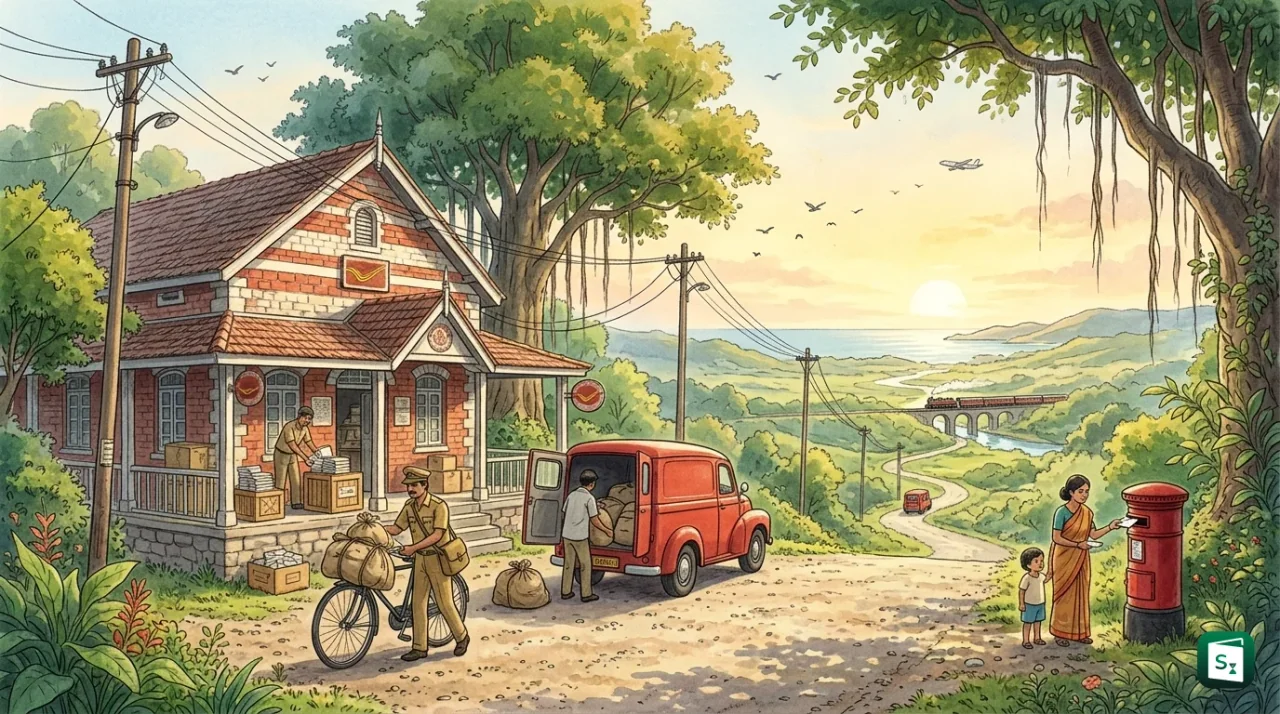
World Post Day 2026 was observed on 9 October under the theme “One Postal Network, Infinite Possibilities,” marking 152 years since the Universal Postal Union was founded in Bern, Switzerland. The day celebrates a global postal system that now spans more than 660,000 post offices and connects governments, businesses and citizens across 192 member countries. In India, the observance opened National Postal Week 2026, a seven-day programme from 9 to 15 October that showcases the transformation of India Post into a modern, technology-enabled and citizen-centric network.
What Is World Post Day and Why Is It Observed on 9 October?
World Post Day is an annual observance held on 9 October, the anniversary of the signing of the Treaty of Bern in 1874, which created the Universal Postal Union. It recognises the role of postal services in communication, trade and public service delivery.
The date marks a quiet diplomatic breakthrough. In the mid-nineteenth century, every country followed its own postal rules, rates and transit arrangements. A letter crossing several borders could take weeks and cost a small fortune. Merchants, migrants and governments all wanted one predictable system.
How the Universal Postal Union Was Born in Bern
The idea came from Heinrich von Stephan, a senior postal official in the North German Confederation. He prepared a plan for an international postal union, and at his suggestion the Swiss government convened a conference in Bern on 15 September 1874. Representatives from 22 nations attended.
On 9 October 1874, the delegates signed the Treaty of Bern, establishing the General Postal Union. The treaty created a single postal territory for the exchange of letters, removed transit barriers and introduced uniform treatment of foreign and domestic mail. Membership grew so quickly that the organisation was renamed the Universal Postal Union (UPU) in 1878.
| Feature | Detail |
|---|---|
| Founded | 9 October 1874, Bern, Switzerland |
| Original name | General Postal Union |
| Renamed | Universal Postal Union, 1878 |
| Headquarters | Bern, Switzerland |
| Member countries | 192 |
| UN specialised agency | Since 1 July 1948 |
| World Post Day declared | 1969 UPU Congress, Tokyo |
| India’s membership | 1 July 1876, first Asian member |
The UPU is the second oldest international organisation in the world after the International Telecommunication Union. It sets the rules for international mail exchange and advises member countries on postal policy, regulation and technical cooperation.
World Post Day itself is younger than the union. The UPU Congress held in Tokyo in 1969 declared 9 October as World Post Day, and member countries have observed it annually since then. India joined the UPU on 1 July 1876, becoming the first Asian nation to do so.
What Is the Theme of World Post Day 2026?
The theme for World Post Day 2026 is “One Postal Network, Infinite Possibilities.” It highlights how a single, trusted global network connects people, businesses and governments to financial, digital, social and emergency services, especially where no other public institution is present.
The theme reflects a change in how postal operators see themselves. The post is no longer only a channel for letters and parcels. It is increasingly a platform for financial inclusion, public service delivery, digital participation and economic opportunity. In rural and remote areas, the local post office is often the only government presence within reach.
United Nations Secretary-General António Guterres, in his message for the 2026 observance, pointed to the scale of the network: more than 660,000 post offices and 4.6 million staff worldwide. He noted that the same network helps a young person open a first digital bank account, a family access virtual healthcare, a small business reach global markets and an elderly citizen receive a visit.
Masahiko Metoki is the Director General of the UPU (as of October 2026). He has described postal infrastructure as one of the most enduring examples of international cooperation, built on a network of trust that connects people, communities and nations through universal service.
The UPU estimates that around 2.2 billion people remain offline. Governments are increasingly using postal counters and postal staff to extend digital and financial services to these citizens. That approach also creates new revenue streams for postal operators, many of which face pressure on traditional mail income.
The global campaign uses the hashtags #WorldPostDay and #OnePostalNetwork. Postal operators are sharing stories of how their networks support financial services, government services, emergency relief and e-commerce.
The 2026 observance also featured the 55th International Letter-Writing Competition of the UPU. Twelve-year-old Zhiyuan Si from China won first prize, selected from more than 1.48 million letters submitted by young writers in 65 countries. The winner was invited to the World Post Day ceremony at the UPU International Bureau in Bern.
National Postal Week 2026: The Day-by-Day Calendar
India observes National Postal Week from 9 to 15 October 2026, beginning with World Post Day. The Department of Posts has assigned a specific theme to each working day, covering philately, financial inclusion and citizen services, mail and parcel operations, and technology and innovation.
| Date | Themed Day | Focus |
|---|---|---|
| 9 October (Friday) | World Post Day | Universal role of postal services in connecting people, communities and businesses |
| 12 October (Monday) | Fun with Philately Day | Stamps, postal heritage and philately as a means of learning |
| 13 October (Tuesday) | Financial Inclusion & CCS Day | Post Office Savings Bank schemes, financial inclusion and Citizen Centric Services |
| 14 October (Wednesday) | Mails & Parcels Day | Reliable, efficient and accessible mail and parcel services |
| 15 October (Thursday) | Technology & Innovation Day | Digital tools and innovation in postal operations and service delivery |
The calendar leaves out 10 and 11 October, which fall on a weekend. Each themed day is used by postal circles across the country to run awareness camps, customer outreach programmes and school-level activities.
Citizen Centric Services (CCS) is one of the six business verticals of the Department of Posts. It covers services delivered on behalf of other government departments, such as Post Office Passport Seva Kendras and Aadhaar enrolment and updation. The financial inclusion day therefore highlights both savings products and the department’s wider role as a service delivery point for citizens.
The week is organised around the motto “Dak Sewa, Jan Sewa,” which presents postal work as a form of public service. The Department of Posts uses the occasion to explain its newer initiatives, including N-Gen Post Offices, Jan Sewa Connect Post Offices, the Dak Sewa App and the Dak Mitra App.
India Post: Inside the World’s Largest Postal Network
India Post, officially the Department of Posts, runs the largest postal network in the world. As of 31 March 2025, it operated 164,999 post offices, including 149,385 rural and 15,614 urban offices, making it the most widely distributed postal system in any country.
The department functions under the Ministry of Communications. At the top is the Postal Services Board, the apex management body, which comprises a Chairman and seven members. The members hold portfolios such as Personnel, Operations, Technology, Financial Services, Human Resource Development, Infrastructure, and Service Quality and Marketing.
Subrat Das is the Secretary, Department of Posts, and Chairperson of the Postal Services Board (as of October 2026). Manisha Sinha took charge as Director General of Postal Services on 1 October 2026.
| Indicator | Figure |
|---|---|
| Total post offices (31 March 2025) | 1,64,999 |
| Rural post offices | 1,49,385 |
| Urban post offices | 15,614 |
| Head post offices | 810 |
| Sub post offices | 24,281 |
| Branch post offices | 1,39,908 |
| Share of offices in rural areas | About 90.5 per cent |
| Postal circles | 23, plus a Base Circle for the armed forces |
| PIN codes covered | 19,101 |
| Average population served per post office | 8,566 |
For administration, the country is divided into 23 postal circles, each headed by a Chief Postmaster General. A separate Base Circle, headed by an Additional Director General of the Army Postal Service in the rank of Major General, looks after postal services for the armed forces.
Branch post offices, the smallest units in the network, are run by Gramin Dak Sevaks (GDS). They are not regular central government employees, and their service conditions are governed by separate GDS rules. These village-level offices are the reason India Post can reach habitations that commercial couriers usually avoid.
The department handles ordinary mail, registered post, Speed Post, parcels and the Express Mail Service (EMS) for international delivery. Speed Post was introduced on 1 August 1986 and remains one of its best-known products.
How India Post Powers Financial Inclusion
India Post is one of the country’s largest financial inclusion channels. Its Post Office Savings Bank (POSB) serves more than 47 crore account holders (as of 2025), and its counters sell every major small savings instrument backed by the Government of India.
The savings portfolio ranges from a basic savings account to long-term instruments such as the Public Provident Fund and the Sukanya Samriddhi Account. Interest rates are notified by the Ministry of Finance every quarter.
| Scheme | Interest Rate (October to December 2026) |
|---|---|
| Post Office Savings Account | 4.0% |
| 1-year Time Deposit | 6.9% |
| 2-year Time Deposit | 7.0% |
| 3-year Time Deposit | 7.1% |
| 5-year Time Deposit | 7.5% |
| 5-year Recurring Deposit | 6.7% |
| Monthly Income Scheme | 7.4% |
| Senior Citizens’ Savings Scheme | 8.2% |
| National Savings Certificate | 7.7% |
| Kisan Vikas Patra | 7.5% |
| Public Provident Fund | 7.1% |
| Sukanya Samriddhi Account | 8.2% |
The rates were left unchanged for the October to December 2026 quarter, the tenth consecutive quarter without a revision. The last change was made in the December 2024 review, when the Sukanya Samriddhi Account and the 3-year time deposit rates were raised.
Beyond savings, the postal network delivers pension payments, MGNREGS wages and other government benefits. During January to December 2025, India Post delivered about 1.40 crore Aadhaar PVC cards, 2.61 crore Electoral Photo Identity Cards and 17.45 crore Aadhaar letters.
Postal Life Insurance and India Post Payments Bank
Postal Life Insurance (PLI) dates back to 1884, when it was introduced for postal employees. It later opened to other government and semi-government organisations. Rural Postal Life Insurance (RPLI) extends similar cover to people in rural areas, including farmers, artisans and self-help group members.
India Post Payments Bank (IPPB) is a separate institution. It was launched on 1 September 2018 as a 100 per cent government-owned payments bank under the Department of Posts, with a licence from the Reserve Bank of India. IPPB had more than 120 million customers as of August 2025.
IPPB offers zero-balance savings accounts, doorstep banking through postmen and Gramin Dak Sevaks, Aadhaar-enabled payments, direct benefit transfers and bill payments. A payments bank cannot lend, so IPPB does not give loans. Its savings rates are lower than a Post Office Savings Account, at about 2.0 per cent on balances up to ₹1 lakh and 2.25 per cent up to ₹2 lakh.
The combined outcome is significant. A person in a remote village can open a savings account, buy a National Savings Certificate, pay an electricity bill, receive a pension and get life insurance cover without travelling to a district headquarters.
The Digital Upgrade: N-Gen Post Offices, DIGIPIN and New Apps
India Post is modernising its network through N-Gen Post Offices, Jan Sewa Connect post offices, the Dak Sewa and Dak Mitra apps, a 10-digit DIGIPIN addressing system and the Advanced Postal Technology platform. Together, these changes move the department from manual registers and paper accounting to a digitally integrated delivery system.
N-Gen Post Offices are redesigned service spaces with modular counters, better accessibility and digital service points. The 100th N-Gen Post Office was inaugurated at North Eastern Hill University in Shillong in 2026. Jan Sewa Connect is a flagship modernisation project that turns post offices into one-stop service centres, combining postal, banking, insurance, Aadhaar and passport-related services under one roof.
The Dak Sewa App gives citizens round-the-clock access to postal services, including tracking, booking, complaints, post office and PIN code locators, pickup requests and digital payments. The Dak Mitra App is meant for postal staff and Gramin Dak Sevaks. It is deployed across about 1.3 lakh branch post offices and helps employees manage savings bank accounts, postal insurance, mail and parcels on a single platform.
What Is DIGIPIN and How Does It Work?
DIGIPIN is a 10-character alphanumeric digital address code developed by the Department of Posts with IIT Hyderabad. It divides the country into a grid of 4 metre by 4 metre cells and assigns each cell a unique code, so that a location can be identified far more precisely than a PIN code allows.
The beta version was launched on 19 July 2024. Because the code is grid-based, it can support last-mile delivery, emergency response, logistics planning and geospatial governance. It is also designed to work with open-source mapping data, which makes it useful beyond the postal department.
The Advanced Postal Technology platform, part of the IT Modernisation Project 2.0, was rolled out across nearly 1.65 lakh post offices, completing coverage of all 23 postal circles on 4 August 2025. It introduced cloud-ready systems, end-to-end digital processing from booking to delivery, QR-code payments, OTP-based delivery and improved analytics.
The legal framework changed alongside the technology. The Post Office Act, 2023, passed on 24 December 2023 and brought into force on 18 June 2024, replaced the Indian Post Office Act of 1898. It allows the department to deliver services for public and private entities through agreements and makes track-and-trace a standard feature for parcels. The Post Office Rules, 2024 and Post Office Regulations, 2024 came into effect on 16 December 2024, with 19 rules and 180 regulations.
India’s Role in the Global Postal System
India has been a member of the Universal Postal Union since 1 July 1876 and is among its most active participants. At the 28th UPU Congress in Dubai in 2025, India was re-elected to both the Council of Administration and the Postal Operations Council, the two key standing bodies of the union.
| UPU Body | Role |
|---|---|
| Congress | Highest decision-making body, meets every four years |
| Council of Administration (CA) | Policy, regulatory and governance matters |
| Postal Operations Council (POC) | Technical and operational modernisation |
| International Bureau | Permanent secretariat based in Bern |
The Council of Administration handles policy, regulatory and governance questions. The Postal Operations Council is the technical and operational body that drives the modernisation of postal services worldwide. India has expressed its intention to take a leadership role in the Council of Administration during the current cycle.
On 9 September 2025, at the Dubai Congress, Union Minister of Communications Jyotiraditya Scindia unveiled the UPI-UPU integration project. The Department of Posts, NPCI International Payments Limited and the UPU developed the project. It connects India’s Unified Payments Interface with the UPU’s Interconnection Platform, so that cross-border remittances can use the postal network along with digital payment rails.
India has also pushed e-commerce facilitation through Dak Ghar Niryat Kendras, which are post office-based export support centres for small businesses, artisans and farmers. These centres help sellers with documentation, packaging and international shipping. India has supported postal capacity building in other countries through the Indian Technical and Economic Cooperation programme as well.
The UPU itself marked its 150th anniversary in 2024. The organisation began with 22 countries and now has 192 member states, which makes it one of the most widely subscribed international bodies in the world.
What Challenges Does India Post Face Now?
India Post is growing in parcels and citizen services but still depends heavily on a shrinking letter-mail business. It must improve delivery speed, tracking accuracy and customer support while competing with private couriers and managing the cost of its vast rural network.
In the first quarter of 2026-27, the department recorded its highest-ever first-quarter revenue of more than ₹4,000 crore, a 22 per cent year-on-year increase. Growth was broad-based across its six business verticals.
| Business Vertical | Year-on-Year Growth in Q1 2026-27 |
|---|---|
| Citizen Centric Services | 86% |
| Parcels | 50% |
| Mails | 42% |
| International Relations & Global Business | 34% |
| Postal Life Insurance and Rural Postal Life Insurance | 20% |
| Post Office Savings Bank | 10% |
Citizen Centric Services and parcels grew fastest, reflecting the shift towards service delivery and e-commerce logistics. The savings bank vertical, which holds the largest customer base, grew more slowly.
The pressure points are well known. Letter mail has declined for years as email, messaging apps and digital payments replace paper. Private couriers compete aggressively on speed, tracking and doorstep pickup. India Post must match them on reliability while continuing to serve remote areas that are not commercially attractive.
Digitisation brings its own risks. During Cyber Awareness Month in October 2026, the Department of Posts organised staff sessions on phishing and AI-based attacks. Public awareness about OTP fraud, fake tracking links and fraudulent calls in the name of India Post is equally important, because the trust attached to the postal name makes it a tempting cover for scammers.
The Road Ahead
The immediate priorities are operational. India Post needs faster parcel handling, accurate tracking, smoother returns and better customer support at the counter and on the phone. Expanding N-Gen and Jan Sewa Connect post offices, widening DIGIPIN adoption and growing IPPB’s doorstep banking reach are part of the same effort.
The larger goal is to keep the universal service obligation intact while building new revenue streams. The postal network is not only a commercial asset. It is the state’s assurance that a letter, a pension, a medicine or an identity document can reach a citizen wherever that citizen lives.
How well India Post turns its 1.64 lakh touchpoints into reliable, digital-first service points will determine whether the 2026 theme’s “infinite possibilities” become an everyday reality.
Key Takeaways
- World Post Day is observed every 9 October, the anniversary of the Treaty of Bern, 1874, which established the Universal Postal Union.
- The 2026 theme is “One Postal Network, Infinite Possibilities,” and the global postal network covers more than 660,000 post offices with 4.6 million staff.
- The UPU, headquartered in Bern, Switzerland, has 192 member countries, is the second oldest international organisation after the ITU, and became a UN specialised agency on 1 July 1948.
- India joined the UPU on 1 July 1876, becoming the first Asian member, and was re-elected to the UPU’s Council of Administration and Postal Operations Council at the 28th Congress in Dubai in 2025.
- National Postal Week 2026 ran from 9 to 15 October, with Fun with Philately Day on 12 October, Financial Inclusion and CCS Day on 13 October, Mails and Parcels Day on 14 October and Technology and Innovation Day on 15 October.
- India Post operated 164,999 post offices as of 31 March 2025, including 149,385 rural offices, across 23 postal circles and a Base Circle for the armed forces.
- The Post Office Act, 2023 replaced the Indian Post Office Act, 1898 and came into force on 18 June 2024, while the Post Office Rules, 2024 and Regulations, 2024 took effect on 16 December 2024.
- DIGIPIN is a 10-character alphanumeric address code built on a 4 metre by 4 metre grid, launched in beta on 19 July 2024.