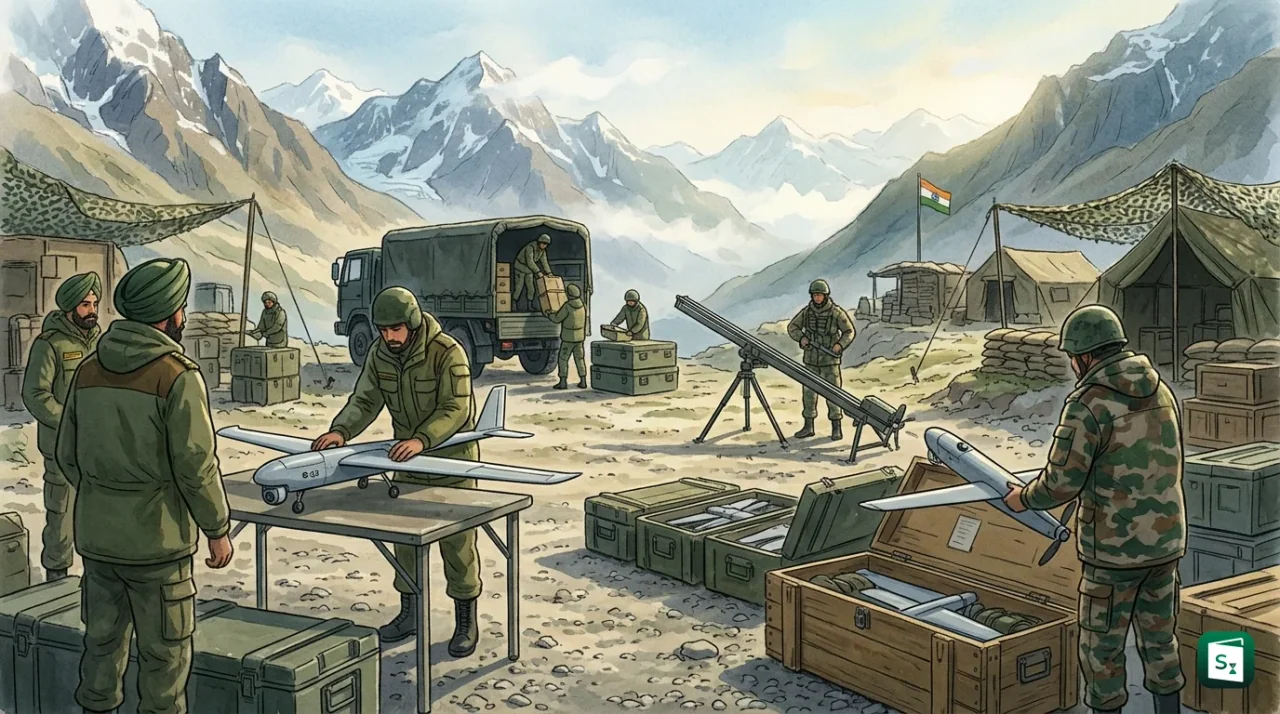
Solar Defence and Aerospace Limited (SDAL) delivered 450 Nagastra-1R loitering munitions to the Indian Army on 13 October 2026, completing a ₹158 crore emergency order placed in June 2025. The Nagpur-based subsidiary of Solar Industries India Limited described it as the largest single-batch supply of loitering munitions to the Army by any manufacturer. The delivery gives frontline troops a short-range, indigenous “kamikaze” drone that can hover over a target, strike with two-metre accuracy, or abort the attack and return for recovery.
What Is the Nagastra-1R Loitering Munition?
The Nagastra-1R is an indigenous, man-portable loitering munition built for short-range precision strikes. It carries a one-kilogram high-explosive warhead, uses GPS-guided navigation for a circular error probable of two metres, and can loiter over a battlefield before diving into a confirmed target.
A loitering munition sits between a drone and a missile. Like a drone, it can stay airborne and send back live video while searching for a target. Like a missile, it destroys itself on impact. This dual nature allows a commander to inspect a target area for several minutes before deciding whether to strike, which is useful against militants, infiltrators and vehicles that appear only briefly.
The Nagastra-1R is a revised, short-range configuration built to the Army’s specifications. The system is designed to engage soft-skin targets such as troops and unarmoured vehicles at close quarters. Service sources describe an engagement envelope of about five kilometres, extendable to 10 kilometres, with an autonomous-mode range of about 15 kilometres.
What separates the Nagastra-1R from most one-way attack drones is its abort-and-recover feature. If the target cannot be confirmed, or if the mission is called off after launch, the operator can redirect the munition back to the control station. It then descends under a parachute and can be retrieved for future use. The launcher itself is pneumatic and fully reusable, which lowers the cost of every sortie.
Analogy · A Reusable Kamikaze Expand analogy
Think of a conventional missile as a stone thrown at a target: once released, it cannot change its mind. A loitering munition is closer to a trained bird that circles above, watches the ground, and only dives when the handler confirms the target. The Nagastra-1R goes one step further, because the handler can call the bird back if the strike no longer makes sense.
Nagastra-1R Specifications at a Glance
The Nagastra-1R packs a one-kilogram warhead into a man-portable system weighing about 30 kilograms, including its ground control station, communication unit and pneumatic launcher. It is optimised for short-range attacks, night operations and targets that require visual confirmation before engagement.
| Parameter | Detail |
|---|---|
| Role | Short-range loitering munition, also called a kamikaze or suicide drone |
| Manufacturer | Solar Defence and Aerospace Limited (SDAL), Nagpur |
| Parent company | Solar Industries India Limited |
| Warhead | 1 kg high-explosive, designed for soft-skin targets such as troops and vehicles |
| Guidance | GPS-guided navigation with a 360-degree gimbal camera |
| Night capability | Optional thermal imaging camera |
| Accuracy | Circular Error Probable (CEP) of 2 metres |
| Engagement range | Targets within about 5 km; service sources cite up to 10 km |
| Autonomous range | About 15 km |
| Endurance | About 40 minutes, roughly double the Army’s stated requirement |
| System weight | About 30 kg for the complete man-portable set |
| Launcher | Pneumatic, fully reusable |
| Detection avoidance | Low acoustic signature; difficult to detect above 200 metres |
| Recovery | Abort, return and parachute landing |
| Indigenous content | More than 80 per cent |
| Contract value | ₹158 crore for 450 units, or roughly ₹35 lakh per munition |
The circular error probable is a standard measure of weapons accuracy. A CEP of two metres means that half of all rounds fired at a target are expected to land inside a circle of that radius around the aim point. For a weapon carrying a one-kilogram fragmentation warhead, that level of precision reduces the risk of collateral damage and the number of munitions needed to neutralise a target.
The optional thermal camera matters because most infiltration and counter-insurgency activity takes place after dark. A unit that can identify a target at night without illuminating it holds a clear advantage. The encrypted video and telemetry links also make it harder for an adversary to jam the control channel or intercept the feed.
Who Makes the Nagastra Drone?
The Nagastra drone is made by Solar Defence and Aerospace Limited (SDAL), a wholly owned subsidiary of Nagpur-based Solar Industries India Limited. SDAL, formerly known as Economic Explosives Limited, builds the loitering munition family in Nagpur, Maharashtra, in association with Bengaluru-based Z Motion Autonomous Systems.
Solar Defence and Aerospace Limited
SDAL is the defence arm of the Solar Group, which began as an industrial explosives business and later moved into military explosives, warheads, rockets and unmanned systems. The company is headquartered in Nagpur and is a supplier to the Indian Army and the Indian Navy.
Its broader product range explains why the Nagastra programme moved quickly. The group already manufactured propellants, warheads and high explosives, which are the most sensitive components of a loitering munition. That backward integration allowed SDAL to design and produce the munition largely within India, with more than 80 per cent indigenous content. The company is now working on indigenising the electric motors, one of the few imported components that remain.
The group also produces the Pinaka multi-barrel rocket system and is developing the Bhargavastra counter-drone system and the Rudrastra vertical take-off and landing unmanned aerial vehicle. In January 2026, Defence Minister Rajnath Singh inaugurated SDAL’s automated medium-calibre ammunition plant in Nagpur and flagged off the first tranche of Guided Pinaka rockets for export to Armenia.
Solar Industries has invested heavily in expanding this defence base. It acquired 223 acres in the MIHAN special economic zone in Nagpur for unmanned systems, robotics and next-generation defence technology, with a planned investment of ₹12,780 crore and an expected 6,800 jobs. The group’s total order book stood at about ₹21,300 crore in 2025-26, and defence revenue nearly doubled to ₹2,634 crore that year.
Why the Company Matters for Self-Reliance
The Nagastra line is a rare example of a private Indian firm winning a competitive Army trial against foreign suppliers. In 2023, Economic Explosives Limited defeated Poland’s WB Electronics Warmate and Israel’s UVision Air to win the initial Nagastra-1 contract. That order was worth about ₹212 crore for 480 munitions, and the company delivered the full lot by December 2024.
The significance goes beyond one contract. Loitering munitions consume quickly in combat, so a domestic production line is as important as the weapon itself. SDAL’s Nagpur facility has been built to produce up to 1,000 loitering munitions a year, which gives the Army a replenishment source that does not depend on foreign approvals or shipping timelines.
From Operation Sindoor to a ₹158 Crore Emergency Order
The 450-unit order followed Operation Sindoor, the 88-hour military operation India launched on 7 May 2025 in response to the Pahalgam terror attack of 22 April, in which 26 people were killed. Indian forces used loitering munitions, including the Nagastra-1 and the Israeli Harop, to strike terrorist and military infrastructure across the border.
The operation also revealed how quickly such stocks are used up. The Ministry of Defence later acknowledged in its Annual Report 2025-26 that indigenous industry could not supply enough niche drones, counter-drone systems and loitering munitions during the operation. That admission shaped the procurement response.
The Trial Route
The Army’s technical trials for a short-range loitering munition were held in March 2025 at the Special Forces Training School in Bakloh, Himachal Pradesh. Four companies took part. According to SDAL, it was the only firm that demonstrated every operational parameter the Army had specified. The system was also evaluated in live firing for target-hit accuracy, and the Nagastra family has been tested in the cold and high-altitude conditions of Ladakh and at the Babina field firing range near Jhansi in Uttar Pradesh.
| Date | Development |
|---|---|
| April 2023 | Army orders 480 Nagastra-1 munitions under emergency procurement for about ₹212 crore |
| June 2024 | First 120 Nagastra-1 units delivered to the Pulgaon ammunition depot |
| December 2024 | Full batch of 480 Nagastra-1 munitions delivered |
| March 2025 | Trials for the short-range variant at the Special Forces Training School, Bakloh; four firms participate |
| 22 April 2025 | Pahalgam terror attack kills 26 people |
| 7 to 10 May 2025 | Operation Sindoor; Nagastra-1 and other loitering munitions used against targets in Pakistan and Pakistan-occupied Kashmir |
| June 2025 | ₹158 crore emergency order placed for 450 Nagastra-1R units, with delivery required within a year |
| 13 October 2026 | SDAL completes delivery of all 450 units in a single batch |
Why Emergency Procurement Was Used
After Operation Sindoor, the Defence Ministry granted the armed forces emergency procurement powers to buy urgently needed equipment outside the normal, slower acquisition cycle. The Army used these powers to sign contracts worth about ₹295 crore with two Indian firms: ₹158 crore with SDAL for the Nagastra-1R and ₹137 crore with ideaForge Technology for hybrid mini unmanned aerial vehicles used for surveillance.
Emergency procurement is a temporary route, not a substitute for standard procurement. It allows the services to respond to an immediate operational gap, but the equipment still has to pass trials and meet the stated parameters. In this case, the contract required delivery within 12 months. SDAL completed the supply in a little over a year.
The larger picture is the scale of post-Sindoor buying. The armed forces have signed emergency procurement contracts worth around ₹30,000 crore, largely for drones, counter-drone systems, radars and electronic warfare equipment. In August 2026, the Defence Ministry signed two more contracts worth ₹1,577 crore with Tata Advanced Systems and Nibe for loitering munitions and associated equipment for artillery regiments.
How Does a Loitering Munition Work?
A loitering munition is launched into a target area, where it circles or “loiters” while its camera sends live images to an operator. Once a target is identified and confirmed, the munition dives into it and explodes. If no valid target is found, it can be recalled or recovered.
The sequence is straightforward. After launch from a pneumatic tube, a rail or a vehicle-mounted canister, the munition flies to the target area and begins to circle, giving the operator time to survey the ground. The operator, or an onboard system, then identifies and confirms the target. The strike usually comes in a steep dive, which reduces the warning time available to the target.
A human is kept in the loop for the final decision in most current systems, including the Nagastra-1R. The operator sees the video feed, selects the aim point and can abort the attack. This matters for legal and ethical reasons as well as military ones, because it allows the chain of command to verify that the target is legitimate.
Loitering Munition, Drone or Missile?
The three categories overlap, but they are not the same. A surveillance drone is meant to observe and return. A cruise missile is meant to fly a pre-planned route and strike a fixed target. A loitering munition combines the watching role of the first with the strike role of the second.
| Feature | Loitering munition | Surveillance drone | Cruise missile |
|---|---|---|---|
| Primary purpose | Search, confirm and destroy a target | Observe and gather intelligence | Strike a pre-planned target |
| Warhead | Built in | Usually none | Built in |
| Recovery | Sometimes recoverable if the mission is aborted | Normally returns to base | Not recoverable |
| Operator control | Man-in-the-loop during flight | Remote or pre-programmed | Fire and forget after launch |
| Flight profile | Loiters over the target area | Loiters for surveillance | Flies a fixed route at speed |
| Relative cost | Lower than a missile, higher than a small drone | Varies widely | High |
The loitering munition concept first emerged in the 1980s as a way to hunt enemy air-defence radars. Israel’s Harpy was among the first widely exported systems, and India operates both the Harpy and the larger Harop. The weapons gained global attention during the 2020 Nagorno-Karabakh conflict, when Azerbaijan used Harop and other drones against Armenian air defences and armoured vehicles. The Russia-Ukraine war then pushed production to industrial scale, with systems such as the Polish Warmate, the Russian Lancet and the American Switchblade being used in large numbers.
India’s inventory reflects this history. Alongside the indigenous Nagastra family, the Army and Air Force operate imported systems including the Harop, the Harpy, the Elbit SkyStriker and the Warmate. The difference now is that a growing share of the arsenal is designed and built at home.
The Wider Nagastra Family and India’s Loitering Munition Push
The Nagastra-1R is one member of a rapidly expanding family. Solar Defence and Aerospace lists several variants, including the baseline Nagastra-1, the 1B, an FPV version, a man-portable loitering munition system, the Nagastra-2, the 2B and the Nagastra-3. Each is meant for a different range, warhead size and launch platform.
| Variant | Role and key features |
|---|---|
| Nagastra-1 | India’s first indigenous loitering munition; 1 kg warhead; about 30 km in autonomous mode; inducted in 2024 |
| Nagastra-1R | Short-range, night-capable variant; 1 kg warhead; reusable launcher; delivered in 2026 |
| Nagastra-2 | Two-man portable system weighing about 20 kg; 4 kg anti-tank and anti-personnel warhead; dual day and night sensors |
| Nagastra-2B | Bunker-buster variant designed to breach reinforced concrete structures and engage main battle tanks |
| Nagastra-3 | Vehicle- or canister-launched long-range system; about 100 km range; heavier warhead; under development |
The Nagastra-3 is the most ambitious of the group. It is being developed as a prototype under the Medium Range Precision Kill System programme, with a Project Sanction Order from the Ministry of Defence and funding under the Make-I category of the Defence Acquisition Procedure 2020. Make-I covers government-funded design and development projects, and it is the route India uses for weapons that industry is not yet ready to build on its own.
Beyond the Nagastra line, SDAL is working on a canister-launched anti-armour loitering munition for infantry fighting vehicles and a family of longer-range “Kalsastra” drones capable of carrying warheads of up to 50 kg. These systems point to a future where loitering munitions are not a specialist add-on but a standard part of every armoured and infantry formation.
The Army’s own plans are equally broad. Its technology roadmap for unmanned aerial systems and loitering munitions, released in April 2026, identifies requirements across 80 types of systems, covering surveillance, precision strike, munition dropping, air defence, jamming, mine warfare, data relay and logistics. The stated ambition is to make India a global drone manufacturing hub by 2030.
How the Army Is Reorganising Around Drones
The Nagastra delivery is part of a wider organisational shift, not an isolated purchase. After Operation Sindoor, the Army began creating dedicated drone units and sub-units instead of treating unmanned systems as add-on equipment handled by soldiers with other duties.
In August 2026, the Army raised its first dedicated drone battalion, named the Baaz Battalion, in Jalandhar under the 11 Corps, also called the Vajra Corps. The unit is meant to act as a central hub for drone operations, data analysis and maintenance on the western front. It will handle larger platforms such as the Searcher, Heron and Hermes, and eventually the MQ-9B, while smaller tactical systems remain with frontline units.
At the lower level, infantry battalions are raising Ashni platoons for reconnaissance and offensive drone operations. The Regiment of Artillery is creating Divyastra batteries equipped with surveillance drones and loitering munitions, along with Shaktibaan regiments focused on unmanned systems and precision firepower. The Army has also ordered the raising of Bhairav battalions, light commando units of about 250 personnel each, for high-tempo and hybrid operations, and is developing Rudra brigades as integrated all-arms formations.
The Ministry of Defence’s Annual Report 2025-26 records that the Army has already manufactured 819 drones in-house with small and medium enterprises, including surveillance, armed and first-person-view types. It has also developed precision-targeting software called LAKSHYA-PT with ADRIN, an ISRO-affiliated centre, to improve target acquisition without depending on foreign agencies.
Why the 450-Unit Delivery Matters
For a forward infantry unit, the Nagastra-1R offers a way to hit a target without calling in artillery or exposing soldiers to fire. A patrol that spots a group of infiltrators near the Line of Control can launch the munition, watch the feed, confirm the target and strike within minutes. The abort option means a doubtful sighting does not automatically become a fatal attack.
Operational Gains for Frontline Units
The short range is a deliberate design choice. The 1R is meant for targets that are close enough for a ground unit to see and verify, not for deep strikes into enemy territory. That makes it a tactical weapon for patrolling, counter-infiltration and local defence, while longer-range systems such as the Nagastra-1 and Nagastra-3 handle deeper targets.
The low acoustic signature is another advantage. Because the munition is electrically powered, it is difficult to hear or detect at heights above 200 metres. A target may realise it is under observation only when the munition is already diving. That short warning time is central to the weapon’s effectiveness.
A Test Case for Atmanirbhar Bharat
The contract works out to roughly ₹35 lakh per munition, a fraction of the cost of imported loitering munitions and far below a guided missile. The price reflects local production, reusable launchers and a supply chain that is more than 80 per cent Indian. For the Army, the advantage is not only cost but availability: a domestic line can replenish stocks during a conflict instead of waiting for foreign deliveries.
The delivery also validates the emergency procurement model. A weapon trialled in March 2025 was ordered in June 2025 and fully delivered by October 2026. That is fast by the standards of India’s normal defence acquisition cycle, and it shows that a private firm with an existing production base can move quickly when the requirement is clearly defined.
The Limits
Loitering munitions are not a substitute for artillery, air power or armoured formations. The Nagastra-1R carries a small warhead, has a short range and depends on GPS and a communication link. Enemy jamming, bad weather and GPS denial can reduce its effectiveness. Its low cost also means it is best used against soft targets, not fortified positions.
The Ministry of Defence’s own annual report acknowledged that indigenous industry could not meet the full demand for niche unmanned systems during Operation Sindoor. The 450-unit delivery narrows that gap for one category, but it does not close it. India still imports several categories of loitering munitions and remains dependent on foreign suppliers for some high-end sensors and components.
The Road Ahead
Solar Defence and Aerospace is moving from a single proven product to a family of systems. The immediate priorities are the Nagastra-2 and Nagastra-3, the canister-launched anti-armour munition for mechanised infantry, and the longer-range Kalsastra drones. Indigenising the electric motors is the next step in raising local content beyond the current 80 per cent.
The Army, meanwhile, is shifting from emergency purchases to a more predictable procurement model. The 2026 technology roadmap is intended to create a steady pipeline across 80 categories of unmanned systems, so that units can train, maintain and replenish equipment on a standard schedule rather than through ad hoc orders. The creation of drone platoons, batteries and battalions gives those systems a permanent place in the order of battle.
Exports are another opening. India has begun exporting the Pinaka rocket system, and the Defence Ministry has set a target of positioning the country as a global drone manufacturing hub by 2030. A combat-proven, low-cost loitering munition is a credible export product for countries that cannot afford Western systems.
The main risk is complacency. A single large delivery does not solve the larger problem of component dependence, production capacity or the need for counter-drone defences against similar systems in enemy hands. Pakistan and China are both expanding their own loitering munition inventories, which means the advantage from the Nagastra-1R will be temporary unless India keeps improving range, sensors, autonomy and electronic warfare resilience.
For now, the 450-unit delivery marks a clear milestone. It shows that an Indian private company can design a precision weapon, win a competitive trial, build it at scale and deliver it to the Army on time. Whether that becomes the norm rather than an exception will depend on the contracts that follow.
Key Takeaways
- Solar Defence and Aerospace Limited (SDAL) delivered 450 Nagastra-1R loitering munitions to the Indian Army on 13 October 2026, the largest single-batch supply of such weapons by a manufacturer.
- The order was placed in June 2025 under the Army’s emergency procurement powers for ₹158 crore, which works out to roughly ₹35 lakh per munition.
- The Nagastra-1R carries a 1 kg high-explosive warhead, has a circular error probable of 2 metres, more than 80 per cent indigenous content, and can abort a mission and return by parachute.
- The system was trialled in March 2025 at the Special Forces Training School in Bakloh, Himachal Pradesh, where four firms participated and SDAL was the only one to meet all operational parameters.
- The Nagastra-1 was used during Operation Sindoor in May 2025, which followed the Pahalgam terror attack of 22 April 2025 in which 26 people were killed.
- SDAL is a wholly owned subsidiary of Solar Industries India Limited, headquartered in Nagpur, and was formerly known as Economic Explosives Limited.