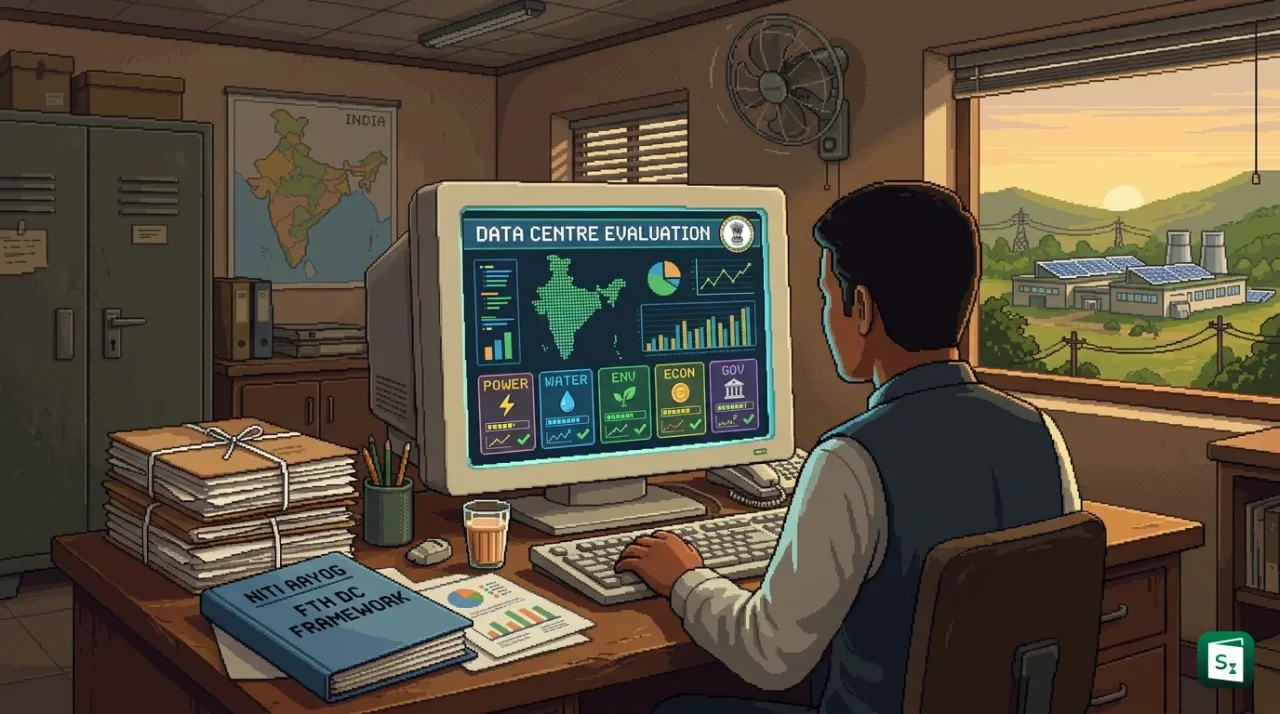
The Frontier Tech Hub of NITI Aayog released the Data Centre Evaluation Framework on 14 October 2026, giving states a common checklist to judge data centre investment proposals. The framework rests on five pillars: power and energy, water and cooling, siting and environmental sustainability, economic and strategic value, and policy, governance and implementation. It arrives as India races to expand computing capacity for artificial intelligence, cloud services and high-performance computing, even as power, water and land emerge as binding constraints.
What Is the Data Centre Evaluation Framework?
The Data Centre Evaluation Framework is a decision-support guide released by NITI Aayog’s Frontier Tech Hub on 14 October 2026. It gives states a common set of parameters to assess data centre proposals across power, water, siting, economic value and governance before granting approvals or incentives.
The framework was prepared by the NITI Frontier Tech Hub (FTH), the action tank launched on 5 March 2025 to study frontier technologies such as artificial intelligence, quantum computing and biotechnology. It was developed with inputs from the Ministry of Electronics and Information Technology (MeitY), the Ministry of Power and the Department for Promotion of Industry and Internal Trade (DPIIT).
The document was released in the presence of Prof. Abhay Karandikar, Member of NITI Aayog, and Anurag Jain, Chief Executive Officer of NITI Aayog (as of October 2026). NITI Aayog itself was constituted through a Cabinet resolution on 1 January 2015, replacing the Planning Commission, and functions as the Union government’s apex policy think tank with the Prime Minister as its Chairperson.
The framework is not a new law and does not add a fresh regulatory layer. States can apply its principles according to their own priorities, resource availability and development goals. Its central message is that states should stop competing only on the size of incentives and start competing on infrastructure readiness, resource security and measurable public value.
Why India’s Data Centre Boom Needs a Common Yardstick
India’s data centre capacity has grown quickly, but the next phase will be far larger. Installed capacity rose from about 375 MW in 2020 to roughly 1.57 GW by August 2026, and official projections point to nearly 8 GW by 2030. The Central Electricity Authority expects the sector’s power demand alone to reach about 17 GW by 2031-32.
| Indicator | Latest available figure |
|---|---|
| Installed capacity in 2020 | About 375 MW |
| Installed capacity in August 2026 | About 1.57 GW |
| Projected capacity by 2030 | Nearly 8 GW |
| Projected power demand by 2031-32 | About 17 GW |
| Announced investment commitments | More than $180 billion (as of September 2026) |
| Operational capacity in H1 2026 | 1,789 MW |
| Under construction and planned capacity in H1 2026 | 3,860 MW |
The money is arriving faster than the supporting infrastructure. Data centre investments were once measured in a few hundred million dollars. They now involve campuses of several hundred megawatts, built by global hyperscalers, domestic operators and real estate developers. A single large campus can draw more electricity than a mid-sized town and can lock up land and water for decades.
The Problem With Competing on Incentives Alone
Many states have responded with dedicated policies offering stamp duty waivers, electricity duty concessions, capital subsidies and faster clearances. As of September 2026, eleven states had dedicated data centre policies in force, and others support the sector through their information technology or industrial policies. The result is a race in which the size of the subsidy often matters more than whether the site can actually support the project.
Competing on subsidies alone creates two risks. A project may be announced with great publicity but stall because the substation, transmission line or water supply is not ready. Or it may be built in a region already facing water stress, forcing local households and farmers to compete with servers for a scarce resource. A common evaluation framework helps states separate credible projects from announcements that cannot be delivered.
Why Location and Resources Matter More Than Ever
Data centres are clustering in Mumbai, Chennai, Hyderabad and Delhi NCR, where fibre connectivity, customers and skilled workers are available. Mumbai alone accounts for nearly half of India’s operational capacity. These hubs are also among the most water-stressed urban centres in the country.
The demand gap is stark. Estimates presented at a NITI Aayog workshop in 2025 put India at nearly 20% of the world’s data generation but only about 3% of global data centre capacity. Closing that gap requires more than new buildings. It requires power connections that arrive on time, water allocations that survive a bad monsoon, and approval systems that do not leave developers waiting for years.
What Is a Data Centre and Why Does It Need So Much Power and Water?
A data centre is a secure facility that houses servers, storage systems and networking equipment. It keeps them powered, cooled and connected around the clock so that cloud platforms, banking systems, streaming services and artificial intelligence models can run without interruption.
Almost every unit of electricity used by a server turns into heat. That heat must be removed continuously, because overheating can slow machines down or damage them permanently. Older racks used about 1 to 3 kilowatts of power. Modern racks average around 8 kilowatts, and AI racks carrying high-end graphics processing units can draw far more. Denser racks mean more heat, which means more energy spent on cooling.
Understanding PUE, WUE and CUE
Three metrics decide how efficiently a facility uses resources. They now form part of India’s data centre standards, published by the Bureau of Indian Standards (BIS) in February 2026 through its LITD 31 technical committee. The standards are aligned with the ISO/IEC 30134 series and remain voluntary unless the government makes them mandatory.
| Metric | What It Measures | Typical Range or Benchmark |
|---|---|---|
| Power Usage Effectiveness (PUE) | Total facility power divided by power used by IT equipment | Ideal is 1.0; global average is about 1.57; efficient hyperscale sites run at 1.1 to 1.5 |
| Water Usage Effectiveness (WUE) | Litres of water consumed per kilowatt-hour of IT energy | Best-in-class is 0.1 to 0.3; evaporative cooling uses 1 to 2; arid sites can exceed 4 |
| Carbon Usage Effectiveness (CUE) | Carbon emissions per unit of IT energy | Lower is better; a fully renewable facility approaches zero |
Analogy · The Restaurant Bill Test Expand analogy
Think of PUE like a restaurant bill. If the food costs ₹100 but gas, rent and waiters add ₹60, the total bill is ₹160. A PUE of 1.6 means every ₹1 spent on computing pulls in 60 paise of supporting overhead such as cooling and power distribution.
The Energy and Water Trade-Off
Cooling choices involve a difficult trade-off. Air-cooled systems use almost no water but consume more electricity, with a typical PUE of about 1.6. Water-cooled systems bring PUE down to roughly 1.25 but can push WUE up to about 3 litres per kilowatt-hour. A policy that rewards low PUE alone can therefore quietly increase pressure on water.
The scale of water use is significant. A 1 MW data centre can consume up to 25.5 million litres of water a year for cooling. A 100 MW hyperscale campus using evaporative cooling can use around 2 million litres a day, roughly the daily demand of several thousand urban households. India’s data centres consumed an estimated 150 billion litres in 2024-25, a figure projected to reach about 358 billion litres by 2030.
Water stress makes this a national planning issue. India has 18% of the world’s population but only about 4% of its water resources. Several major data centre clusters sit in basins that are already stressed, and much of the sector’s water draw has historically gone unreported. The framework tries to make that invisible demand visible before a project is approved.
The Five Pillars States Will Use to Judge Projects
The framework asks states to evaluate every proposal across five pillars: power and energy, water and cooling, siting and environmental sustainability, economic and strategic value, and policy, governance and implementation. Each pillar comes with specific documents and tests that a developer must satisfy before approval and at every stage of commissioning.
Power and Energy
States are asked to assess grid readiness for the entire campus, not just the first phase. The developer, the distribution company and the state transmission utility must jointly validate a Power Readiness and Ramp-up Plan. This plan records total campus demand, built capacity, expected utilisation, sanctioned megawatts, year-wise energisation, substation upgrades and the entity responsible for each upgrade.
Load-flow studies must check feeder limits, voltage stability, transformer loading and contingency scenarios at 132 kV, 220 kV and 400 kV substations. Facilities above 20 MW are expected to be demand-response ready, with telemetry and control integration with the State Load Despatch Centre. The framework also pushes renewable and storage-backed supply, battery energy storage, microgrids and waste-heat recovery, while requiring operators to report operating PUE, CUE and site-level emissions.
Water and Cooling
States should prepare a 20 to 30 year seasonal water balance covering surface water, groundwater, municipal supply, treated wastewater and competing demand from agriculture and households. Before approval, water authorities, urban local bodies and irrigation departments must record the allocation, protected users, no-objection certificate validity, drought rules and infrastructure responsibility.
The framework separates water by use. It asks developers to distinguish facility-level cooling from rack-level cooling and to model peak summer demand at local conditions, including temperatures of about 40°C. Recycled or treated water counts as a deduction from freshwater demand only when it is contracted, connected and available from the day that capacity is commissioned. In high-stress basins, states may require rainwater harvesting, on-site treatment, storage or desalinated water.
Siting and Environmental Sustainability
States are told to look at future climate risk, not just current hazard maps. Coastal flooding, cyclones, seismic activity, heatwaves and ecological sensitivity all need assessment. Large campuses may also require a Community Impact Assessment covering water, traffic, drainage, emissions, noise, waste, emergency access, land-use change and local jobs.
The siting pillar adds a lifecycle view that most state policies currently lack. Developers must plan for e-waste, batteries, hazardous waste, diesel systems, IT asset disposal, recycling and eventual decommissioning. States are encouraged to designate data-centre-ready zones with pre-assessed grid, water, fibre and land readiness, and to mark red zones where development should be restricted because of hazard exposure, water stress or inadequate infrastructure.
Economic and Strategic Value
The framework asks states to measure what they get for what they give. A project’s net fiscal contribution over a defined period should be compared with the land, infrastructure, electricity duty, stamp duty, utility and capital support being offered. States must also assess local procurement, direct and indirect jobs, skilling, research and the share of domestic procurement in both IT and non-IT infrastructure.
Incentives should be linked to outcomes within the developer’s control. Disbursements can be tied to commissioning milestones, renewable supply, PUE or WUE targets, employment, procurement and capability building. The framework explicitly supports Make in India across servers, high-performance computing, AI hardware and the supporting software ecosystem.
Policy, Governance and Implementation
Every condition must have an owner. The framework asks states to map the facility owner, IT owner, workload controller, customer, data fiduciary or processor, regulated entity and incentive recipient. This avoids the familiar problem of conditions being imposed without any department being accountable for checking them.
States are encouraged to run a time-bound digital single-window mechanism and publish a Data Centre Approval Matrix listing each clearance, issuing authority, processing time, dependency, fee and escalation officer. Approved load, water use, safeguards, incentive milestones and grievances should be tracked publicly, while sensitive customer and security data stays confidential. A central audit mechanism with MeitY as the nodal ministry is also proposed.
How India’s Framework Compares With Global Practice
India is not the first economy to discover that data centre demand can outrun the infrastructure meant to support it. The framework studies several global clusters where rapid capacity growth collided with electricity grids, water systems, land availability and local communities.
| Jurisdiction | Lesson Cited in the Framework |
|---|---|
| Virginia, United States | Capacity growth outpaced grid, water, land and community systems |
| Dublin, Ireland | New projects are linked to additional electricity generation |
| Amsterdam, Netherlands | Grid and land constraints led to restrictions on new capacity |
| Singapore | Phased, climate-sensitive assurance on PUE and WUE |
| Johor, Malaysia, and Bangkok, Thailand | Incentive screening tightened for resource efficiency and domestic value |
The Indian framework draws a practical conclusion from these cases: set the rules before the constraints become a crisis. Ireland’s approach ties new connections to new generation. Singapore and several European systems require efficiency guarantees in phases rather than a single promise at approval. Malaysia and Thailand now screen incentives more closely for resource efficiency and domestic economic value.
India’s starting point is different. The country has no binding national data centre policy. A draft national policy circulated by MeitY in 2020 was never notified. Central support has instead come through infrastructure status for data centres above 5 MW in the Union Budget 2022-23, and a tax holiday until 2047 for eligible foreign cloud providers announced in the Union Budget 2026-27.
The new framework is therefore an attempt to fill a policy gap without imposing a national mandate. It offers common templates and benchmarks that states can adopt at their own pace. The risk is uneven adoption. A state that ignores the framework may still attract projects in the short run, while bearing the cost of strained grids and depleted aquifers later.
Why This Matters for India’s AI Ambitions
Artificial intelligence has turned data centres from back-office facilities into strategic infrastructure. Training and running large models requires thousands of GPUs working together, and those chips need dense power and cooling. A country that cannot site and service such facilities will struggle to build sovereign AI capacity, whatever its software talent.
The IndiaAI Mission, approved by the Union Cabinet on 7 March 2024 with an outlay of ₹10,371.92 crore over five years, is the government’s main vehicle for building that capacity. Its seven pillars cover compute infrastructure, an innovation centre for indigenous models, a datasets platform, application development, future skills, startup financing and safe and trusted AI. The mission initially aimed at 10,000 GPUs; by October 2025, more than 38,000 GPUs had been onboarded and were being offered at a subsidised rate of ₹65 per hour.
Data centres also support less visible parts of the economy. Cloud platforms, payment networks, government portals, insurers and hospitals all depend on them. Global hyperscalers, the largest builders of AI data centres, accounted for more than 80% of data centre absorption in the first half of 2026. That shows how quickly cloud and AI workloads are shaping domestic demand.
The competition is international. Vietnam, the UAE and Indonesia are actively courting the same investors. If Indian approvals take years while power and water remain uncertain, capital can move to another market. The framework tries to shorten that uncertainty by telling developers in advance what evidence they must produce and which authority will clear each condition.
There is an industrial upside too. A growing data centre sector creates demand for servers, networking gear, cooling systems, electrical equipment and skilled technicians. The PLI Scheme 2.0 for IT Hardware and the semiconductor programme can supply part of that chain. The framework’s emphasis on domestic procurement and skilling tries to connect the data centre boom to India’s manufacturing ambitions.
The Road Ahead
The framework’s influence will depend on how states use it. Because it creates no legal obligation, a state can adopt the five pillars in its data centre policy, attach them to incentive agreements, or ignore them altogether. The early test will be whether state approval matrices and data-centre-ready zones actually appear, and whether incentives start moving from upfront subsidies to milestone-linked payments.
Several pieces of the national architecture still need to be built. The framework asks the Ministry of Power and the Central Electricity Regulatory Commission to publish model green tariff, banking and open-access principles for round-the-clock renewable and storage-backed supply. It asks the Bureau of Energy Efficiency, BIS and MeitY to standardise how PUE, WUE and CUE are measured and verified. It also suggests that BEE examine a designated consumer pathway for large data centres.
Data remains a weak spot. Many states do not publish reliable information on water allocation, groundwater stress or pending clearances. The framework relies on secondary data and offers templates rather than a live monitoring system. Without standard disclosure, comparing one project with another will remain difficult, and claims of sustainability will be hard to verify.
The bigger question is whether India can convert investment announcements into operating capacity. Transmission lines, substations, water treatment plants and fibre routes take longer to build than a server hall. If those pieces arrive late, the cost of the delay is borne by developers and, eventually, by electricity consumers and local communities. The framework is an attempt to sequence the build-out before that happens.
The framework’s value lies in changing the question states ask. Instead of asking how large an investment is, they are being asked whether the grid can carry it, whether the water can be spared, whether the site is safe and whether the public is getting fair value. That is a more difficult test, and a more useful one.
Key Takeaways
- NITI Aayog’s Frontier Tech Hub released the Data Centre Evaluation Framework on 14 October 2026 as a decision-support tool for state governments.
- The framework is built on five pillars: Power and Energy; Water and Cooling; Siting and Environmental Sustainability; Economic and Strategic Value; and Policy, Governance and Implementation.
- India’s installed data centre capacity rose from about 375 MW in 2020 to roughly 1.57 GW in August 2026, and is projected to reach nearly 8 GW by 2030.
- The Central Electricity Authority estimates that data centre power demand could reach about 17 GW by 2031-32.
- Power Usage Effectiveness (PUE) compares total facility power with IT power, with an ideal value of 1.0, while Water Usage Effectiveness (WUE) measures litres of water consumed per kilowatt-hour of IT energy.
- India’s data centres consumed an estimated 150 billion litres of water in 2024-25, a figure projected to rise to about 358 billion litres by 2030.
- The framework recommends data-centre-ready zones with pre-assessed infrastructure and red zones where development should be restricted due to hazard or water stress.
- The IndiaAI Mission, approved on 7 March 2024 with an outlay of ₹10,371.92 crore, had more than 38,000 GPUs onboarded by October 2025 to support AI compute demand.