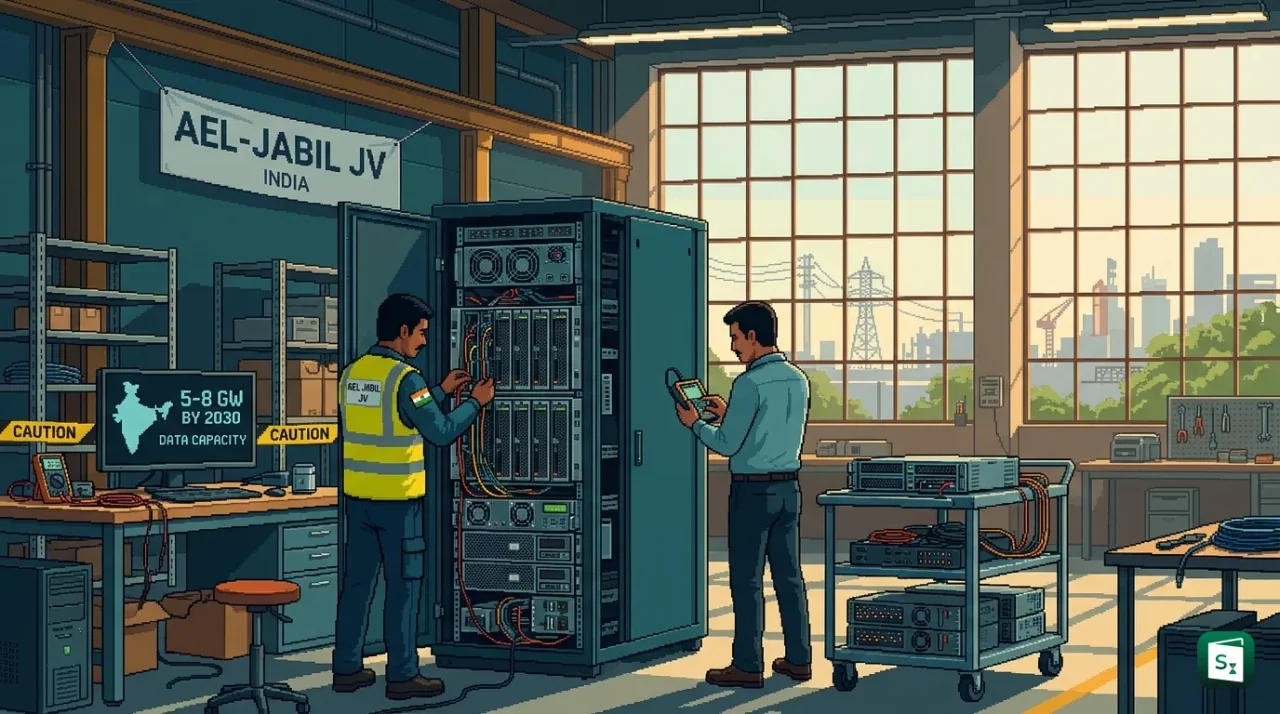
Adani Enterprises Limited and American manufacturer Jabil Inc signed a non-binding agreement on 13 October 2026 to form a 50:50 joint venture that would make AI and data centre equipment in India. The proposed venture would produce AI racks, servers, storage, networking gear, power distribution units, liquid-cooling systems and transformers. The agreement arrives as India’s data centre capacity is projected to grow from about 1.4 GW to 5-8 GW by 2030, creating demand for hardware that the country currently imports.
What Is the Adani Jabil Joint Venture?
The Adani Jabil joint venture is a proposed 50:50 company between Adani Enterprises and Jabil Inc to manufacture AI and data centre hardware in India. The firms signed a non-binding MoU on 13 October 2026; operations will begin only after definitive agreements and approvals.
The agreement sets out a framework rather than a completed investment. Adani Enterprises and Jabil have not disclosed the capital commitment, the location of the factory, the customer contracts or a production deadline. Both companies said the proposal remains subject to definitive agreements, applicable approvals and customary conditions.
The October agreement follows a June 2026 announcement in which the two companies said they would explore a strategic alliance for an AI and data centre manufacturing ecosystem. The new MoU gives that plan a defined ownership structure, although it is still not a binding contract.
| Parameter | Detail |
|---|---|
| Structure | 50:50 joint venture |
| Status | Non-binding MoU signed on 13 October 2026 |
| Partners | Adani Enterprises Limited and Jabil Inc (NYSE: JBL) |
| Products | AI racks, servers, storage, networking gear, power distribution units, liquid-cooling systems and transformers |
| Capacity | Multi-gigawatt AI rack manufacturing |
| Services | Installation and commissioning |
| Target markets | Domestic demand and exports |
| Next step | Definitive agreements, regulatory approvals and customary conditions |
What Equipment Will the Joint Venture Make?
The joint venture would manufacture and assemble AI racks, servers, storage systems and networking equipment, along with the power and cooling equipment that keeps them running. Its product list includes power distribution units, liquid-cooling systems and transformers, plus installation and commissioning services for data centre operators.
A data centre is a secured facility that houses servers, storage and networking equipment, along with the power and cooling systems that keep them running. An AI data centre is built around high-density racks, with more power and cooling per square foot than a conventional facility. An AI rack is a metal frame that holds servers, graphics processing units, switches and storage in one integrated unit. Traditional server racks draw a few kilowatts of power. AI racks pack far more computing into the same space and can draw several times that load, which is why they need specialised power delivery and cooling.
Liquid cooling has become essential because air alone cannot remove heat from densely packed AI processors. A coolant distribution unit circulates liquid through cold plates attached to chips, while power distribution units split electricity safely across the rack. Transformers step down grid voltage to usable levels. The June 2026 announcement also listed switchgear, busbars and thermal management systems as part of the planned portfolio.
| Product category | Role in a data centre |
|---|---|
| AI racks | House servers, GPUs, storage and switches in a dense, integrated frame |
| Servers and storage | Run AI training, inference and general computing workloads |
| Networking equipment | Connect servers inside the data centre and to external networks |
| Power distribution units | Distribute electricity safely to individual racks and equipment |
| Liquid-cooling systems | Remove heat from high-density chips using coolant and cold plates |
| Transformers | Step down grid voltage to the level needed by data centre equipment |
Data centre capacity is measured by the electrical load that its IT equipment can draw, usually in megawatts (MW) or gigawatts (GW), rather than by the number of buildings. A multi-gigawatt rack manufacturing capacity would mean the venture could produce racks that together support several gigawatts of computing load, not that the factory itself would consume that much power.
The venture is intended to do more than simple assembly. It would integrate computing, power and thermal systems, test them, and then install and commission them at customer sites. That combination of manufacturing and deployment services sits higher up the value chain than basic contract assembly.
What Is a Joint Venture and Why Is This MoU Non-Binding?
A joint venture is a separate business created by two or more companies that share ownership, control, profits and risks. A non-binding MoU records the intended terms but does not create enforceable obligations; the parties must still sign definitive agreements before the venture can be formed.
The 50:50 structure means both partners would hold equal stakes and share control of the new company. Equal ownership is common when both sides contribute critical assets and neither wants to be a junior partner. It also creates the risk of deadlock on major decisions, so definitive agreements usually set out governance rules, reserved matters and exit provisions.
A joint venture does not have to be owned 50:50. Companies can choose any shareholding split, and the ratio usually reflects how much capital, technology, market access or manufacturing know-how each partner brings.
A non-binding MoU is a statement of intent. It lets the partners announce a plan, begin due diligence and negotiate without committing capital. If the talks fail, either side can walk away without the liabilities that a binding contract would create. That is why the October document is best read as a framework for negotiation, not as confirmation that a factory will be built.
Analogy · Engagement, Not Marriage Expand analogy
A non-binding MoU is like an engagement announcement. It signals that two parties intend to build a life together, but the marriage still depends on a final agreement, family approvals and a date that both sides can meet. Until the definitive agreements are signed, either partner can still walk away.
Several steps remain before the venture becomes an operating company. These include due diligence, board approvals, definitive agreements, site selection, financing and regulatory clearances. The companies have not indicated how long these steps will take.
How Big Is India’s Data Centre Opportunity?
India’s data centre capacity is projected to reach 5 to 8 GW by 2030, up from about 1.4 GW in mid-2025. The growth is driven by AI adoption, cloud expansion, data localisation rules and tax incentives for global cloud providers that use Indian facilities.
The Economic Survey 2025-26 estimated capacity at about 1.4 GW in the second quarter of 2025 and projected roughly 8 GW by 2030. India had about 130 privately operated data centres and 49 run by government agencies as of June 2025. Industry estimates place the required capital expenditure at around $30 billion. India generates nearly 20 per cent of the world’s data but hosts only about 3 per cent of global data centres, roughly 150 out of 11,000, which shows how far domestic capacity can grow.
Mumbai and Chennai together hold nearly 70 per cent of installed capacity, with Mumbai alone accounting for about half because of its undersea cable landing stations and concentration of banking and financial clients.
| Indicator | Figure |
|---|---|
| Installed capacity in mid-2025 | About 1.4 GW |
| Projected capacity by 2030 | 5 to 8 GW |
| Share of global data generated in India | Nearly 20 per cent |
| Share of global data centres located in India | About 3 per cent |
| Planned hyperscaler spending in India | More than $50 billion |
| Estimated capital expenditure for expansion | About $30 billion |
| Data centre power use in 2024 | About 13 TWh, or 0.8 per cent of electricity demand |
| Projected power use in 2030 | About 57 TWh, or 2.6 per cent of electricity demand |
Policy has also shifted in favour of domestic data centres. The Digital Personal Data Protection Act, 2023 created a legal framework for processing personal data and strengthened the case for hosting data inside the country. RBI’s payment data rules already require payment system operators to store full payment data in India. The Union Budget 2026-27 added a tax holiday until 2047 for foreign companies that provide cloud services to global customers using data centres in India, provided they serve Indian customers through an Indian reseller entity. A 15 per cent safe harbour on cost was also proposed for transactions with related data centre entities.
The tax measure matters because foreign cloud providers had worried that using an Indian data centre could expose their global income to Indian tax. The holiday removes that uncertainty and improves the export case for Indian facilities. It also increases demand for the servers, racks and cooling systems that the proposed Adani Jabil venture plans to make.
Who Are Adani Enterprises and Jabil?
Adani Enterprises is the listed flagship of the Adani Group, with interests in energy, airports, roads, mining and data centres. Jabil is an American electronics manufacturing services company that builds products for global technology brands. Their strengths complement each other: Indian infrastructure and power, plus precision manufacturing.
Adani Enterprises and AdaniConneX
Adani Enterprises was incorporated in 1993 as Adani Exports Limited and renamed in 2006. Headquartered in Ahmedabad, it describes itself as India’s largest listed business incubator. The company has nurtured and separately listed businesses including Adani Ports, Adani Power, Adani Green Energy, Adani Energy Solutions, Adani Total Gas and Adani Wilmar.
Adani Enterprises’ data centre business sits under AdaniConneX, a 50:50 joint venture with the American data centre operator EdgeConneX, formed in 2021. AdaniConneX is developing campuses in Chennai, Navi Mumbai, Noida, Visakhapatnam and Hyderabad. It operates more than 55 MW of live capacity and holds an order book of over 560 MW (as of 2026).
The Adani Group has committed $100 billion to develop 5 GW of green-energy-powered, AI-ready data centres by 2035, building on AdaniConneX’s 2 GW platform. The group has announced partnerships with Google for a gigawatt-scale campus in Visakhapatnam and additional capacity in Noida, with Microsoft for facilities in Hyderabad and Pune, and with Flipkart for an AI data centre. Adani Green Energy operates part of the 30 GW Khavda park in Gujarat, which can supply power to these facilities.
What Does Jabil Do?
Jabil is an American electronics manufacturing services company that designs, manufactures and manages supply chains for global brands. It makes products for AI data centres, networking, healthcare, automotive and consumer electronics, and reported $36 billion in revenue in fiscal 2026.
Jabil was founded in 1966 in Detroit by William Morean and James Golden and is headquartered in St. Petersburg, Florida. Jabil is listed on the New York Stock Exchange under the ticker JBL and joined the exchange in 1993. The company has more than 140,000 employees across 120 sites in more than 30 countries. Its fiscal 2026 revenue of $36 billion was 21 per cent higher than the previous year, and it has guided for $44.5 billion in fiscal 2027.
Jabil organises its business into three segments: Regulated Industries, which serves automotive, healthcare and renewable energy customers; Intelligent Infrastructure, which covers AI, cloud, data centre and networking customers; and Connected Living and Digital Commerce, which includes warehouse automation and robotics. Jabil is a contract manufacturing partner for several global brands, including Apple, Cisco and HP.
In India, Jabil has operated a factory in Pune since 2003. It opened a new advanced manufacturing plant at Ranjangaon in Pune in June 2026, expanding its Indian footprint from 500,000 square feet to 1.2 million square feet and its workforce from 5,000 to almost 11,000. The plant makes AI-enabled data centre equipment, 5G gear, networking products, industrial power electronics and consumer electronics. Jabil also announced a ₹2,000 crore electronics plant near Trichy in Tamil Nadu in 2024, expected to create about 5,000 jobs.
Jabil has strengthened its data centre capabilities through two acquisitions. Hanley Energy Group provides critical power and energy management systems, while Mikros Technologies specialises in liquid cooling for high-performance computing.
How the Two Partners Compare
| Parameter | Adani Enterprises | Jabil Inc |
|---|---|---|
| Headquarters | Ahmedabad, Gujarat | St. Petersburg, Florida, USA |
| Founded or incorporated | 1993, as Adani Exports Limited | 1966, in Detroit |
| Listing | NSE and BSE: ADANIENT | NYSE: JBL |
| Core strength | Infrastructure, energy, ports, airports and data centres | Electronics design, manufacturing and supply chain management |
| Data centre presence | AdaniConneX, 50:50 joint venture with EdgeConneX | Intelligent Infrastructure segment serving AI and cloud customers |
| India manufacturing | Data centre campuses and group infrastructure | Pune since 2003, new Ranjangaon plant, Trichy project |
| Latest disclosed revenue | ₹1,00,365 crore in FY2025 | $36 billion in FY2026 |
Why Does This Matter for India’s AI Hardware Ambitions?
India’s data centre boom is currently built on imported hardware. A domestic AI rack, server and cooling manufacturing base would shorten supply chains, create engineering jobs and help India move from being a buyer of AI infrastructure to a producer and exporter.
Industry estimates suggest that India imports 60 to 70 per cent of high-value data centre components, and that 75 to 85 per cent of rack servers are sourced from Taiwan, China and Southeast Asia. The current import bill for data centre components is estimated at $2 billion to $3 billion a year and could exceed $17 billion cumulatively between FY26 and FY30 if domestic capacity does not expand. A factory that integrates racks, power and cooling in India directly addresses that gap.
The venture fits into a wider policy push under Make in India, launched in 2014, and Atmanirbhar Bharat, announced in 2020. The government has backed electronics manufacturing through production-linked incentives and component schemes, and the proposed joint venture would sit at the point where those components become finished data centre systems.
| Policy or scheme | Year | Relevance to the venture |
|---|---|---|
| PLI Scheme 2.0 for IT Hardware | 2023 | ₹17,000 crore outlay; covers servers, laptops, tablets and all-in-one PCs |
| Electronics Component Manufacturing Scheme | 2025 | Outlay raised to ₹40,000 crore in Budget 2026; supports PCBs, connectors, enclosures and sub-assemblies |
| Semicon 2.0 | 2026 | ₹1,27,500 crore programme covering fabs, advanced packaging, design, materials and equipment |
| Data centre tax holiday | 2026 | Tax holiday until 2047 for foreign companies providing global cloud services from Indian data centres |
The economic stakes go beyond one factory. Data centre ecosystems create demand for construction, electrical equipment, fibre, cooling and logistics, and industry estimates put the multiplier effect at 2.5 to 3 times the direct investment. Jabil’s Pune expansion is designed to integrate Indian firms and MSMEs into its supply chain, and a larger venture could deepen that local network.
For Adani, the venture extends its role from powering and hosting AI infrastructure to manufacturing the equipment inside it. For Jabil, it offers a larger base in a market that is becoming important for both domestic and global AI demand. The two companies estimate the global market for AI infrastructure at more than $3 trillion over the next seven years, and they intend to serve customers in India and abroad from the same manufacturing base.
Supply chain resilience is the other strategic gain. Advanced AI hardware is concentrated in a small number of economies, and tariffs, export controls or shipping disruptions can delay projects. Domestic manufacturing gives Indian data centre operators an alternative source for racks, cooling and power equipment, even if the most advanced chips and memory continue to be imported.
What Are the Risks and Challenges?
The biggest immediate risk is that the venture does not yet exist. The MoU is non-binding, no capital commitment or factory site has been disclosed, and the partners must still negotiate definitive agreements, obtain approvals and win customers in a market where global suppliers are already entrenched.
Manufacturing racks and cooling systems is not the same as manufacturing semiconductors. India will still need to import graphics processing units, high-bandwidth memory, advanced printed circuit boards and precision components. The venture can raise domestic value addition in integration, testing, power and thermal systems, but it will not remove India’s dependence on imported chips in the near term.
Cost competitiveness is another test. Taiwanese, Chinese and Southeast Asian contract manufacturers already operate at large scale and supply hyperscalers directly. Indian production faces higher landed costs for some components, import duties and logistics. Industry estimates place average server prices in India 8 to 15 per cent above mature markets, so the venture will need scale, automation and policy support to compete for export orders.
Power and water availability could constrain the entire data centre programme, not just this venture. Data centres are expected to consume about 57 TWh of electricity by 2030, or 2.6 per cent of national demand, up from 0.8 per cent in 2024. Grid operators have warned that 8 to 10 GW of data centre load would be equivalent to the demand of an entire state, requiring long-term resource adequacy planning and firm power contracts. Cooling systems also have water and land requirements, and water stress in some data centre clusters is an additional constraint. Liquid cooling can lower energy use at high densities, but it does not remove the need for reliable power.
The venture also carries ordinary joint venture risks. Equal ownership can produce deadlocks, and the partners must align on capital calls, technology transfer, customer prioritisation and exit rights. AdaniConneX, an existing Adani data centre platform, could become an anchor customer, but related-party sales would still need to be priced competitively and disclosed properly. Global trade policy adds another layer of uncertainty, because tariffs and export controls on AI hardware can change the economics of cross-border supply chains.
The Way Forward
The next milestones are concrete: definitive agreements, a site announcement, an investment figure and a production timeline. Until those appear, the venture should be treated as a plan rather than installed capacity.
The site decision will be an early signal. A location near an AdaniConneX campus would shorten logistics and allow the partners to test equipment close to customers. A site near Jabil’s existing Pune cluster would draw on an established supplier base and trained workforce. A new greenfield location would require fresh investment in power, roads, housing and skills.
The first product line will matter as much as the factory. AI racks and liquid-cooling systems require precision engineering, testing and certification. If the venture begins with assembly and gradually adds design, testing and component localisation, it can build domestic capability rather than remain a screwdriver operation.
Policy implementation will shape the outcome. The Budget 2026-27 tax holiday needs clear rules for foreign cloud providers and Indian resellers. The Electronics Component Manufacturing Scheme must deliver the PCBs, connectors, enclosures and power components that rack manufacturers need. MeitY has indicated that AI servers may be added to the IT hardware incentive scheme in a later revision, which would improve the economics for ventures such as this one.
If these pieces come together, the Adani Jabil venture could support India’s projected 5 to 8 GW of data centre capacity, reduce a growing import bill and create a base for exports. If they do not, the agreement will remain one more announcement in a sector that has no shortage of ambitious plans.
Key Takeaways
- Adani Enterprises and Jabil Inc signed a non-binding MoU on 13 October 2026 for a 50:50 joint venture to manufacture AI and data centre equipment in India.
- The proposed venture is to make AI racks, servers, storage, networking gear, power distribution units, liquid-cooling systems and transformers, and provide installation and commissioning services.
- The agreement follows the June 2026 strategic alliance announcement and remains subject to definitive agreements and regulatory approvals.
- India’s data centre capacity was about 1.4 GW in mid-2025 and is projected to reach 5 to 8 GW by 2030.
- Budget 2026-27 proposed a tax holiday until 2047 for foreign companies providing cloud services globally from Indian data centres, with a 15 per cent safe harbour on cost for related entities.
- Jabil, founded in 1966 and headquartered in St. Petersburg, Florida, reported $36 billion in revenue in fiscal 2026 and employs more than 140,000 people.
- AdaniConneX, a 50:50 joint venture between Adani Enterprises and EdgeConneX formed in 2021, anchors the group’s data centre business, and the Adani Group has committed $100 billion to build 5 GW of green-energy-powered AI-ready data centres by 2035.