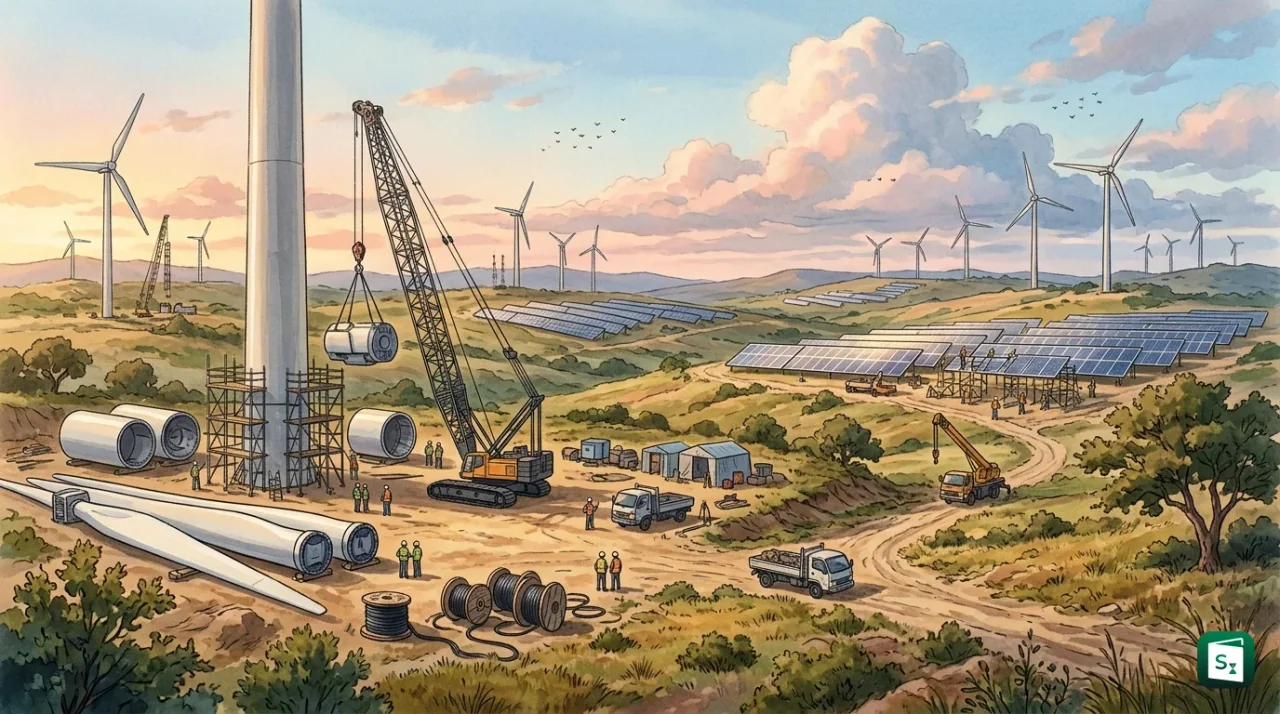
ReNew Energy Global plc has secured a $100 million (₹955 crore) debt facility from FMO, the Dutch entrepreneurial development bank, to fund renewable energy projects that are still under construction. The 10-year, rupee-denominated facility was extended to ReNew Solar Power Private Limited, the company’s wholly owned subsidiary, on 13 October 2026. The deal is FMO’s largest single-ticket investment in India’s energy sector and points to the growing role of overseas development finance in India’s clean energy build-out.
What Exactly Has ReNew Secured from FMO?
The facility is a $100 million (₹955 crore), 10-year rupee loan from FMO to ReNew Solar Power, a wholly owned unit of ReNew Energy Global. It is routed through the Voluntary Retention Route and will fund under-construction solar and hybrid projects across the ReNew group.
The money is being provided as a corporate debt facility, not as project-level finance tied to a single plant. A debt facility is a pre-arranged pool of credit that a borrower can draw down in tranches, and the terms debt facility and credit facility are often used interchangeably. This corporate structure gives ReNew the flexibility to allocate capital across its construction pipeline, where projects move through different stages of land clearance, transmission connectivity and commissioning. FMO has classified the entire facility as Green, which means the lender treats the investment as a direct contribution to climate mitigation.
| Feature | Detail |
|---|---|
| Lender | FMO (Nederlandse Financierings-Maatschappij voor Ontwikkelingslanden N.V.), the Dutch entrepreneurial development bank |
| Borrower | ReNew Solar Power Private Limited, a wholly owned subsidiary of ReNew Energy Global plc |
| Amount | $100 million, about ₹955 crore |
| Tenor | 10 years |
| Currency | Indian rupee |
| Route | Voluntary Retention Route for foreign portfolio investment in Indian debt |
| Use of proceeds | Under-construction renewable projects across the ReNew group, including solar and hybrid projects |
| Green classification | 100% of the facility classified as Green by FMO |
| Social tag | Qualifies under the 2X Challenge for gender-inclusive investment |
| Milestone | FMO’s largest single-ticket investment in India’s energy sector and its largest 2X-aligned corporate financing in Asia to date |
The facility is a loan, not a green bond. A green bond raises money from bond investors through a securities issue, while this transaction is a direct debt facility from a development bank. The green label here comes from FMO’s internal classification of the loan, based on the climate benefit of the projects it will finance.
The transaction was announced on 13 October 2026. It also marks FMO’s largest investment in advancing opportunities for women in Asia’s energy sector, a point that links the financing to the lender’s gender-inclusion mandate alongside its climate goals.
What Is FMO, the Dutch Entrepreneurial Development Bank?
FMO is the Dutch entrepreneurial development bank, formally Nederlandse Financierings-Maatschappij voor Ontwikkelingslanden N.V. Founded in 1970, it is 51% owned by the Dutch state and invests in private-sector projects across more than 85 developing and emerging economies. It is one of the larger bilateral development banks in the world.
A development finance institution (DFI) is a lender, usually government-backed, that provides long-term capital and takes risks that commercial banks usually avoid. FMO fits that description. It provides loans, equity, trade finance and guarantees, and it often brings in other investors by taking on higher risk and by setting high environmental and social standards.
| Attribute | Detail |
|---|---|
| Full name | Nederlandse Financierings-Maatschappij voor Ontwikkelingslanden N.V. |
| Type | Bilateral development finance institution and development bank |
| Founded | 1970 |
| Headquarters | The Hague, Netherlands |
| Ownership | 51% Dutch state; 49% commercial banks, trade unions, employers’ associations and private investors |
| Credit rating | AAA from Fitch and S&P |
| Committed portfolio | About €15.3 billion across more than 85 countries |
| Focus sectors | Agribusiness, food and forestry; energy; financial institutions |
| Supervisor | Dutch Central Bank |
FMO has a long record in India’s energy sector. In December 2025, it extended a $50 million facility to AMPIN Energy Transition for greenfield renewable projects. The ReNew transaction is larger.
The bank’s mandate explains why it can offer a 10-year rupee loan when domestic banks often lend for shorter periods. FMO is not chasing quarterly returns. It is expected to support projects that contribute to development, and it can accept longer payback periods than commercial lenders.
What Is the Voluntary Retention Route?
The Voluntary Retention Route (VRR) is a Reserve Bank of India (RBI) channel that lets foreign portfolio investors registered with the Securities and Exchange Board of India (SEBI) buy Indian debt with fewer restrictions, provided they keep a minimum share of the money in India for at least three years.
The Reserve Bank of India introduced the VRR in March 2019 after floating the idea in a discussion paper in October 2018. The route was designed to attract stable foreign capital into Indian debt rather than hot money that enters and exits quickly. Under the framework, an investor bids for a committed portfolio size and must keep at least 75% of that amount invested during the retention period. The minimum lock-in is three years.
Investments through the VRR are free from several macro-prudential and regulatory limits that apply to ordinary foreign portfolio investment in debt. In return, the foreign investor accepts a longer stay. The route covers central government securities, state development loans, corporate debt and commercial paper.
The framework changed in 2026. A Reserve Bank circular dated 6 February 2026 merged the separate VRR investment limits into the General Route with effect from 1 April 2026. Existing VRR investments were transferred to the corresponding General Route ceilings. The route itself was not abolished. It continues to exist as a framework, but its separate quantitative cap is gone. That is why the ReNew facility in October 2026 can still be described as a VRR transaction.
Analogy · A Lock-In With Better Terms Expand analogy
The VRR works like a fixed deposit that offers easier rules in exchange for a longer lock-in. A foreign investor gets relief from some debt-market restrictions, but must keep a large share of the money in India for at least three years.
For FMO, the route offers a way to hold Indian corporate debt for a long period without being constrained by several macro-prudential limits that shape ordinary portfolio flows. The 10-year loan to ReNew is a good fit because the borrower earns revenue in rupees and needs capital for assets that will operate for decades. The VRR provides the regulatory wrapper, while the loan agreement sets the commercial terms.
Why Does a 10-Year Rupee Loan Matter?
A 10-year rupee loan matches the long life of a renewable asset and removes the currency mismatch that comes with dollar borrowing. ReNew earns in rupees, so repaying in rupees avoids hedging costs and protects the project from exchange-rate swings.
Solar and wind projects are capital-heavy at the start and then earn steady revenue for 25 years or more. A developer needs debt that lasts long enough to match that revenue stream. Indian banks often lend for shorter periods, which forces developers to refinance every few years. Refinancing is not guaranteed, and it becomes harder when interest rates rise or credit markets tighten. A 10-year facility reduces that pressure.
| Feature | Why it matters for ReNew |
|---|---|
| 10-year tenor | Matches the operating life of the asset and lowers refinancing risk |
| Rupee denomination | Aligns project revenue with loan repayment and avoids currency hedging costs |
| Corporate debt structure | Allows the company to allocate funds across several under-construction projects |
| DFI lender | Brings patient capital and signals confidence to other lenders |
| Green classification | Marks the loan as climate finance and supports FMO’s own green targets |
The corporate structure has a trade-off. Because the loan sits at the company level rather than inside a single project special purpose vehicle, ReNew has more flexibility but also more direct exposure on its balance sheet. ReNew’s net debt stood at ₹69,712 crore ($7.36 billion) as of 30 June 2026. The new $100 million facility is about 1.4% of that net debt, so it is a useful addition to the funding mix rather than a transformational sum.
The interest rate on the FMO facility has not been disclosed. That detail matters because the main benefit of development finance is often not just the tenor but also a pricing advantage over commercial borrowing. Without the interest rate, the full cost advantage cannot be measured.
ReNew Energy at a Glance
ReNew Energy Global plc is one of India’s largest renewable energy companies, with a gross portfolio of 20.5 gigawatts (GW) and about 13.5 GW of commissioned capacity. Founded in 2011, it develops solar, wind and hybrid projects and also manufactures solar modules and cells.
The company was set up by Sumant Sinha, a former investment banker and wind-sector executive. It is incorporated in England and Wales, while its main operational headquarters is in Gurugram, Haryana. In 2021, it became the first Indian renewable energy company to list on the Nasdaq, where it trades under the tickers RNW and RNWWW. Its financial year (FY) runs from April to March.
| Attribute | Detail |
|---|---|
| Founded | 2011 |
| Founder, Chairperson and CEO | Sumant Sinha |
| Legal domicile | England and Wales |
| Operational headquarters | Gurugram, Haryana |
| Listing | Nasdaq (RNW, RNWWW) |
| Gross portfolio | 20.5 GW, including 1.7 GW/6.2 gigawatt-hours (GWh) of battery storage (August 2026) |
| Commissioned capacity | About 13.5 GW (Q1 FY27 update) |
| Presence | 10 states and more than 150 sites |
| Manufacturing | 6.4 GW of solar modules and 2.5 GW of solar cells; 4 GW cell expansion due by December 2026 |
| Q1 FY27 results | Total income of ₹4,786 crore and net profit of ₹595 crore |
| FY27 construction guidance | 1.6 to 2.4 GW |
ReNew’s scale matters for this deal. A lender taking a 10-year exposure needs confidence that the borrower can execute projects, manage grid connectivity and collect payments from state utilities. ReNew commissioned a record 2.4 GW in FY26, taking its operating capacity to about 12.6 GW, the second largest in India. That track record gives FMO a basis for underwriting a corporate-level loan rather than a single-project facility.
The company is also moving beyond power generation. Its solar manufacturing arm gives it a foothold in the domestic supply chain at a time when India is pushing to reduce dependence on imported cells and modules. The planned 4 GW cell expansion, expected by December 2026, is part of that strategy. The FMO loan is aimed at the power portfolio, not the factories, but the manufacturing base strengthens ReNew’s overall ability to supply its own projects.
The 2X Challenge and the Gender Finance Angle
The 2X Challenge is a global gender-finance initiative launched at the Group of Seven (G7) Summit in Canada in 2018. It asks development finance institutions to invest in businesses that advance women as entrepreneurs, leaders, employees and consumers, and it has mobilised more than $33.6 billion since then.
The initiative began with a target of $3 billion by 2020. That goal was exceeded, and a second phase set a $15 billion target for 2021 to 2022. The current phase, announced at the G7 Summit in Italy in 2024, aims to mobilise at least $20 billion over 2024 to 2027 and is open to private capital providers as well as public institutions.
| 2X Challenge feature | Detail |
|---|---|
| Launch | G7 Summit, Canada, 2018 |
| Initial target | $3 billion by 2020 |
| Mobilised by 2024 | More than $33.6 billion |
| Current phase | At least $20 billion over 2024 to 2027 |
| FMO’s role | Joined the initiative in May 2019 |
| ReNew’s qualifying target | 30% women in the workforce by 2030, against an industry average of 11% |
FMO joined the 2X Challenge in May 2019, along with the development finance institutions of Sweden, Finland and Denmark. The label is not a grant or a subsidy. It means the investment meets a set of criteria related to women’s economic participation, and the lender can count it toward its gender-finance commitments.
ReNew qualifies through its governance and accountability practices and its target of raising women’s share of its workforce to at least 30% by 2030. The company also runs mentoring and professional development programmes. The 11% industry average shows how large the gap is in India’s renewable energy sector, where construction and engineering roles are still heavily male-dominated.
For FMO, the ReNew facility is its largest 2X-aligned corporate financing in Asia to date. For ReNew, the tag broadens its appeal to investors who screen for both climate and social outcomes. The limitation is that the 2X label measures the design of the investment, not the final result. The workforce target will need independent tracking to show whether the promise translates into actual change.
India’s Renewable Energy Financing Gap
India has 300.50 GW of non-fossil power capacity, more than 54% of its total installed capacity. To reach 500 GW by 2030, it needs roughly 200 GW more in four years, which requires annual investment of $48 to $54 billion against current flows of $13 to $18 billion.
Data from the Ministry of New and Renewable Energy showed that India crossed 300 GW of non-fossil capacity on 31 July 2026. Solar is now the largest non-fossil source, followed by wind and hydro. The country added a record 55.29 GW of non-fossil capacity in 2025-26, but the pace still falls short of what the 2030 target demands.
| Source | Installed capacity as on 31 July 2026 |
|---|---|
| Solar | 164.59 GW |
| Wind | 58.14 GW |
| Hydro (large and small) | 57.24 GW |
| Bio-power | 11.75 GW |
| Nuclear | 8.78 GW |
| Total non-fossil | 300.50 GW |
The investment gap is the central problem. A 2026 study by Knight Frank India estimated that India needs $48 to $54 billion a year to stay on track for 500 GW, while current investment is only $13 to $18 billion. That leaves an annual shortfall of about $35 billion. The Secretary of the Ministry of New and Renewable Energy has put the total requirement at about $500 billion by 2030 and $13 trillion by 2070, the year India aims to reach net zero.
Private developers account for more than 90% of India’s renewable capacity, so the burden of closing the gap falls mainly on companies like ReNew. Yet financing renewable projects in India remains almost 80% more expensive than in mature markets, according to the same study. Long-tenor foreign debt from development banks can lower that cost, but it cannot fill the gap alone.
The government has tried to make investment easier. Foreign direct investment in renewable energy is allowed up to 100% under the automatic route, and the policy framework includes a renewable purchase obligation trajectory to 2030 and production-linked incentives for solar manufacturing. Domestic institutions such as the Indian Renewable Energy Development Agency (IREDA) and public sector banks also lend to the sector, but their tenors and pricing are not always suited to large, long-lived projects.
The FMO facility is small in this context. At $100 million, it is a fraction of the annual gap. Its value lies in the template: a long-tenor, rupee-denominated loan from a highly rated development bank, structured to match the cash flows of renewable assets. If more such deals follow, they can ease the refinancing pressure that slows down project pipelines.
What the Deal Signals for India’s Clean Energy Transition
The deal signals that international development finance is willing to take long-tenor rupee exposure to Indian renewable developers. It gives ReNew stable capital for projects under construction and shows other global lenders that Indian clean energy assets can meet rigorous environmental, social and governance standards.
A Signal to Other Lenders
FMO’s decision to commit its largest single-ticket energy investment in India is a confidence vote at a time when the country needs about $35 billion more in annual renewable investment. The loan is aimed at projects that are still being built, which are riskier than operating assets because they have no revenue yet. A development bank willing to lend at that stage sends a useful signal to commercial lenders who prefer to wait until commissioning.
The structure also broadens ReNew’s funding base. The company already borrows from Indian banks, issues bonds and raises equity from global investors. Adding a long-tenor rupee facility from a AAA-rated Dutch DFI reduces its dependence on any single market. If domestic credit tightens or bond yields rise, this kind of lender can keep a project pipeline moving.
| What the deal changes | What it does not change |
|---|---|
| Adds long-term rupee capital for under-construction projects | India’s annual renewable financing gap of about $35 billion |
| Diversifies ReNew’s lender base beyond domestic banks and bonds | The scale of ReNew’s existing debt, with net debt of ₹69,712 crore |
| Signals DFI confidence in Indian renewable assets | Project-level execution, land and transmission risks |
| Supports FMO’s green and gender-finance mandates | The need for a deeper domestic corporate bond market |
The Limits
The facility is not a solution to the sector’s financing problem. At $100 million, it is about 1.4% of ReNew’s net debt and a tiny share of the annual investment gap. It adds leverage to a company that already carries a large debt load. The interest rate has not been disclosed, so it is not clear how much cheaper this money is than domestic borrowing.
There are also project-level risks that a loan cannot remove. Renewable projects need land, transmission connectivity, modules and long-term power purchase agreements. State distribution companies are sometimes late in paying generators, which strains cash flows. A 10-year loan gives ReNew more room to manage these risks, but it does not eliminate them.
The 2X label is another area where execution matters. Meeting the target of 30% women in the workforce by 2030 will require changes in hiring, training and site management. The label recognises the commitment, not the outcome.
The Way Forward
ReNew plans to complete construction of 1.6 to 2.4 GW in FY27 and to add 4 GW of solar cell capacity by December 2026. The FMO facility supports the first of those goals. The second depends on equipment supply, factory ramp-up and demand for domestic cells.
For India, the larger task is to make long-tenor rupee debt more common. That means deepening the corporate bond market, expanding credit enhancement for infrastructure loans, using instruments such as Infrastructure Investment Trusts (InvITs) to recycle capital from operating assets, and encouraging more development finance institutions to lend in rupees rather than dollars. FMO’s own pipeline suggests it sees room to do more. On 1 October 2026, it committed $138 million to a Copenhagen Infrastructure Partners vehicle that will invest in renewable projects in India and other growth markets.
The ReNew deal is best read as a building block. It shows that a global DFI can structure a long-term rupee loan around Indian renewable cash flows. Whether it becomes a repeatable model depends on how quickly other lenders follow and how well the projects financed by this facility are executed.
Key Takeaways
- ReNew Energy Global plc secured a $100 million (₹955 crore) debt facility from FMO, the Dutch entrepreneurial development bank, on 13 October 2026.
- The 10-year, rupee-denominated facility was extended to ReNew Solar Power Private Limited, a wholly owned subsidiary, to fund under-construction solar and hybrid projects.
- The transaction is FMO’s largest single-ticket investment in India’s energy sector and its largest 2X-aligned corporate financing in Asia to date.
- FMO was founded in 1970, is headquartered in The Hague, and is 51% owned by the Dutch state, with the remaining 49% held by banks, employers’ associations, trade unions and private investors.
- The facility is structured under the Voluntary Retention Route, a Reserve Bank of India channel for foreign portfolio investment in Indian debt; from 1 April 2026, VRR limits were merged into the General Route.
- The loan qualifies under the 2X Challenge, launched at the Group of Seven (G7) Summit in Canada in 2018; ReNew aims to raise women’s share of its workforce to 30% by 2030.
- India had 300.50 GW of non-fossil power capacity as of 31 July 2026, more than 54% of its total installed capacity, against the 500 GW target for 2030.