The Indian Air Force marked its 94th Air Force Day on 8 October 2026 with a ceremonial parade at Air Force Station Hindan in Ghaziabad and the theme “Indian Air Force - Infallible, Impervious and Precise”. The celebrations now move to Varanasi, where the IAF’s “Wings Over Ganges” aerial display begins on 22 October and culminates on 25 October. The anniversary comes months after Operation Sindoor and during a major multinational exercise, making the theme a statement about combat readiness rather than a ceremonial slogan.
When Is Indian Air Force Day Celebrated and Why?
Indian Air Force Day is celebrated every year on 8 October because the Indian Air Force Act of 1932 came into force on that date, formally creating the service as an auxiliary arm of the Royal Air Force. The IAF’s first squadron was raised on 1 April 1933.
The date marks the legal birth of the force, not the day its first aircraft took off. For decades, the IAF observed its anniversary on 1 April, the day No. 1 Squadron was raised in 1933 and the date on which Air Marshal Subroto Mukerjee became the first Indian Chief of the Air Staff in 1954. In 1976, the observance was shifted to 8 October to honour the statute that created the Indian Air Force.
The distinction matters because the IAF’s early years were shaped by British control. The force was raised as an auxiliary of the Royal Air Force, adopted RAF uniforms and insignia, and began with a handful of officers and biplanes. The anniversary is therefore both a celebration of air power and a reminder of how a colonial support unit became one of the world’s largest air forces.
| Year | Event |
|---|---|
| 1932 | Indian Air Force Act passed; IAF established on 8 October as an auxiliary of the Royal Air Force |
| 1933 | No. 1 Squadron raised on 1 April at Drigh Road, Karachi |
| 1945 | “Royal” prefix granted on 12 March |
| 1950 | “Royal” prefix dropped on 26 January when India became a republic |
| 1954 | Air Marshal Subroto Mukerjee becomes the first Indian Chief of the Air Staff |
| 1976 | Air Force Day shifted from 1 April to 8 October |
What Is the Theme of Indian Air Force Day 2026?
The 2026 theme is “Indian Air Force - Infallible, Impervious and Precise”, also rendered in Hindi as “Bharatiya Vayu Sena: Achook, Abhedya aur Sateek”. It was used for the 93rd anniversary in 2025 as well, and it stresses reliability, resilience against threats and accuracy in combat operations.
Each word in the theme carries a specific operational meaning for the force. The IAF is expected to act without failure when called upon, survive enemy attacks and still function, and strike only the intended target. In a conflict where civilian casualties can undo a military advantage, precision is as important as firepower.
| Term | Literal meaning | Operational context |
|---|---|---|
| Infallible | Cannot fail; dependable | The force must be ready at short notice and get the mission right the first time |
| Impervious | Cannot be penetrated or harmed | Air defence, survivability and resilience against missile and drone attacks |
| Precise | Exact and accurate | Precision strikes that hit the target while limiting collateral damage |
The theme is not a fresh slogan. The IAF used the same phrase for its 93rd anniversary in 2025, including the Guwahati air show, and retained it for the 94th anniversary in 2026. The repetition signals continuity in the force’s public messaging after Operation Sindoor, the armed forces’ response to the Pahalgam terror attack of 22 April 2025, in which 26 people were killed.
During Operation Sindoor, the IAF used Rafale jets, SCALP cruise missiles and HAMMER precision-guided bombs against nine terror sites in Pakistan and Pakistan-occupied Jammu and Kashmir. The operation gave the theme a practical context: the IAF presented it as proof of both offensive reach and effective air defence.
| Year | Anniversary | Theme |
|---|---|---|
| 2023 | 91st | IAF: Airpower Beyond Boundaries |
| 2024 | 92nd | Bhartiya Vayu Sena: Saksham, Sashakt, Aatmanirbhar |
| 2025 | 93rd | Indian Air Force: Infallible, Impervious and Precise |
| 2026 | 94th | Indian Air Force: Infallible, Impervious and Precise |
How Was the 94th Air Force Day Celebrated at Hindon?
The 94th Air Force Day parade was held on 8 October 2026 at Air Force Station Hindan in Ghaziabad, Uttar Pradesh. The station is also commonly spelled as Hindon. Air Chief Marshal Amar Preet Singh, the Chief of the Air Staff, reviewed the parade. The Army Chief, General Dhiraj Seth, and the Navy Chief, Admiral K. Swaminathan, attended, along with former air chiefs and senior officers. Group Captain Manish Sharma commanded the parade.
The ceremony began with the marching-in of the President’s Colours. Three Mi-17 1V helicopters flew in the Dhwaj formation, carrying the national flag and the IAF flag. An investiture ceremony followed, in which air warriors received medals for gallantry and distinguished service. Five unit citations were presented to 24 Squadron ‘The Hawks’, 110 Helicopter Unit ‘The Vanguards’, 200 Squadron ‘Skanda’, 2402 Squadron ‘Vajra’ and the Electronic Warfare Range.
The static display included the Rafale, Su-30MKI, Jaguar, LCH Prachand and ALH Dhruv, along with surface-to-air and surface-to-surface guided weapons, radars and one-way attack unmanned systems. The IAF Heritage Flight flew a vintage Tiger Moth. Team Shakti, the IAF’s all-women Air Warrior Drill Team, performed, and the 33-member IAF Drummers Team played. The display underlined the force’s focus on Make in India and indigenous capability development.
| Element | Details |
|---|---|
| Date and venue | 8 October 2026, Air Force Station Hindan, Ghaziabad, Uttar Pradesh |
| Reviewing officer | Air Chief Marshal Amar Preet Singh, Chief of the Air Staff |
| Parade commander | Group Captain Manish Sharma |
| Ceremonial opening | Marching-in of the President’s Colours; Dhwaj formation by three Mi-17 1V helicopters |
| Awards | Investiture ceremony; five Unit Citations |
| Static display | Rafale, Su-30MKI, Jaguar, LCH Prachand, ALH Dhruv, guided weapons, radars and one-way attack drones |
| Heritage display | Vintage Tiger Moth aircraft of the IAF Heritage Flight |
| Special teams | Team Shakti all-women drill team; 33-member IAF Drummers Team |
Air Chief Marshal Singh used the occasion to outline the force’s direction. He described air power as the primary means of protecting national interests and said the IAF was alert, committed and ready for any contingency. He said Atmanirbharta, or self-reliance, was the guiding principle, and that artificial intelligence and autonomous systems would be integrated while keeping human authority at the core. He also described space as a natural extension of the air domain and pointed to the IAF’s collaboration with ISRO and its role in the Gaganyaan mission. Singh is due to retire on 31 October 2026.
What Is the ‘Wings Over Ganges’ Aerial Display?
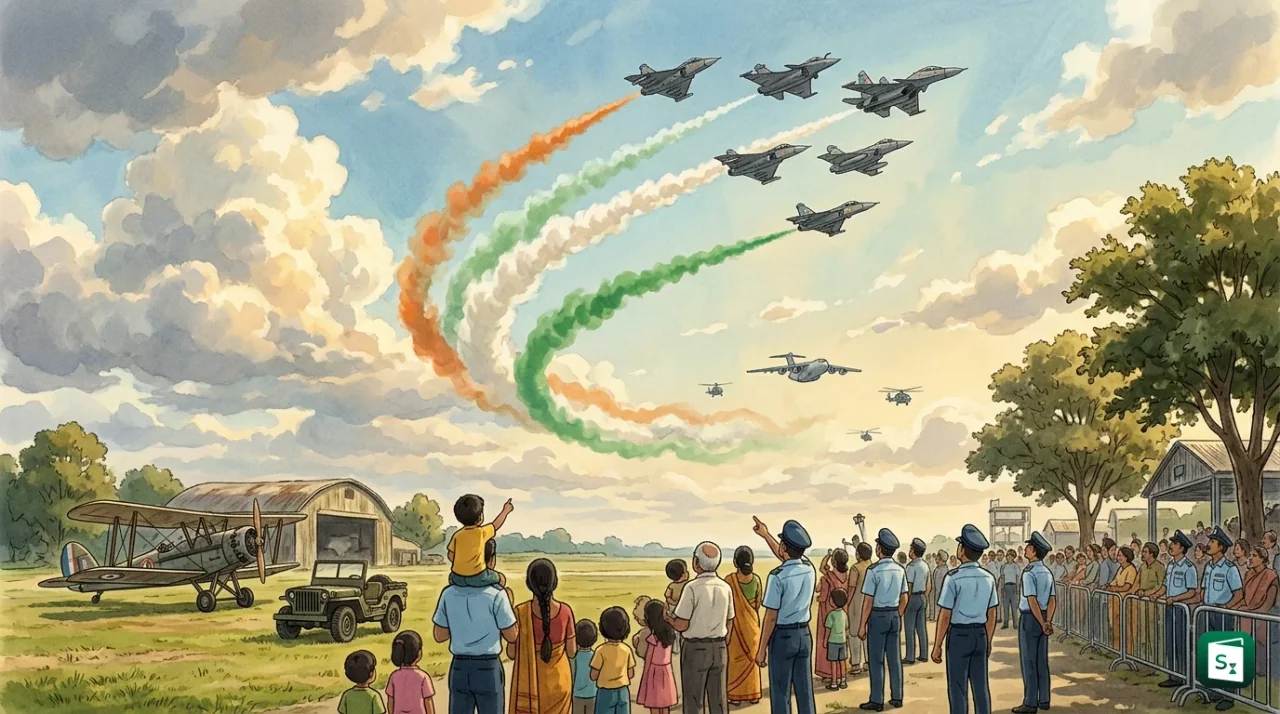
The “Wings Over Ganges” aerial display is the public finale of the IAF’s 94th Air Force Day celebrations. It is being held at Namo Ghat in Varanasi on 22, 24 and 25 October 2026, with the main show on 25 October and around 100 aircraft participating.
The display is organised by the IAF’s Central Air Command, headquartered at Bamrauli in Prayagraj. The command has been based in the city since February 1966 and completes 60 years there in 2026. Namo Ghat will host the VIP stand, while the public can watch from designated viewing areas along the riverfront. Prime Minister Narendra Modi is scheduled to attend the main display on 25 October.
The show is expected to feature about 100 aircraft, including 52 fighter jets, 15 transport aircraft and 32 helicopters. Frontline platforms include the Rafale, Su-30MKI, MiG-29, Tejas, LCH Prachand, IL-76, IL-78, C-295 and AN-32. The Surya Kiran Aerobatic Team and the Sarang Helicopter Display Team will perform. Aircraft from the Indian Navy and the Indian Army will also take part, highlighting jointness.
| Detail | Information |
|---|---|
| Event | Air Force Day Aerial Display 2026, themed “Wings Over Ganges” |
| Venue | Namo Ghat, Varanasi, Uttar Pradesh |
| Dates | 22, 24 and 25 October 2026; main display on 25 October |
| Organiser | Central Air Command, headquartered at Bamrauli, Prayagraj |
| Aircraft | About 100, including 52 fighters, 15 transport aircraft and 32 helicopters |
| Key platforms | Rafale, Su-30MKI, MiG-29, Tejas, LCH Prachand, IL-76, IL-78, C-295, AN-32 |
| Display teams | Surya Kiran Aerobatic Team and Sarang Helicopter Display Team |
| Expected guest | Prime Minister Narendra Modi on 25 October (as scheduled) |
The choice of Varanasi is part of a wider effort to take Air Force Day to the public. In 2022, the parade and flypast were held in Chandigarh; in 2023, in Prayagraj; and in 2024, in Chennai, where the Marina Beach show drew an estimated 15 lakh spectators and entered the Limca Book of Records. In 2025, the parade returned to Hindan and the aerial display was held at Lachit Ghat in Guwahati, the first full-scale air show of its kind in the Northeast. The 2026 edition follows the same pattern: a ceremonial parade at Hindan and a large public display in another city.
From Six Officers to a Modern Air Force: The IAF’s History
The IAF’s creation was recommended by the Skeen Committee of 1926, which was asked to examine the Indianisation of the armed forces. The force came into being on 8 October 1932 under the Indian Air Force Act. Its first squadron, No. 1 Squadron, was raised on 1 April 1933 at Drigh Road in Karachi, now in Pakistan. It had four Westland Wapiti biplanes, six RAF-trained officers and 19 Havai Sepoys, the air soldiers of the time. The first five pilots were Harish Chandra Sircar, Subroto Mukerjee, Bhupendra Singh, Aizad Baksh Awan and Amarjeet Singh, led by RAF Flight Lieutenant Cecil Bouchier.
The IAF saw action in the Second World War and was rewarded with the “Royal” prefix on 12 March 1945. When India became a republic on 26 January 1950, the force dropped the prefix and became the Indian Air Force. Subroto Mukerjee became the first Indian Chief of the Air Staff in 1954. In 1965, Air Marshal Arjan Singh led the IAF through the war with Pakistan. The rank of Chief of the Air Staff was later upgraded to Air Chief Marshal, and he became the first officer to hold it. In 2002, he was made Marshal of the Air Force, a five-star rank held by no other IAF officer.
| Year | Operation or conflict | Significance |
|---|---|---|
| 1947-48 | First Kashmir War | IAF transports and fighters supported Indian forces in Jammu and Kashmir |
| 1961 | Operation Vijay | IAF supported the liberation of Goa |
| 1962 | Sino-Indian War | IAF carried out airlift and reconnaissance in difficult terrain |
| 1965 | Indo-Pak War | IAF gained air superiority; Arjan Singh led the force |
| 1971 | Bangladesh Liberation War | IAF helped secure air superiority in the eastern theatre |
| 1999 | Operation Safed Sagar | IAF Mirage 2000 jets struck Pakistani positions in the Kargil sector |
| 2019 | Balakot air strike | Mirage 2000 jets hit a Jaish-e-Mohammed camp in Khyber Pakhtunkhwa |
| 2025 | Operation Sindoor | Precision strikes on nine terror sites in Pakistan and Pakistan-occupied Jammu and Kashmir |
The IAF’s modern record includes Operation Safed Sagar during the Kargil War of 1999, when Mirage 2000 jets struck Pakistani positions on the heights. In 2019, Mirage 2000 jets struck a Jaish-e-Mohammed camp at Balakot in Khyber Pakhtunkhwa. In May 2025, the IAF took part in Operation Sindoor, hitting nine terror sites in Pakistan and Pakistan-occupied Jammu and Kashmir with Rafale jets, SCALP missiles and HAMMER bombs. These operations explain why the 2026 theme focuses on precision and resilience.
How Is the Indian Air Force Organised and Trained?
The IAF is headed by the Chief of the Air Staff, a four-star Air Chief Marshal, at Air Headquarters in Vayu Bhawan, New Delhi. It is divided into seven commands: five operational commands and two functional commands. Each command is led by an Air Officer Commanding-in-Chief of the rank of Air Marshal. The force operates more than 60 air force stations and a large number of squadrons and units. Its personnel strength is about 1.7 lakh.
| Command | Headquarters | Role |
|---|---|---|
| Western Air Command | New Delhi | Largest operational command; guards the borders with Pakistan and China from Jammu and Kashmir to Rajasthan |
| Eastern Air Command | Shillong | Eastern sector bordering China, Myanmar and Bangladesh |
| Central Air Command | Bamrauli, Prayagraj | Central sector; conducts the Varanasi aerial display |
| South Western Air Command | Gandhinagar | Gujarat and Rajasthan sector |
| Southern Air Command | Thiruvananthapuram | Peninsular India and maritime air operations |
| Training Command | Bengaluru | Training academies and flying schools |
| Maintenance Command | Nagpur | Aircraft and equipment maintenance |
Ranks and Recruitment
Officer ranks in the IAF follow a structure inherited from the RAF. From the top, they are Air Chief Marshal, Air Marshal, Air Vice Marshal, Air Commodore, Group Captain, Wing Commander, Squadron Leader, Flight Lieutenant and Flying Officer. The five-star rank of Marshal of the Air Force is ceremonial and has been held only by Arjan Singh. Airmen form the technical and support backbone of the force.
Officers are trained through the National Defence Academy at Khadakwasla, the Combined Defence Services (CDS) examination, or the Air Force Common Admission Test (AFCAT). The Air Force Academy at Dundigal, about 43 km from Hyderabad, is the force’s premier training institution. It was established in 1969 and began operations in 1971. It trains the flying, technical and ground duty branches, and also trains officers from the Army, Navy and friendly countries. The academy inducted women cadets in June 1993. The IAF opened the fighter stream to women in 2016, when Avani Chaturvedi, Bhawana Kanth and Mohana Singh were commissioned as the first women fighter pilots.
Under the Agnipath scheme announced in June 2022, the IAF recruits Agniveer Vayu for a four-year engagement. Up to 25 per cent of Agniveers are retained in the regular cadre after the four-year term. The scheme is meant to bring younger personnel into the force while keeping a trained core.
What Aircraft and Systems Does the IAF Operate?
The IAF flies a mix of Russian, French, American and indigenous platforms. The Su-30MKI is the backbone of the fighter fleet, while the Rafale provides a modern multirole capability. The indigenous Tejas Light Combat Aircraft, inducted in 2016, is central to the force’s future. The IAF has ordered 180 Tejas Mk1A aircraft, with 83 contracted in February 2021 and 97 in September 2025. Deliveries have been delayed by engine supply bottlenecks, and the first Mk1A squadron is targeted for March 2027.
| Category | Major platforms |
|---|---|
| Fighter aircraft | Su-30MKI, Rafale, Tejas, MiG-29, Mirage 2000, Jaguar |
| Transport aircraft | C-17 Globemaster III, C-130J Super Hercules, C-295, IL-76, AN-32 |
| Helicopters | AH-64E Apache, CH-47F Chinook, Mi-17, ALH Dhruv, LCH Prachand |
| Airborne early warning | Netra AEW&C, Phalcon AWACS on IL-76 |
| Trainers | Pilatus PC-7 Mk II, Hawk Mk 132, HTT-40 |
| Air defence | S-400 Triumf, Akash, Rohini and Arudhra radars |
| Weapons | BrahMos, Astra, SCALP, HAMMER |
The Defence Acquisition Council granted Acceptance of Necessity for 114 Rafale jets under the Multi-Role Fighter Aircraft (MRFA) programme in February 2026. About 90 of these aircraft are to be built in India with around 50 per cent indigenous content. The Advanced Medium Combat Aircraft (AMCA), India’s proposed fifth-generation fighter, is targeted for induction around 2035.
India’s indigenous defence industry supplies the Dhruv and Prachand helicopters, the Akash surface-to-air missile system, the Astra beyond-visual-range air-to-air missile and the BrahMos supersonic cruise missile. Hindustan Aeronautics Limited (HAL) is targeting production of more than 24 aircraft a year. The IAF’s push for self-reliance covers equipment as well as maintenance, repair and overhaul, software and unmanned systems.
Why the IAF Matters, and What Challenges It Faces
Air Power and National Security
Air power has become the first instrument of national power in a crisis because it can strike quickly, see deep and reach where ground forces cannot. The IAF’s role in Operation Sindoor showed this. The force carried out precision strikes on terror infrastructure, defended Indian airspace against drones and missiles, and did so without escalating to a full-scale war. The IAF also provides strategic airlift and humanitarian assistance during floods, earthquakes and evacuations. Its aircraft have supported relief operations in Uttarakhand, Jammu and Kashmir, Nepal and other disaster zones.
The Squadron Shortage
The IAF’s most visible challenge is its fighter squadron shortage. The force operates 29 fighter squadrons against a sanctioned strength of 42.5 (as of October 2026). The retirement of the MiG-21 in September 2025 removed an entire generation of aircraft. The IAF says it needs 36 to 40 new fighters every year just to stop the decline. Tejas Mk1A deliveries are behind schedule, the MRFA contract is yet to be signed, and the AMCA is years away from service. A two-front challenge from China and Pakistan makes the gap more serious.
New Domains and Jointness
The IAF is also adapting to new domains. It is integrating drones, loitering munitions, artificial intelligence and autonomous systems. It is working with ISRO on space-based capabilities and has a role in the Gaganyaan mission. The force is also part of the debate on integrated theatre commands, which are proposed joint commands that would place Army, Navy and Air Force assets under a single theatre commander. The IAF has supported jointness but wants the structure to preserve the flexibility of air power.
The Way Forward
The IAF’s immediate priority is to arrest the decline in fighter numbers. The Tejas Mk1A production line, the MRFA contract and the AMCA programme form the backbone of that effort. HAL’s ability to deliver engines and aircraft on time will decide whether the force can raise new squadrons this decade. The IAF is also investing in drones, counter-drone systems, secure communications and space-based surveillance, because future air campaigns will depend on networks as much as aircraft.
The force’s longer-term goal is to become a fully network-centric, multi-domain aerospace force. That means closer integration with the Army and Navy, stronger links with ISRO and the private defence industry, and a larger role for indigenous systems. The 94th Air Force Day theme captures the standard the IAF has set for itself: a force that does not fail, cannot be broken and strikes with precision. The next few years will show whether the force can meet that standard while its squadron strength remains under pressure.
Key Takeaways
- The 94th Indian Air Force Day was celebrated on 8 October 2026 at Air Force Station Hindan, Ghaziabad, with the parade reviewed by Air Chief Marshal Amar Preet Singh.
- The 2026 theme was “Indian Air Force - Infallible, Impervious and Precise”, also rendered in Hindi as “Achook, Abhedya aur Sateek”.
- The IAF was established on 8 October 1932 under the Indian Air Force Act, 1932, as an auxiliary air force of the Royal Air Force.
- No. 1 Squadron, the IAF’s first squadron, was raised on 1 April 1933 at Drigh Road, Karachi, with four Westland Wapiti biplanes.
- Air Force Day was observed on 1 April until 1976, when it was shifted to 8 October to mark the Act’s coming into force.
- The “Wings Over Ganges” aerial display is being held at Namo Ghat, Varanasi, on 22, 24 and 25 October 2026, with about 100 aircraft.
- The IAF is headquartered at Vayu Bhawan, New Delhi, operates seven commands, and has 29 fighter squadrons against a sanctioned strength of 42.5 (as of October 2026).
- Air Chief Marshal Amar Preet Singh is due to retire on 31 October 2026.