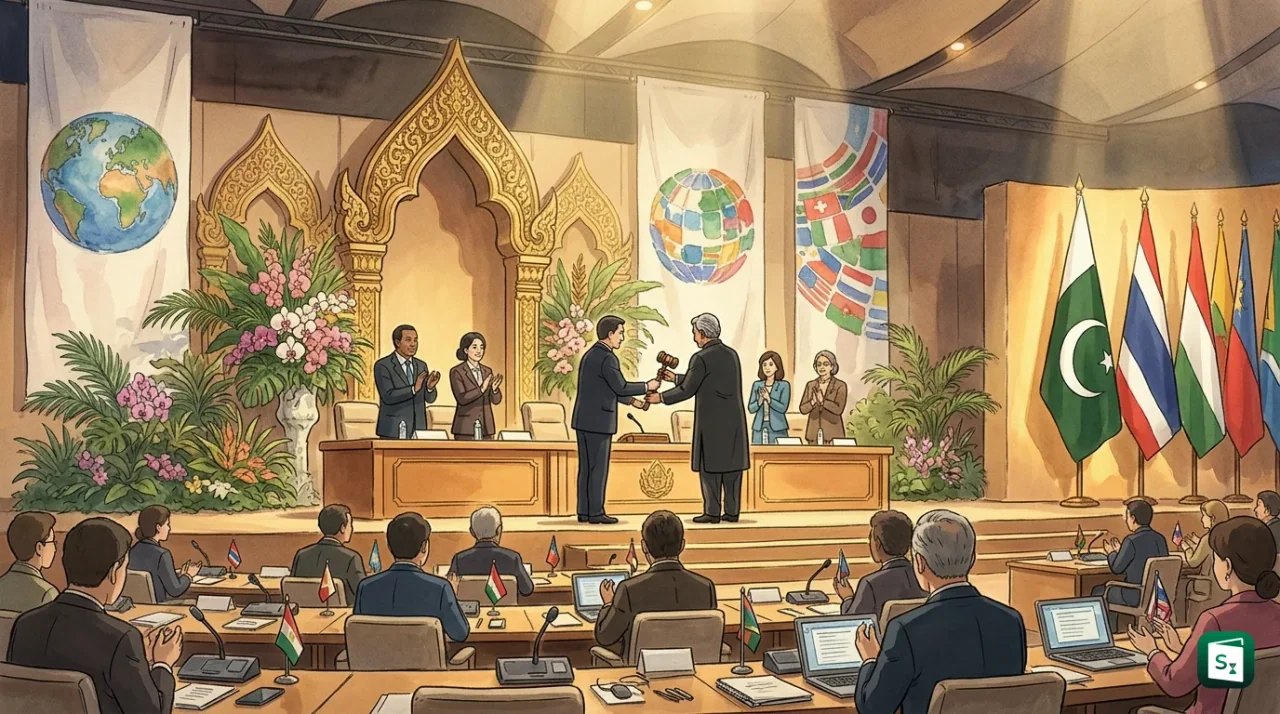
Pakistan was named the incoming chair of the Boards of Governors of the International Monetary Fund (IMF) and the World Bank Group (WBG) for 2027 during the plenary session of the 2026 Annual Meetings in Bangkok on 16 October 2026. Ahad Khan Cheema, Pakistan’s Minister for Economic Affairs and its governor to the World Bank, was designated as the incoming chair. Pakistan last held the position in 1953.
Pakistan Named Incoming Chair for 2027
The announcement came at the plenary session of the 2026 Annual Meetings, held from 12 to 18 October at the Queen Sirikit National Convention Center in Bangkok. More than 15,000 participants from 191 countries attended the meetings, including finance ministers, central bank governors and private sector leaders.
Ahad Khan Cheema was formally named the incoming chair during the plenary. The outgoing chair was Carlos Carvallo Spalding, president of the Central Bank of Paraguay, who presided over the 2026 meetings. After the plenary, Cheema met WBG Vice President and Corporate Secretary Aradhana Kumar-Capoor and was briefed by the WBG Corporate Secretariat on the responsibilities of the chair.
Pakistan’s Ministry of Economic Affairs described the development as a historic milestone. The ministry said the chair would give Islamabad a platform to contribute to global economic and development discussions and to encourage dialogue among member countries. The 2027 Annual Meetings are scheduled for 4 to 9 October in Washington, D.C.
The Announcement in Bangkok
The 2026 meetings were the 81st edition of the Annual Meetings and returned to Bangkok for the first time since 1991. The Queen Sirikit National Convention Center was originally built to host the 46th Annual Meetings in 1991.
The plenary on 16 October was the central business session. It brought together the Annual Meetings chair, World Bank Group President Ajay Banga (as of October 2026) and IMF Managing Director Kristalina Georgieva (as of October 2026). The chair of the Boards of Governors presides over the plenary and sets the order of speaking.
A Position Last Held in 1953
Pakistan last chaired the joint boards in 1953, when Finance and Economic Affairs Minister Mohammad Ali presided over the eighth edition of the Annual Meetings in Washington. Mohammad Ali later became Prime Minister of Pakistan. The 2027 chairmanship marks a return to the role after 74 years.
The chairmanship is not reserved for large shareholders. It rotates among member countries, and smaller economies have held it in recent years. Paraguay held the chair in 2026, Cabo Verde in 2025 and the Maldives in 2024.
India chaired the Annual Meetings in Paris in 1950, when Finance Minister C.D. Deshmukh presided. Ceylon, now Sri Lanka, chaired in 1968, and Nepal in 1999. The 2027 chairmanship therefore returns to South Asia after more than two decades.
What the Boards of Governors Do
The Boards of Governors are the highest decision-making bodies of the IMF and the World Bank Group. Each member country appoints one governor and one alternate. The governor is usually the finance minister, the central bank governor or a senior development minister.
All powers of the two institutions are vested in their boards. The boards delegate day-to-day authority to the Executive Boards, except for certain reserved powers such as admitting new members, increasing capital or quotas, and approving amendments to the Articles of Agreement.
The boards meet once a year at the Annual Meetings. The IMF’s International Monetary and Financial Committee (IMFC) and the joint IMF-World Bank Development Committee also meet during the same week. The IMFC has 25 members drawn from the governors and oversees the IMF’s work. The Development Committee advises both boards on development issues and the resources needed to reduce poverty.
The Annual Meetings are the main opportunity for governors to review the global economy, approve resolutions and hold bilateral talks with the institutions’ management. The Spring Meetings, held every April in Washington, focus on the same institutions but do not include the full plenary of the Boards of Governors.
One Governor per Member Country
The IMF has 191 member countries, and the World Bank has 189. Each member appoints a governor and an alternate. The governor represents the country on the board and votes on major decisions.
In India, Finance Minister Nirmala Sitharaman is the IMF Governor and the RBI Governor, Sanjay Malhotra, is the Alternate Governor. Pakistan’s World Bank Governor is Ahad Khan Cheema, while the Governor of the State Bank of Pakistan represents the country on the IMF Board of Governors. The split reflects the division of work between the Economic Affairs Division and the Finance Division in Pakistan.
How the Chair Is Selected
The chair is chosen from among the governors. The World Bank’s bylaws say the Board of Governors selects a governor to act as chair at each annual meeting. The IMF’s bylaws contain a similar provision, and the IBRD Articles of Agreement allow the board to select one of its governors as chairman.
The chair rotates among member countries each year. Pakistan’s selection was announced at the 2026 meetings, and Cheema will preside over the 2027 plenary. The appointment is largely procedural and follows an established rotation rather than a contested election.
The Chair Is Not the Head of Either Institution
The World Bank Group’s chief executive is its President, Ajay Banga. The IMF’s chief executive is its Managing Director, Kristalina Georgieva. Neither post is called chairman, and neither is chosen by the Boards of Governors in the annual plenary.
The chair of the Boards of Governors is a governor of a member country, not the head of the institution. The chair presides over the plenary, sets the speaking order and may communicate information about the proceedings to the press alongside the World Bank President and the IMF Managing Director. The chair does not sit on the Executive Boards and does not take part in lending decisions.
Who Is Ahad Khan Cheema?
Ahad Khan Cheema has been Pakistan’s Federal Minister for Economic Affairs since 11 March 2024. He is also Pakistan’s Governor to the World Bank Group, which made him eligible to be selected as chair of the joint Boards of Governors.
Cheema is a retired officer of the Pakistan Administrative Service. He earlier served as Director General of the Lahore Development Authority and held senior positions in the Punjab administration. His move from provincial administration to federal economic policy places him at the centre of Pakistan’s engagement with multilateral lenders.
In Pakistan’s system, the Economic Affairs Division handles the World Bank and other multilateral development institutions, while the Finance Division deals with the IMF. This division of work explains why Cheema, rather than the finance minister, is Pakistan’s World Bank Governor and the incoming chair. The Governor of the State Bank of Pakistan represents the country on the IMF Board.
From Civil Service to Economic Diplomacy
Cheema’s career has been closely tied to large public projects and donor-funded programmes. As head of the Lahore Development Authority, he managed urban infrastructure work in Pakistan’s second-largest city. He later worked on power sector projects before entering the federal cabinet.
At the Economic Affairs Ministry, Cheema oversees Pakistan’s relationships with the World Bank, the Asian Development Bank and other development partners. He has represented Pakistan at the World Bank’s Spring and Annual Meetings and has worked on the country’s ten-year Country Partnership Framework with the World Bank Group.
His Priorities for 2027
Cheema has said Pakistan will use the chair to amplify the voice of developing countries and to push for effective and predictable development finance. He has also emphasised better coordination among multilateral development institutions and the need to mobilise private investment for sustainable and inclusive growth.
These priorities fit the broader debate at the 2026 meetings, where developing economies pressed for more affordable financing, greater private capital and a stronger say in the governance of the Bretton Woods institutions. The chair gives Pakistan a visible platform for that argument, though not a vote on lending decisions.
What the Chair Can and Cannot Do
The chair’s formal powers are limited. The chair presides over the plenary, establishes the order of speaking and may communicate information about the proceedings to the press alongside the World Bank President and the IMF Managing Director. The chair does not control the institutions’ policy agenda, lending programmes or executive decisions.
The role is not comparable to the presidency of the G20 or BRICS. Those positions allow a country to set the agenda of a major forum. The chair of the Boards of Governors presides over an annual meeting whose agenda is shaped by the institutions’ management, executive boards and shareholders. K.V. Subramanian, a former Indian Executive Director at the IMF, has described the position as protocol rather than power and noted that it rotates annually.
A Procedural and Diplomatic Role
The chair is a governor of a member country, not a member of the Executive Board. The chair has no vote on loan approvals, conditionality or quota changes. The IMF’s Executive Board and the World Bank’s Board of Executive Directors take those decisions.
The chair’s influence comes from the platform, not from formal authority. A chair can use the plenary and the surrounding meetings to draw attention to specific issues, build coalitions among governors and shape the tone of the discussion. That is a diplomatic role, and its value depends on the chair’s credibility and skill.
Why the Platform Still Matters
The chairmanship gives Pakistan a rare turn at the centre of global economic diplomacy. The Annual Meetings bring finance ministers, central bank governors and private investors together in one place. The chair can use that setting to press for cheaper development finance, debt relief and a stronger voice for developing countries.
The role also carries symbolic weight. For a country that has repeatedly relied on IMF programmes, the chair offers a chance to help set the terms of the debate rather than simply respond to them.
That said, the chairmanship does not change Pakistan’s borrowing status. The announcement came shortly after Pakistan and the IMF reached a staff-level agreement on the fourth review of the EFF and the third review of the RSF. The agreement is subject to approval by the IMF Executive Board, and the chairmanship has no bearing on that decision.
Pakistan’s IMF Programme in Numbers
| Item | Details |
|---|---|
| IMF Extended Fund Facility (EFF) | $7 billion, 37 months, approved in September 2024 |
| IMF Resilience and Sustainability Facility (RSF) | $1.4 billion, 28 months, approved in May 2025 |
| Latest staff-level agreement | 7 October 2026, fourth EFF review and third RSF review |
| Potential disbursement | About $1.21 billion, subject to Executive Board approval |
| Total disbursements after approval | About $5.7 billion |
| IMF arrangements since membership | 25 |
Pakistan’s economy was worth $452.1 billion in FY2026, with real growth of 3.7%. Public debt stood at 68.3% of GDP on the government’s broad measure at the end of June 2026. These numbers explain why the chairmanship is politically useful but financially limited: Pakistan remains a programme country while it holds the chair.
IMF vs World Bank: What Is the Difference?
The IMF promotes global monetary stability and lends to countries facing balance-of-payments crises. The World Bank finances long-term development and poverty reduction through loans, grants and technical advice. Both were created at Bretton Woods in 1944 and are headquartered in Washington, D.C.
| Feature | IMF | World Bank |
|---|---|---|
| Full form | International Monetary Fund | World Bank, comprising the International Bank for Reconstruction and Development (IBRD) and the International Development Association (IDA) |
| Founded | July 1944, Bretton Woods | July 1944, Bretton Woods |
| Headquarters | Washington, D.C., United States | Washington, D.C., United States |
| Members | 191 | 189 |
| Head | Managing Director Kristalina Georgieva | President Ajay Banga |
| Main mandate | Monetary stability, economic surveillance and balance-of-payments support | Long-term development, poverty reduction and shared prosperity |
| Lending | Short- to medium-term support, usually with policy conditions | Project and policy-based development finance |
Who Is the Chairman of the World Bank?
The World Bank does not have a permanent chairman. Its chief executive is President Ajay Banga. The chair of the Boards of Governors is a rotating governor: Carlos Carvallo Spalding of Paraguay in 2026 and Ahad Khan Cheema of Pakistan in 2027.
Who Is the Chairman of the IMF?
The IMF is led by Managing Director Kristalina Georgieva, not a chairman. The chair of the Boards of Governors is a separate, rotating role drawn from member-country governors. Ahad Khan Cheema will hold that chair for the 2027 Annual Meetings.
Shared Origins, Different Mandates
The IMF and the World Bank were created at the Bretton Woods conference in New Hampshire in July 1944, where delegates from 44 nations designed a framework for post-war economic cooperation. The IMF came into formal existence in December 1945 and began financial operations in March 1947. The IBRD, the original lending arm of the World Bank, began operations in June 1946.
The two institutions have complementary roles. The IMF monitors economies, advises governments and provides short-term financing when a country cannot pay for imports or service its external debt. The World Bank provides long-term finance and knowledge for infrastructure, education, health, agriculture and private sector development.
Membership in the IMF is a prerequisite for joining the World Bank. The World Bank Group now has five institutions: the IBRD, the IDA, the International Finance Corporation (IFC), the Multilateral Investment Guarantee Agency (MIGA) and the International Centre for Settlement of Investment Disputes (ICSID). The IBRD and IDA together make up the World Bank. The IFC works with private companies, MIGA offers political risk insurance and ICSID settles investment disputes.
Public discussion often uses the phrases “World Bank chairman” and “IMF chairman” loosely. The accurate titles are President of the World Bank Group and Managing Director of the IMF. The chair of the Boards of Governors is a different position, tied to the annual meeting rather than the management of either institution.
India and South Asia in the Rotating Chair
India has a long history with both institutions. It was among the founding members of the IMF, joining on 27 December 1945, and was also a founding member of the World Bank. India chaired the Annual Meetings in Paris in 1950, when Finance Minister C.D. Deshmukh presided over the proceedings.
Pakistan followed in 1953, Ceylon in 1968 and Nepal in 1999. Pakistan’s 2027 chair will be the first from South Asia since Nepal held the position. The sequence shows that the chairmanship has regularly gone to developing economies rather than being confined to the largest shareholders.
| Year | Chair | Country | Venue |
|---|---|---|---|
| 1950 | C.D. Deshmukh | India | Paris |
| 1953 | Mohammad Ali | Pakistan | Washington, D.C. |
| 2026 | Carlos Carvallo Spalding | Paraguay | Bangkok |
| 2027 | Ahad Khan Cheema | Pakistan | Washington, D.C. |
India Chaired the 1950 Meetings in Paris
The 1950 Annual Meetings were held in Paris, one of the early overseas editions of a gathering that normally meets in Washington. C.D. Deshmukh, then India’s Finance Minister, chaired the proceedings. Deshmukh had earlier served as Governor of the Reserve Bank of India, and as Finance Minister he represented India on the boards of both Bretton Woods institutions.
India’s chairmanship came when the Bretton Woods institutions were still shaping their post-war role. India was a founding member of both and became one of the World Bank’s early borrowers.
India’s Weight in the Institutions
India holds an IMF quota of 2.75%, making it the eighth-largest quota holder (as of October 2026). Quotas are measured in Special Drawing Rights (SDRs), the IMF’s unit of account, and they determine a member’s voting power and access to IMF financing.
India’s Governor on the IMF Board is Finance Minister Nirmala Sitharaman, and the RBI Governor, Sanjay Malhotra, is the Alternate Governor. India’s Finance Minister also serves as the country’s Governor on the World Bank Board.
At the 2026 Annual Meetings, Sitharaman spoke at the Development Committee plenary and called for greater private capital, job creation and a stronger voice for developing countries in the World Bank’s governance. India’s engagement with the two institutions is therefore substantial, and it does not depend on who holds the rotating chair.
The Road to Washington 2027
The 2027 Annual Meetings will be held in Washington, D.C. from 4 to 9 October 2027. The meetings return to the headquarters city after the 2026 edition in Bangkok. Under the established pattern, the Annual Meetings are held in Washington two years out of three and in another member country every third year.
The 2027 plenary will bring the same cast together: the chair of the Boards of Governors, the World Bank Group President and the IMF Managing Director. The chair will preside over the session, set the order of speaking and join the two institutional heads in communicating the outcome to the press.
Dates, Venue and Agenda
The 2026 meetings focused on jobs, the use of artificial intelligence in development, private capital mobilisation and the risks of global economic fragmentation. Those themes are expected to carry into 2027, along with continuing debates on debt sustainability and affordable development finance.
The Annual Meetings also include the meetings of the IMFC and the Development Committee. These committees issue statements that guide the Executive Boards of the two institutions. For Pakistan, the 2027 chairmanship is a chance to influence the tone of those discussions and to keep the financing needs of developing countries on the agenda.
What Pakistan Will Preside Over
As chair, Cheema will preside over the plenary and the procedural business of the joint boards. He will not chair the IMFC or the Development Committee, which have their own chairs and memberships. The chair’s role is to keep the plenary moving and to represent the boards in communications with the press.
Pakistan has said it will use the year to push for predictable development finance, better coordination among multilateral institutions and more private investment in developing economies. Whether that translates into concrete outcomes will depend on the support Pakistan can build among other governors.
The 2029 Abu Dhabi Meeting
The 2029 Annual Meetings will be held in Abu Dhabi, United Arab Emirates. The UAE signed the hosting agreement during the 2026 meetings in Bangkok. The United Arab Emirates last hosted the meetings in Dubai in 2003.
Pakistan will hold the chair in 2027, the meetings return to Washington in 2027 and 2028, and the 2029 edition moves to Abu Dhabi. The chairmanship and the venue are separate decisions, but both reflect the effort to give different regions a turn in the institutions’ global calendar.
The Way Forward
The 2027 chairmanship is a test of diplomacy rather than a source of financial power. Pakistan can use the platform to argue for cheaper and more predictable development finance, debt relief and a stronger voice for developing countries. Its credibility will depend on its own reform record and its ability to bridge the positions of developed and developing members.
The role also matters for the wider debate on the governance of the Bretton Woods institutions. Developing economies have long sought a greater say in the IMF and World Bank, and the rotating chair is one of the few positions open to them. Whether Pakistan uses it to build consensus or treats it as a ceremonial honour will shape how the 2027 meetings are remembered.
Key Takeaways
- Pakistan was named the incoming chair of the Boards of Governors of the IMF and the World Bank Group for 2027 at the plenary of the 2026 Annual Meetings in Bangkok on 16 October 2026.
- Ahad Khan Cheema, Pakistan’s Minister for Economic Affairs and its World Bank Governor, will chair the joint boards for the 2027 Annual Meetings.
- Pakistan last chaired the joint boards in 1953; India chaired the Annual Meetings in Paris in 1950, Ceylon in 1968 and Nepal in 1999.
- The chair is a rotating and largely ceremonial role, and it does not give Pakistan authority over IMF or World Bank lending decisions.
- The IMF and the World Bank were founded at Bretton Woods in 1944 and are headquartered in Washington, D.C.; the IMF has 191 members and the World Bank 189.
- The IMF is led by Managing Director Kristalina Georgieva and the World Bank Group by President Ajay Banga.
- The 2027 Annual Meetings will be held in Washington, D.C. from 4 to 9 October 2027, and the 2029 meetings will be held in Abu Dhabi.
- Pakistan is under a $7 billion EFF and a $1.4 billion RSF; a staff-level agreement on 7 October 2026 could unlock about $1.21 billion, subject to Executive Board approval.