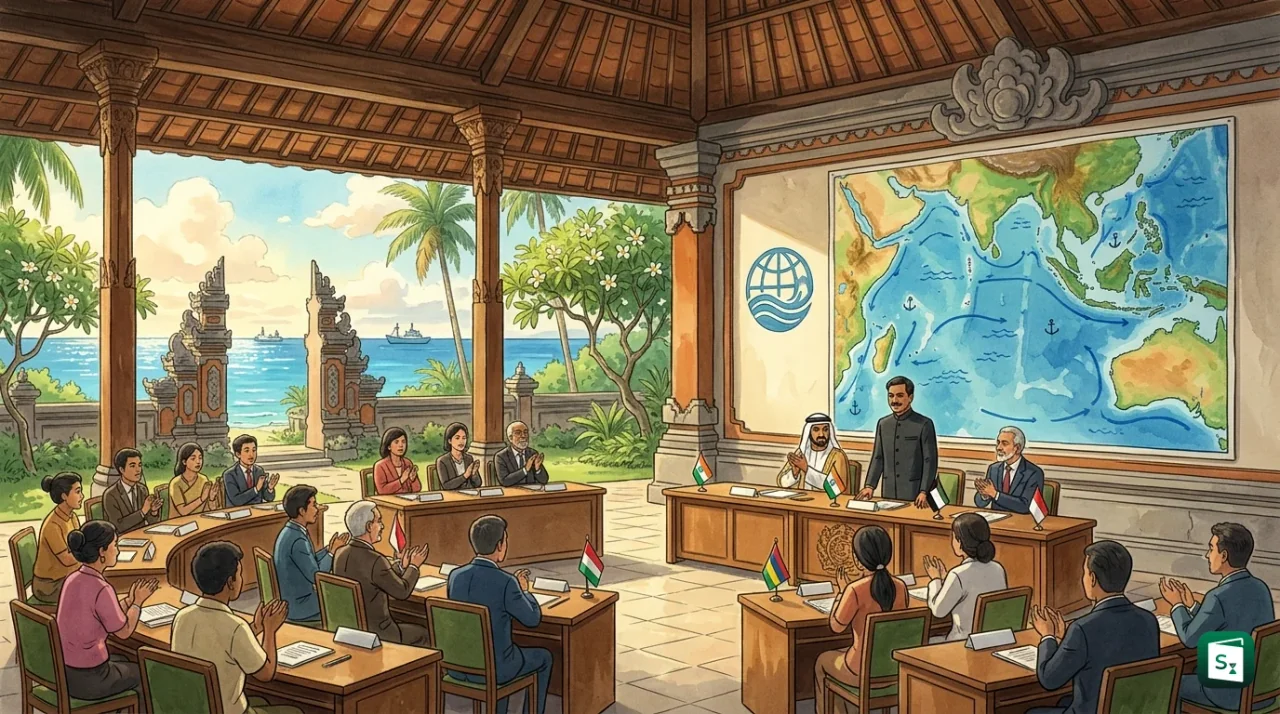
Dr T.M. Balakrishnan Nair, Director of the Indian National Centre for Ocean Information Services (INCOIS) in Hyderabad, has been elected Chair of the Intergovernmental Oceanographic Commission (IOC) Sub-Commission for the Indian Ocean, known as IOCINDIO, under UNESCO. The election took place at the sub-commission’s second Intergovernmental Session in Bali, Indonesia, held from 12 to 14 October 2026, where Kuwait’s Dr Turki Al-Saeed and Mauritius’s Dr Rezah M. Badal were chosen as Vice-Chairs. Dr Nair moves up from the vice-chair’s seat he held since May 2025, placing an Indian scientist at the head of a regional body that coordinates ocean science across 15 member states.
What Is IOCINDIO?
IOCINDIO is the Intergovernmental Oceanographic Commission’s Sub-Commission for the Central Indian Ocean, a regional body under UNESCO that coordinates ocean science, observations, data exchange and early warning services among Indian Ocean countries. It is one of the IOC’s regional subsidiary bodies and works with member states on shared ocean priorities. Its formal name uses the word “Central”, though it is widely described as the sub-commission for the Indian Ocean.
The body is not new in substance, only in status. For roughly three decades, the IOC ran a Regional Committee for the Central Indian Ocean under the same acronym. At its 32nd session in June 2023, the IOC Assembly adopted Resolution A-32/1, which elevated that committee into a full intergovernmental sub-commission. The upgrade took effect once nine member states submitted formal letters of adhesion to the IOC Executive Secretary. Thirteen had signed on by the time the sub-commission was formally launched.
| Feature | Detail |
|---|---|
| Full name | IOC Sub-Commission for the Central Indian Ocean |
| Parent body | Intergovernmental Oceanographic Commission of UNESCO |
| Legal basis | IOC Assembly Resolution A-32/1, June 2023 |
| Predecessor | IOC Regional Committee for the Central Indian Ocean |
| Member states | 15 (as of October 2026) |
| First session | Ras Al Khaimah, United Arab Emirates, 21 to 23 May 2025 |
| Second session | Bali, Indonesia, 12 to 14 October 2026 |
The membership now covers Bangladesh, France, India, Indonesia, Iran, Kenya, Kuwait, Mauritius, Oman, Russia, Saudi Arabia, Seychelles, Sri Lanka, the UAE and the United States. France and the United States participate because of their long-standing territorial and scientific interests in the region, which gives the sub-commission a mix of littoral states, distant maritime powers and small island economies.
IOCINDIO’s mandate is to promote international cooperation and coordinate programmes in research, services and capacity development. In practice, that means pooling ocean observations, sharing data, improving forecasts, strengthening tsunami preparedness and helping member states use ocean science in policy decisions. Membership carries no mandatory financial contribution, only voluntary participation in joint programmes and projects.
What Happened at the Second IOCINDIO Session?
The second IOCINDIO session in Bali elected Dr T.M. Balakrishnan Nair of India as Chair for October 2026 to October 2028, with Kuwait and Mauritius taking the two vice-chair posts. Delegates also finalised a regional workplan and budget for the 2028-2029 biennium.
The meeting was hosted by the Government of Indonesia. A regional workshop was held on 12 October 2026, followed by the formal intergovernmental session on 13 and 14 October 2026. India’s election win came on the strength of the work done by INCOIS in operational oceanography, which several member states already depend on for forecasts and tsunami bulletins.
| Position | Name | Country |
|---|---|---|
| Chair | Dr T.M. Balakrishnan Nair | India |
| Vice-Chair | Dr Turki Al-Saeed | Kuwait |
| Vice-Chair | Dr Rezah M. Badal | Mauritius |
The session was originally scheduled for April 2027, two years after the first session. It was brought forward after the IOC adopted Resolution A-33/3 on governance, programming and budgeting, which asked subsidiary bodies to align their meetings with the commission’s budget cycle. Holding the session in October 2026 allowed the region to feed its priorities into the IOC programme and budget for 2028-2029.
Beyond the election, the agenda covered the regional workplan and budget, which was endorsed as a recommendation to the 2027 IOC Assembly. Delegates reviewed activities under five High Level Objectives of the IOC results framework, including healthy ocean ecosystems, tsunami and hazard warning systems, climate resilience, services for a sustainable ocean economy and foresight on emerging science issues.
Two other threads ran through the meeting. One was the setting up of the IOCINDIO Secretariat at INCOIS in India, a decision that gives India a permanent institutional role in the sub-commission’s day-to-day work. The other was the “IOC and the Future of the Ocean” consultation, whose regional inputs will shape the IOC’s next Medium Term Strategy for 2030-2037.
Under IOC rules, a chairperson or vice-chairperson cannot serve more than two successive terms. The previous Chair, Dr Saif AlGhais of the UAE, and Vice-Chair Dr Maryam Ghaemi of Iran completed their first term. Dr Nair, who was also serving his first term as Vice-Chair, has now moved to the top post. Where a contest is unavoidable, IOC subsidiary bodies decide by a simple majority of members present and voting, usually through a secret ballot.
Who Is Dr T.M. Balakrishnan Nair?
Dr T.M. Balakrishnan Nair is the Director of INCOIS and one of its founding scientists. A marine scientist with a doctorate from Mangalore University, he has spent more than three decades building India’s ocean observation and forecasting systems. He took charge as Director in May 2025.
His academic base is in marine geology and oceanography. He completed a Master’s degree in Marine Geology and Oceanography at Cochin University of Science and Technology in 1994, finishing second in his batch. He then earned a Ph.D. in Marine Science from Mangalore University in 2001, working on the geochemistry of settling particles in the northern Indian Ocean as a CSIR research fellow. A DAAD fellowship took him to the University of Bremen in Germany for advanced research between 1999 and 2000.
Dr Nair joined INCOIS in March 2001, a little over two years after the centre was registered, and rose through the scientist grades to become its Director in May 2025. He led its Ocean Information and Forecast Services group for nearly two decades.
His core contribution is the operational ocean forecast system that INCOIS runs every day. The system combines real-time observations from buoys, tide gauges, Argo floats and satellites with numerical models to produce forecasts of waves, currents, sea surface temperature and storm surges. The same service was extended to Maldives, Seychelles and Sri Lanka, and its warnings during Cyclones Phailin and Hudhud are cited as evidence of its operational value.
| Year | Honour |
|---|---|
| 2000 | Young Scientist Award, Indian Association of Sedimentologists |
| 2007 | Certificate of Merit, Ministry of Earth Sciences |
| 2014 | National Geoscience Award, Ministry of Mines |
| 2024 | National Maritime Search and Rescue Award, Ministry of Defence |
| 2025 | Swadeshi Shastra Puraskaram, Vijnana Bharati (Kerala) |
He is a Fellow of the Telangana Academy of Sciences and a recognised research guide at several Indian universities. His publication record runs to about 160 peer-reviewed papers, with an h-index of 28 and more than 2,700 citations. He has supervised six doctoral theses.
His international roles prepared him for the IOCINDIO chair. He is the Chair of the Global Ocean Observing System (GOOS) of IOC/UNESCO (as of October 2026) and has served as Vice-Chair of two World Meteorological Organization expert teams, one on met-ocean requirements and another on marine services. He is also India’s national coordinator for the Ship Observation Team of GOOS and for the Coordinated Wave Climate Programme.
What Is INCOIS and Where Is It Located?
INCOIS stands for the Indian National Centre for Ocean Information Services. It is an autonomous institute under the Ministry of Earth Sciences, headquartered in Hyderabad, Telangana, and provides ocean forecasts, advisories and tsunami warnings to India and Indian Ocean countries.
The centre was registered as a society on 3 February 1999 under the Andhra Pradesh (Telangana) Public Societies Registration Act. It operates from Ocean Valley at Pragathi Nagar, on the outskirts of Hyderabad, and is a unit of the Earth System Science Organisation, the umbrella research network chaired by the Secretary of the Ministry of Earth Sciences.
INCOIS was created to turn ocean data into usable services. Its mandate covers sustained ocean observations, numerical modelling, early warning systems and the delivery of marine information to fishermen, shipping companies, ports, the oil and gas industry, the Navy, the Coast Guard and coastal administrators.
The Indian Tsunami Early Warning Centre (ITEWC) is its best-known facility. India built the centre after the 26 December 2004 Indian Ocean tsunami, and it became operational in October 2007. The ITEWC monitors seismic and sea-level networks round the clock, detects tsunamigenic earthquakes in the Indian Ocean within about ten minutes and issues bulletins to Indian authorities and neighbouring countries. UNESCO’s IOC has recognised it as a Regional Tsunami Service Provider for the Indian Ocean rim.
| Service | What It Provides |
|---|---|
| Tsunami early warning | 24x7 advisories to India and Indian Ocean countries |
| Ocean State Forecast | Three to seven day forecasts of waves, currents and sea surface temperature |
| Potential Fishing Zone advisories | Fishing location guidance in Hindi, English and eight regional languages |
| High wave and storm surge alerts | Coastal hazard warnings during cyclones and rough seas |
| Ocean data services | Archival and distribution of observational and satellite ocean data |
| Search and rescue support | Drift modelling for locating people or vessels lost at sea |
The centre also runs the International Training Centre for Operational Oceanography (ITCOocean), which UNESCO recognises as a Category 2 Centre. INCOIS signed a memorandum of agreement with IOC/UNESCO in July 2013 to support training and capacity development for Indian Ocean countries. It is designated as the National Oceanographic Data Centre under the IOC’s data exchange programme and as the Regional Argo Data Centre for the Indian Ocean.
Its work now feeds directly into national missions. Under the Deep Ocean Mission, launched in 2021 with an outlay of ₹4,077 crore, INCOIS has carried out glider missions in the Arabian Sea and the Bay of Bengal and deployed dozens of Argo floats and wave drifters. The institution received the Subhash Chandra Bose Aapda Prabandhan Puraskar in 2025 for its role in disaster management.
Why the Indian Ocean Matters for India and Its Neighbours
The Indian Ocean is the world’s third largest ocean and supports the fisheries, trade and coastal livelihoods of more than two dozen countries. For India, it is central to maritime trade, monsoon rainfall, disaster preparedness and the blue economy, and to regional security.
India’s stake in the ocean is largely geographic. The country has a coastline of about 7,517 km, nine coastal states, 1,382 islands and an exclusive economic zone of roughly 2.2 million sq km, which gives it legal rights over marine resources in a vast area. A very large share of India’s external trade by volume moves by sea, and the sea lanes that connect Indian ports to Southeast Asia, the Gulf, Africa and Europe pass through these waters.
The ocean also drives India’s weather. The Indian Ocean Dipole (IOD) is a pattern of alternating warm and cool sea surface temperatures between the western and eastern parts of the ocean. A positive IOD usually strengthens monsoon rainfall over India, while a negative phase can weaken it. The IOD interacts with El Niño and La Niña in the Pacific, and the combination of the two decides whether a monsoon season turns out wet or dry.
| Climate Signal | Status in October 2026 |
|---|---|
| Indian Ocean Dipole | Positive phase, index above the +0.4°C threshold |
| El Niño | Strong event in the Pacific, expected to persist into early 2027 |
| Marine heatwaves | Affecting about 80% of the Arabian Sea and 90% of the Bay of Bengal |
| Fisheries outlook | Warm water and weaker upwelling may reduce sardine and mackerel landings |
The human costs of ocean hazards are just as real. The 2004 Indian Ocean tsunami killed nearly 2.3 lakh people across 14 countries and pushed India to build a permanent warning system. Cyclones, storm surges, high waves, coastal erosion and sea-level rise continue to threaten dense coastal populations. As ocean temperatures rise, marine heatwaves damage coral reefs and disrupt fish migration, which directly affects the income of fishing communities.
These risks explain why the region needs shared observation networks rather than isolated national systems. A tsunami generated near Indonesia or a cyclone forming in the Arabian Sea does not respect maritime boundaries. Warnings, forecasts and data have to cross borders at speed, and that is the practical work IOCINDIO is meant to coordinate.
How Does IOCINDIO Fit Into Indian Ocean Governance?
IOCINDIO is one of several regional bodies in the Indian Ocean. It handles ocean science and observations under UNESCO, while IORA covers broader economic cooperation, the Indian Ocean Commission represents island states and the IOTC manages tuna fisheries. Each has a distinct mandate and membership.
| Body | Type and Parent | Headquarters | Main Focus |
|---|---|---|---|
| IOCINDIO | IOC sub-commission under UNESCO, elevated in 2023 | Secretariat at INCOIS, Hyderabad | Ocean science, observations, data and early warning |
| IOC | Intergovernmental Oceanographic Commission of UNESCO, set up in 1960 | Paris, France | Global ocean science, tsunami warning and capacity building |
| IORA | Intergovernmental grouping, started in 1997 | Ebene, Mauritius | Trade, investment, blue economy and maritime safety |
| Indian Ocean Commission | Intergovernmental body of island states, set up in 1982 | Port Louis, Mauritius | Island development, biodiversity and climate resilience |
| IOTC | Regional fisheries body under the FAO, set up in 1996 | Victoria, Seychelles | Management of tuna and tuna-like species |
| IOGOOS | Global Ocean Observing System regional alliance, set up in 2002 | Secretariat at INCOIS, Hyderabad | Indian Ocean observation and operational oceanography |
The Intergovernmental Oceanographic Commission was founded in 1960 and functions as a specialised body within UNESCO. It has about 150 member states and is headquartered in Paris. Its Assembly, the main governing body, meets once every two years, while a 40-member Executive Council meets annually. The commission coordinates global programmes on ocean observations, tsunami warning, marine data exchange, ocean literacy and the UN Ocean Decade, which runs from 2021 to 2030.
IOCINDIO is one of the IOC’s regional subsidiary bodies, alongside similar structures for Africa, the Caribbean and the Western Pacific. Its creation followed a long regional committee phase, and its upgrade to a sub-commission was meant to give the central Indian Ocean the same institutional weight as other IOC regions.
The acronym IOC can refer to three unrelated organisations, which is a common source of confusion. The Intergovernmental Oceanographic Commission is the UNESCO body described here. The International Olympic Committee, based in Lausanne, governs the Olympic movement. Indian Oil Corporation is India’s largest public sector oil marketing company, headquartered in New Delhi. In the context of ocean science and UNESCO, IOC always refers to the commission.
Another point of confusion is the Indian Ocean Commission, a separate body known by its French name, Commission de l’Océan Indien. It was founded in 1982 at Port Louis and groups Comoros, Madagascar, Mauritius, Seychelles and France, the last representing its overseas department of Reunion. It focuses on island economies rather than ocean science, and it is not part of UNESCO.
What Does the Chairmanship Mean for India?
The chairmanship gives India a formal leadership role in regional ocean science and a platform to shape the sub-commission’s workplan, data-sharing norms and training programmes. It also complements India’s blue economy goals and its tsunami warning role for Indian Ocean countries.
The election is an endorsement of what INCOIS has built over two decades. India already supplies tsunami bulletins to Indian Ocean countries as a Regional Tsunami Service Provider and has extended ocean forecasts to Maldives, Seychelles and Sri Lanka. Those services have made Indian oceanographic data a practical public good for the region, and the chair’s position recognises that contribution.
| Initiative | Year | Purpose |
|---|---|---|
| SAGAR | 2015 | Security and Growth for All in the Region, India’s framework for maritime cooperation |
| Deep Ocean Mission | 2021 | Deep-sea exploration, manned submersibles and ocean climate services |
| Maritime India Vision 2030 | 2021 | Port modernisation, shipping capacity and inland waterways |
| ITCOocean | 2013 | UNESCO Category 2 training centre at INCOIS for Indian Ocean professionals |
| Maritime Amrit Kaal Vision 2047 | 2023 | Long-term roadmap for India’s maritime sector |
Institutional presence matters as much as the title. The IOCINDIO Secretariat is being established at INCOIS, which means India will host the body’s working secretariat and not just its chair. A secretariat prepares agendas, coordinates working groups, manages data and sustains continuity between sessions. Hosting it gives India influence over the everyday functioning of the sub-commission, an advantage that outlasts any single chair’s term.
The chair also strengthens India’s position in South-South cooperation. Most IOCINDIO members are developing economies with limited ocean research infrastructure. India can offer training through ITCOocean, share forecast products and help smaller states meet their reporting and data obligations. That kind of technical support builds goodwill and gives India a credible voice in wider ocean governance debates, including the UN Ocean Decade and the BBNJ Agreement on marine biodiversity beyond national jurisdiction.
There are limits to what the role can deliver. IOCINDIO does not have a large budget of its own, and much of its work depends on voluntary contributions and the resources member states bring to the table. Coordination with IORA, the Indian Ocean Commission and fisheries bodies is easier to endorse than to execute, because each has its own mandate and governing structure. Data sharing is another hurdle, since countries are often reluctant to release observations that have commercial or strategic value.
The strategic context adds weight. The Indian Ocean is now a theatre of competing maritime presence, and science cooperation offers a low-friction way for India to stay engaged with every littoral state. A chairmanship that delivers better forecasts, faster warnings and trained scientists is likely to earn more influence than one that relies on declarations alone.
The Way Forward
Dr Nair’s two-year term runs from October 2026 to October 2028, and the immediate task is to convert the Bali decisions into working programmes. The 2028-2029 regional workplan endorsed at the session will go to the IOC Assembly in 2027 as a formal recommendation, which means the coming months will decide how much of the region’s wish list survives the budget process.
The first test is the IOCINDIO Secretariat at INCOIS. Getting a permanent secretariat staffed and funded would give the sub-commission a working centre for the first time, allowing it to coordinate working groups, manage regional data and respond to member state requests between sessions.
The second test is delivery on shared science. The session’s agenda included joint cruises, expansion of ocean observations, tsunami preparedness training, harmful algal bloom monitoring, ocean literacy and the regional implementation of the UN Ocean Decade. Several of these depend on extra-budgetary funding, so India and other member states will have to commit resources, not just endorse recommendations.
A third priority is coherence. IOCINDIO, IORA, the Indian Ocean Commission and the IOTC all work in the same waters with different mandates. Avoiding duplication and building joint programmes with these bodies would make the region’s science spending go further. The sub-commission has already invited regional partners and observers into its sessions, which is a useful starting point.
Saudi Arabia has offered to host a future session, a sign that Gulf states want a larger role in Indian Ocean science. For India, that is an opportunity to build a durable coalition around open data, shared warnings and training. The measure of this chairmanship will be whether IOCINDIO becomes a body that governments consult before they act, rather than one they only meet every two years.
Key Takeaways
- Dr T.M. Balakrishnan Nair, Director of INCOIS, was elected Chair of IOCINDIO at its second Intergovernmental Session held in Bali, Indonesia, from 12 to 14 October 2026.
- Dr Turki Al-Saeed of Kuwait and Dr Rezah M. Badal of Mauritius were elected Vice-Chairs, and the new leadership holds office from October 2026 to October 2028.
- IOCINDIO was elevated from a regional committee to a sub-commission by IOC Resolution A-32/1 at the 32nd IOC Assembly in June 2023, and it now has 15 member states.
- The IOCINDIO Secretariat is being established at INCOIS in Hyderabad, giving India a permanent institutional role in the sub-commission.
- INCOIS was registered on 3 February 1999 as an autonomous society under the Ministry of Earth Sciences, and its Indian Tsunami Early Warning Centre has operated since October 2007.
- The Intergovernmental Oceanographic Commission was founded in 1960, is headquartered in Paris and serves about 150 member states as part of UNESCO.