Union Minister for Environment, Forest and Climate Change Bhupender Yadav launched the implementation guidelines for the National Coastal Mission 2.0 on 30 September 2026 in New Delhi. The National Coastal Mission 2.0 is a Central Sector Scheme with an approved outlay of ₹767 crore for the period 2025-26 to 2030-31, covering nine coastal states and four Union Territories. The guidelines create a single, transparent framework to protect coastal and marine ecosystems while unlocking sustainable blue economic growth.
What Is National Coastal Mission 2.0?
The National Coastal Mission 2.0 is a Central Sector Scheme of the Ministry of Environment, Forest and Climate Change (MoEFCC) for integrated coastal management across India. As a Central Sector Scheme, it is fully funded by the Union Government. The National Coastal Mission 2.0 carries an approved outlay of ₹767 crore for 2025-26 to 2030-31 and subsumes the first phase of the mission implemented from 2021-22 to 2025-26.
The National Coastal Mission began as part of India’s response to rising sea levels, erosion, pollution and loss of coastal habitats. The first phase focused on building institutions, mapping hazard lines and piloting Integrated Coastal Zone Management in Gujarat, Odisha and West Bengal with World Bank support. The National Coastal Mission 2.0 builds on that base. It provides a consolidated framework for climate resilient management, ecosystem restoration and sustainable livelihoods through active collaboration with coastal states, Union Territories and stakeholders.
Five Thematic Areas Driving the Mission
The National Coastal Mission 2.0 framework is organised into five thematic categories. The categories link conservation with risk reduction, climate action and better project delivery. Each project proposed by a state or Union Territory must fit within one of these themes.
| Thematic Area | What It Covers |
|---|---|
| Climate resilient blue economic growth | Sustainable fisheries, eco-tourism, seaweed farming, marine spatial planning and livelihood support |
| Coastal vulnerability and risk reduction | Hazard line mapping, erosion control, Coastal Vulnerability Index, disaster preparedness and resilient infrastructure |
| Climate change adaptation with mitigation co-benefits | Mangrove and coral reef restoration, carbon sequestration, pollution control and protection of blue carbon habitats |
| Capacity building and outreach | Training, research, awareness, knowledge networks and support to coastal zone management authorities |
| Committed liabilities and project management | Ongoing works, monitoring, evaluation, coordination and administrative support for timely completion |
Coastal vulnerability and risk reduction responds to a pressing reality. Nearly seven percent of India’s coast faces high erosion, and stretches in West Bengal, Kerala, Puducherry and Lakshadweep are highly eroding. Work under this theme supports shoreline mapping, sediment cell studies and nature based defences. It also strengthens disaster plans for cyclones, storm surges, flooding and saltwater intrusion.
The adaptation theme delivers mitigation co-benefits. Restored mangroves and seagrasses store large amounts of carbon, shield shores from waves and nurture fish breeding grounds. Pollution management under the same theme targets marine litter, plastics, microplastics and coastal outfalls. Capacity building keeps the system running. It trains officials, supports research and spreads good practices among fishing villages, local bodies and management authorities.
Coverage Across Coastal Areas in India
The National Coastal Mission 2.0 covers nine coastal states and four Union Territories. The scale is large. India’s coastline has been reassessed to 11,098.81 km by the National Hydrographic Office in coordination with the Survey of India, using high resolution mapping of the High Water Line. The revised length was promulgated through a circular of the Ministry of Ports, Shipping and Waterways dated 29 April 2025. The Exclusive Economic Zone of India extends over about 2.4 million sq. km, and more than four million fisherfolk depend on coastal resources for livelihood.
| Region | States and Union Territories Covered |
|---|---|
| West coast | Gujarat, Maharashtra, Goa, Karnataka, Kerala |
| East coast | Tamil Nadu, Andhra Pradesh, Odisha, West Bengal |
| Union Territories | Dadra and Nagar Haveli and Daman and Diu, Puducherry, Lakshadweep, Andaman and Nicobar Islands |
Each coastal area in India carries distinct stakes. Gujarat has long mangrove belts and the Gulfs of Kutch and Khambhat. Maharashtra and Goa combine port cities with coral patches and tourism pressure. Karnataka, Kerala and Tamil Nadu host estuaries, backwaters and the Gulf of Mannar. Andhra Pradesh now holds the third longest coastline among states after the reassessment. Odisha and West Bengal anchor the Sundarbans and Bhitarkanika delta systems. Island territories add pristine reefs in Lakshadweep and the Andaman and Nicobar Islands. The mission allows states and Union Territories to propose location specific projects within the five themes, based on local erosion hotspots, sediment cells and ecosystem needs.
Integrated Coastal Management and Regulatory Framework
Coastal management means balancing protection of fragile shores with ports, fisheries, tourism and settlements. India moved from a uniform regulatory approach to Integrated Coastal Zone Management, which plans for an entire coastal stretch together. The approach combines science, spatial planning, community needs and disaster risk into one decision system.
The legal anchor is the Coastal Regulation Zone (CRZ) Notification, 2019, issued under the Environment (Protection) Act, 1986. The notification declares coastal stretches and territorial waters as the Coastal Regulation Zone, excluding the islands of Andaman and Nicobar and Lakshadweep which have separate island protection rules. It classifies shores into CRZ-I for ecologically sensitive areas like mangroves and coral reefs, CRZ-II for built up urban shores, CRZ-III for rural and undisturbed shores, and CRZ-IV for water areas. The notification relies on the High Tide Line demarcated by the National Centre for Sustainable Coastal Management (NCSCM) and the hazard line mapped by the Survey of India. States prepare Coastal Zone Management Plans based on these lines.
Three institutions carry the work forward. The Society of Integrated Coastal Management (SICOM), housed in the MoEFCC, acts as the national project lead and coordinates plans across states and Union Territories. The NCSCM, established in 2011 in Chennai at the Anna University campus, provides research, mapping and policy support for sustainable coastal management. The National Coastal Zone Management Authority and state coastal zone management authorities handle clearances, monitoring and enforcement. The National Coastal Mission 2.0 guidelines clarify these roles, stress convergence with ongoing schemes and push a whole of government approach with stronger monitoring and accountability.
Marine Ecosystem Conservation: Mangroves and Coral Reefs
A coastal ecosystem includes shores, estuaries, mangroves, seagrasses, coral reefs and the marine life they support. These systems control erosion, reduce storm surge force, trap sediment and provide breeding grounds for fish. Mangroves and coral reefs are the most valuable defences in this chain.
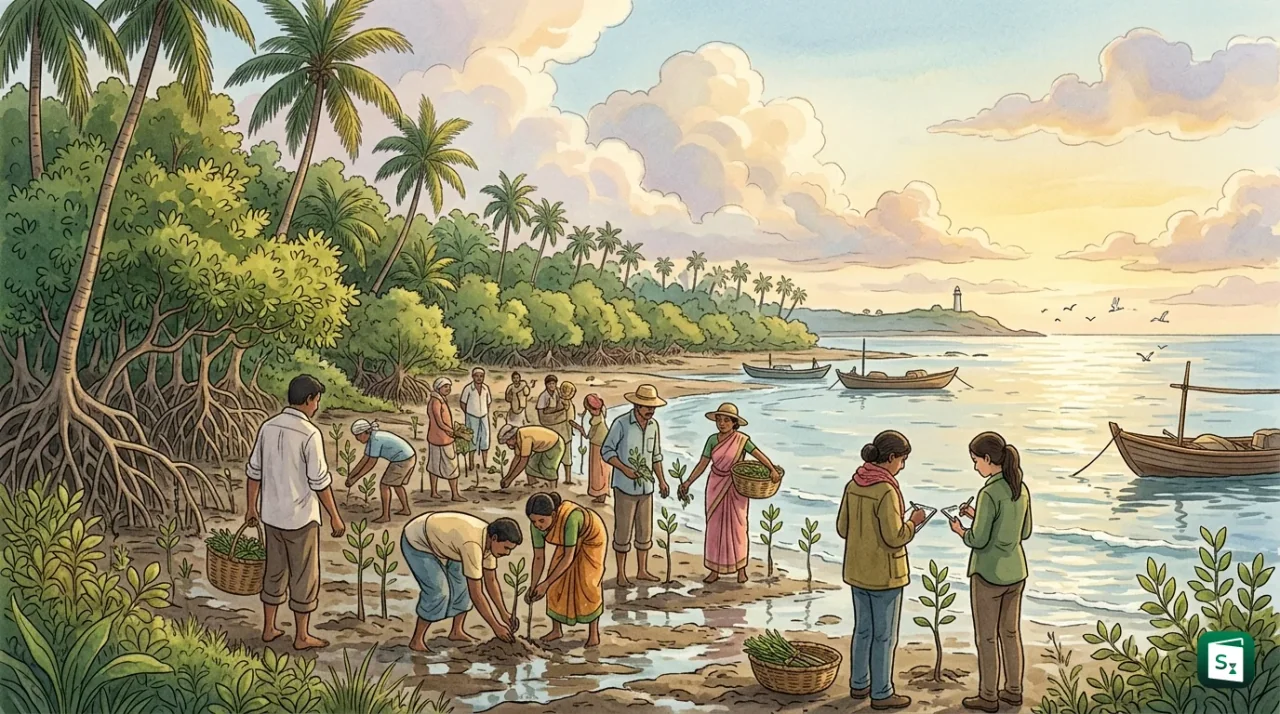
India holds about 4.99 lakh hectares of mangrove cover, nearly three percent of the world’s mangroves. Large patches stand in the Sundarbans of West Bengal, Bhitarkanika in Odisha, the Andaman and Nicobar Islands and the coastal belts of Gujarat. Their dense roots cut tidal energy and check erosion. During the 1999 Odisha super cyclone and the 2004 tsunami, mangrove rich stretches suffered less damage. Mangroves also store carbon up to five times more efficiently than tropical rainforests and support nearly half of coastal fisheries as nursery grounds.
Coral reefs in India occur mainly around Lakshadweep, the Andaman and Nicobar Islands, the Gulf of Mannar, the Gulf of Kutch and parts of Maharashtra. Though reefs cover less than one percent of the ocean floor, they sustain more than one quarter of marine biodiversity. They form natural breakwaters, sustain reef fisheries and anchor marine tourism. Coral reefs face bleaching from warming seas, acidification and pollution. Mangrove shade can help some corals resist heat stress, which makes joint mangrove reef protection powerful.
The National Coastal Mission links this science to action. Earlier work focused on restoring mangrove and coral reef sites through centre state coordination. Complementary efforts include the MISHTI scheme, which stands for Mangrove Initiative for Shoreline Habitats and Tangible Incomes and was announced in the Union Budget 2023-24 to restore mangroves with community participation. Tamil Nadu’s Gulf of Mannar Biosphere Reserve has tested coral transplantation and seagrass restoration. The National Coastal Mission 2.0 scales such models through vulnerability assessment, ecosystem restoration, biodiversity conservation and spatial planning.
What Is Blue Economy and Why It Matters for India?
The blue economy is the sustainable use of ocean and coastal resources for growth, jobs and food security while protecting marine health. It includes fisheries, aquaculture, ports, shipping, coastal tourism, offshore energy, seabed minerals, marine biotechnology and coastal manufacturing.
In India, the blue economy covers the full system of ocean resources and man made infrastructure in marine, maritime and onshore coastal zones within national jurisdiction, with links to growth, environmental sustainability and national security. The Ministry of Earth Sciences serves as the nodal agency for blue economy policy, and the draft national framework was shaped with support from the Economic Advisory Council to the Prime Minister. The idea gained global weight after the Rio+20 summit in 2012 and the adoption of Sustainable Development Goal 14 on conservation and sustainable use of oceans.
The stakes are high. Sea routes carry about 90 percent of India’s trade by volume. Seafood exports reached 17.81 lakh metric tonnes worth ₹60,523 crore in 2023-24. Sagarmala, the Pradhan Mantri Matsya Sampada Yojana, the Deep Ocean Mission and the O-SMART ocean services scheme already invest in ports, fishers and marine science. The National Coastal Mission 2.0 adds the ecological base for this growth. Healthy mangroves lower storm damage and disaster costs. Healthy reefs sustain fish catch and tourism income. Clean coasts improve the ease of doing business for ports, eco-resorts and seaweed or cage culture ventures.
Implementation, Monitoring and The Way Forward
The MoEFCC will steer the National Coastal Mission 2.0 with SICOM, NCSCM, state coastal zone management authorities and local stakeholders. The new guidelines set a clear implementation path. They simplify procedures, define who does what and tighten monitoring so funds move faster and results can be tracked. Convergence is central. Coastal projects must align with related programmes on fisheries, tourism, disaster management and pollution control instead of working in isolation.
The focus now shifts to execution quality. Priority tasks include completing Coastal Zone Management Plans for all coastal stretches, updating hazard lines and Coastal Vulnerability Index maps, and using high resolution data for local planning. Pollution hotspots need time bound action. Sustainable tourism needs spatial plans that keep construction above the High Tide Line and away from dunes and sensitive intertidal zones. Research and capacity building must reach field staff, fishing villages and urban local bodies.
The mission points toward the long term vision of Viksit Bharat 2047. Resilient shores protect ports, power plants, roads and heritage sites. Productive seas secure protein, jobs and export earnings. If states use the five themes to blend grey infrastructure with green defences like mangroves and sand dunes, the coastline can support growth while absorbing climate shocks.
Key Takeaways
- The National Coastal Mission 2.0 guidelines were launched on 30 September 2026 by Union Minister Bhupender Yadav in New Delhi.
- The National Coastal Mission 2.0 is a Central Sector Scheme with an outlay of ₹767 crore for 2025-26 to 2030-31.
- The mission covers 9 coastal states and 4 Union Territories and works through five thematic areas.
- India’s coastline has been reassessed to 11,098.81 km, with the Coastal Regulation Zone Notification, 2019 as the key legal framework.
- The National Centre for Sustainable Coastal Management, established in 2011 in Chennai, provides mapping and research support for coastal management.