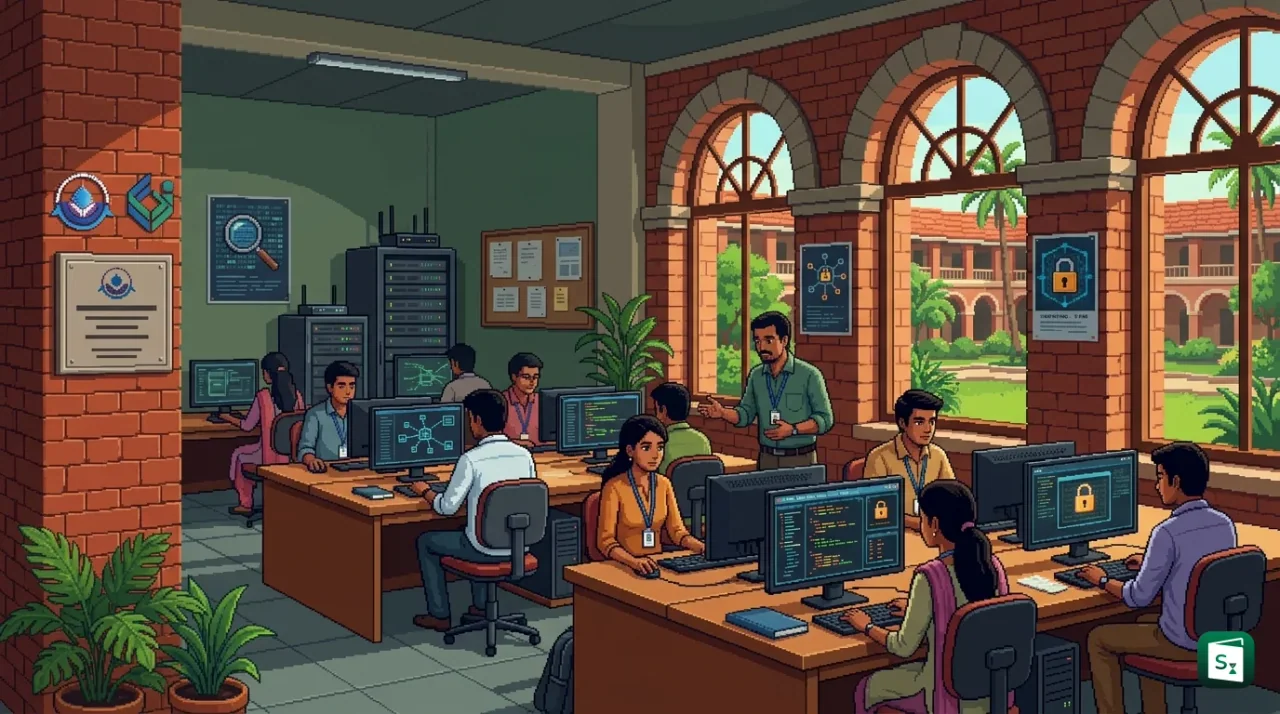
Tata Communications Ltd has set up a ₹3.5 crore Centre of Excellence in cybersecurity and digital forensics at SASTRA Deemed University in Thanjavur, Tamil Nadu. The centre was launched on 27 September 2026 by Managing Director and Chief Executive Officer Ganesh Lakshminarayanan during the university graduation ceremony. It will train students to detect cyber attacks, investigate digital evidence and build skilled manpower for India’s growing digital economy.
What Is the New Centre of Excellence at SASTRA?
A Centre of Excellence (CoE) is a dedicated facility where experts, advanced tools and training come together in one place to build deep skill in a specific field. The new CoE at SASTRA focuses on two linked fields, cybersecurity and digital forensics. Tata Communications and SASTRA have jointly set it up at a cost of ₹3.5 crore as a research and capacity building facility.
Tata Communications launched the CoE on the sidelines of the SASTRA graduation ceremony in Thanjavur. Ganesh Lakshminarayanan, Managing Director and Chief Executive Officer of Tata Communications, opened the facility. S Vaidhyasubramaniam, Vice Chancellor of SASTRA, presided over the event. More than 1,000 graduates of the School of Computing received their degrees at the same ceremony. Prince Jayakumar, Executive Vice President and Global Head of Human Resources at HCL Technologies, also attended the event.
The stated goal of the CoE is to create focused manpower capable of handling different levels of digital and cyber vulnerabilities. In simple terms, it will help students learn how to protect computer systems and how to investigate crimes after they happen. At the event, the Tata Communications chief noted that the transformational role of artificial intelligence (AI) is still in an early exploration phase, with a large share of corporate investments yet to show full returns. The message underlined why hands on research labs matter. Students need real tools and real case studies, not only classroom theory.
SASTRA University in Thanjavur: Institutional Profile
SASTRA stands for Shanmugha Arts, Science, Technology and Research Academy. The institution began in 1984 as Shanmugha Engineering College at Thirumalaisamudram in Thanjavur district of Tamil Nadu. It received Deemed to be University status in 2001 from the University Grants Commission (UGC) under Section 3 of the UGC Act, 1956. It was the first institution in Tamil Nadu to receive this status.
SASTRA is now a multi disciplinary university with programmes in engineering, law, management, sciences, humanities and education. The main campus is spread over 232 acres at Thirumalaisamudram. SASTRA also runs an off campus centre called the Srinivasa Ramanujan Centre at Kumbakonam. The university has more than 15,000 students, over 975 faculty members and 23 research centres. It has been re accredited with NAAC A++ grade with a score of 3.76 out of 4 and recognised as a Category I institution for graded autonomy by the UGC.
SASTRA University figures regularly in the National Institutional Ranking Framework (NIRF), which is released by the Ministry of Education to rank Indian colleges and universities. Its recent positions show its strength in engineering and law.
| Category | NIRF 2025 Rank |
|---|---|
| University | 29 |
| Overall | 51 |
| Engineering | 40 |
| Law | 11 |
The Vice Chancellor of SASTRA is S Vaidhyasubramaniam (as of October 2026). Admission to its popular BTech programmes is based on qualifying examination marks and JEE Main scores. The per semester tuition fee for BTech is about ₹85,000, with a small annual increase from the second year. This background explains why the CoE location matters. A highly ranked technology campus in Tamil Nadu gives industry a ready pool of computing students for advanced cybersecurity training.
Tata Communications Limited: Company Overview
Tata Communications Ltd is a part of the Tata Group and works as a global digital ecosystem enabler. It is headquartered at the Bandra Kurla Complex in Mumbai. The company began as Videsh Sanchar Nigam Limited (VSNL), which was incorporated in 1986. It was renamed Tata Communications Limited in 2008 after the Tata Group took over the business.
Tata Communications operates in more than 190 countries and territories. It serves over 7,000 customers globally, including 300 of the Fortune 500 companies. The company carries around 30 percent of the world’s internet routes and connects businesses to 80 percent of the world’s cloud giants. Its main work includes network services, cloud hosting, internet of things solutions, media services and managed security services. The company also runs Cyber Security Response Centres in cities including Chennai, Pune, Singapore and Dubai.
This is not the first partnership between Tata Communications and SASTRA. In September 2018, the company funded a specialised cybersecurity laboratory at SASTRA to build course content and practical training in threat detection and mitigation. Senior company engineers helped design the curriculum and visited as guest faculty. The 2026 CoE builds on that earlier lab with a larger research focus on digital forensics.
Is Tata Communications the Same as TCS?
No. Tata Communications and Tata Consultancy Services (TCS) are not the same company. Both belong to the Tata Group, but they are separate listed businesses with different work. TCS is mainly an information technology services and consulting company. Tata Communications is mainly a communications technology company that owns global data networks, subsea cables and cloud and security platforms. The CoE at SASTRA belongs to Tata Communications, not TCS.
What Is Digital Forensics in Cybersecurity?
Digital forensics in cybersecurity is the scientific method of finding, collecting, preserving and analysing evidence stored on computers, phones, servers and networks to investigate cybercrime. It helps experts find how an attack happened, what data was stolen or changed, and who was responsible. The findings can support internal action and can also be presented as evidence in court.
Forensic science is the use of scientific methods to examine crime related material and help the justice system. Digital forensics is a branch of forensic science. While traditional forensics studies fingerprints, blood or documents, digital forensics studies hard drives, memory, emails, logs and cloud data. Other common terms for the same broad field include computer forensics, cyber forensics, IT forensics and electronic forensics.
The CoE will focus on this investigation side of cybersecurity. Cybersecurity has two parts. One part tries to stop attacks through firewalls, passwords and monitoring. The other part investigates after an incident through a process called digital investigation. That second part is where digital forensics sits. It reconstructs the timeline of an attack and fixes weak points so the same attack does not repeat.
How Does Digital Forensics Work?
Digital forensics follows a strict chain of custody to prove that evidence was not altered or damaged during handling. The National Institute of Standards and Technology (NIST) of the United States describes four main stages in this work. Indian labs and training programmes follow the same basic logic.
First comes collection. Experts identify devices that may hold evidence and make exact bit by bit copies called disk images. The original device is sealed and kept safe. All later work is done on the copy to avoid changes. Then comes examination. Analysts search the copy for hidden files, deleted data, logs, emails and network records. After that comes analysis. They connect the pieces to answer what happened, when it happened and how the attacker entered. Finally comes reporting. The team writes a clear report with a timeline, methods used and findings.
Cloud forensics, mobile device forensics, network forensics and database forensics are special branches of this process. Network forensics studies internet traffic and event logs to trace the attacker. Mobile forensics recovers data from phones and tablets under safe conditions. Database forensics studies stored records and their metadata. The CoE is expected to give students practical exposure across these branches.
Common Digital Forensics Tools
Digital forensics tools include both hardware and software that collect and study data without changing it. Modern labs no longer depend only on live analysis of running systems, which carries a high risk of altering evidence. They use tested platforms that preserve integrity through techniques like hashing.
| Tool Type | Examples | What It Does |
|---|---|---|
| Comprehensive suites | EnCase, Forensic Toolkit (FTK) | Examine disk images, recover deleted files and prepare case reports |
| Open source platforms | CAINE, Kali Linux tools | Provide low cost environments for file, memory and network study |
| System examination | OSForensics | Searches drives, memory and logs for traces of activity on computers |
| Network capture | Wireshark | Intercepts and logs network traffic for later inspection |
A Certified Computer Examiner is a professional certification in this field that tests the ability to collect and examine digital evidence in a sound manner. Such certifications, along with university training at facilities like the new CoE, improve job readiness for roles such as security analyst, incident responder and digital forensics expert.
Why Cybersecurity Is Important for India
Cybersecurity is important because banks, power grids, hospitals, government records and daily payments now run on connected computer systems. A single breach can steal money, stop services and expose personal data of millions of people. Strong protection and fast investigation reduce financial loss, protect privacy and keep public trust in digital services.
India faces this challenge at a large scale. The Indian Computer Emergency Response Team (CERT-In) is the national nodal agency for responding to cybersecurity incidents. It works under the Ministry of Electronics and Information Technology (MeitY) and has been operational since January 2004. It was given statutory powers under the Information Technology (Amendment) Act, 2008, especially Section 70B. Its work includes collecting incident reports, issuing alerts and advisories, coordinating response and publishing security guidelines.
The legal and policy base has grown around this agency. The Information Technology Act, 2000 provides the main law for electronic records and cyber offences. CERT-In directions require reporting of certain incidents within six hours. The Digital Personal Data Protection Act, 2023 has added new duties for handling personal data. For the financial sector, the Digital Threat Report 2025-26, prepared with CERT-In, CSIRT-Fin and SISA, has called for continuous risk assessment, stronger Digital Forensics and Incident Response (DFIR) capacity and better threat intelligence sharing. These steps show why trained investigators are in short supply and high demand.
The SASTRA CoE fits directly into this national need. Industry estimates place entry level cybersecurity pay in India between ₹4 lakh and ₹8 lakh per year, with higher pay in Bengaluru, Mumbai, Hyderabad and Pune for skilled roles. Demand is strong for security operations centre analysts, threat hunters and forensics experts. A campus lab with company mentors, real case studies and updated course content can shorten the gap between degrees and jobs while supporting the goals of Digital India.
The Way Forward
The success of the CoE will depend on how well classroom learning turns into practical skill. Joint curriculum design, guest lectures by company engineers and training for faculty will be central. If students regularly handle simulated breaches, analyse logs and prepare evidence reports, the lab can become a steady source of employable talent.
The model can also be repeated. Tata Communications already works with universities outside India, including the Singapore University of Technology and Design, on cybersecurity projects. A strong outcome at Thanjavur could encourage similar centres in other states. For Tamil Nadu, which hosts a large student base in computing and a growing technology corridor around Chennai, the CoE strengthens the link between campuses and industry at a time when cyber threats are rising.
Key Takeaways
- Tata Communications and SASTRA set up a ₹3.5 crore Centre of Excellence in cybersecurity and digital forensics at Thanjavur, launched on 27 September 2026.
- SASTRA stands for Shanmugha Arts, Science, Technology and Research Academy, founded in 1984 and granted Deemed University status in 2001.
- SASTRA ranked 29th among universities, 51st overall, 40th in engineering and 11th in law in NIRF 2025.
- Tata Communications Ltd, earlier VSNL (1986) and renamed in 2008, is a Tata Group company distinct from TCS and operates in over 190 countries.
- Digital forensics is a branch of forensic science that collects and analyses digital evidence through collection, examination, analysis and reporting.
- CERT-In, operational since 2004 under MeitY and empowered under Section 70B of the IT (Amendment) Act, 2008, is India’s nodal cybersecurity agency.