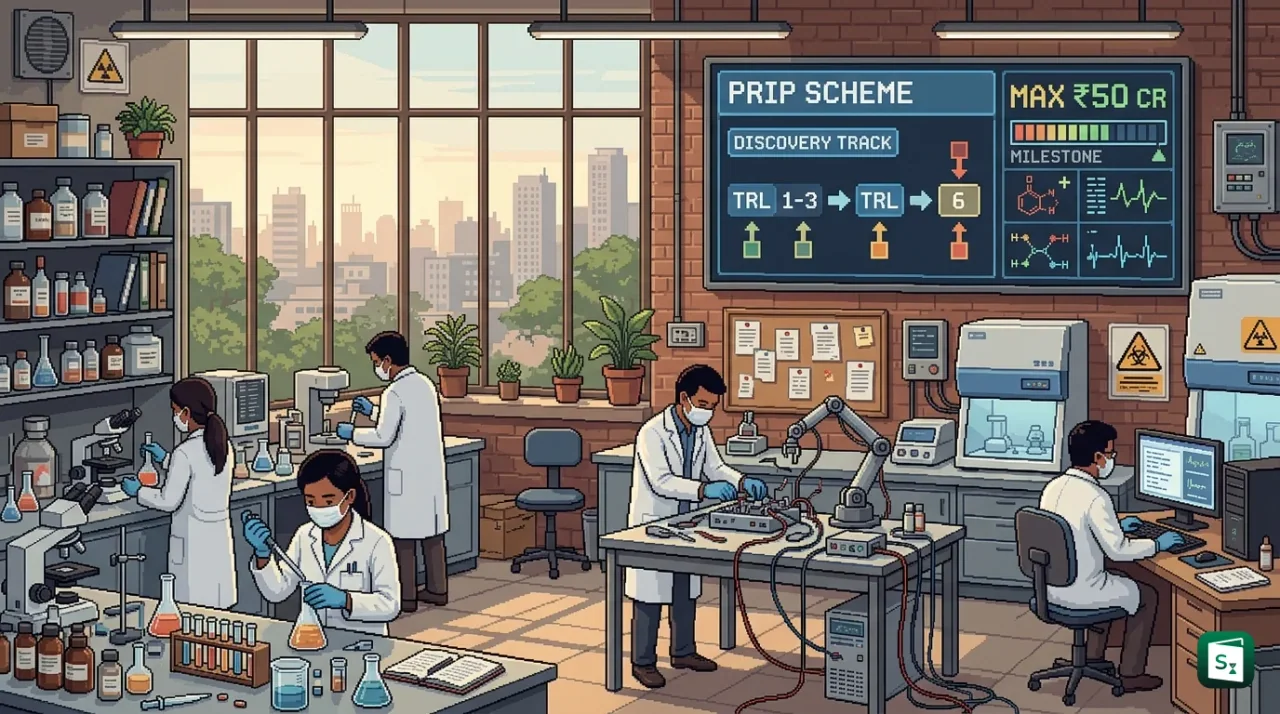
The Department of Pharmaceuticals announced a New Discovery Track under the PRIP scheme on 30 September 2026 to fund early stage drug discovery by startups and MSMEs. The track offers financial assistance of up to ₹50 crore per company, project or portfolio of projects through the PRIP portal. It targets a critical gap in Indian pharma research where promising laboratory leads often stall for lack of large risk capital.
What Is the PRIP Scheme?
The Promotion of Research and Innovation in Pharma and MedTech (PRIP) scheme is a Central Sector Scheme for the period FY 2023-24 to FY 2027-28 with a total financial outlay of ₹5,000 crore. The Department of Pharmaceuticals notified the PRIP scheme through Gazette Notification on 17 August 2023, following the announcement in the Union Budget 2023-24 for a new programme to promote research in pharmaceuticals through Centres of Excellence.
The core aim of the PRIP scheme is to shift Indian pharma and MedTech from cost based growth to innovation based growth. India is the third largest pharmaceutical producer in the world by volume and supplies about 20 percent of global generic medicines by volume. Yet its share by value is much lower, around 14th in global ranking, because high value discovery research and patented products remain limited. The PRIP scheme seeks to fix this gap by building research infrastructure, deepening industry academia linkage and supporting Indian companies to climb the innovation value chain.
The PRIP scheme has two main parts. Component A provides ₹700 crore to set up seven Centres of Excellence (CoEs) at the seven National Institutes of Pharmaceutical Education and Research (NIPERs) located at Mohali, Ahmedabad, Guwahati, Hajipur, Hyderabad, Kolkata and Raebareli. NIPERs are Institutes of National Importance under the Department of Pharmaceuticals and they provide postgraduate and doctoral education in pharmaceutical sciences. The seven CoEs focus on areas such as anti viral and anti bacterial drug discovery, medical devices, bulk drugs, flow chemistry, novel drug delivery systems, phytopharmaceuticals and biological therapeutics. Component B provides ₹4,250 crore as direct financial support to industry, startups and MSMEs, often in collaboration with academic institutions, for research projects in priority areas.
PRIP Scheme Under Which Ministry?
The PRIP scheme is implemented by the Department of Pharmaceuticals under the Ministry of Chemicals and Fertilizers. The Department of Pharmaceuticals was created on 1 July 2008 to give focused attention to pricing, availability, research, intellectual property and international commitments related to medicines. It also administers NIPERs, the National Pharmaceutical Pricing Authority and related production linked incentive schemes for pharmaceuticals and bulk drugs.
New Discovery Track for Pharma Startups and MSMEs
The New Discovery Track is an exclusive window under the second call of the PRIP scheme for startups and MSMEs working on early stage novel drug discovery. The Department of Pharmaceuticals opened the PRIP portal at prip.pharma-dept.gov.in for applications under this track on 30 September 2026. The objective is to encourage small innovators to enter the high risk field of discovering new drugs and therapies, instead of leaving such work only to large companies.
Under the New Discovery Track, the Department of Pharmaceuticals will provide financial assistance of up to ₹50 crore per company, project or portfolio of projects. The support is subject to a minimum 25 percent co funding of the project cost from bona fide institutional investors. This design is deliberate. Early discovery needs large risk capital, and private investors often hesitate to fund unproven molecules. Public money thus acts as anchor risk capital and pulls institutional investors in at an earlier stage of drug development.
Only projects involving New Chemical Entities (NCEs) and New Biological Entities (NBEs) at Technology Readiness Levels (TRL) 1, 2 or 3 can apply under this track. A New Chemical Entity is a newly invented chemical molecule with potential therapeutic use, while a New Biological Entity is a new medicine derived from living cells or biological processes, such as antibodies or therapeutic proteins. The Department of Pharmaceuticals will support selected projects to move to higher maturity levels, but not beyond TRL 6. In simple terms, the track takes an idea from the laboratory bench to the stage of regulated pre clinical proof and early clinical readiness.
Technology Readiness Levels From TRL 1 to 3 to TRL 6 Explained
Technology Readiness Level (TRL) is a nine point scale first developed by NASA to measure how mature a technology is, from basic idea to full market use. In drug research, TRL 1 means basic principles are observed and literature is reviewed, TRL 2 means a product hypothesis and disease target are identified, and TRL 3 means a candidate compound is identified with proof of concept in laboratory and early animal tests. The PRIP scheme uses this global scale to decide which projects qualify for which funding track.
TRL 4 involves optimisation and initial demonstration of safety and efficacy in the laboratory, TRL 5 involves advanced characterisation and start of manufacturing process development, and TRL 6 involves regulated production and early clinical studies. Movement from TRL 1 to 3 to TRL 6 is therefore the most difficult jump in drug discovery, where many leads fail. By funding this specific jump, the New Discovery Track aims to create more indigenous NCE and NBE assets that can progress toward clinical trials and build a globally competitive drug pipeline for India.
Three Priority Areas and Other Tracks in Second Call
The second call of the PRIP scheme invites applications across three priority areas. These are New Medicines, which include New Chemical Entities, New Biological Entities and phytopharmaceutical drugs derived from plants, Complex Generics and Biosimilars, which are difficult to copy versions of approved drugs and biological medicines, and Novel Medical Devices, which include artificial intelligence based tools, software as a medical device, genetic diagnostics, surgical robotics, telemedicine enabled devices and novel in vitro diagnostics for precision medicine.
Apart from the New Discovery Track, the Department of Pharmaceuticals is accepting applications under two regular tracks in the second call. The structure ensures that very early ideas, mid level prototypes and near market products each get suitable support without mixing their funding rules.
| Track | Who Can Apply | Entry TRL and Goal | Financial Assistance |
|---|---|---|---|
| New Discovery Track | Startups and MSMEs with NCE or NBE projects | TRL 1, 2 or 3 to higher level up to TRL 6 | Up to ₹50 crore per company or project, with minimum 25 percent co funding from institutional investors |
| Early Stage Track | Startups and MSMEs | TRL 1, 2 or 3 to higher level up to TRL 5 | Up to ₹5 crore per project, no co funding if project cost is up to ₹1 crore, half of amount above ₹1 crore to be co funded by applicant |
| Later Stage Track | Industry, startups and MSMEs | TRL 4, 5 or 6 to higher levels | Up to ₹100 crore per project, limited to 35 percent of project cost, balance to be co funded by applicant, 50 percent for strategic priority innovations |
The application process follows a two step route for early ideas. Applicants for the Early Stage and New Discovery tracks first submit a short concept note, and shortlisted candidates are then invited to file a detailed application. Applicants for the Later Stage track apply directly with a detailed application form. Guidance documents, concept note format, milestone catalogue, frequently asked questions and the applicant support toolkit are available on the PRIP portal. The Department of Pharmaceuticals has clarified that applicants who applied in Round 1 should not resubmit the same project.
First Round Results: 41 Projects and ₹1,600 Crore Funding
Under the first call of the PRIP scheme, the Department of Pharmaceuticals has approved 41 projects for financial assistance of around ₹1,600 crore. These approved projects are expected to bring in an additional ₹3,020 crore as private investment, taking the total research investment across these projects to about ₹4,620 crore. Evaluation of the remaining applications from the first round is still underway, with more results expected over the coming month.
Of the 41 approved projects, 12 are early stage and 29 are later stage projects. Nineteen projects are led by startups and MSMEs, while 22 projects are led by large companies. By priority area, 27 projects fall under New Medicines, five under Complex Generics and Biosimilars, and nine under Novel Medical Devices. The portfolio includes innovators such as Biocon, Bharat Biotech, Sun Pharma, Wockhardt, Zydus, Mankind Pharma, Pandorum Technologies, Cellogen Therapeutics, Aurigene Oncology and Bugworks Research.
The approved portfolio covers the full innovation chain from novel discovery to clinical development and advanced devices. Examples include an antibacterial targeting multidrug resistant Gram negative infections, an exosome based regenerative therapy for corneal disease, an in vivo CAR-T platform for cancer treatment, patient derived breast cancer organoids for drug testing, a programmable RNA targeting antiviral technology, portable plasmonic PCR for point of care infection diagnosis and a microfluidic platform for tuberculosis detection. Six projects have been approved under the strategic priority framework for areas such as bacterial pneumonia and meningitis, dengue, influenza and next generation tuberculosis vaccines, along with work on neglected tropical diseases, rare diseases and antimicrobial resistance for India priority pathogens.
Why India Needs Pharma Innovation: From Volume to Value
India is widely called the pharmacy of the world. The Indian pharmaceutical market stood at around $55 billion in 2025, with domestic consumption of about $23.5 billion and exports of about $26.5 billion in FY 2023-24, and it is projected to reach $120 billion to $130 billion by 2030. India provides about 20 percent of global generic medicines by volume and meets about 60 percent of global vaccine demand. The industry has more than 3,000 drug companies and 10,500 manufacturing units and exports to over 200 countries including the United States, the European Union and Japan.
The weakness lies in value, not volume. India manufactures more than 500 Active Pharmaceutical Ingredients (APIs), the chemical building blocks of medicines, yet it remains dependent on imports for several critical starting materials. Research spending is low compared to global leaders. The medical technology sector, valued at about $12 billion to $15 billion in 2024-25, is still import heavy even though India is the fourth largest MedTech market in Asia. The PRIP scheme, along with the Production Linked Incentive schemes for pharmaceuticals and bulk drugs, the Bulk Drug Parks scheme and the Strengthening of Pharmaceutical Industry scheme, aims to move India from affordable manufacturing alone toward original discovery, high value biologics and advanced devices.
Allied Support Ecosystem: MedTech Mitra and Industry Linkage
The PRIP scheme does not offer money alone. The Department of Pharmaceuticals pairs funding with mentorship and collaboration platforms to improve the chances that laboratory outputs reach the market. MedTech Mitra is a key handholding initiative that helps MedTech innovators with clinical validation, regulatory guidance and market access. A Patent Mitra type support helps researchers protect and manage intellectual property. An online platform under the scheme connects industry, startups, academic institutions and NIPER CoEs.
This ecosystem approach matters for small firms. A startup with a promising molecule often lacks access to good manufacturing practice facilities, animal study centres or clinical trial networks. By linking PRIP funded projects with NIPER infrastructure and industry partners, the Department of Pharmaceuticals aims to reduce duplication, share high cost equipment and nurture a steady pool of scientists. The amended scheme notified on 1 October 2025 further clarified governance and benefit sharing rules, so that academic inventors, companies and public funders have clear terms on ownership of results.
The Way Forward
The success of the New Discovery Track will depend on quick evaluation, steady disbursal and quality mentoring. The Department of Pharmaceuticals has kept the PRIP portal open for the second call and provided detailed toolkits to help first time applicants prepare strong concept notes. Institutional investors will watch whether public risk capital truly shortens the path from TRL 3 to TRL 6.
If implemented well, the track can widen the base of drug discovery in India beyond a few large laboratories. More indigenous New Chemical Entities and New Biological Entities can enter pre clinical and clinical stages within the scheme period up to FY 2027-28. That outcome would strengthen health security, create high skill jobs and support the larger national goal of making India a global hub not only for affordable generics but also for original pharma and MedTech innovation.
Key Takeaways
- The New Discovery Track under the PRIP scheme was announced on 30 September 2026 by the Department of Pharmaceuticals.
- The track offers up to ₹50 crore per company or project with minimum 25 percent co funding from institutional investors.
- Only startups and MSMEs with NCE or NBE projects at TRL 1, 2 or 3 moving up to TRL 6 are eligible.
- The PRIP scheme was launched in 2023 with an outlay of ₹5,000 crore and is implemented by the Department of Pharmaceuticals under the Ministry of Chemicals and Fertilizers.
- Under the first call, 41 projects received about ₹1,600 crore, expected to catalyse total R and D investment of ₹4,620 crore.