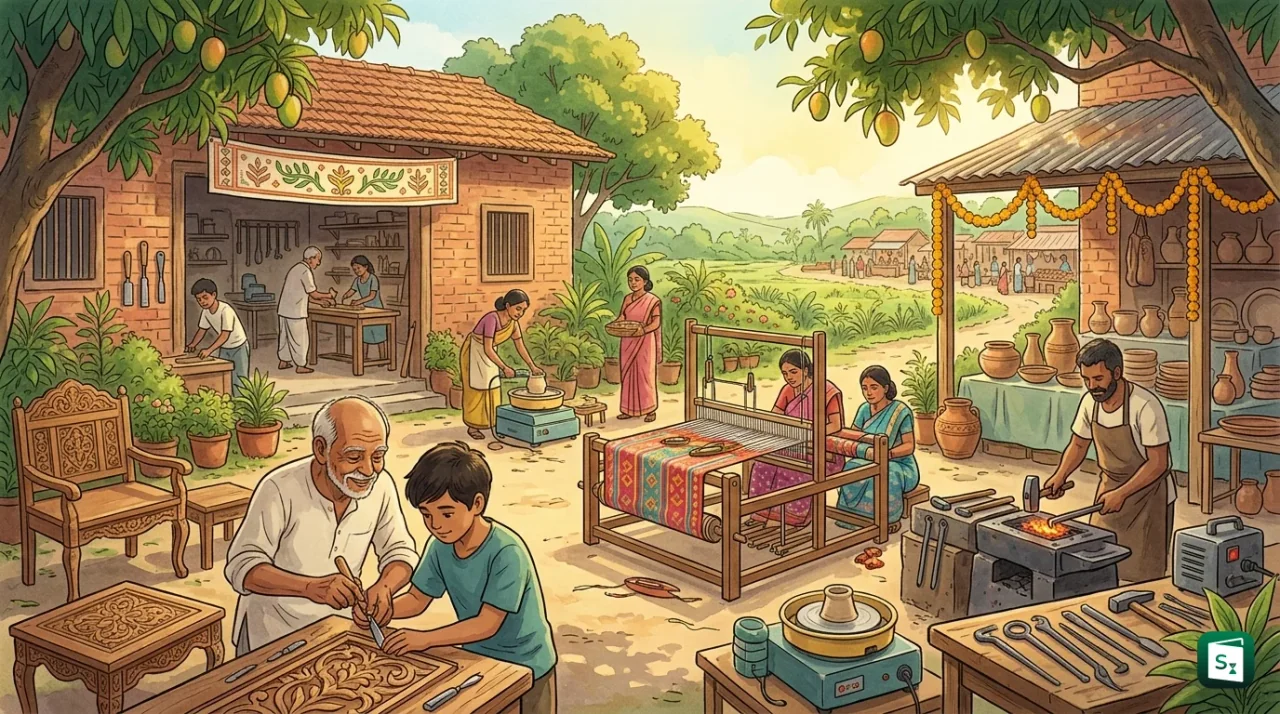
The PM Vishwakarma Scheme has completed three years of implementation, with 30 lakh traditional artisans and craftspeople successfully registered after verification. Launched on 17 September 2023, the scheme gives end to end support for recognition, skill training, modern tools, cheap credit and market access. The third anniversary was marked in Kolkata on 17 September 2026, underlining how the programme has moved from launch to scale in a short period.
What Is PM Vishwakarma Yojana?
The PM Vishwakarma Yojana is a Central Sector Scheme that provides holistic and end to end support to traditional artisans and craftspeople who work with their hands and tools. It covers self employed workers in the unorganised sector and helps them scale up conventional products and services through training, modern toolkits, collateral free credit, digital incentives and market linkages.
The full name of the scheme is Pradhan Mantri Vishwakarma Kaushal Samman Yojana. It was announced by the Prime Minister in the Independence Day address of 2023 and approved by the Cabinet Committee on Economic Affairs on 16 August 2023. It was formally launched on 17 September 2023 on the occasion of Vishwakarma Jayanti at the India International Convention and Expo Centre (Yashobhoomi) in Dwarka, New Delhi.
The scheme is fully funded by the Union Government with a financial outlay of ₹13,000 crore for the period from FY 2023-24 to FY 2027-28. It aims to strengthen the Guru Shishya tradition of family based skills while turning artisans, also called Vishwakarmas, into recognised entrepreneurs. Special attention is given to women, Scheduled Castes, Scheduled Tribes, Other Backward Classes, persons with disabilities, transgender persons and residents of the North Eastern Region, island territories and hilly areas.
PM Vishwakarma Scheme Under Which Ministry?
The PM Vishwakarma Scheme is under the Ministry of Micro, Small and Medium Enterprises (MSME), which is the nodal ministry for implementation. The MSME Ministry frames the guidelines, bears the interest subvention and credit guarantee costs, and monitors progress through the pmvishwakarma.gov.in portal and district units.
Implementation is carried out jointly with two other central agencies. The Ministry of Skill Development and Entrepreneurship (MSDE) handles skill verification, basic and advanced training and certification through the National Skill Development Corporation (NSDC) and empanelled training centres. The Department of Financial Services (DFS) under the Ministry of Finance coordinates banks and lending institutions for disbursement of Enterprise Development Loans.
For last mile delivery, the scheme uses Common Service Centres (CSCs) for free biometric based registration and District Project Management Units (DPMUs) for awareness, batch scheduling and training centre monitoring. As of July 2025, 497 DPMUs were covering 618 districts. Gram panchayats and urban local bodies take part in three stage verification before an applicant is finally registered as a Vishwakarma.
18 Traditional Trades Covered Under PM Vishwakarma
The PM Vishwakarma Scheme covers 18 identified family based traditional trades. Only an artisan or craftsperson actively engaged in one of these trades on the date of registration, working on a self employment basis in the unorganised sector, can apply. Eligibility also requires a minimum age of 18 years, benefit to only one member per family (defined as husband, wife and unmarried children), no government service for the applicant or family members, and no loan under similar central or state self employment credit schemes such as PMEGP, PM SVANidhi or Mudra in the past five years.
The list of trades can be updated by the National Steering Committee with the approval of the Minister for MSME. The present coverage spans wood, metal, gold, clay, leather, construction and other manual services.
| Category | Trades Covered |
|---|---|
| Wood based | Carpenter (Suthar), Boat Maker |
| Iron, metal and stone based | Armourer, Blacksmith (Lohar), Hammer and Tool Kit Maker, Locksmith, Sculptor (Moortikar and stone carver) and Stone Breaker |
| Gold and silver based | Goldsmith (Sunar) |
| Clay based | Potter (Kumhaar) |
| Leather based | Cobbler (Charmakar), Shoesmith and Footwear Artisan |
| Construction | Mason (Rajmistri) |
| Other traditional services | Basket, Mat, Broom Maker and Coir Weaver, Doll and Toy Maker (Traditional), Barber (Naai), Garland Maker (Malakaar), Washerman (Dhobi), Tailor (Darzi), Fishing Net Maker |
Data up to August 2025 shows Mason (Rajmistri) as the highest registered trade, followed by tailor, garland maker, carpenter and cobbler. Top states for registrations include Karnataka, Maharashtra, Madhya Pradesh, Rajasthan and Andhra Pradesh, showing wide spread across southern, western and central India.
Benefits for Artisans: Training, Toolkit, Loan and Market Support
The PM Vishwakarma Scheme combines six forms of support so that an artisan gains identity, skill, tools, credit, digital readiness and buyers in one chain. Recognition comes first through a PM Vishwakarma Certificate and ID Card, which formally acknowledges the trade and unlocks all other benefits. This identity also helps artisans onboard on the Udyam Assist Platform (UAP), the MSME system that registers informal micro enterprises and issues an Udyam Registration Number.
Skill support begins with verification followed by basic training of 5 to 7 days (40 hours). Interested beneficiaries can later opt for advanced training of 15 days (120 hours). During training, every participant receives a stipend of ₹500 per day. Training manuals and toolkit manuals have been released trade wise so that learning and tool use follow a common standard.
Toolkit help is given as a grant of ₹15,000 in the form of an e-voucher. The voucher is issued at the start of basic training and can be redeemed at designated vendors for modern, quality tools. The aim is to raise productivity and product quality without pushing the artisan toward high cost borrowing for equipment.
Digital and marketing support complete the package. For digital empowerment, the scheme pays Re 1 per digital transaction for up to 100 transactions per month, covering both receipts and payouts credited to the beneficiary account. Tie ups have been signed with the India Post Payments Bank, PhonePe, Paytm, PayNearby and BharatPe for QR codes and payment onboarding. For market access, the National Committee for Marketing (NCM) provides quality certification, branding and promotion, e commerce linkage, participation in fairs, exhibitions and trade shows, and onboarding on platforms such as the Government e Marketplace (GeM), ONDC, FabIndia and Meesho. More than 30,000 beneficiaries have been onboarded on GeM, improving access to institutional buyers.
How the ₹3 Lakh Collateral Free Loan Works
The core of PM Vishwakarma credit support is the collateral free Enterprise Development Loan (EDL) of up to ₹3 lakh, disbursed in two tranches. No collateral security is required. The beneficiary pays a fixed concessional interest rate of 5 percent, while interest above that level, up to a subvention cap of 8 percent, is borne by the MSME Ministry. Credit guarantee fees are paid by the Government of India and loans are covered under the Credit Guarantee Fund Trust for Micro and Small Enterprises (CGTMSE) framework.
| Tranche | Loan Amount | Repayment Period | Eligibility Condition |
|---|---|---|---|
| First tranche | Up to ₹1 lakh | 18 months | Completion of basic training |
| Second tranche | Up to ₹2 lakh | 30 months | First loan availed, standard loan account maintained, plus adoption of digital transactions or completion of advanced training |
This graded design lets support grow with the business. The first tranche helps buy tools, raw material or meet working capital needs. The second, larger tranche supports expansion after repayment discipline and digital use are shown. By keeping the rate at 5 percent, the scheme frees artisans from dependence on informal moneylenders who often charge 15 to 20 percent.
Registration and Application Process on the Official Portal
Registration under PM Vishwakarma is free and fully online through the official portal pmvishwakarma.gov.in. Applications are sourced through CSCs with Aadhaar authentication using biometrics. The applicant provides Aadhaar, mobile number linked to Aadhaar, bank account details, ration card or family details, and proof of occupation in the chosen trade.
After enrolment, the application passes three stage verification involving the gram panchayat or urban local body, the district screening committee and final approval. On approval, the artisan receives the certificate and ID card and can check progress through applicant login or status check by Aadhaar number. Separate logins exist for CSCs, banks and branches, gram panchayats, India Post and administrators. There is no fixed last date announced for 2026, and the portal continues to accept registrations while training and loan processing run in parallel.
Three Years of Progress: 30 Lakh Registrations Milestone
The PM Vishwakarma portal shows that the original five year target of 30 lakh registrations till 2028 was already achieved in September 2025, within two years of launch. As on 31 August 2025, around 30 lakh artisans were registered, skill verification was completed for more than 26 lakh beneficiaries, and about 86 percent of them had completed basic training. More than 23 lakh e-vouchers had been issued for toolkits.
By December 2025, the number of trained beneficiaries had risen to 23.09 lakh out of 30 lakh registered. Loan approvals had crossed 4.7 lakh across both tranches. Digital payment incentives had reached more than 6.8 lakh artisans with disbursement of about ₹22 crore. The portal dashboard in 2026 reports 5.9 lakh loan sanctions with sanctioned amount above ₹5,060 crore, toolkit delivery to more than 15.3 lakh applicants, and digital incentives to over 7.79 lakh applicants.
The third anniversary event at the Dhono Dhanyo Auditorium in Kolkata on 17 September 2026 highlighted this scale up. Field examples cited by the government include a mason in Amravati who used a ₹1 lakh loan to buy advanced tools, a carpenter in Varanasi who moved from high cost informal credit to a 5 percent loan with five days of training, a mat maker in Nagaon who expanded her unit with training and a ₹1 lakh loan, and a barber in Samastipur who opened his own shop after modern salon training and now earns ₹500 to ₹1,000 per day. These cases show how certification, stipend supported skilling and cheap formal credit combine to raise income and dignity together.
Key Takeaways
- The PM Vishwakarma Scheme was launched on 17 September 2023 with an outlay of ₹13,000 crore for FY 2023-24 to FY 2027-28.
- The nodal ministry for PM Vishwakarma is the Ministry of Micro, Small and Medium Enterprises (MSME), with training by MSDE and NSDC and credit coordination by DFS.
- The scheme covers artisans in 18 traditional trades, with Mason (Rajmistri) as the highest registered trade (as of September 2026).
- Beneficiaries get a ₹15,000 toolkit e-voucher, training stipend of ₹500 per day, and Re 1 per digital transaction for up to 100 transactions per month.
- The collateral free Enterprise Development Loan offers up to ₹3 lakh in two tranches of ₹1 lakh (18 months) and ₹2 lakh (30 months) at 5 percent interest.
- The scheme completed 3 years in September 2026 with 30 lakh verified registrations, meeting its five year target two years early.