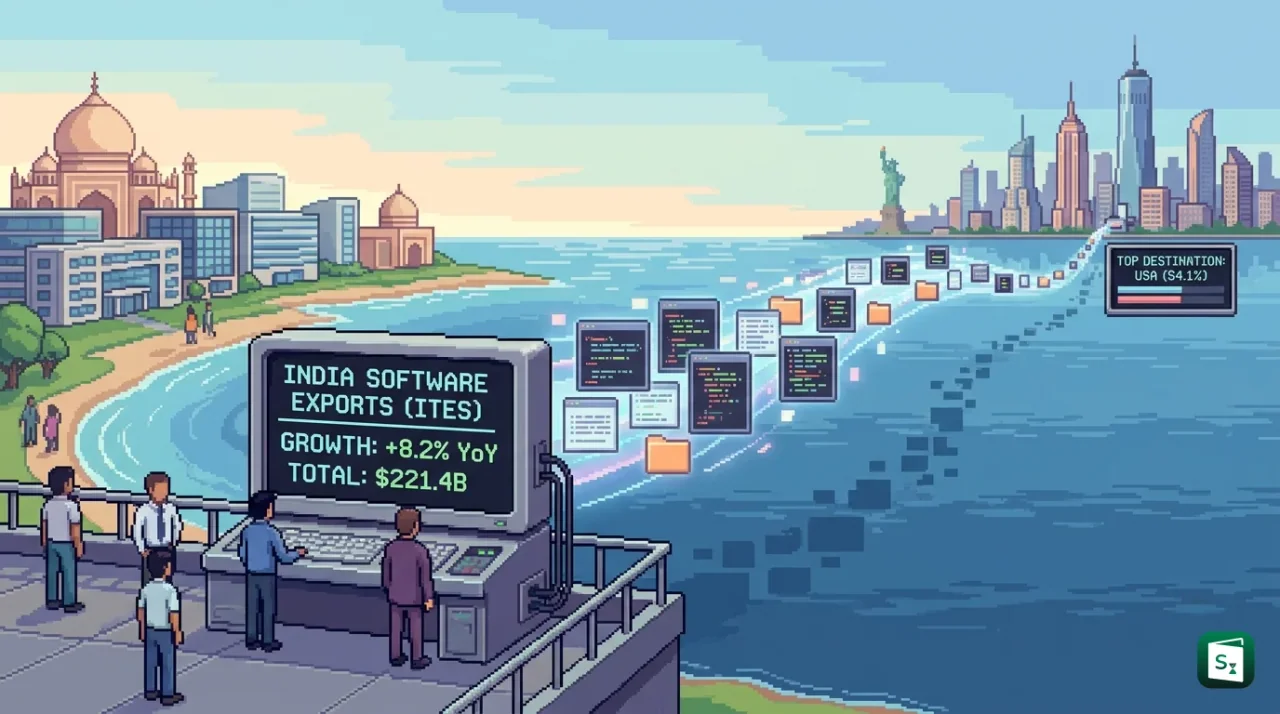
The Reserve Bank of India released its Survey on Computer Software and Information Technology Enabled Services Exports for 2025-26 on 18 September 2026. The survey found that India services exports of software reached $221.4 billion in 2025-26, a growth of 8.2 percent over $204.7 billion in 2024-25. The United States remained the top destination with a 54.1 percent share, worth $119.7 billion.
What Is Software Export and What Is ITES?
Software export means selling computer services and Information Technology Enabled Services to clients in other countries. ITES stands for Information Technology Enabled Services. It covers services delivered with the help of IT, such as BPO, finance and accounting support, customer support and engineering services.
The RBI survey divides software services exports from India into two broad groups. The first group is computer services. It includes IT services, such as software development, maintenance and cloud support, and software product development, which means creating ready to use software products. The second group is ITES, or Information Technology Enabled Services. It includes Business Process Outsourcing (BPO) services, where a company handles business tasks like customer care, finance and accounting, and back office work for a foreign client, and engineering services, such as embedded solutions, product design and other technical design support.
In simple terms, IT and ITES together form the full software services export basket. IT writes and maintains the code. ITES uses technology to deliver business processes. The RBI survey tracks both together because foreign clients often buy them as a package from the same Indian provider.
How the RBI Survey Measures Computer Software and ITES Exports
The Reserve Bank of India (RBI), established on 1 April 1935 under the Reserve Bank of India Act, 1934 and headquartered in Mumbai, conducts this survey every year. The RBI uses the survey results to prepare India’s external sector statistics, which record India’s trade in services with the rest of the world. The survey covers exports by type of activity, on site and off site delivery, country of destination and mode of supply.
For the 2025-26 round, the RBI contacted 7,569 software exporting companies. A total of 2,363 companies responded, including most of the large companies. These responding companies accounted for around 89 percent of the total estimated exports. The RBI estimated the exports of the remaining smaller non responding companies using the method published in the March 2018 issue of the RBI Bulletin.
The headline figure of $221.4 billion excludes sales made through overseas commercial presence. This means it does not count the local sales of Indian owned offices and subsidiaries located abroad. When those sales are added, total software services exports including commercial presence stood at $239.3 billion in 2025-26, up 9.5 percent from $218.6 billion in 2024-25. The two totals answer different questions, so they should not be treated as competing estimates of the same activity.
IT and ITES Combined Export Architecture: Computer Services Lead Growth
India IT exports grew faster than the overall basket in 2025-26. The RBI survey shows that computer services continued to account for more than two thirds of total software services exports. Their value rose to $153.4 billion, with a share of 69.3 percent, up from $138.1 billion and 67.4 percent in 2024-25. Within this group, IT services rose to $147 billion from $131.3 billion. In contrast, software product development slipped to $6.4 billion from $6.8 billion.
The RBI survey shows that ITES exports rose to $68 billion in 2025-26 from $66.6 billion in the previous year. However, the share of ITES in the total fell to 30.7 percent from 32.6 percent because computer services grew faster. Within ITES, BPO services remained the main part with $56 billion, or 82.4 percent of ITES exports. Engineering services contributed $12 billion, up from $10.8 billion.
| Activity | 2024-25 Value | 2024-25 Share | 2025-26 Value | 2025-26 Share |
|---|---|---|---|---|
| Computer Services | $138.1 billion | 67.4 percent | $153.4 billion | 69.3 percent |
| of which IT Services | $131.3 billion | 64.1 percent | $147.0 billion | 66.4 percent |
| of which Software Product Development | $6.8 billion | 3.3 percent | $6.4 billion | 2.9 percent |
| IT Enabled Services | $66.6 billion | 32.6 percent | $68.0 billion | 30.7 percent |
| of which BPO Services | $55.8 billion | 27.3 percent | $56.0 billion | 25.3 percent |
| of which Engineering Services | $10.8 billion | 5.3 percent | $12.0 billion | 5.4 percent |
| Total Software Services Exports | $204.7 billion | 100 percent | $221.4 billion | 100 percent |
The growth rate of 8.2 percent in 2025-26 was higher than the 7.3 percent growth recorded in 2024-25. This improvement came mainly from stronger demand for core IT services, which added nearly $15.7 billion in a single year. The fall in software product development and the slower rise in BPO show that global clients spent more on maintaining and upgrading existing systems than on buying new packaged products or expanding back office contracts.
National Services Export Performance: USA Keeps 54.1 Percent Share
The RBI survey confirms that the United States is the largest market for software exports from India. Exports to the USA rose to $119.7 billion in 2025-26 from $108.3 billion in 2024-25. This is a growth of about 11 percent, which is faster than the overall growth of 8.2 percent. As a result, the share of the USA increased to 54.1 percent from 52.9 percent. This level matches the share recorded in 2023-24, before it slipped in 2024-25.
Europe remained the second largest destination with a combined share of 31.8 percent, worth $70.3 billion. Within Europe, the United Kingdom held the largest share with $34 billion, or 15.4 percent of total exports. Asia accounted for 6.3 percent, while Australia and New Zealand together accounted for 2.5 percent. Canada held a share of 1.3 percent.
| Destination | 2024-25 Value | 2024-25 Share | 2025-26 Value | 2025-26 Share |
|---|---|---|---|---|
| United States of America | $108.3 billion | 52.9 percent | $119.7 billion | 54.1 percent |
| Europe | $67.2 billion | 32.8 percent | $70.3 billion | 31.8 percent |
| of which United Kingdom | $31.8 billion | 15.5 percent | $34.0 billion | 15.4 percent |
| Asia | $13.0 billion | 6.4 percent | $13.9 billion | 6.3 percent |
| Australia and New Zealand | $5.0 billion | 2.4 percent | $5.5 billion | 2.5 percent |
| Canada | $2.7 billion | 1.3 percent | $3.0 billion | 1.3 percent |
| Other Countries | $8.5 billion | 4.2 percent | $9.0 billion | 4.0 percent |
This high concentration means that more than four out of every five dollars earned from software services exports came from the USA and Europe together. Strong demand in the USA therefore lifted the total, while slower growth in Europe pulled its share down even though its value in dollar terms still rose.
How Software Exports Are Delivered and Billed
Software services exports from India are delivered mainly from within India. In the RBI survey, off site services mean work done from offices located in India for a foreign client. On site services mean work done by Indian staff posted at the client location abroad. In 2025-26, off site exports rose to $203 billion and accounted for 91.7 percent of the total, up from 90.7 percent in the previous year. On site services accounted for the remaining 8.3 percent, worth $18.4 billion, down from $19 billion.
The survey also groups exports by mode of supply. This classification comes from the Manual on Statistics of International Trade in Services, which is jointly prepared by international agencies. Mode 1, or cross border supply, means the service crosses the border while both the provider and client stay in their own countries, such as code sent online from Bengaluru to New York. This is the main mode for India. Mode 2, or consumption abroad, means the foreign client travels to India to use the service. Mode 3, or commercial presence, means sales through offices set up abroad. Mode 4, or presence of natural persons, means Indian professionals travelling abroad to deliver the service.
The currency pattern reflects the destination pattern. The US dollar was the main invoicing currency with a share of 72.6 percent, up from 72 percent. The euro accounted for 9.6 percent, the Indian rupee for 6.3 percent, down from 7.1 percent, and the pound sterling for 6 percent. Invoice currency and customer location are different measures. A client in Europe or Asia can also be billed in dollars, so the dollar share of 72.6 percent is higher than the USA market share of 54.1 percent.
Why Software Services Exports Matter for India
Software services are the largest part of India services exports and a major source of foreign exchange. These earnings help pay for imports of crude oil, electronics and other goods, and they support the current account in the balance of payments. The rise in off site delivery to 91.7 percent shows that India can deliver complex work remotely at scale, which keeps costs low for foreign clients and jobs and revenue within India.
The same data also points to a concentration risk. When more than half the exports depend on one country, changes in client spending, visa rules or technology budgets in the USA can affect total growth quickly. A wider spread across Europe, Asia and other markets would make earnings more stable. Faster growth in engineering services, which rose from $10.8 billion to $12 billion, offers one path for diversification into high value design and product work.
Export Trade in India Is Regulated by Whom?
Export trade in India is regulated by the Directorate General of Foreign Trade under the Foreign Trade Policy and the Foreign Trade Act, 1992. Foreign exchange transactions are managed by the Reserve Bank of India under the Foreign Exchange Management Act, 1999.
The Directorate General of Foreign Trade (DGFT), which works under the Ministry of Commerce and Industry, frames the Foreign Trade Policy and issues licences and export promotion schemes. The RBI survey supports this system by providing clean data on software trade. The RBI monitors foreign exchange receipts through the Foreign Exchange Management Act (FEMA), 1999, while exporters file a SOFTeX declaration form for software exports and settle invoices in approved currencies.
Key Takeaways
- India’s software services exports rose 8.2 percent to $221.4 billion in 2025-26, as per the RBI survey released on 18 September 2026.
- The USA remained the top destination with a 54.1 percent share, worth $119.7 billion, followed by Europe with 31.8 percent.
- Computer services accounted for 69.3 percent of exports at $153.4 billion, with IT services alone contributing $147 billion.
- ITES exports stood at $68 billion, in which BPO services held $56 billion and engineering services held $12 billion.
- Off site delivery accounted for 91.7 percent of exports, while the US dollar was the invoicing currency for 72.6 percent of exports.