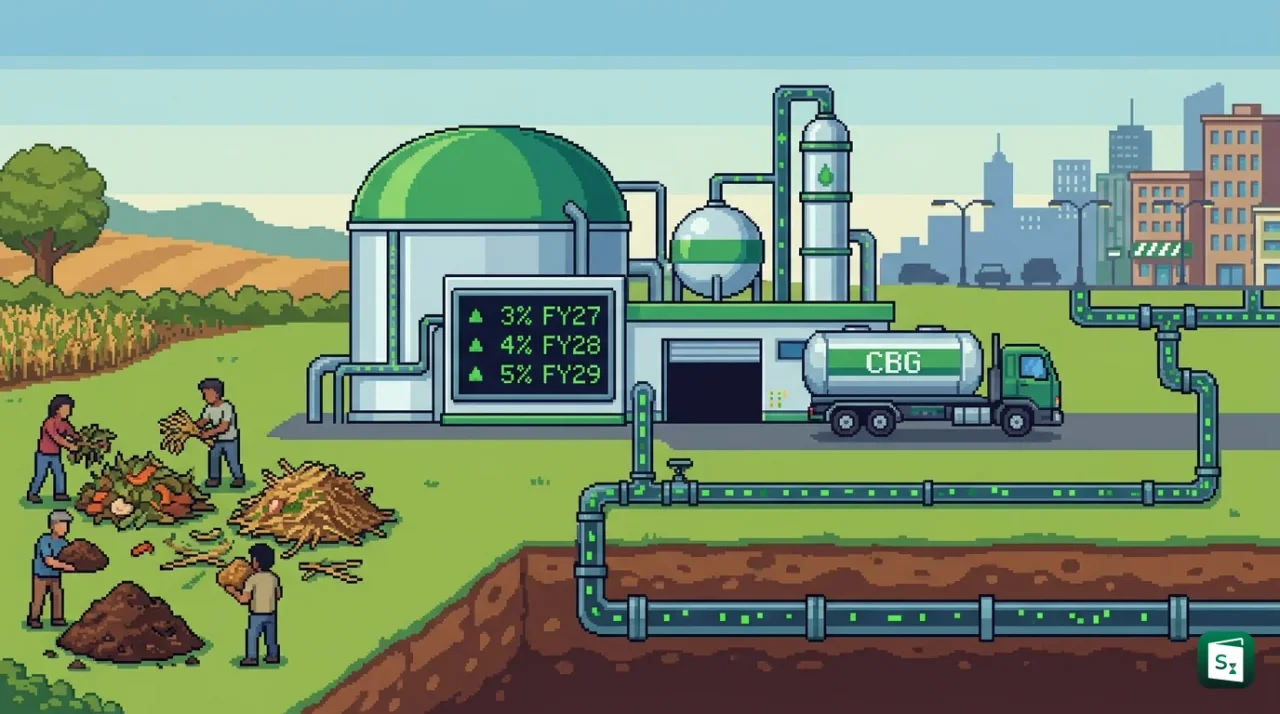
The Ministry of Petroleum and Natural Gas issued component-wise operational guidelines on 15 September 2026 for the GOBARdhan scheme, the national programme to scale up Compressed Biogas (CBG). The rulebook details six components covering assured offtake, a 10-year administered price, capital assistance, pipelines, credit guarantee and an ecosystem fund. It backs the move with mandatory purchase targets of 3% in FY27, 4% in FY28 and 5% from FY29 for city gas companies selling CNG and domestic piped gas.
What Is the GOBARdhan Scheme?
The GOBARdhan scheme, which stands for Galvanizing Organic Bio-Agro Resources Dhan, is India’s national circular bioenergy programme to convert cattle dung, farm residue, food waste and other organic waste into biogas and compressed biogas. The Ministry of Petroleum and Natural Gas is the nodal ministry for the scheme in its present form, and the scheme runs from FY2026-27 to FY2035-36 with a total outlay of ₹23,731 crore.
GOBARdhan was first launched on 30 April 2018 under the Swachh Bharat Mission (Grameen) by the Department of Drinking Water and Sanitation. At that stage, it was a rural cleanliness and waste to wealth effort that helped village bodies turn dung and kitchen waste into biogas and bio slurry. Financial help of up to ₹50 lakh per district was available for community and cluster biogas plants during the 2020-21 to 2026-27 period.
The 2026 version is a much larger redesign. The Union Cabinet approved it on 6 August 2026 as a Central Sector Scheme fully focused on Compressed Biogas (CBG). The earlier CBG ecosystem was spread across four ministries, which slowed decisions on price, offtake and finance. The Cabinet therefore placed the entire CBG value chain under the Ministry of Petroleum and Natural Gas to give investors, lenders and producers one clear platform. The scheme will take effect from 1 September 2026 and aims to raise domestic CBG output nearly tenfold, cut import dependence at a time when India meets nearly half its natural gas need through imports, and build rural income through feedstock supply and organic manure.
What Is CBG Gas and How Does a CBG Plant Work?
CBG is the full form of Compressed Biogas. It is a purified, compressed fuel with more than 90% methane that works like Compressed Natural Gas (CNG) in vehicles, kitchens and industry. A CBG plant makes this fuel by digesting farm residue, dung, press mud and municipal organic waste without oxygen, cleaning the raw gas and compressing it for sale.
Raw biogas from a village digester is very different from CBG. Biogas contains only 55 to 65% methane and large shares of carbon dioxide, moisture and hydrogen sulphide, so its energy value is low at about 19.5 MJ per kg. It also corrodes engines and pipes. A CBG plant therefore adds two extra stages of purification and compression. After cleaning, the methane share rises above 90% and the energy value rises to 47 to 52 MJ per kg, which is close to CNG. The Bureau of Indian Standards controls this quality through IS 16087:2016, which sets strict limits on methane, moisture, hydrogen sulphide and carbon dioxide.
The working of a CBG plant follows four clear stages. First, feedstock is collected and prepared, which includes sorting, chopping and mixing of dung, straw, press mud, poultry litter, food waste and sewage sludge. Second, the material enters an airtight digester for anaerobic digestion, where bacteria break it down at about 35 to 38 degrees Celsius and release raw biogas along with a slurry byproduct. Third, the raw gas is purified using water scrubbing, pressure swing adsorption or membrane methods to remove carbon dioxide, hydrogen sulphide and water. Fourth, the clean biomethane is compressed at about 200 to 250 bar and filled into cascades of cylinders or fed into a pipeline.
| Feature | Raw Biogas | CBG or Bio CNG |
|---|---|---|
| Methane content | 55 to 65% | More than 90% |
| Carbon dioxide | 30 to 40% | Less than 4% |
| Calorific value | About 19.5 MJ per kg | 47 to 52 MJ per kg |
| Main use | Cooking and power at source | Transport fuel, piped gas, industrial fuel |
CBG and CNG look the same to the user but their origin is different. CNG is a fossil fuel drilled from underground rock formations, while CBG is a renewable fuel made from waste that would otherwise rot and release methane. Because of this similarity, CBG needs no change in CNG vehicles or in the city gas network. The Ministry of Road Transport and Highways has permitted bio compressed natural gas for motor vehicles as an alternative composition of CNG. The plant also produces Fermented Organic Manure (FOM) and liquid manure from the slurry, which improves soil health and gives farmers a second income.
CBG Offtake Assurance Mechanism and Pricing Framework
The GOBARdhan guidelines give CBG producers something they lacked earlier, a certain buyer and a certain price. Under the offtake assurance mechanism, an eligible producer can choose assured purchase of up to 100% of CBG available for sale, subject to technical and operational feasibility. The Ministry of Petroleum and Natural Gas will map each plant to a nearby City Gas Distribution (CGD) entity or geographical area, or group small plants into clusters for injection into trunk pipelines.
GAIL (India) Limited acts as the designated synchro operator for this system. GAIL pools the gas, manages the CBG CGD synchronisation mechanism and supplies CBG mixed with domestic gas at a uniform base price to city gas companies. Firm sale through the city gas route rests on a tripartite agreement among the producer, the CGD entity and GAIL. Sale through trunk pipelines rests on firm contractual arrangements alone. The design removes the earlier uncertainty where a plant had to hunt for buyers station by station.
The contracts also fix clear duties after the first year. There is no take or pay duty on the CGD entity in year one, but from year two the city gas company must lift up to 90% of its annual nominated quantity. The producer carries a supply or pay duty of up to 50% of the annual contracted quantity from year two. This balance protects the buyer from paying for gas that never arrives and protects the producer from building capacity that never gets used.
Price certainty comes from the Administered CBG Price (ACP) of ₹2,110 per Metric Million British Thermal Unit (MMBTU). At 95% methane content, this works out to about ₹98 per kg, excluding taxes and compression charges. The price framework will stay in force for a minimum of 10 years, until 31 March 2036. The Project Approval Board can revise it prospectively based on production cost, inflation measured through the Consumer Price Index and other factors, but producers get a long window for loan planning.
To keep retail fuel affordable while paying producers a remunerative rate, the government will give affordability support to the synchro operator. The support is capped at ₹10 per kg of CBG procured, equal to about ₹215.31 per MMBTU, and will run for 10 years from 2026-27 to 2035-36. Projects must install real time monitoring through SCADA systems, online gas quality measurement and automatic shutoff to qualify for benefits, which helps verify actual production.
Capital Assistance, Pipeline Infrastructure and Credit Guarantee Support
Capital assistance under GOBARdhan covers CBG plant cost and subsidy. Eligible greenfield projects can receive up to ₹2 crore per tonne per day (TPD) of installed CBG capacity, within an overall ceiling of ₹30 crore per project. This total has two parts. The core plant machinery part is ₹1.25 crore per TPD. The feedstock aggregation and organic manure value addition part covers up to 50% of eligible machinery cost, subject to a ceiling of ₹0.75 crore per TPD. Brownfield expansion gets support only for fresh additional capacity at 50% of the greenfield rate. An existing biogas unit upgraded to make CBG can get ₹0.60 crore per TPD, capped at ₹5 crore per project.
| Project Type | Assistance Rate | Ceiling |
|---|---|---|
| New greenfield CBG plant, core machinery | ₹1.25 crore per TPD | Within ₹30 crore per project |
| Feedstock and manure machinery | 50% of cost, up to ₹0.75 crore per TPD | Within ₹30 crore per project |
| Existing biogas plant upgraded to CBG | ₹0.60 crore per TPD | ₹5 crore per project |
The money is not paid as a one-time grant. It comes in three tranches linked to approvals, first commercial sale of CBG and plant performance. Performance is checked from SCADA data and other verification tools. If a developer misses the agreed milestones, the bank guarantee furnished at approval can be encashed. Projects based mainly on municipal solid waste are not eligible for capital assistance and credit guarantee support, since other urban waste programmes cover that stream.
Pipeline support tackles evacuation, which has been the weakest link for interior plants. A standalone CBG plant will generally need at least 2 TPD capacity, with preference for plants above 5 TPD, to get network connectivity. Support is available for pipeline length up to 75 km. For costing, the scheme assumes ₹1 crore per km for steel pipelines and ₹15 lakh per km for MDPE (Medium Density Polyethylene) pipelines. Standalone connectivity gets 50% of eligible cost, capped at ₹50 lakh per km for steel and ₹7.5 lakh per km for MDPE. Cluster pipelines that link a group of plants to a trunk line get higher support of up to 80% of eligible capital cost. Better pipeline access cuts transport by cascades, improves reliability and lets more domestic CBG reach kitchens and buses.
Credit access is handled through a dedicated Credit Guarantee Fund managed by the National Credit Guarantee Trustee Company Limited (NCGTC), with the Ministry of Petroleum and Natural Gas as settlor. The fund carries an outlay of ₹625 crore and covers term loans up to 15 years, including an 18 month moratorium from first disbursement. Cover can reach 85% of the outstanding amount at default, with a cap of ₹20 crore per project for general MSME units and ₹25 crore for women led units. The window stays open until 31 December 2030 or until cumulative loans of ₹15,000 crore are issued, whichever is earlier. A unit must be registered on the GOBARdhan portal with a valid Plant Identification Number to qualify.
The sixth component, the CBG Ecosystem Challenge Fund, works at the district level. It supports feedstock mapping, aggregation infrastructure, district CBG planning, technology adoption, process improvement, value addition of organic manure, capacity building and awareness. Fertilizer marketing companies will also be pushed to procure more fermented organic manure, with procurement share planned to rise from 20% toward 50%, which strengthens the non fuel revenue of CBG units.
SATAT Scheme, City Gas Distribution and Mandatory CBG Targets
The SATAT scheme, which stands for Sustainable Alternative Towards Affordable Transportation, is the earlier CBG programme under the Ministry of Petroleum and Natural Gas. The Ministry launched SATAT on 1 October 2018 to invite oil and gas marketing companies such as IOCL, BPCL, HPCL, GAIL and IGL to procure CBG from private entrepreneurs for use as auto fuel. The plan at launch spoke of 5,000 plants, assured offtake and jobs for 75,000 people, along with 50 million tonnes of bio manure.
SATAT will be subsumed into GOBARdhan from 1 September 2026. Liabilities already committed under SATAT will be honoured, and existing SATAT retail outlets will be encouraged to join the GOBARdhan framework. As on 31 July 2026, about 217 CBG plants with aggregate capacity of nearly 1,773 tonnes per day were functional, including 180 plants under SATAT and the CBG CGD synchronisation route. During 2025-26, blending in the city gas system reached about 1.05% against the 1% target, more than double the quantity of the previous year, which showed that assured demand can lift supply.
City Gas Distribution (CGD) is the network that supplies Compressed Natural Gas (CNG) for transport and Piped Natural Gas (PNG) for homes through licensed geographical areas. The CBG Blending Obligation (CBO) makes it compulsory for these entities to mix a share of CBG into their CNG and domestic PNG sales. The National Biofuels Coordination Committee decided the trajectory in November 2023. Blending stayed voluntary till FY2024-25 and turned mandatory from FY2025-26.
| Financial Year | Mandatory CBG Share in CNG Transport and Domestic PNG |
|---|---|
| FY2025-26 | 1% |
| FY2026-27 | 3% |
| FY2027-28 | 4% |
| FY2028-29 onwards | 5% |
The new guidelines operationalise this trajectory for the GOBARdhan period. Demand planners estimate that a 3% share in FY27 will need about 1.03 to 1.24 million metric standard cubic metres per day, rising to about 2.07 to 2.09 at the 5% level. That scale explains why the government is pairing the mandate with assured offtake, long term pricing and pipeline funds, instead of leaving compliance to the market alone.
GOBARdhan Portal and the Way Forward
The GOBARdhan Unified Registration Portal is the single window for project entry. Biogas units register on the portal managed under the Swachh Bharat Mission, while CBG registration is handled through the CBG portal managed for the Ministry of Petroleum and Natural Gas. A plant receives a Plant Identification Number after registration, which is needed for capital help, credit guarantee and offtake contracts. The Project Management Agency will set the assessment period, document list and scoring method for district ranking, subject to approval by the Project Approval Board. Districts will be ranked on feedstock readiness, approvals and ecosystem support to focus funds where plants can run at high utilisation.
An entrepreneur who wants to set up a CBG plant must therefore plan three things together. The first is feedstock tie up with farmers, dairies, sugar mills for press mud and local bodies for organic waste, plus machinery for collection and storage. The second is technology choice for digestion, purification and compression that meets IS 16087:2016 and supports SCADA based reporting. The third is location near a city gas network or trunk pipeline, or within a viable cluster, so that the 75 km pipeline support and the GAIL led offtake route can be used. Detailed application formats, contractual frameworks and standard operating procedures will be notified separately by the Ministry.
The larger stakes are energy security and rural economy. India imports nearly half its natural gas, and nearly 55 to 60% of liquefied natural gas imports move through the Strait of Hormuz, which has seen disruption linked to geopolitical tension. Domestic CBG that replaces imported gas saves foreign exchange, steadies city gas supply and turns stubble, dung and food waste into value. The byproduct chain of solid and liquid manure supports chemical free farming and the waste to energy mission. If offtake, price and pipeline support hold on the ground, GOBARdhan can move CBG from scattered pilot plants to a mainstream green gas pillar for transport, cooking and industry through 2036.
Key Takeaways
- GOBARdhan stands for Galvanizing Organic Bio-Agro Resources Dhan and is now run as a Central Scheme by the Ministry of Petroleum and Natural Gas.
- The scheme was first launched on 30 April 2018 under Swachh Bharat Mission (Grameen) and was recast on 6 August 2026 with an outlay of ₹23,731 crore for FY2026-27 to FY2035-36.
- CBG means Compressed Biogas, a fuel with more than 90% methane that meets IS 16087:2016 and matches CNG in use.
- The 15 September 2026 guidelines provide 100% offtake assurance through GAIL as synchro operator and tripartite agreements with city gas companies.
- The Administered CBG Price is ₹2,110 per MMBTU for 10 years till 31 March 2036, with affordability support capped at ₹10 per kg.
- Capital help reaches ₹2 crore per TPD within a ₹30 crore project ceiling, while credit guarantee covers up to 85% of loans through NCGTC.
- The CBG Blending Obligation for CNG transport and domestic PNG is 3% in FY27, 4% in FY28 and 5% from FY29 onwards.