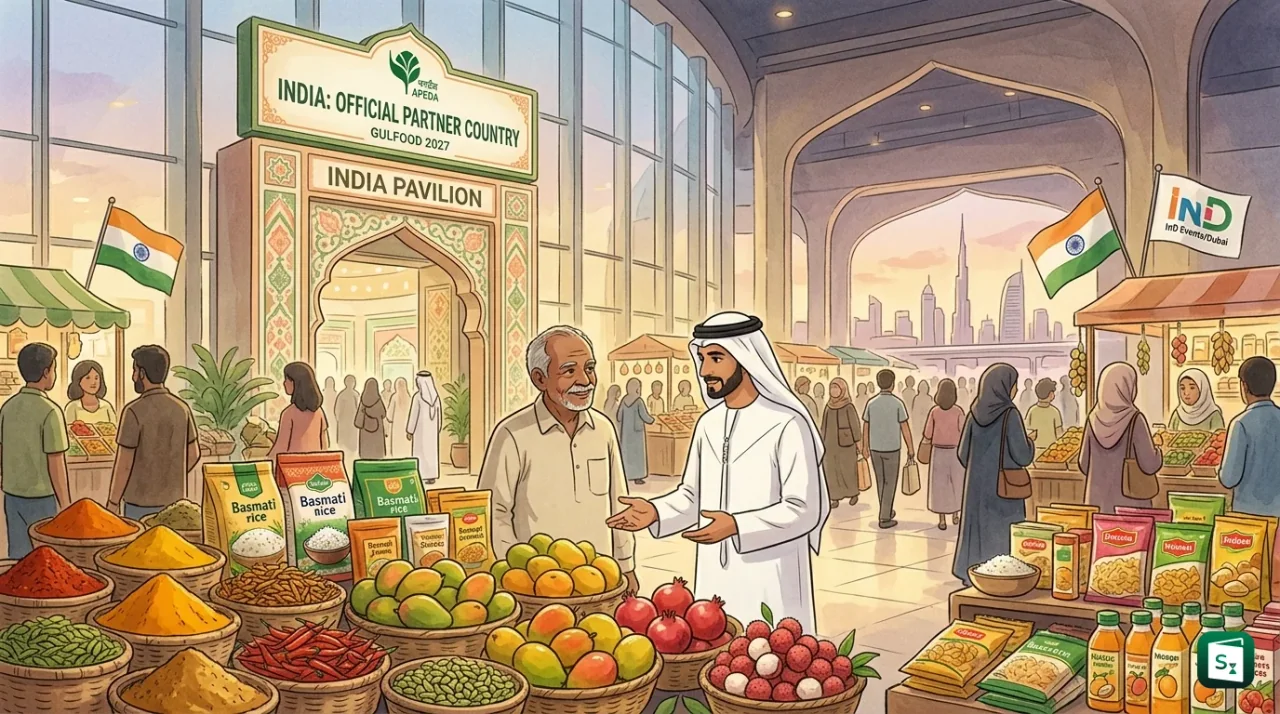
The Agricultural and Processed Food Products Export Development Authority (APEDA) signed a Memorandum of Understanding (MoU) with InD Events Dubai on 16 September 2026 at Vanijya Bhawan in New Delhi. Under the pact, India will be the Official Partner Country at Gulfood 2027, to be held from 15 to 19 March 2027 in Dubai, for the second straight year. The move gives Indian farmers, food processors and exporters a larger global stage to win new buyers across the Gulf, the Middle East and Africa.
What Does the APEDA Pact for Gulfood 2027 Provide?
APEDA signed the MoU with InD Events Dubai, the organiser of Gulfood, at Vanijya Bhawan in New Delhi on 16 September 2026. APEDA Secretary Dr. Saswati Bose and Mark Napier, Vice President for Exhibitions and Growth for Food and Hospitality at InD, signed the pact. Commerce Secretary Rajesh Agrawal was present, along with APEDA Chairman Abhishek Dev (as of September 2026) and senior officers of the Department of Commerce.
The pact confirms India as the Official Partner Country at Gulfood 2027 for the second year in a row, after the same status at Gulfood 2026. It gives India a central position at the fair, with an expanded India Pavilion that brings exporters, Farmer Producer Organisations (FPOs), Micro, Small and Medium Enterprises (MSMEs), startups, commodity boards and government bodies onto one national platform. An FPO is a group of farmers who join together to process and sell their produce. An MSME is a small business defined by limits on investment and turnover.
India’s display will focus on premium, branded, innovative and value added foods along with its steady strengths in commodities such as rice, cereals, meat, fresh fruits and vegetables, and processed foods. The programme includes curated business to business meetings, product showcases, conferences and industry interactions to help Indian sellers meet foreign buyers and close export deals. A special aim is to widen participation by MSMEs, FPOs, startups and exporters led by women and by Scheduled Caste and Scheduled Tribe members, so that new and small producers also gain direct access to global markets.
What Is Gulfood and When Is Gulfood 2027?
Gulfood is the world’s largest food and beverage trade fair, organised in Dubai by the Dubai World Trade Centre. Gulfood 2027, its 32nd edition, will be held from 15 to 19 March 2027 across two venues, the Dubai World Trade Centre and the Dubai Exhibition Centre at Expo City Dubai.
Gulfood is a business fair where food producers, buyers, supermarket chains, importers, caterers and investors meet to place orders and form supply deals. It started more than three decades ago and now stands with Anuga in Cologne and SIAL in Paris among the top global food trade shows. The 2026 edition used two mega venues for the first time and drew more than 8,500 exhibitors from 195 countries, which set the base for an even larger 2027 edition.
| Gulfood 2027 Fact | Detail |
|---|---|
| Full name | Gulfood, global food and beverage sourcing event |
| Edition | 32nd edition |
| Dates | 15 to 19 March 2027 |
| Venues | Dubai World Trade Centre and Dubai Exhibition Centre, Expo City Dubai |
| Show timings | 10 am to 6 pm from 15 to 18 March, 10 am to 5 pm on 19 March |
| Organiser linked to APEDA pact | InD Events Dubai |
The Dubai World Trade Centre will host the long standing core food sectors, while the Dubai Exhibition Centre will host expanded and newer verticals such as startups, power brands and related food systems. For India, the fair is most valuable because Dubai works as a gateway. Buyers from the Gulf Cooperation Council (GCC), the wider Middle East and Africa attend in large numbers, so one display in Dubai can open many regional markets at once.
What Is APEDA?
APEDA is the Agricultural and Processed Food Products Export Development Authority, India’s statutory export promotion body for farm and processed foods. Established in 1986 under the APEDA Act, 1985, it works under the Ministry of Commerce and Industry and is headquartered in New Delhi.
APEDA was created by a law passed by Parliament in December 1985, which came into force on 13 February 1986. It replaced the earlier Processed Food Export Promotion Council. As a statutory body, it gets its powers directly from the law and not merely from a government order. It functions under the Department of Commerce and is led by a Chairman appointed by the Central Government.
| APEDA Fact | Detail |
|---|---|
| Full form | Agricultural and Processed Food Products Export Development Authority |
| Legal status | Statutory body under the APEDA Act, 1985 |
| Year of establishment | 1986 |
| Nodal ministry | Ministry of Commerce and Industry |
| Headquarters | New Delhi |
| Field presence | Head office plus regional offices in cities including Mumbai, Bengaluru, Kolkata, Guwahati, Chennai and Hyderabad |
APEDA promotes the export and development of scheduled products. These are the farm and food items listed under the APEDA Act and include fruits and vegetables, cereals and Basmati rice, meat and poultry, dairy, honey, floriculture, organic products, pickles, chutneys, sauces, ready to eat meals and many other processed foods. Its work includes setting export standards, improving packaging and marketing, inspecting meat plants, collecting trade data, training exporters, and helping Indian sellers take part in global fairs and buyer seller meets. APEDA also acts as the secretariat for the National Programme for Organic Production and runs online traceability systems such as TraceNet for organic goods, Meat.Net for meat and Peanut.Net for groundnuts.
What Is APEDA Registration and Who Needs It?
APEDA registration means obtaining the Registration cum Membership Certificate (RCMC) from APEDA. It is mandatory for exporters of APEDA scheduled products and must be taken within 30 days of first export. Exporters apply online through the DGFT e-RCMC portal after obtaining an Importer Exporter Code.
The Importer Exporter Code (IEC) is a ten digit business identity issued by the Directorate General of Foreign Trade (DGFT), which is India’s foreign trade regulator. Once an exporter has the IEC, the exporter can file for the APEDA RCMC. The RCMC is also called the APEDA certificate or APEDA licence in common use. It is valid for five years and needs regular renewal to stay active. The online fee is ₹5,000 plus 18 percent Goods and Services Tax (GST), which totals ₹5,900.
Registration is compulsory for anyone exporting scheduled items such as Basmati rice, fresh fruits and vegetables, processed fruits and vegetables, meat, dairy, honey, cereals, floriculture and organic products. Without a valid RCMC, an exporter cannot get export authorisations under the Foreign Trade Policy or use APEDA services such as participation in trade fairs, market guidance and financial help for quality testing and packaging. The application needs basic papers such as the IEC copy, Permanent Account Number (PAN), GST registration, Food Safety and Standards Authority of India (FSSAI) licence, and bank and business proof. Manufacturer exporters must also show proof linked to food safety or factory registration.
APEDA and MPEDA
Exporters often confuse APEDA with MPEDA. MPEDA is the Marine Products Export Development Authority, which handles fish and marine exports. APEDA handles farm and processed foods grown on land, while MPEDA handles catch from sea and aquaculture. An exporter of Basmati rice needs APEDA registration, while an exporter of frozen shrimp needs MPEDA registration.
Why the Partnership Matters for Indian Agri Exports
The Gulfood pact directly supports India’s food trade with the United Arab Emirates (UAE) under the Comprehensive Economic Partnership Agreement (CEPA). CEPA is India’s free trade pact with the UAE. It was signed on 18 February 2022 and came into force on 1 May 2022. It cuts or removes customs duty on many goods, sets clear rules of origin to stop misuse, and aims to raise merchandise trade to $100 billion.
| India UAE CEPA Fact | Detail |
|---|---|
| Type | Comprehensive Economic Partnership Agreement, a full trade pact |
| Signed | 18 February 2022 |
| In force | 1 May 2022 |
| Bilateral merchandise trade | Nearly doubled from $43.3 billion in 2020-21 to $83.7 billion in 2023-24, and crossed $100.06 billion in 2024-25 |
| Trade goal | $100 billion in non oil trade by 2030 |
Food is a natural pillar of this trade. India already supplies about one fifth of the UAE’s food needs and is among its top food suppliers. The UAE depends heavily on food imports because of its desert climate and limited farm land, while India offers a large and diverse supply of cereals, fruits, vegetables, dairy, meat, spices, honey and ready to eat foods. Lower duties under CEPA, faster approvals and joint work on food safety between APEDA and UAE regulators help Indian goods enter and clear UAE ports more smoothly.
Dubai adds a second layer of value. The city is a re export hub with world class ports, cold chains and logistics links to the six nation Gulf Cooperation Council, North Africa and the wider Middle East. The six members of the GCC are Bahrain, Kuwait, Oman, Qatar, Saudi Arabia and the UAE. A buyer met at Gulfood in Dubai can therefore carry Indian products to many more shelves across the region. For India, a strong Partner Country showcase shifts the image from bulk commodities alone to branded, premium and innovative foods that earn higher prices and steady orders for MSMEs, FPOs and startups.
The Way Forward
APEDA has already opened work linked to Gulfood 2027 through its Trade Fairs Division, which handles India’s presence at global food shows. Exporters with a valid RCMC can watch for APEDA circulars on space booking, participation charges and product selection for the India Pavilion. Early planning matters because premium stalls at Gulfood are allotted quickly and buyers fix meeting schedules months before the March window.
For the 2027 edition, success will be measured by firm export orders, not only footfall. Curated meetings, live product trials and clear labelling as per UAE food safety rules will decide how many talks turn into contracts. If India repeats its 2026 visibility and converts it into wider orders for value added and organic foods, the second year as Partner Country can lock in Dubai as a steady launch pad for Indian brands into Gulf, Middle East and African stores.
Key Takeaways
- APEDA signed an MoU with InD Events Dubai on 16 September 2026 at Vanijya Bhawan in New Delhi for Gulfood 2027.
- India will be the Official Partner Country at Gulfood 2027 for the second consecutive year after Gulfood 2026.
- Gulfood 2027 will be held from 15 to 19 March 2027 at the Dubai World Trade Centre and the Dubai Exhibition Centre, Expo City Dubai.
- APEDA is a statutory body set up in 1986 under the APEDA Act, 1985, working under the Ministry of Commerce and Industry with headquarters in New Delhi.
- The APEDA RCMC is mandatory for exporters of scheduled farm and processed food products, is valid for five years, and is applied for online through the DGFT e-RCMC portal.
- The pact supports India UAE trade under CEPA, signed on 18 February 2022 and in force from 1 May 2022, with a goal of $100 billion in non oil trade by 2030.