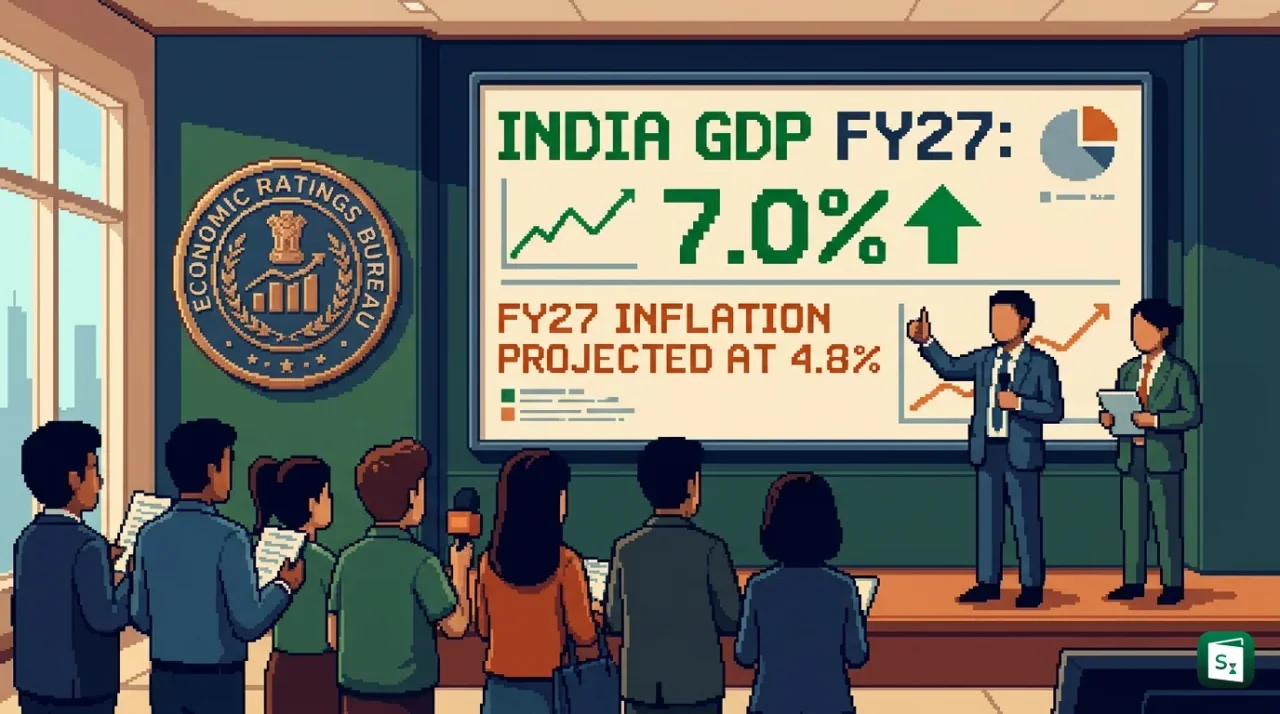
Moody’s Ratings raised India’s real Gross Domestic Product (GDP) growth forecast for FY27 to 7 percent from 6 percent on 18 September 2026, citing resilience to the West Asia conflict. FY27 refers to fiscal year 2026-27 ending in March 2027. The upgrade followed a strong 7.8 percent growth print in the April to June quarter of FY27 and signals that domestic demand has absorbed the global oil shock better than expected.
What Is GDP and How Is It Measured in India?
Gross Domestic Product (GDP) is the total value of final goods and services produced within India in a year. Real GDP measures output at constant base year prices to remove price changes, while nominal GDP uses current prices. India derives GDP from Gross Value Added plus net taxes on products.
Gross Domestic Product (GDP) is the market value of all final goods and services produced inside a country during a specific period. Gross Value Added (GVA) is the value of output minus the cost of inputs and raw materials used to produce it. India arrives at GDP by adding all GVAs across sectors and then adding taxes on products minus subsidies on products, often called net taxes.
Real GDP shows growth after removing the effect of rising prices. Nominal GDP shows output at the actual prices of that year, so it includes both higher production and higher prices. For example, if India produces the same quantity of goods but prices rise by 10 percent, nominal GDP will rise while real GDP will stay flat. Policy makers and rating agencies focus on real GDP growth because it shows whether actual production is expanding.
The National Statistical Office (NSO) under the Ministry of Statistics and Programme Implementation (MoSPI) compiles India’s GDP estimates. In February 2026, MoSPI shifted the GDP base year from 2011-12 to 2022-23 to reflect changes such as digital services, renewable energy and new consumption patterns. The year 2022-23 was chosen because it was the first normal year after the Covid pandemic, with stable data from surveys. Under the new series, MoSPI uses double deflation for manufacturing and agriculture, which means output and inputs are adjusted for prices separately using detailed Consumer Price Index (CPI) and Wholesale Price Index (WPI) data at the item level.
| Concept | What It Measures | Price Base |
|---|---|---|
| Real GDP | Actual change in production volume | Constant prices of base year 2022-23 |
| Nominal GDP | Value of output at current market prices | Current year prices |
| GVA | Output minus input costs by sector | Basic prices before product taxes |
| GDP | Sum of all GVA plus net taxes on products | Constant prices for real, current prices for nominal |
| GNP | GDP plus net income earned from abroad | Depends on real or nominal use |
What Did Moody’s Announce for FY27?
Moody’s Ratings raised India’s real GDP growth forecast for fiscal year 2026-27 to 7 percent from 6 percent on 18 September 2026. The agency projected average inflation at 4.8 percent for FY27, sharply higher than 2.4 percent in FY26.
The announcement came in Moody’s periodic review of India issued on 18 September 2026. Moody’s Ratings is the rating arm of Moody’s Corporation, a United States based agency that assesses the credit strength of governments and companies. For FY27, which runs from April 2026 to March 2027, the agency revised real GDP growth upward to 7 percent from 6 percent estimated earlier.
The revision reversed Moody’s cautious stand in April 2026, when it had cut the FY27 forecast to 6 percent from 6.8 percent after the start of the West Asia conflict on 28 February. At that time, Moody’s had expected subdued private consumption, softer industrial activity and weak capital formation due to high energy prices. The September review said India showed greater resilience to that shock than first assessed.
Moody’s kept its average inflation projection for FY27 at 4.8 percent, compared with an actual outcome of 2.4 percent in FY26. The agency said India would continue to grow faster than all other Group of Twenty (G20) economies and similarly rated emerging market sovereigns, but it warned that risks remain.
Why Did Moody’s Raise the Forecast to 7 Percent?
Moody’s pointed to strong domestic demand in the first half of calendar year 2026. Real GDP growth accelerated to 8.2 percent year on year in January to June 2026, up from 7.3 percent for the full calendar year 2025. The agency said stronger private consumption, robust capital formation, continued public infrastructure spending and sustained strength in services drove this performance.
The quarterly data supports this view. India’s real GDP grew by 7.8 percent in the April to June quarter of FY27, against 6.9 percent in the same quarter of FY26. Real GDP in that quarter stood at ₹81.36 lakh crore, while nominal GDP stood at ₹88.27 lakh crore with growth of 10.3 percent. Real Gross Value Added (GVA) grew by 8.2 percent. This result beat the Reserve Bank of India (RBI) estimate of 7 percent for the quarter and marked the highest first quarter growth in four years from 2023-24 to 2026-27.
Private consumption remained firm. Private Final Consumption Expenditure (PFCE) grew by 7.1 percent in the June quarter, up from 6.8 percent a year earlier. Investment showed a sharper recovery. Gross Fixed Capital Formation (GFCF), which tracks investment in machinery, buildings and infrastructure, grew by 11.9 percent, up from 5.8 percent a year earlier, and its share in GDP rose to 34.3 percent. Exports of goods and services grew by 12 percent, while government consumption grew by 4.3 percent.
On the supply side, services led the expansion. Financial, real estate and professional services grew by 12.1 percent. Manufacturing grew by 9.2 percent, construction by 7.7 percent, and electricity, gas and water supply by 8.9 percent after a contraction last year. Trade, hotels, transport and communication grew by 8.5 percent. Agriculture grew more slowly at 3.6 percent due to heatwave conditions and delayed rains, while mining contracted by 2.4 percent on a high base.
Moody’s also noted the government’s restrained fiscal response to the West Asia shock. The muted rise in subsidies reflects a commitment to cut the central fiscal deficit to 4.3 percent of GDP in FY27 from 4.4 percent in FY26. Continued capital spending by the Centre, reported to be up by around 30 percent year on year in the early months of FY27, helped crowd in private investment.
Inflation Projection at 4.8 Percent: What Are the Risks?
Moody’s projects average Consumer Price Index (CPI) inflation at 4.8 percent in FY27, double the 2.4 percent recorded in FY26. CPI inflation measures the change in retail prices paid by households for a fixed basket of goods and services. Food, fuel, housing, clothing and services carry different weights in this basket.
The main risk comes from energy. Since the start of the West Asia conflict, crude oil prices have risen to more than $100 per barrel in September 2026 from about $73 before the conflict. The region supplies around 55 percent of India’s crude oil imports and more than 90 percent of liquefied petroleum gas (LPG) imports. Any prolonged disruption to LPG shipments can cause household shortages and raise fuel and transport costs. Higher oil and gas prices also raise fertiliser costs, because India depends on imports for key fertiliser inputs, and this can push up food prices.
The second risk comes from weather. Moody’s flagged El Nino related pressure on food prices. El Nino is a warming of waters in the central Pacific Ocean that often weakens the Indian monsoon and reduces farm output. India recorded its weakest monsoon since FY10, and analysts expect the rural impact to show in the final quarter of FY27. Higher food inflation hurts private consumption because households spend more on essentials and less on other goods.
Moody’s warned that without a lasting resolution of the conflict, average inflation could rise beyond 4.8 percent. That would weigh on consumption and economic activity. It could also force the government to spend more on fuel and fertiliser subsidies and provide extra support to households. Higher spending on subsidies, along with rising defence and infrastructure outlays, can slow progress toward fiscal consolidation. The Wholesale Price Index (WPI), which tracks prices at the factory and mandi level, is also under watch because higher input costs can squeeze company margins if firms cannot pass them to buyers.
How Do Other Agencies Assess India’s FY27 Growth?
Moody’s 7 percent forecast is the most optimistic among major official forecasters. Most other agencies place FY27 growth between 6.4 percent and 6.7 percent, while some domestic agencies moved up after the strong June quarter print. The table below places these assessments together for easy comparison.
| Agency | FY27 Real GDP Forecast | Key Basis Stated |
|---|---|---|
| Moody’s Ratings | 7 percent, raised from 6 percent in September 2026 | Domestic demand resilience to West Asia shock |
| Reserve Bank of India (RBI) | 6.7 percent in August 2026, earlier 6.6 percent in June and 6.9 percent in May | Private consumption, investment, stable macros, with downside from oil and weather |
| International Monetary Fund (IMF) | 6.4 percent in July 2026, down from 6.5 percent in April | Strong private consumption and services activity |
| World Bank | 6.6 percent in June 2026, raised by 10 basis points | Resilient domestic demand, GST rate cuts partly offset by energy costs |
| S and P Global Ratings | 6.6 percent in June 2026 | Risks from energy prices, weak monsoon and slow global growth |
| Organisation for Economic Co-operation and Development (OECD) | 6.1 percent | Moderation due to West Asia energy shock |
The RBI is India’s central bank and the authority for monetary policy and the policy repo rate. RBI Governor Sanjay Malhotra (as of September 2026) projected quarterly growth of 7 percent in the June quarter, 6.4 percent in the September quarter, 6.5 percent in the December quarter and 6.8 percent in the March quarter. The RBI projected CPI inflation at 4.6 percent for FY27, slightly below Moody’s 4.8 percent.
The IMF kept India as the fastest growing major economy in both FY27 and FY28. It raised the FY28 forecast to 6.7 percent from 6.5 percent. The World Bank also raised the FY28 forecast to 7.2 percent. After the 7.8 percent June quarter outcome, domestic assessors also revised upward. ICRA raised its FY27 estimate to 7.1 percent from 6.7 percent, Bank of Baroda to 7 percent from a range of 6.6 to 6.8 percent, and CareEdge to 7.3 percent from 7 percent. Government data showed the economy grew by 7.7 percent in FY26 on the old base, later placed at 7.6 percent under the new 2022-23 base series.
What Is Moody’s Rating for India?
A sovereign credit rating is an assessment of a government’s ability to repay its debt on time. Moody’s rates India at Baa3 with a stable outlook (as of September 2026). Baa3 is the lowest level within investment grade, which means debt is judged to carry moderate credit risk and remains eligible for most large global investors.
Moody’s Investors Service, now called Moody’s Ratings, first placed India at Baa3 in 2004, raised it to Baa2 in 2017, cut it back to Baa3 in June 2020 during the pandemic, and kept a negative outlook until October 2021 before restoring it to stable. The stable outlook reflects large and fast growing domestic demand, strong foreign exchange reserves, mostly rupee denominated public debt and a stable domestic funding base for government borrowing. Weak points cited are high general government debt near 80 percent of GDP, low income per person and high interest payments relative to revenue.
India holds the lowest investment grade from all three global agencies. S and P Global Ratings upgraded India’s long term rating to BBB with a stable outlook in August 2025, the first upgrade in 18 years. Fitch Ratings holds India at BBB minus with a stable outlook. The table below shows how their scales match.
| Moody’s | S and P and Fitch | Grade Meaning |
|---|---|---|
| Baa1 | BBB plus | Lower medium investment grade |
| Baa2 | BBB | Lower medium investment grade |
| Baa3 | BBB minus | Lowest investment grade, India’s Moody’s and Fitch level |
| Ba1 | BB plus | Highest speculative grade, below investment grade |
A higher rating usually lowers borrowing costs for the government and companies abroad. An upgrade would need durable fiscal consolidation, a clear fall in the debt burden and stronger debt affordability, along with deeper private investment and broader high value manufacturing and digital services.
India’s Position in the Global Economy
India is the fastest growing major economy in the world for FY27 on every major forecast, even though the growth numbers differ. Moody’s expects India to grow faster than all other G20 members. The IMF said in July 2026 that India remains among the world’s fastest growing major economies and a key engine of global growth. The World Bank said the same in April 2026, despite cutting global growth to around 2.5 to 3 percent for 2026 due to the energy shock.
The size of the economy provides context. Nominal GDP is estimated at ₹345.47 lakh crore in FY26, with real GDP at ₹322.58 lakh crore under the new base series. This size places India among the top five economies in the world in nominal dollar terms, in the range of $4 trillion. Total size alone does not show living standards. Per capita income, which is GDP divided by population, remains far below advanced economies because India’s large population spreads output widely. That is why agencies track both total GDP and income per person.
Strong growth helps incomes rise over time, supports tax collection and makes public debt easier to carry. It also builds buffers such as foreign exchange reserves and a healthy banking system. These buffers explain why the World Bank said India entered the West Asia crisis from a position of strength, with low inflation at the start, rupee denominated debt and diversified trade.
Key Takeaways
- Moody’s Ratings raised India’s real GDP growth forecast for FY27 to 7 percent from 6 percent on 18 September 2026.
- Moody’s projects average CPI inflation at 4.8 percent in FY27, up from 2.4 percent in FY26.
- India’s real GDP grew by 7.8 percent in Q1 FY27, with real GVA growth at 8.2 percent and nominal GDP growth at 10.3 percent.
- The GDP base year was revised from 2011-12 to 2022-23 by MoSPI, with double deflation for manufacturing and agriculture.
- Moody’s rates India at Baa3 with a stable outlook, the lowest investment grade, while S and P rates India at BBB.
- The RBI projects 6.7 percent growth for FY27, the IMF projects 6.4 percent and the World Bank projects 6.6 percent.