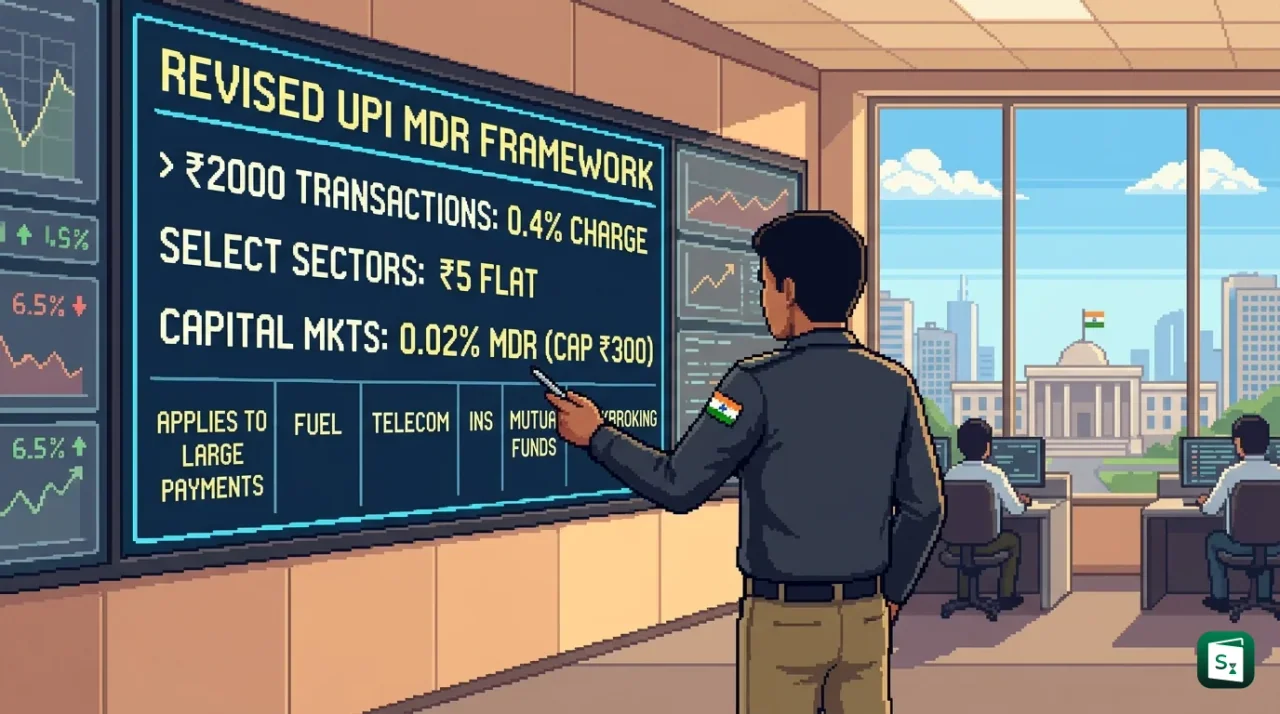
The National Payments Corporation of India (NPCI) has notified a new Merchant Discount Rate (MDR) framework for Unified Payments Interface (UPI) that will take effect from October 15, 2026. Under the revised rules decided by the UPI and Services Steering Committee, Person-to-Merchant payments above ₹2,000 will attract a charge of 0.4 percent, capped at ₹300, while select essential and capital market categories will pay lower concessional rates. The framework keeps all Person-to-Person transfers and merchant payments up to ₹2,000 free, ending more than six years of zero MDR on UPI.
What Is Merchant Discount Rate and What Is MDR in UPI?
Merchant Discount Rate (MDR) is the fee a merchant pays to its acquiring bank for accepting a digital payment, and MDR in UPI is the same fee now introduced on select Person-to-Merchant UPI payments. It is usually calculated as a percentage of the transaction value and is deducted before the settlement amount is credited to the merchant, so the customer pays only the posted price.
In practice, MDR is not kept by one entity alone. It is shared among participants in the payment chain. The largest part is the interchange fee paid to the customer’s issuing bank which bears risk and account management costs, followed by the network or scheme fee for using the NPCI network, and the acquirer markup retained by the merchant’s bank or payment aggregator for onboarding, processing, fraud prevention and customer service. This distinction matters because MDR is the total merchant-facing charge, while interchange is only one component inside it.
For UPI, the term has extra policy significance. UPI, or Unified Payments Interface, is an instant real time payments system developed by NPCI, which was established in 2008 as an initiative of the Reserve Bank of India (RBI) and the Indian Banks’ Association under the Payment and Settlement Systems Act, 2007. Since January 1, 2020, UPI and RuPay debit card payments had operated under a statutory zero MDR regime to accelerate adoption. That is the regime now being partially revised for larger merchant payments.
What is MDR charges and how is it calculated?
MDR charges are computed on the transaction value above the threshold. For example, a ₹3,000 purchase at 0.4 percent results in ₹12 as MDR, and a ₹50,000 purchase results in ₹200. For a ₹1,00,000 purchase, the calculated amount of ₹400 is replaced by the ₹300 cap that applies to transactions of ₹75,000 and above. Transactions below ₹2,000 attract no MDR at all.
New UPI MDR Framework Effective From October 15, 2026
The revised UPI MDR framework will apply from October 15, 2026, as notified by NPCI on September 15, 2026 through detailed Frequently Asked Questions. The operational parameters, fee sharing and category caps have been decided by the UPI and Services Steering Committee, a 22 member body headed by NPCI that includes the Indian Banks’ Association (IBA) and the Payments Council of India (PCI). Acquiring banks, payment aggregators, fintech applications and corporate accounting platforms have been given a one month window to update software and billing systems.
The new UPI new rules 2026 create a differentiated structure rather than a single flat charge. All Person-to-Person (P2P) transfers remain outside the framework, and Person-to-Merchant (P2M) payments up to ₹2,000 remain free. Only eligible P2M transactions above ₹2,000 fall under the charge, which the Ministry of Finance has noted covers only about 4 to 5 percent of P2M transaction volume.
| Category | MDR Applicable | Threshold and Cap |
|---|---|---|
| P2P UPI transfers | Zero | No charge irrespective of amount |
| P2M up to ₹2,000 | Zero | No MDR |
| Standard P2M above ₹2,000 | 0.4 percent | Applies above ₹2,000, capped at ₹300 for ₹75,000 and above |
| Essential sectors above ₹2,000 | Flat ₹5 per transaction | Railways, telecom, insurance, fuel, agriculture inputs, utilities, education |
| Capital market transactions | 0.02 percent, capped at ₹300 | Mutual funds, securities, stockbrokers, dealers, investment platforms |
| Small P2PM merchants | Zero | Up to ₹1 lakh monthly UPI QR receipts |
| UPI app platform fee | Not permitted | No additional fee for UPI payments |
Standard Charge: 0.4 Percent Above ₹2,000 and ₹300 Cap
The standard rate of 0.4 percent applies to eligible P2M UPI payments above ₹2,000. The charge is capped at ₹300 per transaction for payments of ₹75,000 and above. NPCI has illustrated that a merchant receiving ₹3,000 will pay ₹12, while on ₹50,000 the fee is ₹200, and on ₹1,00,000 the payable amount stays at ₹300 instead of ₹400. This rate is lower than international benchmarks cited by the committee, such as Brazil’s PIX at about 0.33 percent and China at about 0.40 percent, and is positioned as an affordable option for merchants.
Flat ₹5 Rate for Essential Sectors: Railways, Telecom, Insurance and Fuel
Certain merchant categories will not pay the percentage rate. For payments above ₹2,000 in railways, telecom services, insurance, fuel, agriculture inputs, public utilities including electricity, municipal water and piped natural gas, and educational fee collections, a flat ₹5 per transaction applies irrespective of the transaction value. NPCI has stated this concessional flat structure prevents cost escalation in critical public services and thin margin sectors like fuel retail, where a percentage fee on high value annual premiums or bulk purchases would be disproportionate. Payments of ₹2,000 or less in these categories continue to carry zero MDR.
Concessional 0.02 Percent for Capital Market Transactions
Capital market transactions through UPI will attract a much lower rate of 0.02 percent, also capped at ₹300. The category covers regulated entities including asset management companies (AMCs), SEBI-registered stockbrokers, securities dealers and investment platforms, and applies to equity purchases, debt market investments, mutual fund purchases and broker wallet top ups. For example, a ₹50,000 payment towards a mutual fund attracts ₹10, and a ₹5,00,000 payment attracts ₹100. Even a ₹15,00,000 or ₹50,00,000 payment is capped at ₹300. The lower rate is intended to avoid dampening retail participation in financial markets while still contributing to infrastructure costs.
Is UPI Free for Consumers and Small Merchants?
Yes, UPI remains free for consumers and for most small value merchant payments. The framework explicitly states that customers pay only the posted price, and merchants onboarded on the UPI network cannot pass MDR on to buyers, including the flat ₹5 fee. Person-to-Person transfers, including transfers between a user’s own linked bank accounts, remain free irrespective of amount, and UPI app providers are not permitted to levy any platform fee or other charge for UPI payments.
For merchants, the position is differentiated. Transactions of ₹2,000 or less remain free even for large commercial entities, which protects more than 95 percent of UPI P2M transactions by volume. Small merchants covered under the Person-to-Person-Merchant (P2PM) framework, designed for local shops and vendors who receive UPI payments directly into their accounts, remain exempt up to ₹1 lakh per month in UPI QR receipts. Recurring payments collected through UPI AutoPay mandates, such as mutual fund SIPs, insurance premiums, mobile bills, electricity bills and OTT subscriptions, are treated separately from fresh manual P2M payments and do not automatically attract MDR merely because the value exceeds ₹2,000.
Credit linked UPI payments, including RuPay credit cards linked to UPI and pre sanctioned bank credit lines, operate under separate rules and are not covered by this bank account to bank account MDR framework.
Why Is MDR Being Introduced Now?
UPI has grown from a pilot in April 2016 with 21 banks to the world’s largest real time payments system. UPI was publicly launched on 25 August 2016 and the BHIM (Bharat Interface for Money) app was launched in December 2016 to demonstrate its potential. By FY 2025-26, UPI processed 24,162 crore transactions valued at about ₹314 lakh crore, up from just 1.78 crore transactions and ₹0.07 lakh crore in FY 2016-17. In July 2026 alone, UPI handled 2,366 crore transactions worth ₹29.88 lakh crore, with 741 banks live on the platform and about 55.49 crore users onboarded as of June 2026 (as of June 2026). At this scale, operating costs for server bandwidth, fraud prevention, cybersecurity, settlement infrastructure and customer support are estimated at about ₹20,000 crore annually.
Since January 2020, after amendments to the Payment and Settlement Systems Act, 2007 and the Income-tax Act, 1961, UPI and RuPay debit card transactions carried zero MDR. The government compensated banks and fintechs through an annual incentive scheme, which cost about ₹2,512 crore for the first two years for transactions up to ₹2,000. NPCI has now described those incentives as short term bridge funding rather than a permanent solution, noting that reliance on budget allocations creates funding uncertainty and limits long term technology investment.
To create a sustainable commercial model, Parliament during the Monsoon Session in August 2026 amended Section 10A of the Payment and Settlement Systems Act, 2007 through the Taxation and Other Laws (Amendment) Bill, 2026. The amendment provides an enabling framework allowing the government to notify which electronic payment modes remain free and which may carry MDR. Following this, a gazette notification dated September 14, 2026 clarified that bank account UPI payments up to ₹2,000 and RuPay debit card payments remain free, and cannot be charged directly or indirectly. Transactions above that threshold for specified merchant categories were then enabled for the revised MDR.
Finance Minister Nirmala Sitharaman (as of September 2026) assured Parliament that the amendment does not impose any tax or transaction charge on consumers, and that any future MDR would apply only to a limited category of merchant transactions above a prescribed threshold. The government has reiterated that everyday low value payments to small vendors will stay free.
A dedicated fund will also be created from 5 percent of MDR collections to expand digital payment acceptance in Tier 3 to Tier 6 centres, including the Northeastern states, Jammu and Kashmir and Ladakh, and to support initiatives in Tier 1 and Tier 2 centres under schemes such as PM SVANidhi and PM Vishwakarma. The fund will provide assistance to acquiring banks and payment aggregators for merchant onboarding and incentives for rural transactions. NPCI has stated the detailed framework will be finalised in consultation with RBI within three months.
How Does UPI MDR Compare With Debit and Credit Card Charges?
UPI MDR has been deliberately set below traditional card MDR to keep UPI the most affordable acceptance option for merchants. The comparison also clarifies the broader pillar of merchant discount rate vs interchange fee, where UPI follows a simpler shared fee model.
| Instrument | Typical MDR in India | Cap and Condition |
|---|---|---|
| UPI standard P2M above ₹2,000 (from October 15, 2026) | 0.4 percent | Capped at ₹300 for ₹75,000 and above |
| UPI essential sectors (railways, telecom, insurance, fuel) | Flat ₹5 | For payments above ₹2,000 |
| UPI capital market (mutual funds, stocks) | 0.02 percent | Capped at ₹300 |
| Credit cards | 1.5 to 2.5 percent, up to about 3 percent for premium | Unregulated, negotiated |
| Debit cards (non RuPay) | Up to 0.90 percent, typically 0.40 percent for small merchants | Capped at ₹200 for small merchants and ₹1,000 for large merchants as per RBI 2017 norms |
| RuPay debit and UPI up to ₹2,000 | Zero | Statutory zero MDR since January 2020 |
On a ₹10,000 payment, a merchant would keep ₹9,960 after a 0.4 percent UPI MDR, compared with ₹9,750 to ₹9,850 after a typical credit card MDR. The government and NPCI will not retain any part of the UPI MDR, the revenue will be distributed among acquiring banks, issuing banks and app providers as decided by the UPI and Services Steering Committee, to fund resilience, innovation and service upgrades.
UPI Transaction Limits and Framework Context
Understanding UPI transaction limits helps separate security controls from the new MDR threshold. UPI limits are risk management caps set by NPCI and individual banks. They are not charging thresholds and do not by themselves trigger MDR.
The general UPI transaction limit per day for Person-to-Person payments is typically ₹1 lakh per transaction, with a daily cumulative cap often set at ₹1 lakh by many banks, though some banks allow higher daily totals depending on category. For verified merchant payments, NPCI has raised ceilings in recent circulars. Capital market transactions, including mutual funds and securities, have been permitted up to ₹5 lakh per transaction and ₹10 lakh per day. Similar enhanced limits of ₹5 lakh per transaction and ₹10 lakh per day apply to categories such as insurance, travel, government e marketplace, collections and credit card bill payments, with jurisdiction specific sub caps, for example ₹2 lakh per transaction for jewellery and ₹6 lakh daily for credit card bills. The UPI transaction limit per month is not a single uniform figure, monthly usability depends on daily caps multiplied by days, and on bank specific cumulative limits.
The critical point for the new framework is that the ₹2,000 MDR threshold is independent of these higher transaction ceilings. A ₹50,000 capital market payment may be well within the permissible UPI limit but will still attract the concessional 0.02 percent MDR, while a ₹50,000 P2P transfer to a friend remains free. At the same time, daily limits remain a separate safeguard against fraud and will continue to be enforced by issuing banks even after October 15, 2026.
How the New Rules Will Work for Merchants and Users
For ordinary users scanning a QR code at a neighbourhood shop, the change is largely invisible. More than 96 percent of P2M transactions by the Ministry of Finance’s assessment will remain unaffected, and all payments up to ₹2,000 continue free. For a consumer paying ₹3,000 for shopping, the merchant’s acquiring bank will deduct ₹12 before settling the remainder, but the consumer’s account is debited exactly ₹3,000.
For merchants, the settlement will reflect the applicable MDR plus 18 percent Goods and Services Tax (GST) on the fee, as is standard for payment processing charges. An illustrative deduction for a ₹3,000 sale at 0.4 percent would therefore mean ₹12 as MDR and about ₹2.16 as GST on that fee. The framework also reinforces that payment aggregator or gateway platform fees cannot be presented to the customer as a UPI surcharge.
For fintechs and banks, industry surveys suggest the calibrated MDR could encourage new entrants to invest in acceptance infrastructure in smaller towns, fraud detection and customer support, areas previously funded only through budgetary incentives. For investors using UPI for mutual funds, the practical impact is minimal because Asset Management Companies and broking platforms are expected to absorb the 0.02 percent cost rather than levy it on the investor, and investments up to ₹2,000 remain free in any case.
The Way Forward
The October 15, 2026 timeline gives the ecosystem a short transition window to adjust. Acquiring banks and payment aggregators will need to classify merchants correctly under the right Merchant Category Code to ensure the flat ₹5 and 0.02 percent concessional rates are applied accurately and to avoid misclassification disputes.
The proposed small merchant support fund, built from 5 percent of MDR collections, will be central to balancing revenue generation with financial inclusion. Its success will depend on transparent governance, close coordination between NPCI and RBI, and targeted deployment in underserved regions. Regular reporting on fund utilisation, merchant onboarding numbers in Tier 3 to Tier 6 centres, and UPI growth trends among existing small merchants will be key indicators to watch.
For the broader digital payments landscape, the framework represents a shift from full subsidy dependence to a threshold based commercial model that keeps everyday transactions free while asking larger commercial merchants to contribute modestly. If enforced without pass through to consumers and with clear audit trails on settlement reports, the calibrated MDR could provide stable funding for cybersecurity upgrades, resilience and innovation, supporting the next decade of UPI growth that already accounts for 84 percent of India’s digital payments and about 49 percent of global real time volumes in 2025.
Key Takeaways
- The new UPI MDR framework takes effect from October 15, 2026, with 0.4 percent MDR on eligible Person-to-Merchant UPI payments above ₹2,000, capped at ₹300 for transactions of ₹75,000 and above.
- Flat ₹5 per transaction applies to UPI payments above ₹2,000 in railways, telecom, insurance, fuel, agriculture inputs, utilities and education, while payments up to ₹2,000 remain free.
- Capital market UPI transactions including mutual funds and stockbroking attract a concessional 0.02 percent MDR capped at ₹300.
- UPI remains free for consumers, Person-to-Person transfers of any amount remain free, and merchants cannot pass MDR on to customers, the charge is borne within the merchant payment ecosystem.
- NPCI, established in 2008 under the Payment and Settlement Systems Act, 2007 and operator of UPI launched on 25 August 2016, heads the UPI and Services Steering Committee that will decide fee sharing and category caps.
- The zero MDR regime on UPI and RuPay debit cards since January 1, 2020 was enabled under Section 10A of the Payment and Settlement Systems Act, which was amended in August 2026 to allow threshold based MDR, with 5 percent of collections earmarked for a fund to expand digital payments in Tier 3 to Tier 6 centres.