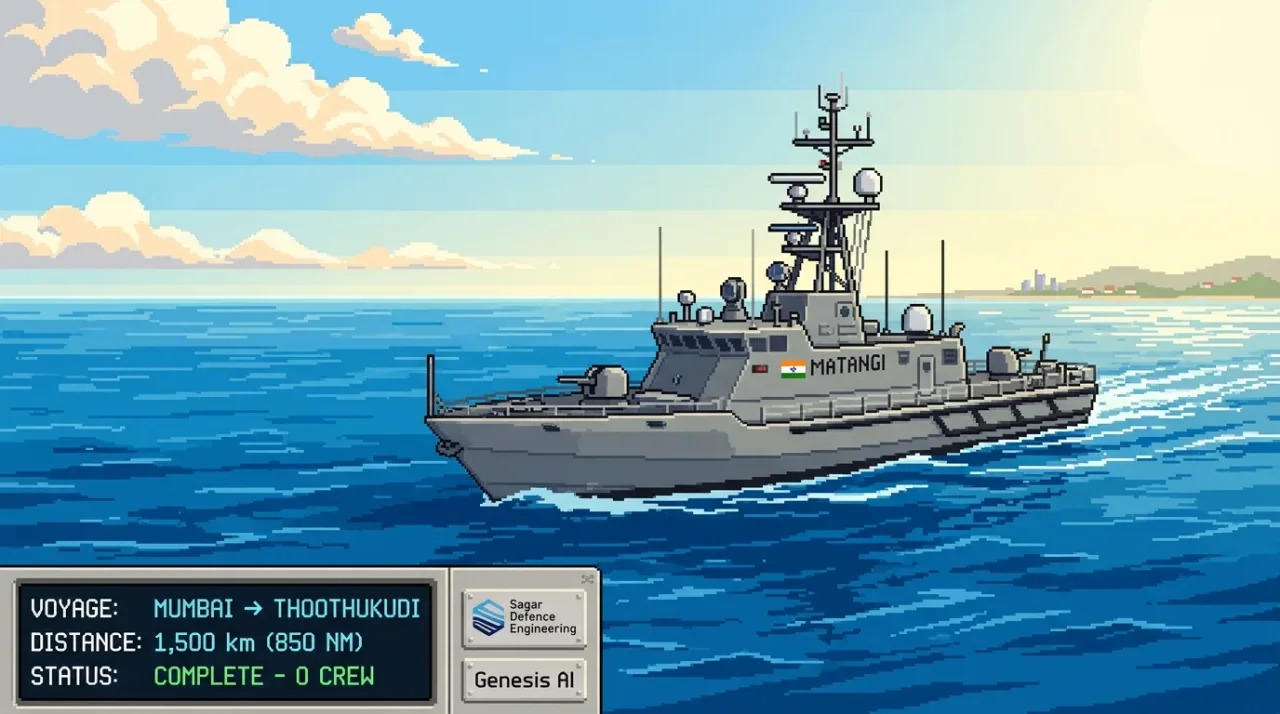
India’s indigenous Matangi Autonomous Surface Vessel has completed a landmark 1,500 km (850 nautical miles) open-ocean voyage from Mumbai to Thoothukudi in Tamil Nadu with zero human intervention on board. The Sagarmala Parikrama mission was virtually flagged off by Union Defence Minister Rajnath Singh during Swavlamban 2024 at Bharat Mandapam, New Delhi, and was executed by Sagar Defence Engineering under the Indian Navy’s Swavlamban initiative. Powered entirely by the indigenously developed Genesis AI operating suite, the success places India firmly in the small club of nations mastering long-range autonomous maritime systems.
What Is Matangi and What Is an Unmanned Surface Vessel?
What is Matangi? Matangi is India’s first indigenous Autonomous Surface Vessel (ASV), a 13 metre long unmanned boat developed by Sagar Defence Engineering Pvt Ltd of Pune. The Indian Navy’s Matangi vessel completed a fully autonomous 850 nautical mile passage from Mumbai to Thoothukudi as part of the Sagarmala Parikrama demonstration, with no captain or crew on board.
What is a USV? An Unmanned Surface Vessel (USV) is a boat or ship that operates on the water surface without a crew on board. USVs work with different levels of autonomy, from remote control by an operator on shore to partially autonomous navigation and to fully Autonomous Surface Vessels (ASVs) that can navigate, avoid obstacles and execute missions on their own using sensors and artificial intelligence.
Matangi belongs to the highest autonomy category. It is a fast interceptor type USV designed for coastal surveillance, high speed interdiction, patrol and constabulary operations. The vessel can operate at speeds of more than 50 knots, carries a 12.7 mm stabilised remote controlled gun (SRCG) for armed roles, and is built to patrol day and night with capabilities for sea state 6 operations and survival in sea state 8. In a hybrid search and rescue configuration, it can also carry up to 14 persons. The name Matangi should not be confused with Goddess Matangi from Hindu tradition or the character Matangi in the animated film Moana 2, both of which share the same name but are unrelated to the naval platform.
Autonomous Vessel Versus Unmanned Vessel
| Term | Meaning | Human Role |
|---|---|---|
| Unmanned Surface Vessel (USV) | Umbrella term for any surface craft without crew on board | Crew absent, but control may be remote or autonomous |
| Autonomous Surface Vessel (ASV) | A USV with high onboard autonomy that makes navigation decisions itself | No direct human steering, system decides route and collision avoidance |
| Remotely Operated Vessel | Vessel steered continuously by a human operator via radio or satellite link | Human controls heading and speed at all times |
| Matangi | An ASV, which is also a USV, with full autonomy demonstrated over 1,500 km | Zero human intervention during the Mumbai to Thoothukudi voyage |
How Did Matangi Complete the 1,500 km Mumbai to Thoothukudi Voyage?
The Matangi autonomous voyage demonstrates true long-range autonomy at sea, not a short harbour trial. The mission, named Sagarmala Parikrama, covered 1,500 km or 850 nautical miles of open ocean along India’s west and south coast, from Mumbai in Maharashtra to Thoothukudi (Tuticorin) in Tamil Nadu. The Indian Navy’s Naval Innovation and Indigenisation Organisation (NIIO), its Technology Development Acceleration Cell (TDAC) and the Innovations for Defence Excellence (iDEX) initiative under the Defence Innovation Organisation (DIO) supported the project.
The voyage was virtually flagged off by Union Defence Minister Rajnath Singh on 29 October 2024 during the plenary session of Swavlamban 2024 at Bharat Mandapam, New Delhi. Matangi then sailed in fully autonomous mode, with no captain or crew on board, using its indigenous navigation and collision avoidance software to steer, maintain route and avoid maritime traffic.
The passage was executed in legs. The vessel completed the first leg from Mumbai to Karwar in Karnataka, covering about 350 nautical miles (about 600 km) overnight, before continuing the remaining around 1,000 km to Thoothukudi. The company, Sagar Defence Engineering, described the journey on 6 November 2024 as a first of its kind that highlights India’s growing expertise in autonomous maritime technology and establishes a milestone in developing unmanned systems for national security. Captain Nikunj Parashar, Managing Director and founder of Sagar Defence Engineering, said the success demonstrates India’s ability to build autonomous maritime systems indigenously, which is critical to national security, and reflects partnership and the vision of Aatmanirbharta.
| Stage | Detail |
|---|---|
| Mission Name | Sagarmala Parikrama |
| Flag Off | 29 October 2024 by Rajnath Singh at Swavlamban 2024, Bharat Mandapam |
| Route | Mumbai to Thoothukudi via Karwar |
| Total Distance | 1,500 km (850 nautical miles) open ocean |
| First Leg | Mumbai to Karwar, about 350 nautical miles (600 km) |
| Mode | Fully autonomous, zero human intervention |
| Support | Indian Navy through NIIO, TDAC and iDEX/DIO |
What Powers Matangi: The Genesis AI Operating Suite and Technology Stack?
What is the Genesis AI suite? Genesis is an indigenously developed AI-driven autonomous operating suite created by Sagar Defence Engineering that serves as the brain of Matangi. The Genesis suite lets the vessel navigate, avoid collisions and execute missions without human steering, and it can be ported to transform other maritime platforms into intelligent autonomous systems (as of September 2026).
The Genesis system gives Matangi the ability to operate in three broad ways that are common across Indian USV programmes. It can function in remote controlled mode where a shore operator takes over, in autonomous waypoint navigation where it holds a patrol area while automatically avoiding traffic and adapting to sea conditions, and in fully autonomous mode where the software takes complete charge of navigation and mission execution.
The technology stack relies on a fused sensor and computing architecture. Like other certified Indian USV autonomy systems such as the Advanced Autonomous Navigation and Control Software (A2NCS) developed by the Weapons and Electronics Systems Engineering Establishment (WESEE) of the Indian Navy with Bharat Electronics Limited (BEL), Matangi’s autonomy integrates radar, Automatic Identification System (AIS), electro-optical and infrared (EO/IR) cameras, Inertial Navigation System (INS), Global Positioning System (GPS) and electronic navigation charts. Onboard edge computing processes this data in real time to deliver 360 degree situational awareness, obstacle avoidance, compliance with the International Regulations for Preventing Collisions at Sea (COLREGs), AI-driven decision making, cyber resilience and fail safe behaviour, including operation without continuous internet connectivity.
Matangi’s physical design complements this software. The vessel uses modern command control boards for heading, speed and dynamic positioning. It is built for persistence at sea, high speed interdiction and low intensity maritime operations. Advanced features now being rolled out across the emerging Indian USV fleet include satellite and mesh radio frequency (RF) network control for swarm operations, where multiple boats share a decentralised, self healing communication network, and self righting capability to return upright after capsizing.
| System Layer | What It Does | Key Features |
|---|---|---|
| Genesis AI Operating Suite | Core autonomy brain | Indigenous, platform agnostic, AI based navigation and mission execution |
| Sensors | Eyes and ears at sea | Radar, AIS, EO/IR, INS, GPS, electronic charts |
| Intelligence | Decision making | Collision avoidance, COLREGs compliance, route optimisation |
| Communications | Command and swarm linkage | Satellite and mesh RF network for remote and cooperative operation |
| Safety | Survivability | Edge computing, fail safe modes, self righting, sea state 6 operation |
Who Built Matangi: Sagar Defence Engineering Pvt Ltd
Sagar Defence Engineering Pvt Ltd is a Pune based defence technology company founded in 2015 and headquartered in Mumbai, Maharashtra, with additional presence in Andhra Pradesh and the United States (as of September 2026). The company is led by Captain Nikunj Parashar (as of September 2026), Managing Director and founder, and specialises in unmanned systems for commercial, defence and scientific use. It describes itself as a pioneer in India’s unmanned marine surface vehicles and has grown to more than 236 employees.
The company is a winner under the Innovations for Defence Excellence (iDEX) DISC 7 SPRINT framework. SPRINT stands for Supporting Pole-Vaulting in R&D through iDEX, NIIO and Technology Development Acceleration Cell, a scheme launched by Prime Minister Narendra Modi and Defence Minister Rajnath Singh to accelerate defence innovation through Micro, Small and Medium Enterprises (MSMEs), startups and individual innovators. Through SPRINT, Sagar Defence entered into agreements with the Indian Navy for development of Autonomous Weaponized Boat Swarms and related autonomous surface craft.
Sagar Defence Engineering has expanded its industrial footprint in line with the Matangi success. The firm has broken ground on an autonomous maritime shipbuilding centre in Andhra Pradesh, reported in 2025 to be coming up in Nellore district, which is projected to be India’s first dedicated autonomous maritime shipyard. The company has also entered into a collaboration with Liquid Robotics, owned by Boeing, to co-develop and co-produce USVs such as the wave and solar powered Wave Glider that can remain on task for months.
The firm’s growing prominence is also reflected in public interest around Sagar Defence Engineering share price, which has seen heightened search interest, though the company remains privately held. For exam purposes, the key fact is that Sagar Defence Engineering is an Indian MSME and startup that has become the lead Indian developer of long-range autonomous surface vessels, with Indian Navy guidance, testing facilities and operational feedback.
What Is Swavlamban and Why Does It Matter for Self-Reliance?
What is Swavlamban? Swavlamban is the Indian Navy’s flagship innovation and indigenisation initiative, anchored by the Naval Innovation and Indigenisation Organisation (NIIO) which was set up in August 2020. The word Swavlamban means self reliance in English and in Hindi it conveys the same idea of Aatmanirbharta. The initiative is implemented with the Technology Development Acceleration Cell (TDAC) and the Defence Innovation Organisation (DIO) through iDEX, and it hosts an annual seminar where the Navy presents operational challenges to industry for solution.
The initiative must not be confused with the Swavlamban card, which is a disability identity card portal run by the Government of India for persons with disabilities. The Indian Navy’s Swavlamban is entirely about defence self reliance, while the Swavlamban card belongs to the social empowerment domain.
Swavlamban builds on two guidance documents. The first Swavlamban document was released in August 2020 by the Raksha Mantri as a needs statement for indigenous naval equipment. Swavlamban 2.0, released in October 2023, acts as a comprehensive, industry friendly roadmap listing equipment, systems and subsystems prioritised for indigenisation over coming years. It aligns with the broader Aatmanirbhar Bharat vision and the Make in India initiative, the Defence Acquisition Procedure (DAP) 2020 and the SRIJAN Portal launched on 14 August 2020, which now hosts more than 38,000 items for indigenisation, of which over 14,000 have been indigenised as of February 2025.
The scale of engagement is large. By Swavlamban 2024, the Navy had received more than 2,000 proposals from Indian industry under SPRINT challenges, converted into 155 challenges and then into 171 contracts, with collaboration involving more than 200 MSMEs and startups under iDEX. Acceptance of Necessity of more than ₹2,000 crore had been accorded in 19 cases, with contracts worth about ₹784 crore already concluded. In that framework, Matangi emerged as a success story. The vessel was a result of a challenge posed in an earlier edition, it met the Navy’s operational requirements during trials, and it was showcased at Swavlamban 2024.
By November 2025, the ecosystem had expanded further to more than 565 iDEX challenges defence wide, including 198 linked to Indian Navy requirements, and Swavlamban 2025, held on 25 and 26 November 2025 at the Manekshaw Centre, New Delhi, focused sharply on unmanned and counter unmanned systems, lessons from Operation Sindoor in May 2025 and new high tech challenges in quantum, high performance computing and space based capabilities.
Why Is Matangi Significant for Indian Maritime Security and the Future USV Fleet?
The Indian Navy faces the task of securing a 7,500 km coastline and a 2.3 million sq km Exclusive Economic Zone (EEZ) while keeping pace with the rapid rise of autonomous warfare seen in the Russia-Ukraine conflict, the Red Sea campaign and Operation Sindoor 2025. Matangi shows that India can now field a long endurance unmanned platform that extends persistence at sea without putting crew at risk, offering lower cost per hour of surveillance and the ability to operate in high risk littoral waters.
The significance is fourfold. First, operational validation. An 850 nautical mile open ocean transit with collision avoidance in dense traffic proves that indigenous autonomy can handle real world maritime conditions, including waves, currents and COLREGs compliance, beyond controlled lake trials.
Second, fleet integration. Matangi is the precursor to a larger unmanned fleet. The Indian Navy has already placed orders for 10 Matangi type autonomous boats following successful trials, Vice Chief of Naval Staff Vice Admiral Sanjay Vatsayan confirmed in November 2025, with plans to acquire 12 such boats for coastal and lake operations including patrolling of Pangong Tso in Ladakh. Broader plans under the Integrated Unmanned Roadmap 2021 to 2030 and the Technology Perspective and Capability Roadmap (TPCR) 2025 envisage induction of hundreds of USVs over five years, including Compact Autonomous Surface Craft (CASCADE) for mine countermeasures, autonomous fast interceptor craft and weaponised swarms.
Third, strategic learning. Global navies are moving quickly. The United States Navy fields Sea Hunter and Sea Hawk medium displacement USVs and is developing Large USVs of 1,000 to 2,000 tonnes, while China is producing trimaran hull USVs from 15 metres to 58 metres and 420 tonnes. Matangi keeps India in that technology race, with a 13 metre, more than 40 knot, more than 300 nautical mile range class that can operate singly or in swarms for harbour defence, local naval defence, surveillance and anti swarm roles.
Fourth, indigenous ecosystem. The voyage validates the startup led model. The Navy’s role as tester and first customer, paired with Bharat Electronics Limited (BEL) and WESEE’s Advanced Autonomous Navigation and Control Software (A2NCS) certification by the Indian Register of Shipping (IRClass) in January 2026 as the first certified Indian USV software, and Accurate Industrial Controls’ ISACA autonomy stack certified to IRS AUTN 4-R(N) after 2,500 hours of trials, shows a maturing certification pathway for autonomy in India.
Together, these steps move Indian USVs from experimental technology to a force multiplier that complements crewed warships. As the Navy builds toward a 175 ship fleet by 2035, with 45 warships under construction as of mid 2026, unmanned surface vessels like Matangi are expected to form a distributed surveillance network with shore hubs, ship launch capability and manned unmanned teaming.
The Way Forward
The immediate way forward for Matangi is transition from demonstration to deployment. Delivery of the ordered 10 boats is scheduled to begin next year, with integration into coastal security and patrol tasks. The Indian Navy’s Defence Acquisition Council (DAC) has already given Acceptance of Necessity (AoN) for related autonomy lines, including High Endurance Autonomous Vehicles in December 2022, and Mine Counter Measure Vessels, Submersible Autonomous Vessels and Compact Autonomous Surface Craft in July and August 2025, signalling that CASCADE and mine warfare autonomy will soon move from approvals to contracts and trials.
At the institutional level, the Navy is working to close integration gaps highlighted by policy research. Recommendations include forming a Directorate of Unmanned Systems within Naval Headquarters as a single point for induction and doctrine, creating a Unified Platform Management System for operating all unmanned systems from a common console, and codifying USV specific rules of engagement for authority and escalation control. Technical priorities include improving endurance, communications resilience under mesh networks, underwater navigation accuracy, modular payloads and swarm coordination.
The Indian Naval Indigenisation Plan (INIP) 2015 to 2030 and Swavlamban 2.0 provide the long term frame, aiming to lift indigenisation in the Fight category from about 50 percent toward higher goals, while the Navy moves toward becoming a fully Aatmanirbhar force by 2047. For industry, the message from Swavlamban is that the challenge pipeline will keep expanding, with Operation Sindoor lessons, counter drone systems and autonomous underwater platforms next in line.
Key Takeaways
- Matangi is an indigenously built Autonomous Surface Vessel (ASV) developed by Sagar Defence Engineering Pvt Ltd that completed a 1,500 km (850 nautical miles) autonomous voyage from Mumbai to Thoothukudi.
- The Sagarmala Parikrama mission was flagged off on 29 October 2024 by Union Defence Minister Rajnath Singh at Swavlamban 2024 in Bharat Mandapam, New Delhi, and completed with zero human intervention.
- The vessel is powered by the indigenous Genesis AI operating suite, which provides autonomous navigation, collision avoidance and COLREGs compliance.
- Matangi is a 13 metre, more than 50 knot platform armed with a 12.7 mm stabilised remote controlled gun, built under the iDEX SPRINT framework with support from NIIO, TDAC and DIO.
- The Swavlamban initiative, anchored by NIIO set up in August 2020, aims to make the Indian Navy a fully Aatmanirbhar force by 2047 and is distinct from the Swavlamban disability card.
- Following trials, the Indian Navy has placed orders for 10 Matangi boats with plans for 12 boats including deployment at Pangong Tso, as part of a roadmap to induct hundreds of USVs including CASCADE craft by 2030.