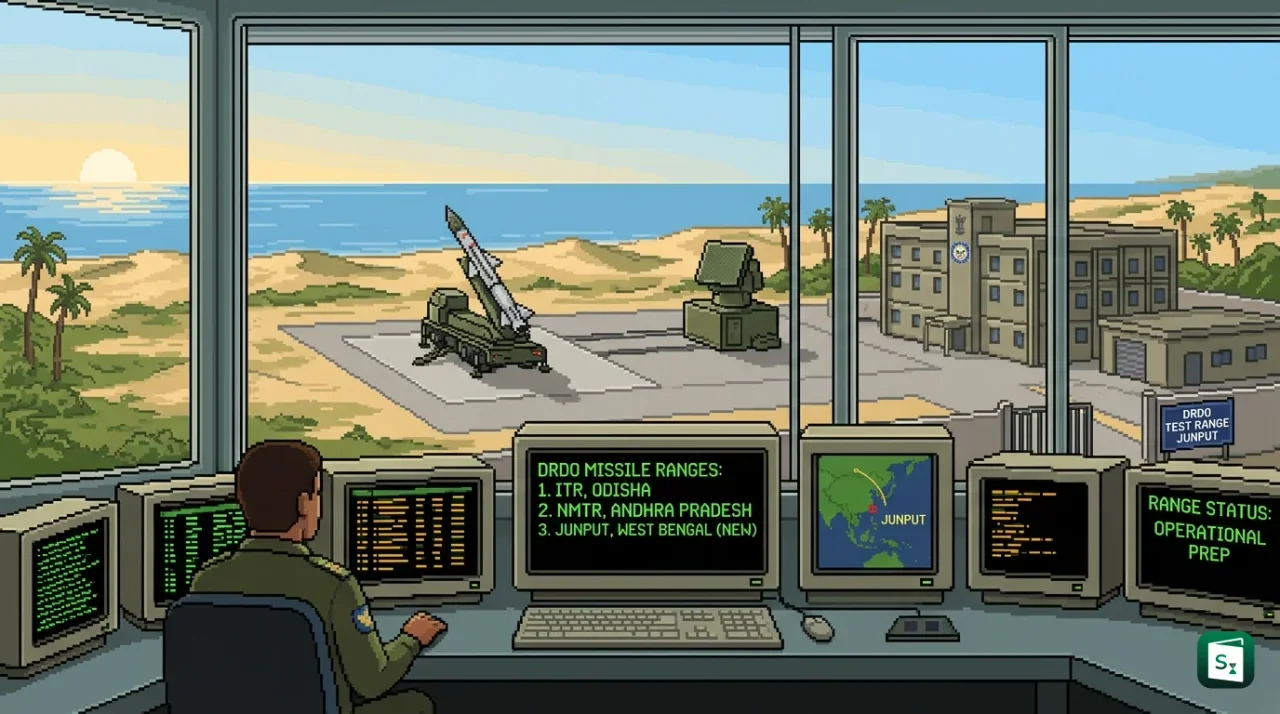
The West Bengal government has approved the Defence Research and Development Organisation (DRDO) proposal to set up a new weapon and missile testing range at Junput village in Purba Medinipur district on the Bay of Bengal coast. The Junput facility will become the third major missile testing hub for DRDO, easing the heavy workload on the Integrated Test Range (ITR) at Chandipur in Odisha. It will complement the two existing eastern coast nodes, the ITR in Odisha and the upcoming Navdurga Missile Test Range (NMTR) at Nagayalanka in Andhra Pradesh.
What Has Been Approved at Junput?
The West Bengal government has cleared the Defence Research and Development Organisation (DRDO) proposal to establish a weapon and missile testing range at Junput village in Purba Medinipur district. Chief Minister Suvendu Adhikari confirmed in September 2026 that the state had responded to a pending DRDO communication and granted approval, describing the project as important for the state’s development and for national defence infrastructure. DRDO had first proposed the Purba Medinipur coastal site in April 2024 to complement the overloaded Integrated Test Range (ITR) at Chandipur in Odisha, but the proposal did not move forward under the previous state administration.
DRDO sources have confirmed that the Junput facility is now back on track as a priority eastern seaboard hub. The new range is planned on 8.73 acres of coastal land at Junput and is designed as an additional operational area for the ITR at Chandipur, rather than a fully independent national range. It will function as an extension node to share testing workload. Administrative approval from the state allows DRDO to advance statutory processes, including environmental clearance from the Ministry of Environment, Forest and Climate Change, Coastal Regulation Zone clearances, and consultations with local communities and fisheries groups.
Local concerns had earlier stalled progress. Fishing groups and cooperatives near the coast had raised issues about access to traditional fishing grounds and the impact of exclusion zones during tests. The state government indicated that earlier bottlenecks have been resolved and that work on hard standings and approach roads would resume. According to earlier disclosures, testing protocols will involve temporary evacuation of residents within a one kilometre radius during launches, with compensation and shelter arrangements, along with standard NOTAM and NAVAREA notifications to clear air and sea routes.
Where Is Junput and Why Does Its Location Matter?
Junput is a coastal village in Deshapran Community Development Block in Contai subdivision of Purba Medinipur district in West Bengal. It lies on the Bay of Bengal coast, about 40 km from Digha, 9 km from Contai (Kanthi), and 177 km from Kolkata by coastal route (about 145 km by road via Mecheda and Contai), within the northern Bay of Bengal coastal belt that stretches from Odisha to the Sunderbans.
The location gives DRDO a direct eastward sea corridor for missile flight tests. Like Chandipur, a Bay of Bengal coastline offers a wide, unobstructed trajectory over the sea, which keeps tests away from populated areas and allows precise tracking of the entire flight from launch to impact. Junput sits only about 70 to 74 km by air from Chandipur (about 133 km by road), a proximity that is strategically deliberate.
DRDO officials have explained that Junput together with the existing Chandipur to Dr APJ Abdul Kalam Island corridor will extend the available over sea testing range to about 150 km. At present, the air distance between Chandipur Launch Complex III and Kalam Island Launch Complex IV is also about 74 km, which limits trials that need a larger engagement envelope. An additional node at Junput provides more geometry for positioning tracking radars, telemetry and electro optical systems.
Junput Beach and Bay of Bengal Coastal Context
Junput Beach is known as a quiet, relatively unspoilt beach lined with casuarina trees, mudflats and sandy ridges shaped by tides and coastal erosion. The state fisheries department conducts brackish water fish cultivation and research there, and accommodation is limited to a fisheries inspection bungalow and small private hotels. This low density, open coastal character, along with the mesotidal conditions of the northern Bay of Bengal, made the site attractive for a controlled test corridor, even as planners must account for cyclones, heavy sea breeze and coastal erosion that affect this stretch of the West Bengal coast two to three times a year.
How Many Missile Testing Ranges Does India Have?
India currently has one fully operational Integrated Test Range (ITR) with two launch complexes, and two additional major hubs under development that will take the total to three distinct missile testing geographies.
The Defence Research and Development Organisation (DRDO), formed in 1958 by merging the Technical Development Establishment, the Directorate of Technical Development and Production and the Defence Science Organisation and headquartered at DRDO Bhawan in New Delhi (as of September 2026 the Chairman is Rajesh Kumar Singh holding additional charge), is the agency responsible for all three.
| Testing Hub | Location | Status (as of September 2026) | Primary Role |
|---|---|---|---|
| Integrated Test Range (ITR) | Balasore district, Odisha, Launch Complex III at Chandipur-on-Sea and Launch Complex IV on Dr APJ Abdul Kalam Island off Dhamra coast | Fully operational since 1982 | National missile test and evaluation centre for short and long range systems |
| Navdurga Missile Test Range (NMTR) | Nagayalanka (Gullalamoda village), Krishna district, Andhra Pradesh near Machilipatnam at the Krishna River and Bay of Bengal confluence | Under development, foundation stone laid by Prime Minister in May 2025, cost about ₹1,460 crore, Cabinet Committee on Security approved in October 2024 | Strategic and Ballistic Missile Defence Phase II interceptor trials, tactical missiles |
| Junput Range | Junput, Purba Medinipur, West Bengal on Bay of Bengal | State approved in September 2026, planned as 8.73 acre additional operational area for ITR Chandipur | Short range tactical missiles, surface to air systems, radar and weapon system trials |
Beyond these main hubs, DRDO also operates a Floating Test Range at sea and an Aeronautical Test Range at Chitradurga in Karnataka for airborne systems, but the three coastal nodes form the core missile flight test infrastructure.
What Is the Integrated Test Range and How Is It Organised?
The Integrated Test Range (ITR) is DRDO’s principal test and evaluation centre for rockets, missiles and airborne weapon systems. Established in 1982 as a project under the Integrated Guided Missile Development Programme (IGMDP) and initially called the Interim Test Range, it was renamed ITR in 2003. It is located in Balasore, Odisha, about 200 km from both Kolkata and Bhubaneswar, and is headed by a Director (as of September 2026 Shri K. Suchendar is listed as Director).
The ITR provides safe and reliable launch facilities and deploys a network of Electro Optical Tracking Systems (EOTS), tracking radars, telemetry systems and a central computer system to measure precise location and health parameters of a flight vehicle throughout its trajectory. All tests require real time tracking, data capture, range safety and countdown control from a central control centre, with down range stations, including ship based stations, extending coverage beyond the horizon.
Integrated Test Range Chandipur and Dr APJ Abdul Kalam Island Explained
The Integrated Test Range operates two main launch complexes:
Launch Complex III at Chandipur-on-Sea in Balasore district is the coastal pad used largely for short range and tactical systems. Missiles such as Prithvi, Akash, Astra, Pinaka, Nag and Trishul and other surface to air and tactical weapons have been tested from this complex, along with pilotless target aircraft like Lakshya and remotely piloted vehicles.
Launch Complex IV on Dr APJ Abdul Kalam Island is the island based complex used for long range and strategic trials. The island was formerly known as Wheeler Island, named after British commandant Lieutenant Hugh Wheeler, and was renamed Dr APJ Abdul Kalam Island on 4 September 2015 to honour former President Dr A. P. J. Abdul Kalam, who was also the first Director of the ITR in 1982. The island is about 2 km long, 390 acres in area, lies about 10 km off the eastern coast in the Bay of Bengal, about 70 km south of Chandipur and 150 km east of Bhubaneswar in Bhadrak district near Dhamra Port. It is accessed by ship and has a helipad and a railway line to move missile components. Tests of long range systems such as the Agni series including Agni 5, K series submarine launched missiles, BrahMos, Nirbhay, Shaurya, Advanced Air Defence and Prithvi Air Defence systems are conducted here.
The ITR history traces to the early search for a dedicated test site for the Agni programme. After the first Agni test on 22 May 1989 from Chandipur and the abandonment of the proposed National Test Range at Baliapal in 1995, Launch Complex IV was built on the Wheeler Island group leased for 99 years to DRDO. The first test from the island, a Prithvi missile on 30 November 1993 with an accuracy of 27 metres, is commemorated by the Prithvi Point granite memorial on the island.
What Is the Navdurga Missile Test Range at Nagayalanka?
The Navdurga Missile Test Range (NMTR) is the second new hub being developed at Gullalamoda village in Nagayalanka mandal, Krishna district, Andhra Pradesh, near Machilipatnam where the Krishna River meets the Bay of Bengal. The project requires more than 260 to 300 acres of coastal land.
The Union Government announced the Machilipatnam Test Range concept as early as 2012, held a ground breaking ceremony in August 2019 with then Defence Minister Rajnath Singh and Chief Minister Y. S. Jagan Mohan Reddy, and the Cabinet Committee on Security approved the proposal on 10 October 2024. Prime Minister Narendra Modi laid the foundation stone in May 2025 for a facility costing about ₹1,460 crore, comprising a launch centre, technical instrumentation facilities, indigenous radars, telemetry and electro optical systems.
Unlike the coastal Junput extension, Nagayalanka offers different testing geometry. While Junput mainly adds capacity for short range and radar trials to relieve Chandipur, NMTR is central to DRDO’s Phase II Ballistic Missile Defence (BMD) programme. Phase II aims to intercept more sophisticated and longer range incoming ballistic missiles. Such trials need a target missile and an interceptor to be launched on carefully designed trajectories and tracked by multiple sensors. The Nagayalanka location, with its inland and coastal characteristics, allows new flight geometries and validation of advanced radar networks and telemetry that cannot be replicated at Chandipur alone.
How Are Missiles Tested?
Missile testing is the structured evaluation of a flight vehicle to verify its design, guidance, propulsion and accuracy before it is accepted for service. The DRDO testing process combines ground checks, flight trials and post flight analysis under strict range safety control.
A typical flight test unfolds in four stages. In ground tests, sub systems undergo developmental tests, hardware in loop simulation, pre integration checks and launch pad checks. In pre mission activities, range instrumentation is deployed, including tracking radars in S or C band, Electro Optical Tracking Systems using infrared image processing, telemetry stations, telecommand and central timing systems, all linked by a reliable communication network. A countdown document defines every event, hold procedure and range clock synchronisation. During mission execution, the missile is tracked from lift off to splashdown by multiple stations. EOTS provides passive infrared tracking using triangulation from at least three sites, radars provide active skin or transponder tracking at longer ranges, and telemetry relays health data such as velocity, temperature, pressure and inertial navigation data. NOTAM and NAVAREA warnings clear the airspace and sea lanes. Down range ships extend coverage beyond the curvature of the earth. In post mission work, data from all sensors is processed by the Range Central Computer to reconstruct trajectory and system performance and is handed to designers for defect investigation or design refinement, even when a test fails to hit the target.
Tests at ITR follow a clear division of labour. A target missile is often launched from Launch Complex III at Chandipur, while an interceptor is fired from Launch Complex IV on Dr APJ Abdul Kalam Island, a pattern that explains why a larger corridor such as the Junput extension is needed for long range interception scenarios involving the Advanced Air Defence (AAD) system and other interceptors.
Why Does India Need a Third Missile Testing Hub?
The Integrated Test Range at Chandipur has handled the bulk of India’s missile trials for more than four decades, from Prithvi and Agni in 1989 to recent Agni 5 tests with ranges over 5,000 km in August 2025 and August 2026. The volume has grown sharply as DRDO develops Akash, Astra, BrahMos, Nag, Nirbhay, Prahaar, Shaurya, SMART, Pralay, Very Short Range Air Defence Systems, Quick Reaction Surface to Air Missiles and hypersonic programmes alongside air defence interceptors. A single coastal corridor cannot provide enough launch windows and tracking geometries.
Junput addresses this congestion directly. It will absorb short range tactical missiles, surface to air systems, multi barrel rocket launchers such as Pinaka, and radar equipment tests, freeing Chandipur and Kalam Island for long range strategic trials. By adding a node about 70 km away, DRDO gains flexible launch and interception geometries, can position tracking assets differently, and can test scenarios that require engagement distances longer than the present 74 km Chandipur to Kalam Island envelope.
The expansion also reflects geography. India’s eastern coast from Odisha to Andhra Pradesh and West Bengal offers the safest over sea flight corridors. Distributing ranges along this 1,000 km plus seaboard improves resilience, allows simultaneous test campaigns, reduces downtime caused by weather or sea state at one site, and provides distinct coastal, island and river delta environments for validating indigenous sensors. For West Bengal, the project brings defence infrastructure, technical instrumentation facilities and associated development to Purba Medinipur, a district otherwise known for tourism and fisheries.
The Way Forward
State approval is only the first step. The DRDO Junput facility must now secure final environmental and coastal zone clearances, complete detailed land surveys and build launch infrastructure, instrumentation pockets, blockhouses, communication networks and road connectivity. Coordination with fisheries stakeholders, civil aviation authorities and maritime agencies to define exclusion zones will determine how smoothly regular test windows can be scheduled.
If completed on schedule, Junput will operate as an integrated extension of the Chandipur ITR network, sharing tracking and telemetry resources. Together with the Nagayalanka Navdurga range, it will give India three complementary geometries, coastal, island and delta, for missile and air defence validation. That diversity will be critical for accelerating trials of next generation interceptors, hypersonic vehicles and tactical systems that demand complex trajectories and layered sensor coverage.
Key Takeaways
- The West Bengal government approved in September 2026 the DRDO proposal for a new weapon and missile testing range at Junput in Purba Medinipur district on the Bay of Bengal coast.
- The Junput facility will be the third major missile testing hub for DRDO, planned on 8.73 acres as an additional operational area for the Integrated Test Range at Chandipur, not a standalone national range.
- The Integrated Test Range (ITR) in Odisha, established in 1982 and renamed in 2003, operates Launch Complex III at Chandipur and Launch Complex IV on Dr APJ Abdul Kalam Island, formerly Wheeler Island renamed on 4 September 2015.
- The Navdurga Missile Test Range (NMTR) at Nagayalanka (Gullalamoda village), Krishna district, Andhra Pradesh, was approved by the Cabinet Committee on Security on 10 October 2024 and its foundation stone was laid in May 2025 with an investment of about ₹1,460 crore.
- Junput lies about 70 to 74 km by air from Chandipur and about 177 km from Kolkata, and will extend the over sea testing corridor to about 150 km for longer interception trials.
- DRDO, formed in 1958 and headquartered at DRDO Bhawan in New Delhi, conducts missile testing using EOTS, tracking radars, telemetry and central timing systems with NOTAM and NAVAREA clearances for range safety.