India hosted the 18th BRICS Summit on 12 and 13 September 2026 at Bharat Mandapam in New Delhi under its 2026 chairship theme “Building for Resilience, Innovation, Cooperation and Sustainability”. The two day gathering brought together leaders and delegations from 11 member countries, 10 partner countries and outreach invitees, and closed with the unanimous adoption of the New Delhi Declaration. Alongside the declaration, the summit launched a suite of new initiatives on health surveillance, logistics, startups and energy, and marked 20 years of BRICS cooperation from 2006 to 2026 with commemorative postage stamps.
What Is BRICS and Why Was It Formed?
BRICS stands for Brazil, Russia, India, China and South Africa, later expanded to 11 members. It is an intergovernmental grouping of emerging economies formed in 2006 as BRIC and renamed BRICS in 2011 after South Africa joined, to promote cooperation on economic, political and cultural issues and to push for a more balanced global order.
The BRICS acronym was first coined in 2001 by economist Jim O’Neill of Goldman Sachs to describe four fast growing economies with potential to dominate the global economy by 2050. The governments of Brazil, Russia, India and China turned this idea into a diplomatic forum with their first summit in Yekaterinburg, Russia in 2009. South Africa attended as a guest in 2010 and became a full member at the 2011 Sanya Summit in China, which added the letter S. BRICS is often described as a platform of the Global South that seeks greater representation for emerging markets and developing countries in global decision making.
Is BRICS an International Organisation and Where Is Its Headquarters?
BRICS is not a treaty-based formal international organisation with a charter. It has no headquarters and no permanent secretariat. The chair rotates annually among members, and that chair sets the agenda and hosts the summit, which is the central decision making event. This informal but structured model lets BRICS coordinate without a fixed bureaucracy.
Its most important institution is the New Development Bank (NDB), established through an agreement signed at the Fortaleza Summit in 2014 and headquartered in Shanghai, China. The NDB became operational in 2016, with an initial authorised capital of $100 billion and initial subscribed capital of $50 billion, with $10 billion contributed by each of the five founding members. The bank funds sustainable infrastructure and development projects and is complemented by the Contingent Reserve Arrangement (CRA) for liquidity support. A regional office of the NDB is located in Johannesburg, South Africa, for Africa operations.
When Was BRICS Established and Why Is It Important?
BRICS was established as a foreign ministers meeting on the margins of the United Nations General Assembly in 2006, moving to annual leader summits from 2009. It was formed to increase coordination among large emerging economies, reform global governance, and provide an alternative voice to Western dominated institutions such as the International Monetary Fund (IMF) and the World Bank, both headquartered in Washington, D.C.
BRICS matters because its members together represent about 45 percent of the world population, about 40 percent of global gross domestic product on a purchasing power basis, and a large share of world trade and energy resources after the 2024 to 2025 expansion. For members, the grouping offers a channel to push for United Nations Security Council reform, fairer financial rules, development finance through the NDB, and practical cooperation in health, agriculture, energy and technology.
What Is the BRICS Summit 2026 and Where Was It Held?
The BRICS Summit 2026 is the 18th BRICS Leaders Summit, the annual head of state level meeting of the grouping. The 2026 edition was held on 12 and 13 September 2026 at Bharat Mandapam, the India Trade Promotion Organisation convention centre at Pragati Maidan in New Delhi, which also hosted the G20 Summit in 2023.
India assumed the BRICS Chair in 2026 on 1 January 2026 for the fourth time after 2012, 2016 and 2021. The chairship theme was “Building for Resilience, Innovation, Cooperation and Sustainability”, reflecting a people centric approach rooted in “Humanity First”. The theme was built on four pillars, resilience against crises, innovation led growth, deeper cooperation, and sustainability. Under India’s chairship, more than 350 meetings and engagements were held across more than 25 cities in India, covering three broad pillars of BRICS cooperation, political and security, economic and financial, and cultural and people to people exchanges.
Host Country, Venue and Key Dates
| Detail | Fact |
|---|---|
| Summit edition | 18th BRICS Summit |
| Host country | India |
| Dates | 12 to 13 September 2026 |
| Venue | Bharat Mandapam, New Delhi |
| Theme | Building for Resilience, Innovation, Cooperation and Sustainability |
| Chairship | India’s 4th chairship, assumed on 1 January 2026 |
| Logo element | Lotus with petals in colours of all members and a Namaste gesture at the centre |
Bharat Mandapam, inaugurated in 2023, is India’s largest convention centre for leader level summits. On 12 September, leaders held a closed session on inclusive global governance and strengthening multilateralism, visited the Bharat Innovates Exhibition, posed for a family photograph and attended a gala dinner. On 13 September, partner countries and outreach invitees joined a session titled “Resilience, Innovation, Cooperation and Sustainability: Shaping the Future for Inclusive Global Growth”. Attendance included Russian President Vladimir Putin, Chinese President Xi Jinping, Iranian President Masoud Pezeshkian and UAE Crown Prince Sheikh Khaled bin Mohamed bin Zayed Al Nahyan, with Brazil represented by Foreign Minister Mauro Vieira and Saudi Arabia by Foreign Minister Prince Faisal bin Farhan Al Saud, alongside United Nations Secretary General Antonio Guterres and heads of the World Trade Organization and World Health Organization.
How Did BRICS Expand and Who Are Its Members Today?
BRICS began with four members in 2009 and became five with South Africa in 2011. A second major expansion was decided at the Johannesburg Summit in August 2023, implemented from January 2024, and further extended in January 2025, taking the grouping to 11 full members and adding a new partner country category from 2024.
The expansion added large energy producers and populous emerging economies, broadening the grouping’s geographic and economic weight. Members commit on paper to support United Nations Security Council reform and not to impose unauthorised sanctions on fellow members, though political differences remain. Informally the expanded grouping is often called BRICS Plus or BRICS+.
| Category | Countries | Effective Date |
|---|---|---|
| Original four (BRIC) | Brazil, Russia, India, China | 2009 |
| First expansion | South Africa | 2011 |
| Second expansion | Egypt, Ethiopia, Iran, United Arab Emirates | January 2024 |
| Special case | Saudi Arabia invited in 2023, participation as full member evolving through 2024 and represented at 2026 summit at foreign minister level | 2024 |
| Latest full member | Indonesia, first Southeast Asian member | January 2025 |
| Partner countries (10) | Belarus, Bolivia, Kazakhstan, Cuba, Malaysia, Nigeria, Thailand, Uganda, Uzbekistan, Vietnam | 2025 |
As of September 2026, BRICS therefore comprises 11 full members and 10 partner countries. Partner status allows participation in selected meetings and the Outreach and BRICS Plus Dialogue without full voting rights. This enlarged footprint means the grouping now spans South America, Europe, Africa, West Asia and Asia, strengthening its claim to speak for the wider Global South and Emerging Markets and Developing Countries (EMDCs).
What Are BRICS Partner Countries and BRICS Plus?
BRICS Partner countries are states that engage regularly with BRICS but are not full members. The concept was approved at the Kazan Summit in October 2024 under the theme “Strengthening Multilateralism for Fair Global Development and Security”, which also finalised membership procedures. BRICS Plus is a broader outreach format where invitees from international organisations and regional groups join summit dialogues, as India did at the 2026 summit with heads of the United Nations, World Trade Organization, World Health Organization and New Development Bank President Dilma Rousseff (as of September 2026).
What Happened at the 18th BRICS Summit in New Delhi?
The 18th BRICS Summit focused on turning dialogue into deliverables. Leaders reviewed progress on over 350 engagements held during India’s chairship and set direction for cooperation across the three traditional pillars, political and security, economic and financial, and cultural and people to people ties, anchored in the four chairship pillars of Resilience, Innovation, Cooperation and Sustainability.
On the first day, the leaders of full member states met in a closed session on Inclusive Global Governance and Strengthening Multilateralism, toured the Bharat Innovates Exhibition showcasing technologies from member states, and joined a tree planting ceremony. Intensive negotiations reportedly continued late into the night to secure consensus on the final declaration after divisions over West Asia language at the earlier foreign ministers meeting. The summit concluded with the unanimous adoption of the New Delhi Declaration, a 45 page document with 140 points, and India’s announcement that China will hold the 19th BRICS Summit in 2027 as the next chair.
The summit also served as a diplomatic stage for bilateral meetings, most watched was the meeting between Prime Minister Narendra Modi and President Xi Jinping, their first on Indian soil since the 2020 Galwan Valley clash and their first since meeting in Kazan in 2024. Other engagements included meetings with Russia, Iran and other delegations, plus business and youth track events leading into the leaders summit.
Major Initiatives Launched at the Summit
India’s chairship emphasised practical, development oriented outcomes rather than only political statements. Eight interlinked initiatives were highlighted at the leaders level and in ministerial tracks that fed into the summit. Each is designed to be implemented through existing ministerial working groups and to be open to voluntary participation by members.
BRICS Integrated Early Warning System for Infectious Diseases
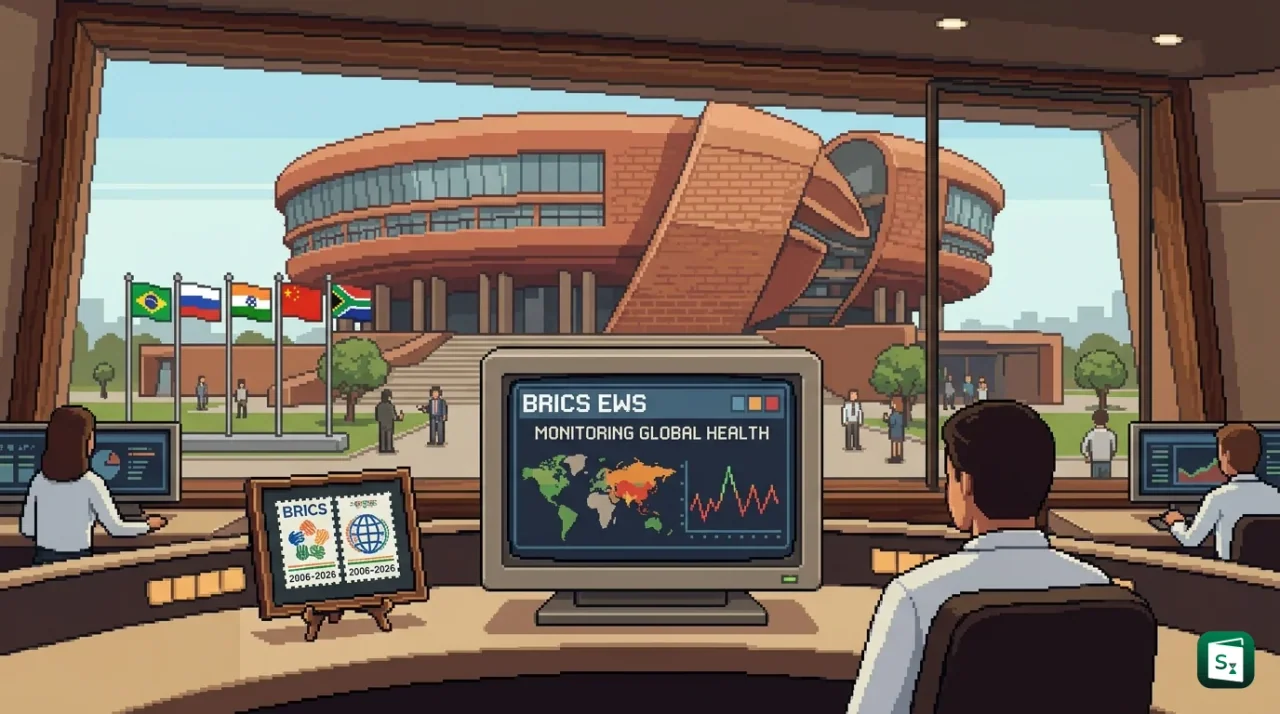
The BRICS Integrated Early Warning System (EWS) for Prevention and Response to Mass Infectious Diseases was the flagship health outcome. BRICS health ministers had already welcomed the creation of a dedicated Sub Working Group on the EWS and adopted its Terms of Reference before the summit, with endorsement by leaders in New Delhi. The system will link national public health institutes, strengthen disease surveillance and information sharing, and coordinate preparedness and rapid response across members. Leaders also agreed on Early Warning Data Integration Guidelines for broader disaster management, and welcomed an operational framework for the BRICS Network of National Public Health Institutes and for cooperation on social determinants of health (DD-SDH). A complementary BRICS Compendium on Digital Health Architecture for Continuum of Care was released as a knowledge resource for remote area access.
BRICS Logistics Supply Chain Cooperation Framework
The BRICS Logistics Supply Chain Cooperation Framework aims to make supply chains more reliable and resilient at a time of pandemic aftershocks and geopolitical disruptions. It will promote policy coordination, sharing of logistics standards, and diversification of supply routes among members. Leaders linked the framework to food, energy and medical supply security, noting that resilient chains are vital for sustainable development and inclusive growth.
Startup Innovation Fund, Incubator Network and Knowledge Hub
On innovation, leaders welcomed the creation of the BRICS Incubator Network and further consideration of a BRICS Startup Innovation Fund to catalyse startup growth. The Tenth BRICS Industry Ministers Declaration, adopted on 6 August 2026, had already set out an Action Plan on Innovation led Growth by Startups. The BRICS Startup Knowledge Hub and BRICS Startup Forum were strengthened as platforms for policy and market intelligence sharing. Together, the network, hub and proposed fund will connect startups, incubators, investors and mentors across members, with special attention to scalable solutions for the Global South.
Support for MSMEs, Smart Grids and Urban Mobility
Four additional platforms reinforce small enterprise and infrastructure cooperation. The BRICS MSME Cooperation Portal will connect micro, small and medium enterprises with technology centres, industry clusters, trade associations, financial institutions and policymakers to help them access markets, finance and support networks. A dedicated BRICS MSME Forum concept is being advanced as a permanent dialogue body. In energy, the BRICS Digital Centre of Excellence (DCoE) for Smart Grids and Energy Storage, launched at the 11th BRICS Energy Ministers Meeting in Gurugram, Haryana, serves as a forum for joint projects, skill building and sharing of best practices on modern electricity networks that use digital communications, sensors and analytics, along with battery and pumped storage solutions. Progress is also linked to the BRICS Energy Research Cooperation Platform (ERCP). For cities, the Urban Mobility Hub (UMH) and a related BRICS Urbanization Forum will share urban transport and planning solutions, while leaders endorsed BRICS CONNECT, a cooperation network for capacity building, employability and new skills including digital public infrastructure and a BRICS Virtual Liaison Office (VLO) for social security.
Centres of Excellence for Agro-Ecology and Other Outcomes
In agriculture, members agreed to establish Centres of Excellence (CoEs) for Agro-Ecology and Regenerative Agriculture and a BRICS Network on Digital Agriculture that will integrate artificial intelligence (AI), geospatial intelligence, Internet of Things monitoring and data analytics with farmer needs. Other working group outcomes include terms of reference for photovoltaic industry cooperation, advances in science, technology and innovation, and labour and employment cooperation focused on skills forecasting in digital, green and care sectors. India also proposed hosting a BRICS Risk Lab at GIFT City International Financial Services Centre (IFSC) in Gujarat to develop common risk models and build reinsurance capacity with voluntary participation of regulators and firms.
Highlights: Commemorative Stamps and China’s 5-Point Action Plan
Two symbolic announcements drew particular attention. Prime Minister Narendra Modi released two commemorative postage stamps titled “BRICS: Two Decades of Cooperation, 2006 to 2026” to mark the 20th anniversary of the forum since the first foreign minister level meeting in 2006. The stamps celebrate the journey from an economic concept to an 11 member grouping that hosts a major summit every year. In India, commemorative stamps are issued by India Post, which functions under the Ministry of Communications.
Chinese President Xi Jinping proposed a 5-point action plan for deeper BRICS cooperation, which includes creation of an open source AI community among BRICS members. The proposal aligns with growing discussion inside BRICS on artificial intelligence governance, digital public infrastructure and equitable access to technology. Leaders in the New Delhi Declaration recognised that AI presents immense opportunities to stimulate economic growth and sustainable development for all, while also requiring cooperative governance frameworks.
Other summit side events included the BRICS Business Forum, BRICS Youth Summit 2026, BRICS Health Ministers Meeting 2026, BRICS Agriculture Ministers Meeting, and the BRICS Urbanization Forum, whose outcomes were fed into the leaders declaration.
The New Delhi Declaration: Core Messages and India’s Role
The New Delhi Declaration, titled “Building for Resilience, Innovation, Cooperation and Sustainability”, was adopted unanimously on 12 September 2026 after negotiations that continued until the early hours of the summit. Leaders reiterated the BRICS spirit of mutual respect, sovereign equality, solidarity, democracy, openness, inclusiveness, collaboration and consensus.
Key messages from the 140 point declaration include:
- Commitment to reforming global governance and strengthening multilateralism and multipolarity, with calls for greater representation of emerging markets, developing countries and least developed countries in decision making structures, including the United Nations Security Council, the IMF and the World Bank.
- Support for international law, preventive diplomacy, mediation with consent of parties, and settlement of disputes through dialogue and diplomacy in line with the United Nations Charter, with expressions of concern over escalating tensions in West Asia and Sudan.
- Reaffirmation of zero tolerance for terrorism and rejection of double standards, with the statement that terrorism should not be associated with any religion, nationality, civilisation or ethnic group, and emphasis on condemnation of the April 2025 Pahalgam terror attack.
- Recognition of the need for balanced and diversified energy mixes reflecting national circumstances, covering renewable energy, bioenergy, fossil fuels, nuclear, hydropower, hydrogen, low carbon technologies and energy storage, and commitment to resilient energy supply chains.
- Endorsement of people to people cooperation, respect for cultural diversity, and full support for China’s BRICS presidency in 2027 and the holding of the 19th BRICS Summit in China.
Prime Minister Modi described the declaration as reflecting a BRICS that is “wider in reach and stronger in purpose”, focused on innovation, sustainability and people to people ties that make cooperation more practical and development oriented. He also cautioned against the weaponisation of technology and critical minerals, saying such actions hinder shared progress and that BRICS should develop solutions for the Global South. The declaration commended India for injecting new impetus into ties and solidarity through over 350 meetings and the inclusion of outreach partners.
Is a BRICS Currency Coming?
The idea of a BRICS currency is frequently discussed but no common currency was launched at the 2026 summit. BRICS leaders have discussed options such as a shared payment system, use of national currencies for intra BRICS trade, and linkages of payment systems and central bank digital currencies, with the Reserve Bank of India noting conversations on these lines. The focus in New Delhi remained on financial cooperation, de risking supply chains and exploring reinsurance capacity rather than announcing a single currency.
BRICS vs G7 and Other Groupings: How Does BRICS Compare?
Comparisons between BRICS and the Group of Seven (G7) are search heavy because both shape global economic governance but differ in composition and approach.
| Feature | BRICS | G7 |
|---|---|---|
| Members | 11 full members plus 10 partners, all emerging or large developing economies | 7 advanced economies: Canada, France, Germany, Italy, Japan, United Kingdom, United States plus the European Union as a non enumerated member |
| Founded | Foreign ministers meeting 2006, first summit 2009 | Founded as G6 in 1975, became G7 in 1976 |
| Headquarters | No headquarters, rotating chair | No headquarters, rotating presidency |
| Economic weight | About 45 percent of world population, about 40 percent of global GDP on PPP basis after expansion | About 10 percent of population but about 40 percent of nominal global GDP |
| Core institution | New Development Bank in Shanghai | Development finance mainly through World Bank, IMF and bilateral aid |
| Focus | Reform of global institutions, South South cooperation, practical sectoral platforms | Coordination of advanced economy policies, rules based order, sanctions regimes |
Differences also exist with BRICS vs NATO and BRICS vs Quad. NATO is a military alliance founded in 1949 and headquartered in Brussels, Belgium, focused on collective defence. The Quad, formally the Quadrilateral Security Dialogue of India, United States, Japan and Australia, is a strategic dialogue focused on a free and open Indo Pacific. BRICS, by contrast, is primarily an economic and diplomatic coordination forum that avoids becoming a military bloc and emphasises development cooperation.
Why Is the 2026 Summit Important for India and the World?
The 2026 summit is important for three reasons, institutional, substantive and geopolitical. Institutionally, it was India’s fourth BRICS chairship and the first to manage an 11 member BRICS plus 10 partners, testing India’s capacity to build consensus, as seen in the late night negotiations that preserved a unanimous declaration. Substantively, the summit shifted BRICS from communiques to kits, early warning data integration, logistics standards, incubator networks, MSME portals, smart grid tools and agro digital networks that can be used by administrations and businesses.
Geopolitically, the summit reinforced calls for inclusive global governance at a time when supply chain weaponisation, health shocks and climate stresses are spilling across borders. India used the platform to highlight that pandemics, climate disasters and logistics disruptions prove no crisis remains confined to one region, and to project its Humanity First vision of BRICS as an ecosystem of solutions rather than only a grouping of countries. The summit also aligned with wider technology cooperation where India is advancing digital public infrastructure (DPI), AI for agriculture and smart meter rollouts, reflecting lessons from its G20 presidency in 2023.
Key Takeaways
- The 18th BRICS Summit was held on 12 to 13 September 2026 at Bharat Mandapam, New Delhi under India’s theme Building for Resilience, Innovation, Cooperation and Sustainability.
- BRICS stands for Brazil, Russia, India, China and South Africa, formed as BRIC in 2006 and renamed BRICS after South Africa joined in 2011, and now has 11 full members and 10 partner countries after the 2024 to 2025 expansion.
- BRICS has no headquarters or secretariat, the chair rotates annually, and its key institution is the New Development Bank headquartered in Shanghai, China, operational since 2016.
- The summit launched the BRICS Integrated Early Warning System for infectious diseases, a Logistics Supply Chain Cooperation Framework, a BRICS Incubator Network with a proposed Startup Innovation Fund, an MSME Cooperation Portal, a Digital Centre for Smart Grids and Energy Storage in Gurugram, an Urban Mobility Hub and CoEs for Agro-Ecology.
- Prime Minister Narendra Modi released two commemorative stamps for “BRICS: Two Decades of Cooperation, 2006 to 2026”, while Chinese President Xi Jinping proposed a 5-point action plan including an open source AI community.
- The New Delhi Declaration, a 45 page, 140 point document, was adopted unanimously and endorsed support for China’s 2027 BRICS presidency and the 19th summit in China.