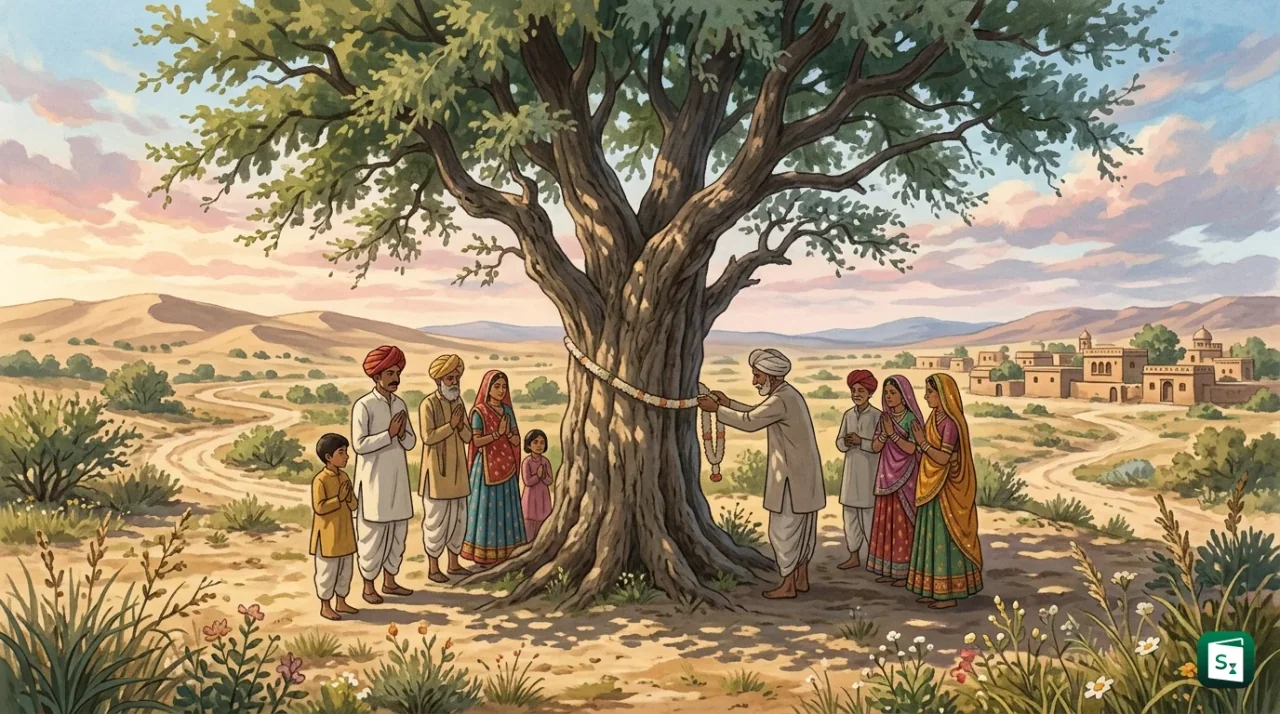
India observes National Forest Martyrs Day, also called Shaheed Van Diwas or Rashtriya Van Shaheed Diwas, every year on September 11 to honour forest personnel who gave their lives protecting forests and wildlife. The Ministry of Environment, Forest and Climate Change (MoEFCC) declared this observance in 2013, choosing the date to recall the Khejarli massacre of 1730 in Rajasthan where 363 Bishnois led by Amrita Devi Bishnoi died protecting Khejri trees. The day connects a nearly 300 year old act of non violent sacrifice with the present day risks faced by frontline forest staff across India.
What Is National Forest Martyrs Day?
National Forest Martyrs Day is a commemorative observance held on September 11 to pay tribute to forest officers, guards, and other personnel who lost their lives while protecting forests and wildlife in India. The Ministry of Environment, Forest and Climate Change (MoEFCC), the nodal agency for environmental and forestry policies headquartered in New Delhi, declared the day in 2013 to institutionalise national remembrance for forest martyrs.
The observance has a dual purpose. It honours contemporary martyrs who died due to wildlife attacks, forest fires, encroachment conflicts, and anti poaching operations, and it recalls the historic sacrifice of the Bishnoi community at Khejarli as the moral foundation of forest conservation in India. Unlike festivals or celebratory days, National Forest Martyrs Day is observed as a solemn tribute, with memorial ceremonies, wreath laying, gun salutes, and reading of names of those who died in the line of duty.
When Is National Forest Martyrs Day Observed and Why September 11?
National Forest Martyrs Day is observed every year on September 11 in India. The Government of India through the Ministry of Environment, Forest and Climate Change chose this date in 2013 because on September 11, 1730, soldiers of Maharaja Abhay Singh of Marwar killed 363 Bishnois at Khejarli village near Jodhpur for protecting Khejri trees.
The choice of date links modern forest protection with India’s earliest recorded environmental martyrdom. The year 2013 marks the formal starting point, but the memory it invokes is almost three centuries old. Observance on September 11 ensures that both strands, present day duty related deaths and the historic Khejarli sacrifice, are remembered together. The day is also referred to locally as Van Shahid Diwas and in Hindi as Rashtriya Van Shaheed Diwas, and the phrase Van Diwas is commonly used in school programmes and forest department events held around this date.
National Forest Martyrs Day is distinct from other forest related observances such as International Day of Forests on March 21, which celebrates forests globally, and World Environment Day on June 5. While those days focus on awareness and action, September 11 is specifically about martyrdom and remembrance.
What Was the Khejarli Sacrifice of 1730?
The Khejarli sacrifice was the killing of 363 Bishnois in September 1730 at Khejarli village near Jodhpur, Rajasthan, when they hugged Khejri trees to stop soldiers of Maharaja Abhay Singh from felling them. Led by Amrita Devi Bishnoi, villagers offered their lives one by one for each tree, creating India’s first recorded non violent environmental resistance.
Who Was Amrita Devi Bishnoi?
Amrita Devi Bishnoi was a Bishnoi woman from Khejarli, then part of the kingdom of Marwar under Maharaja Abhay Singh. She lived with her three daughters, Asu, Ratni and Bhagu Bai, and is remembered as India’s first environmental martyr. On a Tuesday in the month of Bhadrapad in September 1730, when a royal party led by Giridhar Das Bhandari, the Maharaja’s minister or Hakim, arrived to cut green Khejri trees (Prosopis cineraria) to burn lime for a new palace, Amrita Devi confronted the soldiers.
Cutting green trees violates the core tenets of the Bishnoi faith, which forbids felling living trees and killing animals. When the soldiers demanded a bribe to spare the trees, she refused and said Sar santey rookh rahe to bhi sasto jaan, meaning if a tree is saved even at the cost of one’s head, it is worth it. She then hugged a Khejri tree and was beheaded with the same axes brought to cut the trees. Her three daughters followed her example and were also killed.
How 363 Bishnois Embraced Death to Save Trees
The news of the deaths spread quickly. Bishnois from 83 villages were summoned to Khejarli and gathered in council. They resolved that for every green tree marked for felling, one volunteer would embrace the tree and sacrifice life. In the beginning, elderly people came forward and hugged the trees, a tactic that later inspired the Chipko movement of the 20th century where the Hindi word chipko means to hug or cling to.
Despite seeing people killed, the royal party continued felling. The Hakim taunted the Bishnois that they were sending only unwanted old people, yet people of all ages, young and old, men and women, married and unmarried, continued to offer themselves. By the time the Maharaja himself heard of the bloodshed and ordered the operation stopped, 363 Bishnois from 49 villages had been killed. The soil of Khejarli turned red, and the Maharaja is said to have apologised and issued a royal decree on a copper plate forbidding the cutting of trees and hunting of animals in and around Bishnoi villages. That protection laid an early precedent for community based conservation in India.
| Element | Detail |
|---|---|
| Location | Khejarli or Khejadli, about 25 kilometres from Jodhpur, Rajasthan, named after the Khejri trees found in abundance there |
| Date | September 11, 1730, 10th day of the bright fortnight of Bhadrapad |
| Ruler | Maharaja Abhay Singh of Marwar (Jodhpur) |
| Royal officer | Giridhar Das Bhandari |
| Tree protected | Khejri (Prosopis cineraria), also called Shami, Jand or Ghaf, the state tree of Rajasthan and Telangana |
| First martyr | Amrita Devi Bishnoi and her daughters Asu, Ratni and Bhagu Bai |
| Total martyrs | 363 Bishnois |
| Memorial | A cenotaph at Khejarli honours the 363 martyrs, and a fair or mela is held there each September |
The Bishnoi Community and Its Ethos of Conservation
The Bishnoi community, also written as Vishnoi, is a religious group concentrated in the Thar Desert region of Rajasthan, Punjab, Haryana and Madhya Pradesh. As of around 2010, the community is estimated to have about 600,000 followers, with a majority historically from the Jat community and also including members from Bania, Rajput and other groups. The word Bishnoi itself reflects the faith’s foundation in 29 rules.
Guru Jambheshwar and the 29 Principles
The community was founded by Guru Jambheshwar, also called Jambhoji (1451 to 1536), who was born in Pipasar village in Nagaur, Rajasthan, into a Panwar Rajput family. According to tradition, he remained silent in early childhood, worked as a cow herder for 27 years, and at the age of 34 adopted a life of renunciation. In 1485, following a severe drought in Rajasthan, he established the Bishnoi Panth at Samrathal Dhora and laid down 29 Niyamas or principles. These teachings are compiled in the Shabadwani, which contains 120 verses or Shabads.
The name Bishnoi comes from bis meaning twenty and noi meaning nine. The 29 principles combine personal hygiene, social ethics, devotion to Vishnu, and environmental stewardship. Eight of the rules specifically relate to preserving biodiversity and encouraging good animal husbandry, seven relate to healthy social behaviour, and ten relate to personal hygiene and health, while four guide the worship of Vishnu.
Key environmental rules include Jeev Daya Palni which means to have compassion for all living beings, Rookh Lila Nahi Ghave which prohibits cutting green trees, and instructions to protect animals, filter water, and avoid meat, intoxicants and other harmful practices. One precept requires followers to provide shelter for abandoned male goats and sheep to prevent slaughter, a principle reflected today in Bishnoi shelters for rescued animals near temples in Jajiwal Dhora and elsewhere.
The Sacred Khejri Tree
The Khejri tree (Prosopis cineraria) is central to Bishnoi life and to the ecology of western India. The tree is known as Jand in Punjab, Jammi in Telangana, Chaunkro in Braj, and Ghaf or Persian mesquite in West Asia. It grows in extremely arid conditions, with rainfall as low as 15 centimetres a year, and signals a deep water table beneath the desert. Its roots fix nitrogen, which restores soil fertility, while its leaves provide fodder, its bark offers medicinal use, and its unripe pods, called sangri, are used to make the Rajasthani dish ker sangri.
Because the Khejri sustains both people and livestock during droughts, the Bishnois treat it as sacred and do not cut it even when roots damage water pipes. The tree is the state tree of Rajasthan and also of Telangana, and a famous example is the roughly 400 year old Tree of Life in Bahrain, which grows in a waterless desert. This deep cultural and practical bond explains why the Bishnois chose death over allowing Khejri trees to be felled at Khejarli.
How Is National Forest Martyrs Day Observed Across India?
National Forest Martyrs Day is observed by the MoEFCC, state forest departments, research institutes, and forestry academies across India. The observance is solemn rather than celebratory and focuses on remembrance and solidarity with families of those who died on duty.
At the Forest Research Institute (FRI) in Dehradun, National Forest Martyrs Day is observed at the Foresters Memorial on Brandis Road inside the FRI campus. On September 11, 2024, for example, the ceremony included a two minute silence, floral tributes by the Director General of the Indian Council of Forestry Research and Education (ICFRE), the Director of FRI, the Director of the Indira Gandhi National Forest Academy, and probationers of the Indian Forest Service, along with senior officers and scientists.
In Karnataka (as of September 2026), the main state event is held at the Forest Department premises in Ashokapuram, Mysuru, where a memorial for forest martyrs has been constructed. Tributes there include three rounds fired in the air, a minute of silence, wreath laying at the memorial, and the reading of names of personnel who died since the last six decades. Officials have recalled 62 personnel who lost their lives in Karnataka over about 58 years, including figures such as Deputy Conservator of Forests P. Srinivas, who was killed by sandalwood smuggler Veerappan in the 1990s, and Deputy Conservator of Forests Manikandan, who was trampled by a wild elephant in Nagarahole on March 3, 2018.
Similar ceremonies are held in Shivamogga and Kalaburagi, where district judges, conservators of forests, and police officers join forest staff for gun salutes and floral tributes. In Andhra Pradesh (as of September 2026), Deputy Chief Minister and Forest Minister Pawan Kalyan noted that 24 forest personnel from the state have laid down their lives since 1939, and highlighted the Sanjeevini corpus fund created by the state government to support families of forest martyrs and education of their children.
These tributes serve three purposes. They acknowledge the daily risks of frontline staff from forest fires, wildlife attacks, poachers and encroachers. They reassure families that the sacrifice is not forgotten. And they remind the public that forests provide clean air, water, rainfall, medicinal plants and biodiversity, and that protecting them is a shared responsibility. The All India Forest Officers Federation (AIFOF) also participates in organising observances, as seen in its collaboration with the Jammu and Kashmir Forest Department and its proposal for a joint observance with the Uttar Pradesh Forest Department for 2026.
Institutional Memory: The Amrita Devi Bishnoi National Award for Wildlife Conservation
To preserve the legacy of Khejarli, the Government of India instituted the Amrita Devi Bishnoi Wildlife Protection Award, also called the Amrita Devi Bishnoi National Award for Wildlife Conservation. The governments of Rajasthan and Madhya Pradesh first started state level Amrita Devi Bishnoi awards carrying a cash prize of ₹25,000. The award was later upgraded to a national award by the Ministry of Environment and Forests. According to official records, the national award was created in 2000 to 2001 and was formalised as the Amrita Devi Bishnoi National Award in 2013.
The award is presented every year on September 11, coinciding with National Forest Martyrs Day, and is given by the Government of India.
| Feature | Detail |
|---|---|
| Full name | Amrita Devi Bishnoi Wildlife Protection Award / Amrita Devi Bishnoi National Award for Wildlife Conservation |
| Presented by | Government of India, Ministry of Environment, Forest and Climate Change |
| Date of presentation | September 11 |
| Purpose | To recognise significant contribution in wildlife protection showing exemplary courage and valour or exemplary work for protection of wildlife |
| Prize | Cash award of ₹1,00,000, along with a medallion and citation |
| Eligible recipients | Individuals or community based organisations from rural areas, including Gram Sabha, showing courage for wildlife protection. There is no age limit for individuals. Government officials are not eligible |
| First national award | Conferred posthumously on September 11, 2001 on Ganga Ram Bishnoi of Chirai village in Jodhpur, Rajasthan, by the Union Environment and Forest Minister |
The award underscores that wildlife conservation in India is not only a state function but also a community tradition, rooted in rural practices such as those of the Bishnois who protect the blackbuck (Antilocapra cervicapra), chinkara, and Khejri groves even today. The Bishnois’ legal actions, including the well known case against the hunting of blackbucks, illustrate the same ethic that led to Khejarli.
From Khejarli to Chipko: A Legacy of Non Violent Forest Protection
The Khejarli sacrifice is widely described as the earliest recorded example of Chipko, literally meaning to hug or to cling to, as a form of protest. Nearly two and a half centuries later, the same tactic reappeared in the Himalayas.
The Chipko movement began in 1973 in the Himalayan region of Uttarakhand, then part of Uttar Pradesh, near Mandal village in the upper Alaknanda valley. On April 24, 1973, Gandhian social worker Chandi Prasad Bhatt mobilised villagers, especially women, to embrace trees and prevent a contractor, Symonds, which made sporting goods, from felling them after the government had allotted a large forest patch to the company while denying villagers a few trees for agricultural tools. The method was inspired by Gandhian principles of satyagraha or non violent resistance.
Forests in the area had been under pressure from commercial logging since the 1960s. Local people were denied access for fuel and fodder while companies decimated hill slopes. In 1974, after floods in the Alaknanda river, contractors returned to log again, and women drove them out. The state government then set up a committee and imposed a 10 year ban on logging, later extended for another 10 years. Environmentalist Sunderlal Bahuguna carried the movement forward and persuaded Prime Minister Indira Gandhi to impose a 15 year ban on tree felling in the Garhwal and Kumaon region.
The connection between the two movements is explicit. Khejarli is often taught as the precursor to Chipko, and the spirit of Chipko was later adapted as Appiko, meaning embrace in Kannada, during forest protests in Karnataka.
| Aspect | Khejarli Movement, 1730 | Chipko Movement, 1973 onwards |
|---|---|---|
| Location | Khejarli near Jodhpur, Rajasthan, in the Thar Desert | Mandal and Reni villages, Chamoli district, Uttarakhand in the Himalayas |
| Leader | Amrita Devi Bishnoi | Chandi Prasad Bhatt and later Sunderlal Bahuguna |
| Participants | 363 Bishnois from 49 villages, including women and children | Rural villagers, led prominently by women |
| Trigger | Royal order to fell Khejri trees for lime to build a palace | Government allotment of forest to a sports goods company and commercial logging |
| Tactic | Hugging trees, offering life for each tree | Hugging trees to block loggers |
| Outcome | Massacre, followed by royal decree banning tree felling and hunting in Bishnoi villages | Cancellation of logging permits and long term bans on commercial felling |
| Legacy | Memorial at Khejarli, Amrita Devi Bishnoi Award, National Forest Martyrs Day on September 11 | National forest policy reforms, global eco feminist inspiration, Appiko in Karnataka |
The thread linking both movements is community led conservation rooted in daily dependence on forests. For the Bishnois, the Khejri meant survival in a desert, for Himalayan villagers, forests meant fodder, fuel, water security and protection from landslides. In both cases, the people who stood for trees were not outside activists but custodians whose lives were intertwined with the forest itself.
Key Takeaways
- National Forest Martyrs Day (Shaheed Van Diwas) is observed on September 11 every year and was declared by the Ministry of Environment, Forest and Climate Change in 2013.
- The date commemorates the Khejarli massacre of 1730 at Khejarli village near Jodhpur, Rajasthan, where 363 Bishnois were killed by soldiers of Maharaja Abhay Singh while hugging Khejri trees (Prosopis cineraria).
- The first martyr was Amrita Devi Bishnoi, who with her daughters Asu, Ratni and Bhagu Bai gave her life saying Sar santey rookh rahe to bhi sasto jaan.
- The Bishnoi Panth was founded in 1485 at Samrathal Dhora by Guru Jambheshwar (1451 to 1536) and is based on 29 principles that forbid cutting green trees and killing animals.
- The Amrita Devi Bishnoi National Award for Wildlife Conservation carries ₹1,00,000, a medallion and citation, is presented on September 11, and was first conferred posthumously on September 11, 2001 to Ganga Ram Bishnoi of Chirai, Jodhpur.
- The Chipko movement started in 1973 near Mandal village in Uttarakhand led by Chandi Prasad Bhatt and later Sunderlal Bahuguna, and is considered a modern successor to the Khejarli method of hugging trees as non violent resistance.