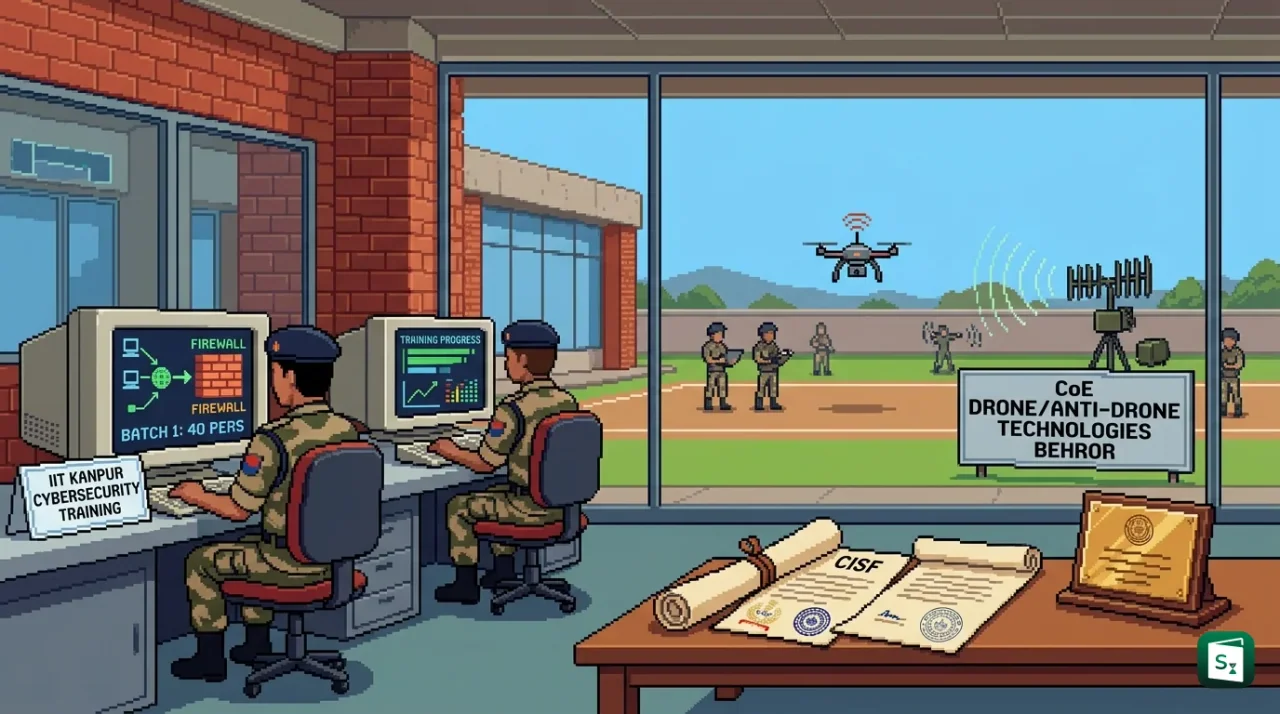
The Central Industrial Security Force signed two Memorandums of Understanding with the Indian Institute of Technology Kanpur on 14 September 2026. The first pact provides a six week residential cybersecurity training programme for CISF personnel through C3iHub, while the second creates a Centre of Excellence for drone and anti-drone technologies at MPRTC Behror in Rajasthan. Together, the two agreements aim to protect airports, power plants and other critical sites from cyber attacks and rogue drones.
What Is CISF?
The Central Industrial Security Force (CISF) is a central armed police force under the Ministry of Home Affairs. CISF secures airports, metro rail, nuclear plants and ports across India. CISF is not part of the Indian Army. CISF was created by the CISF Act of 1968 for industrial security.
The CISF Act was passed by Parliament on 2 December 1968 and the force was raised on 10 March 1969 with a strength of about 2,800 personnel. The first CISF unit was posted at the Fertilizer Corporation plant in Trombay, Maharashtra. At first the force had only watch and guard duties. Parliament made CISF an armed force of the Union in 1983, which gave its members powers of arrest and search.
Today CISF works under the Ministry of Home Affairs and is headed by a Director General from the Indian Police Service. Praveer Ranjan held the post of Director General (as of September 2026). The force headquarters is at 13 CGO Complex, Lodhi Road, New Delhi. The force motto is Protection and Security, written in Hindi as Sanrakshan evam Suraksha. CISF now has about 1.9 lakh personnel and guards more than 350 units, including 66 airports, Delhi Metro, Parliament House, major ports, nuclear and space installations, and heritage sites such as the Taj Mahal and Red Fort. After a 2009 amendment, CISF can also give paid security to private companies.
| CISF Fact | Detail |
|---|---|
| Full form | Central Industrial Security Force |
| Created under | CISF Act, 1968 |
| Raising Day | 10 March 1969 |
| Ministry | Ministry of Home Affairs |
| Headquarters | New Delhi |
| Motto | Protection and Security |
| Core role | Security of airports, metro, nuclear, ports and critical infrastructure |
Six Week Cybersecurity Training Programme With C3iHub
The first Memorandum of Understanding provides a six week residential cybersecurity training programme for CISF personnel at IIT Kanpur. The programme will run under a three year framework and will be conducted by the IHUB NTIHAC Foundation, which is known as C3iHub. Each batch will include 40 nominated CISF personnel. The training will be free of cost on a non-commercial basis.
The course follows a step by step design. It starts with basic IT, computer networks and cybersecurity fundamentals. It then moves to advanced work such as digital forensics, vulnerability assessment, incident detection and response, disaster recovery and business continuity. Trainers will use classroom lessons, hands on lab work and expert sessions to build practical skills for real duty conditions.
A large part of the course focuses on the sites CISF actually guards. The syllabus covers Critical Information Infrastructure and sector specific threats in aviation, power and nuclear facilities. CISF protects control rooms, communication networks and passenger data systems at airports and metro stations. A cyber failure in these systems can halt operations within minutes, so the training links cyber skills directly to physical security duties.
The programme also covers new technology risks. These include Artificial Intelligence and Machine Learning, Generative AI and deepfakes, Internet of Things (IoT), cloud computing and Operational Technology (OT). Operational Technology means the hardware and software that control physical machines such as turbines, baggage scanners and power grids. The course ends with a multi sector crisis simulation where teams must detect, contain and recover from a large scale cyber incident.
The training agreement was signed by Senthil Avoodai Krishna Raj S., Inspector General of CISF, and Tanima Hajra, Chief Executive Officer of C3iHub. The initiative supports the direction given after the Directors General of Police Conference 2024 to build cyber ready forces and dedicated cyber commando units in Central Armed Police Forces and state police.
What Is C3iHub?
C3iHub, or the IHUB NTIHAC Foundation, is a cybersecurity Technology Innovation Hub at IIT Kanpur. C3iHub was set up as a Section 8 non profit company by the Department of Science and Technology under the National Mission on Interdisciplinary Cyber-Physical Systems. C3iHub builds tools, startups and training for cyber-physical security.
The full name IHUB NTIHAC Foundation links to the National Mission on Interdisciplinary Cyber-Physical Systems, which is called NM-ICPS. The mission is run by the Department of Science and Technology. C3iHub is registered as a Section 8 company, which means it works on a not for profit basis. Its goal is to find weak points in cyber-physical systems, build Indian security tools, support startups and train researchers. C3iHub is empanelled with CERT-In, the Indian Computer Emergency Response Team, and has now been upgraded as a Technology Translation Research Park.
C3iHub sits inside the Indian Institute of Technology Kanpur in Kanpur, Uttar Pradesh. IIT Kanpur was established in 1959 and is recognised as an Institute of National Importance. The campus covers about 1,055 acres on the Grand Trunk Road near Kanpur city. C3iHub has earlier trained army personnel, National Informatics Centre officers and police units, and works with ministries on the security of power, communications and digital infrastructure.
What Is an Anti Drone System and How Does It Work?
An anti-drone system is a layered defence that finds, tracks and stops rogue drones. It uses radar, radio frequency sensors and cameras to detect drones. It then uses jamming, spoofing or nets and guns to neutralise them. Indian systems use soft kill jamming and hard kill interception.
A modern Counter Unmanned Aircraft System, or Counter-UAS, works in four steps. First, radar, radio frequency scanners, cameras and sound sensors search the sky. Second, software tracks the flight path and checks if the object is a friendly aircraft, a bird or a hostile drone. Third, the system classifies the threat using its radio signal and shape. Fourth, it selects the right response.
The response has two broad types. A soft kill breaks the link between the drone and its operator without physical damage. Jamming floods the control frequency, usually 2.4 GHz and 5.8 GHz, and blocks satellite navigation signals such as GPS. Spoofing sends false location signals so the drone lands or returns by mistake. A hard kill physically stops the drone with nets, shotgun like guns or laser beams. Indian systems such as the DRDO developed D4 system use both methods and can show live radar, thermal and frequency details on one screen.
For CISF, this technology is urgent. Small commercial drones are cheap, silent and can carry cameras, smuggled goods or explosives. They can halt airport operations, spy on nuclear plants or drop payloads across borders. CISF has already trained more than 3,000 personnel in drone and anti-drone work, and about 80 CISF units use drones for monitoring. The new training will add skills in drone forensics, which means studying a captured drone to find its route, owner and control station.
Centre of Excellence at MPRTC Behror
The second Memorandum of Understanding will set up a Centre of Excellence (CoE) for drone and anti-drone technologies at the Multi-Purpose Recruitment and Training Centre (MPRTC) in Behror, Rajasthan. A Centre of Excellence is a dedicated hub where training, research and testing happen in one place. The CoE will work under a five year framework with IIT Kanpur as the knowledge partner.
MPRTC Behror is one of the main training centres of CISF in northern India. Behror is located in the Kotputli Behror district of Rajasthan on the Delhi Jaipur route. The site is well connected and has open training areas needed for live drone flights. CISF plans to develop Behror as its national hub for drone and counter-drone learning, in line with Union Home Ministry guidelines.
The CoE will focus on specialised training, UAV operations, counter-drone systems, drone forensics and cybersecurity of unmanned systems. UAV stands for Unmanned Aerial Vehicle, which is the technical name for a drone. Joint research will study rogue drone behaviour, radio frequency and micro-Doppler detection, integrated Counter-UAS networks and high altitude operations. Micro-Doppler means studying tiny changes in radar waves to identify spinning blades. The partners will also build simulators, forensic laboratories, course material and technical infrastructure for long term use.
| Feature | First MoU on Cybersecurity | Second MoU on Drones |
|---|---|---|
| Partner at IIT Kanpur | C3iHub | IIT Kanpur drone research teams |
| Location | IIT Kanpur campus | MPRTC Behror, Rajasthan |
| Duration | 3 year framework | 5 year framework |
| Batch size | 40 CISF personnel per batch | Specialised batches for drone roles |
| Core output | Cyber skills and crisis simulation | Training, labs, simulators and joint research |
The Behror plan builds on an earlier CISF agreement with the Drone Federation of India, signed on 28 August 2026. That pact covers standard operating procedures for counter-drone deployment, red teaming exercises and links with Indian drone makers. The IIT Kanpur MoUs widen this network, which already includes IIT Madras Pravartak, IIT Ropar and IIITDM Kancheepuram.
Why These MoUs Matter for Critical Infrastructure Security
The Central Industrial Security Force guards the places where a small failure can cause national disruption. These include 66 airports, nuclear power stations, thermal plants, ports, metro rail and space facilities. Cyber attacks can freeze check in systems, power controls and communication links. Rogue drones can stop flights, photograph restricted zones or carry explosives. The twin MoUs give CISF in house experts who understand both the digital network and the airspace above each site.
The agreements also clarify the distinct role of CISF among central forces. CISF is often compared with the Central Reserve Police Force (CRPF). CISF focuses on static guarding of infrastructure and installations, while CRPF focuses on law and order, counter insurgency and election duties. Both forces work under the Ministry of Home Affairs, but CISF personnel need deeper skills in industrial control systems, aviation rules and now cyber and drone defence. The new courses fill exactly that gap.
The partnerships support the goal of Atmanirbhar Bharat, which means self reliant India. The CoE will test Indian sensors, jammers and software before large scale use. Joint work on radio frequency detection, drone forensics and secure communications will help Indian startups improve their products with real field feedback. Over the next three to five years, the success of the programme will be judged by the number of trained cyber and drone specialists posted at sensitive units, the quality of simulators and labs at Behror, and the speed at which new threats such as AI driven attacks are added to the syllabus.
Key Takeaways
- CISF signed two MoUs with IIT Kanpur on 14 September 2026 for cybersecurity training and a drone and anti-drone Centre of Excellence.
- The first MoU provides a six week residential course for 40 CISF personnel per batch through C3iHub under a three year free training framework.
- The second MoU creates a CoE at MPRTC Behror in Rajasthan under a five year framework for UAV operations, counter-UAS systems and drone forensics.
- CISF was raised on 10 March 1969 under the CISF Act, 1968, works under the Ministry of Home Affairs and is headquartered in New Delhi.
- C3iHub is the IHUB NTIHAC Foundation, a Section 8 company at IIT Kanpur set up by the Department of Science and Technology under NM-ICPS.
- An anti-drone system detects drones with radar and radio sensors and stops them with soft kill jamming or hard kill interception.