

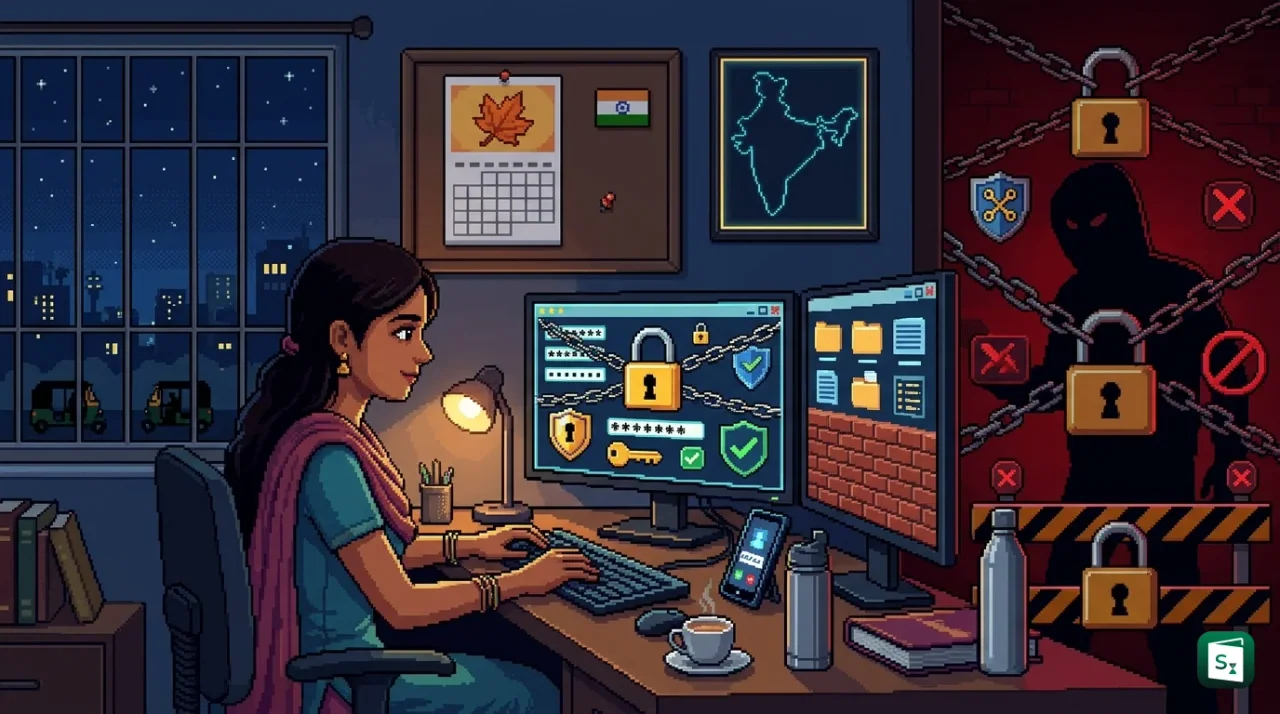
National Cybersecurity Awareness Month is observed every October to promote safe online behaviour among individuals, businesses and governments. The 2026 observance carries the theme Don’t Make It Easy for Them and marks the 23rd annual edition since its launch in 2004. In India, October is observed as National Cyber Security Awareness Month led by the Indian Computer Emergency Response Team (CERT-In).
What Is Cybersecurity and Why Does It Matter?
Cybersecurity is the practice of protecting networks, devices, software and data from unauthorised access, theft, damage or disruption. It seeks to ensure confidentiality, integrity and availability of information, which means data stays private, stays correct and stays accessible to the right users. Network security, which protects computer networks and communication channels from intruders, is one of its best known branches.
Cybersecurity matters because daily life now depends on connected systems for communication, banking, shopping, health records, transport and government services. A single breach can expose personal details, stop business operations, cause large financial loss and erode public trust. Attacks on power grids, hospitals, banks and government networks can also affect national security and essential services.
| Common Cyber Threat | What Happens |
|---|---|
| Phishing | Fake emails, SMS messages or calls trick users into sharing passwords, card numbers or one time passwords |
| Ransomware | Malicious software locks files or systems and demands payment to restore access |
| Malware | Harmful software such as viruses, worms, spyware or trojans damages devices or steals data |
| Social engineering | Attackers misuse trust and urgency to force a person to click a link or download a file |
| Denial of service | Floods of fake traffic overload a website or network and make it stop working |
Modern scams have become harder to spot because attackers use artificial intelligence for realistic phishing messages, voice cloning and deepfakes. This makes basic cyber security awareness, the ability to recognise risks and follow safe habits, as important as technical tools such as firewalls and antivirus software.
When Is Cybersecurity Awareness Month and How Did It Begin?
Cybersecurity Awareness Month is observed from 1 to 31 October every year. The month was launched in 2004 by the United States Department of Homeland Security and the National Cybersecurity Alliance (NCA), a nonprofit body that promotes safe online behaviour. Since 2004, the President of the United States and Congress have declared October as Cybersecurity Awareness Month each year.
The Cybersecurity and Infrastructure Security Agency (CISA) now co-leads the campaign with NCA. CISA was created in 2018 as the civilian federal agency responsible for national cyber defence and resilience, and it works inside the Department of Homeland Security. The campaign is built as a public private partnership in which government agencies, companies, schools, nonprofits and community groups share simple safety messages.
The format has changed over time. Early guidance focused on antivirus updates. Weekly themes were added in 2011, and in October 2023 CISA adopted Secure Our World as an enduring theme for safe behaviour. Other regions adopted the same October window. The European Union observes European Cybersecurity Month through the European Union Agency for Cybersecurity (ENISA) and the European Commission, a practice that began in 2012. Australia also marks October as its awareness month. The 2026 edition is the 23rd annual edition.
What Does the 2026 Theme Don’t Make It Easy for Them Mean?
The NCA theme for 2026 is Don’t Make It Easy for Them. The message is direct. Online safety does not depend on one perfect decision. It depends on small habits that people repeat every day in ordinary moments. When millions of users follow those habits, criminals find it harder to break in.
The campaign promotes four daily habits, often called the Core 4:
| Habit | What It Means in Practice |
|---|---|
| Use strong passwords and a password manager | Create long, unique passwords for each account and store them in a password manager instead of reusing them |
| Turn on multifactor authentication | Add a second check, such as a code on a phone or a fingerprint, along with the password |
| Recognise and report scams | Pause on urgent or unexpected messages, check the sender, avoid clicking unknown links, and report fraud |
| Update software | Install updates for phones, computers, apps and routers so known faults get fixed |
The 2026 toolkit explains each habit through real cases in which attackers used password cracking, unprotected accounts, unpatched systems and phishing, and were later stopped or prosecuted. NCA invites organisations to register as Champions and use its free kit of tip sheets, posters and social media graphics. CISA has linked its 2026 outreach to the idea of Securing the Next 250, a reference to the 250th anniversary of the United States, with focus on strong digital identity and resilient infrastructure.
How India Marks National Cyber Security Awareness Month in October
The Indian Computer Emergency Response Team (CERT-In) observes October as National Cyber Security Awareness Month (NCSAM). Recent India themes include Cyber Surakshit Bharat, Cyber Jagrit Bharat and Build a Culture of Cyber Hygiene, with the tag Satark Nagrik, which means a vigilant citizen. The aim is to improve cyber hygiene and resilience among citizens, students, government staff and industry.
CERT-In releases handbooks, booklets for children and senior citizens, posters, videos and daily safety tips during the month. The Information Security Education and Awareness (ISEA) project of the Ministry of Electronics and Information Technology (MeitY) supports the effort with quizzes, crosswords, newsletters, cartoon stories and workshops. The project has held more than 6,650 workshops covering over 11.37 lakh participants, including students, teachers, police personnel and officials.
October activities connect to year round programmes. India also observes Safer Internet Day on the second Tuesday of February, Swachhta Pakhwada from 1 to 15 February for cleaning malware from devices, and Cyber Jagrookta Diwas on the first Wednesday of every month. Financial sector bodies take part at scale. During NCSAM 2024, entities under the Department of Financial Services held 178 awareness sessions and 86 workshops, engaged more than 46,000 participants, and sent 132 crore SMS messages and 3.3 crore emails with safety tips.
The scale of the problem explains the focus. CERT-In tracked 15,92,917 incidents in 2023, 20,41,360 in 2024 and 29,44,248 in 2025. Losses reported on the National Cyber Crime Reporting Portal rose from ₹2,290 crore in 2022 to ₹7,465 crore in 2023 and ₹22,845 crore in 2024. Unified Payments Interface frauds, which often involve phishing links and stolen one time passwords, reached 13.42 lakh cases involving ₹1,087 crore in 2023-24.
India’s Cyber Security Framework: CERT-In, Policies and Reporting Systems
CERT-In is the national nodal agency for cyber incident response in India. It has operated since January 2004 under MeitY and is based at Electronic Niketan, Lodhi Road, New Delhi. Its role is defined under Section 70B of the Information Technology Act, 2000. CERT-In collects and analyses incident reports, issues alerts, advisories and vulnerability notes, coordinates emergency response, and shares threat intelligence with government, industry and global partners. In 2025 it issued 1,530 alerts, 390 vulnerability notes and 65 advisories.
The National Cyber Security Policy, 2013 provides the policy base. Its vision is to build a secure and resilient cyberspace for citizens, businesses and government. The policy lists 14 objectives, including a secure cyber ecosystem, protection of critical information infrastructure, development of indigenous security technology, creation of a workforce of 5,00,000 skilled professionals, stronger laws for cybercrime control, and global cooperation.
Several bodies share duties within this system:
| Body | Role |
|---|---|
| National Cyber Security Coordinator under the National Security Council Secretariat | Coordinates cyber security work across agencies |
| National Cyber Coordination Centre, run by CERT-In | Detects threats in cyberspace and shares intelligence with stakeholders |
| National Critical Information Infrastructure Protection Centre, set up under Section 70A of the IT Act | Protects critical systems such as power, banking, telecom and transport |
| CSIRT-Fin and CSIRT-Power | Sector teams under CERT-In for finance and power networks |
| Indian Cyber Crime Coordination Centre (I4C) under the Ministry of Home Affairs | Handles cybercrime reporting and coordination |
Citizens can report fraud on the National Cyber Crime Reporting Portal at cybercrime.gov.in and seek quick help on helpline number 1930. The Citizen Financial Cyber Fraud Reporting and Management System has helped save more than ₹7,130 crore across over 23 lakh complaints by stopping fund transfers in time. The Union Budget 2025-26 allocated ₹782 crore for cyber security projects. Laws such as the Digital Personal Data Protection Act, 2023 add duties on data handlers to keep personal data safe.
Key Takeaways
- Cybersecurity Awareness Month is observed from 1 to 31 October every year to promote safe online habits.
- The 2026 theme is Don’t Make It Easy for Them, which promotes strong passwords, multifactor authentication, scam reporting and software updates.
- The observance began in 2004 and is co-led by CISA, created in 2018, and the National Cybersecurity Alliance.
- In India, CERT-In, operational since January 2004 under Section 70B of the IT Act, 2000, leads National Cyber Security Awareness Month in October.
- India’s National Cyber Security Policy, 2013 aims to build a secure cyberspace and set a goal of 5,00,000 skilled professionals.