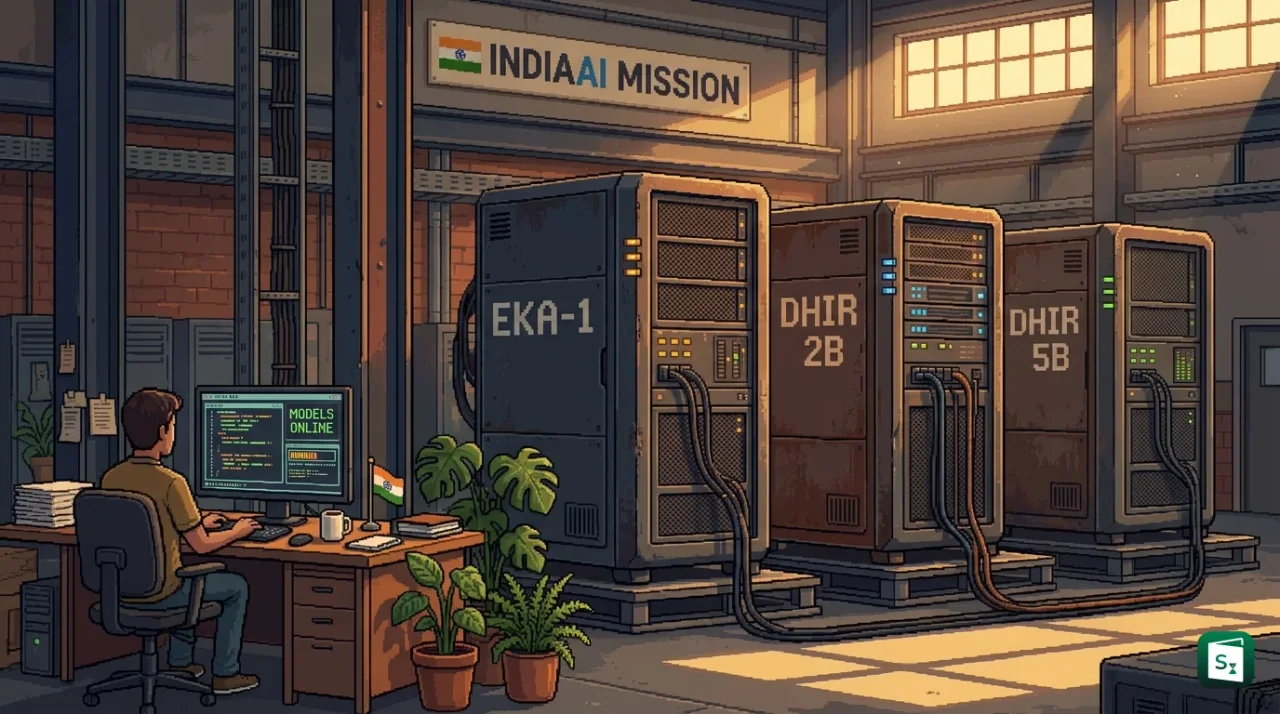
The IndiaAI Mission released three indigenous foundation models, EKA-1, Dhir 2B and Dhir 5B, at an event in New Delhi on 3 November 2026. EKA-1 was built by Soket Labs Technology and Research, while Dhir 2B and Dhir 5B were built by ZenteiQ AiTech Innovations. The release marks a major step toward sovereign AI systems trained on Indian data and languages.
What Is a Foundation Model?
A foundation model is a large artificial intelligence (AI) system trained on vast amounts of data to learn patterns in language, code or images. Once trained, the same base model can be adapted for many tasks such as translation, summarisation, coding help, question answering and document search. A large language model (LLM) is a common type of foundation model that focuses mainly on text.
Most widely used foundation models today are built abroad and work best in English. That creates a gap for India, where administration, courts, classrooms and businesses function in many Indian languages. Indigenous models like EKA-1 and Dhir aim to close this gap by learning directly from Indian languages and local use cases.
What Is the IndiaAI Mission?
The IndiaAI Mission is the national AI programme of the Ministry of Electronics and Information Technology (MeitY). The Union Cabinet approved the mission on 7 March 2024 with a total outlay of ₹10,371.92 crore for five years. The goal of the IndiaAI Mission is to make AI work for all Indians by expanding computing access, data, skills and homegrown models.
The mission is implemented by IndiaAI, an Independent Business Division under the Digital India Corporation (DIC). The Chief Executive Officer of the mission is Abhishek Singh, who also serves as Additional Secretary in MeitY. Its work is organised around seven pillars.
| Pillar | What it does | Approved outlay |
|---|---|---|
| IndiaAI Compute Capacity | Provides subsidised GPUs and an AI marketplace for startups and researchers | ₹4,563.36 crore |
| IndiaAI Innovation Centre | Builds indigenous large and small models, including foundation models | ₹1,971.37 crore |
| IndiaAI Datasets Platform (AIKosh) | Shares quality non-personal datasets for training AI | ₹199.55 crore |
| IndiaAI Application Development Initiative | Supports AI apps for health, agriculture, governance and climate | ₹689.05 crore |
| IndiaAI FutureSkills | Funds fellowships and Data and AI Labs in Tier 2 and Tier 3 cities | ₹882.94 crore |
| IndiaAI Startup Financing | Provides risk capital and global expansion support to deep tech startups | ₹1,942.50 crore |
| Safe and Trusted AI | Funds tools for safety, privacy, bias control and audit of AI | ₹20.46 crore |
Two pillars matter most for this news. The Compute pillar has onboarded more than 38,000 graphics processing units (GPUs) which are offered at about ₹65 per hour. A GPU is a powerful chip that trains and runs AI systems much faster than a normal processor. The Datasets pillar runs AIKosh, a national platform that now hosts more than 7,500 datasets and over 270 AI models for shared use.
What Was Released on 3 November 2026?
The IndiaAI Mission unveiled the three models at a press event in New Delhi on 3 November 2026. S. Krishnan, Secretary of MeitY, released the models in the presence of senior officials of MeitY and IndiaAI and the leadership teams of the two companies. The models are available for researchers, students, startups and enterprises through AIKosh.
Soket Labs and ZenteiQ are among 12 teams selected in February 2026 under the IndiaAI Innovation Centre pillar to build sovereign models. The list also includes Sarvam AI, BharatGen led by the Indian Institute of Technology Bombay, Gnani AI, Gan AI and others. Models from Sarvam, BharatGen and Gnani were already presented at the India AI Impact Summit 2026 held in New Delhi in February 2026.
Public compute support made the new models possible. Selected teams receive subsidised national compute plus 25 percent support for data and staff costs. Soket Labs received support worth ₹177.08 crore, including ₹162.47 crore for compute. ZenteiQ received ₹206.49 crore, including ₹165.19 crore for compute.
EKA-1 by Soket Labs: A Large Model for Math, Code and Reasoning
EKA-1 is the foundation model developed by Soket Labs Technology and Research Pvt Ltd. Soket Labs is an Indian startup founded in 2019 by Abhishek Upperwal and based in Bengaluru. Its main research effort is called Project EKA, which focuses on math, code, reasoning and multilingual AI.
EKA-1 has 26.3 billion parameters and was trained on about 7.5 trillion tokens. Parameters are the adjustable values a model learns during training. Tokens are the small chunks of text and code the model reads while learning. A higher count on both sides generally means wider knowledge and stronger reasoning, though accuracy also depends on data quality and testing.
The model covers all 22 languages in the Eighth Schedule of the Constitution along with English. It is described as an open, sparse hybrid language model. In simple terms, it activates only part of its network for each task, which saves computing power while handling complex work.
Soket Labs has tuned EKA-1 for mathematics, computer programming, logical reasoning and agentic use. Agentic use means the model can carry out multi-step jobs such as reading a problem, writing code, running it and checking the result. The company says the model is tailored for banking, financial services and cybersecurity, where answers must be traceable and data must stay inside the organisation.
EKA-1 is built for secure deployment. It can run on premises, on a private cloud and in air gapped systems where computers are kept disconnected from the public internet. The company says some inference can also run on local devices, so certain functions keep working without mobile data or WiFi.
Dhir 2B and Dhir 5B by ZenteiQ: Compact Models for Offline Use
Dhir 2B and Dhir 5B are open source models developed by ZenteiQ AiTech Innovations of Bengaluru. ZenteiQ was founded by Prof. Sashikumaar Ganesan, a professor in the Department of Computational and Data Sciences at the Indian Institute of Science (IISc), Bengaluru. The company was born out of scientific computing research at IISc and builds models from scratch in India.
Both Dhir models were pretrained from random initialisation, which means they were not adapted from a foreign model. Training ran on Google Cloud tensor processing units (TPUs) in the Mumbai region. A TPU is a specialised chip designed by Google to speed up AI training. ZenteiQ reports using 2,048 TPU v6e chips along with 64 NVIDIA H100 GPUs.
Dhir 2B is a dense model with 2.03 billion parameters. Dhir 5B uses a mixture of experts design with 5.09 billion total parameters and 1.79 billion active parameters per token. In this design, only two of 12 expert networks work on each word, which keeps the model fast and light. Both models have a context length of 16,384 tokens and were trained on more than six trillion tokens each.
The models support English and 10 Indian languages, which are Hindi, Bengali, Tamil, Telugu, Marathi, Gujarati, Kannada, Malayalam, Punjabi and Odia. ZenteiQ has released the weights under the Apache 2.0 licence with evaluation tools through AIKosh. The compact size allows full offline use on laptops, edge devices and tested mobile phones.
The intended users are in defence, government, industry and education. Because the models run on premises and without internet, offices in low connectivity or sensitive locations can use them for document search, knowledge retrieval and citizen services while keeping data on their own devices. A larger Dhir 9B model for scientific work is under development.
How EKA-1 and Dhir Models Differ
EKA-1 and the Dhir models serve different needs. One is a larger reasoning model, while the other two are compact assistants for everyday offline use.
| Feature | EKA-1 by Soket Labs | Dhir 2B by ZenteiQ | Dhir 5B by ZenteiQ |
|---|---|---|---|
| Size | 26.3 billion parameters | 2.03 billion parameters, dense | 5.09 billion total, 1.79 billion active, mixture of experts |
| Training data | About 7.5 trillion tokens | More than 6 trillion tokens | More than 6 trillion tokens |
| Languages | 22 scheduled languages and English | English and 10 Indian languages | English and 10 Indian languages |
| Main use | Math, code, reasoning, agents for banking and cybersecurity | Offline assistant for documents and retrieval | Offline assistant with stronger reasoning for the same tasks |
| Deployment | On premises, private cloud, air gapped, limited on device use | Fully offline on laptops, edge devices and tested phones | Fully offline on laptops, edge devices and tested phones |
| Access | Early access through Soket Labs and AIKosh | Open source under Apache 2.0 through AIKosh | Open source under Apache 2.0 through AIKosh |
Why Indigenous Models Matter for India
The IndiaAI Mission links these models to strategic autonomy. Systems built and trained in India reduce dependence on foreign models for governance, banking and research. They also keep Indian data within Indian jurisdiction instead of feeding external training pipelines.
Language inclusion is the second gain. EKA-1 works across all scheduled languages, while Dhir covers 10 major Indian languages. This helps build voice interfaces, translation tools and citizen service bots that function outside English. Such tools support schools, local courts, hospitals and panchayat offices.
Data security is the third gain. Both model families support on premises and offline deployment. Banks, defence units and government departments can fine tune the models on their own files without sending sensitive records to an external cloud. MeitY Secretary S. Krishnan said this ability can help enterprise AI grow in India, because firms can now run capable models inside their own networks.
Key Takeaways
- The IndiaAI Mission released EKA-1, Dhir 2B and Dhir 5B in New Delhi on 3 November 2026.
- EKA-1 by Soket Labs has 26.3 billion parameters and was trained on 7.5 trillion tokens across 22 scheduled languages and English.
- Dhir 2B with 2.03 billion parameters and Dhir 5B with 5.09 billion parameters were built by ZenteiQ AiTech Innovations for offline use in 10 Indian languages and English.
- The models were built under the IndiaAI Innovation Centre pillar with subsidised national compute of more than 38,000 GPUs at ₹65 per hour.
- The IndiaAI Mission was approved on 7 March 2024 under MeitY with an outlay of ₹10,371.92 crore and is implemented through AIKosh and seven pillars.