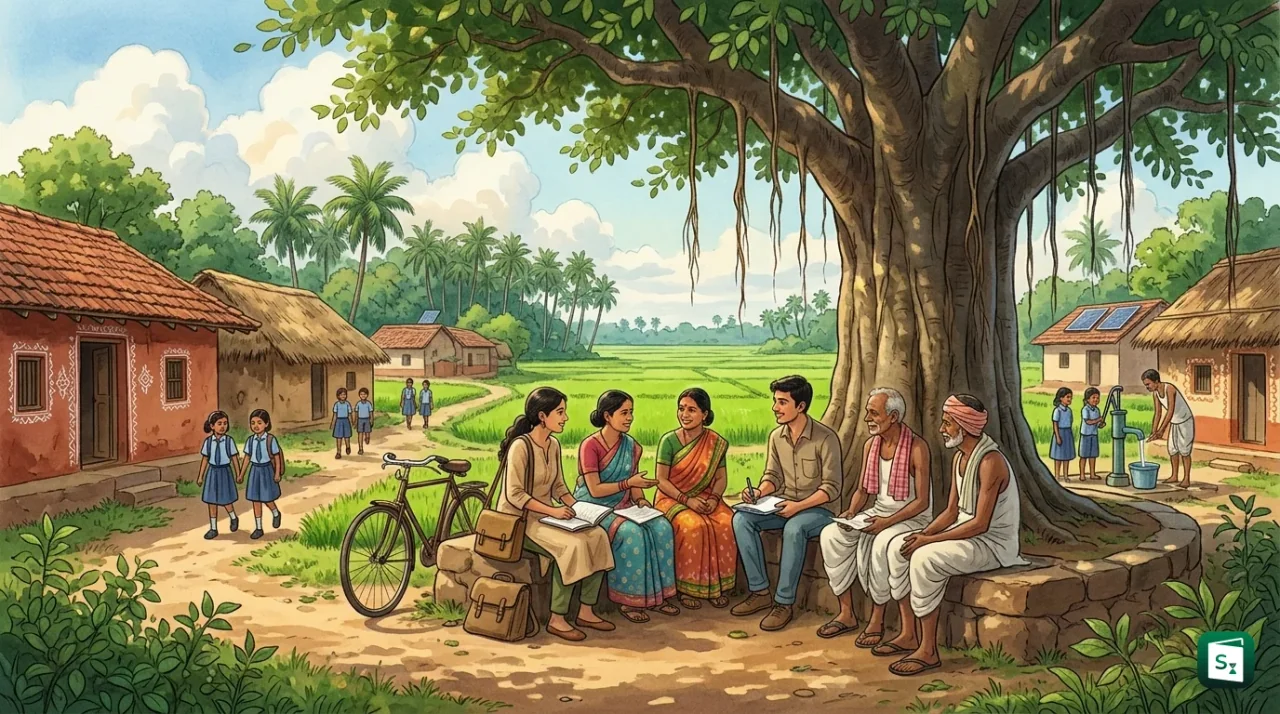
The Government of Odisha signed a three year Memorandum of Understanding with J-PAL South Asia on 4 November 2026 to strengthen evidence based policymaking across state departments. J-PAL South Asia will help departments identify priority challenges, generate rigorous field evidence and convert findings into practical policy advice. The partnership is anchored in the Planning and Convergence Department and supports Odisha Vision 2036 and 2047.
What Did Odisha and J-PAL South Asia Agree On?
The Memorandum of Understanding (MoU) is a written record of shared intent between two or more parties to work together on common goals. The Odisha MoU was signed in Bhubaneswar by Rashmi Kabi, Financial Advisor cum Additional Secretary of the Planning and Convergence Department, and Shobhini Mukerji, Executive Director of J-PAL South Asia.
The signing took place in the presence of Chief Secretary Anu Garg, Development Commissioner cum Additional Chief Secretary Deoranjan Kumar Singh, J-PAL South Asia Acting Associate Director for Policy Murali Mallikarjunan and secretaries of several state departments. The partnership will run for three years.
Under the agreement, J-PAL South Asia will coordinate with individual departments to understand their policy priorities. It will then support research design, field testing and analysis, and help officials turn results into clear actions. The scope and deliverables of each project will be fixed in consultation with the concerned department.
The pact builds on work that started in 2006. Over nearly two decades, J-PAL South Asia has worked with Odisha on early childhood education, foundational literacy and numeracy, governance, sanitation, agriculture and gender. A visible example is Barnali, the gender equity curriculum now taught in about 23,000 government schools. For Barnali, J-PAL South Asia acts as the knowledge and research partner to the School and Mass Education Department and Breakthrough Trust.
What Is J-PAL South Asia?
J-PAL stands for the Abdul Latif Jameel Poverty Action Lab. It is a global research network founded in 2003 at the Massachusetts Institute of Technology (MIT) in the United States by economists Abhijit Banerjee, Esther Duflo and Sendhil Mullainathan. The lab was later named after the late businessman Abdul Latif Jameel in recognition of support from his family for poverty research.
J-PAL South Asia is the India and South Asia regional office of this network. It is hosted at the Institute for Financial Management and Research (IFMR) in Chennai and began field work in India in 2007. It is the oldest and largest regional office of J-PAL.
Today J-PAL works as a network of more than 1,000 affiliated researchers across universities. Together they have completed or started more than 2,500 randomised evaluations in many countries. In 2019, J-PAL co-founders Banerjee and Duflo, along with long time affiliate Michael Kremer, received the Nobel Prize in Economic Sciences for their experimental approach to reducing global poverty.
What Is Evidence Based Policymaking and How Does J-PAL Test Policies?
Evidence based policymaking means using reliable data and field research to decide which public programmes to start, continue or expand. Instead of relying only on opinion or past practice, the government pilots an idea on a small scale, measures the result and then scales up only what works.
J-PAL is known for using randomised controlled trials (RCTs) to create such evidence. In an RCT, eligible people or schools are divided by lottery into two similar groups. One group receives the new programme and the other does not. Researchers then compare outcomes such as learning levels, health visits or incomes. Because the split is random, any clear difference can be linked to the programme itself.
This method is similar to testing a new medicine. Doctors test the drug on one group of patients and give a dummy pill to another group to check the true effect. In policy research, the treatment may be extra tutoring, a sanitation incentive or a gender sensitisation lesson.
A well known example is the Haryana evaluation of the gender equity curriculum developed by Breakthrough. J-PAL affiliated researchers studied about 15,000 students in 314 government schools between 2014 and 2016. They found that classroom discussions shifted gender attitudes of both boys and girls, with boys also reporting more help in household chores. The result held even two years after the sessions ended. This evidence helped Punjab and Odisha adopt the model at scale, as Barnali in Odisha and under a state programme in Punjab.
How Odisha Vision 2036 and 2047 Shapes the Partnership
Odisha Vision 2036 and 2047 is the long term roadmap of the state government. It sets two milestones. Samruddha Odisha by 2036, when the state completes 100 years of its formation in 1936, and Viksit Odisha by 2047, when India completes 100 years of Independence. The central economic goal is to raise Gross State Domestic Product to $500 billion by 2036 and to $1.5 trillion by 2047.
The vision rests on six pillars that cover rural empowerment, people first development, cultural pride, prosperity for all, technology leadership and citizen centric governance. To deliver quick results, the government has also announced a 36 for 36 agenda of 36 high impact flagship initiatives to be completed by 2036. Key targets include higher urbanisation from about 17 percent toward 60 percent, growth in manufacturing and services, expansion of non farm jobs, and sharp gains in health, education and female workforce participation.
Chief Secretary Anu Garg has linked the J-PAL partnership directly to this vision. The government wants research institutions to help pilot innovations and to use data and artificial intelligence tools in line with global practice. J-PAL South Asia is expected to bring global evidence, adapt promising ideas to Odisha conditions, and test data based solutions before the state spends large sums on statewide rollout.
How the Three Year Partnership Will Be Run
A Steering Committee chaired by the Chief Secretary will guide the partnership. It includes senior officials of the Odisha government and representatives of J-PAL South Asia. The committee will meet every six months to review project proposals and track progress.
Day to day coordination will be handled by nodal officers named by both sides. The table below summarises the working arrangement.
| Role | Responsibility |
|---|---|
| Steering Committee | Approves priority areas, reviews proposals and monitors results |
| Planning and Convergence Department | Anchors the MoU and links departments with researchers |
| Line departments | Share field problems, provide data access and help pilot solutions |
| J-PAL South Asia | Designs studies, analyses data and recommends scalable models |
| Nodal officers | Coordinate meetings, timelines and follow up actions |
The focus will be on practical problem solving and capacity building. Departments will get support to frame clear policy questions, improve monitoring systems and use administrative data better. Individual studies will produce cost and impact estimates so that the government can decide which ideas deserve public funds for expansion.
Key Takeaways
- The Government of Odisha signed a three year MoU with J-PAL South Asia on 4 November 2026 to support evidence based policymaking.
- The MoU was signed by Rashmi Kabi and Shobhini Mukerji and is anchored in the Planning and Convergence Department.
- J-PAL was founded at MIT in 2003 by Abhijit Banerjee, Esther Duflo and Sendhil Mullainathan, and its South Asia office is hosted at IFMR Chennai.
- Banerjee and Duflo, with Michael Kremer, won the 2019 Nobel Prize in Economic Sciences for experimental work on poverty.
- The partnership supports Odisha Vision 2036 and 2047, which targets Samruddha Odisha by 2036 and $1.5 trillion GSDP by 2047, and builds on the Barnali curriculum in about 23,000 schools.