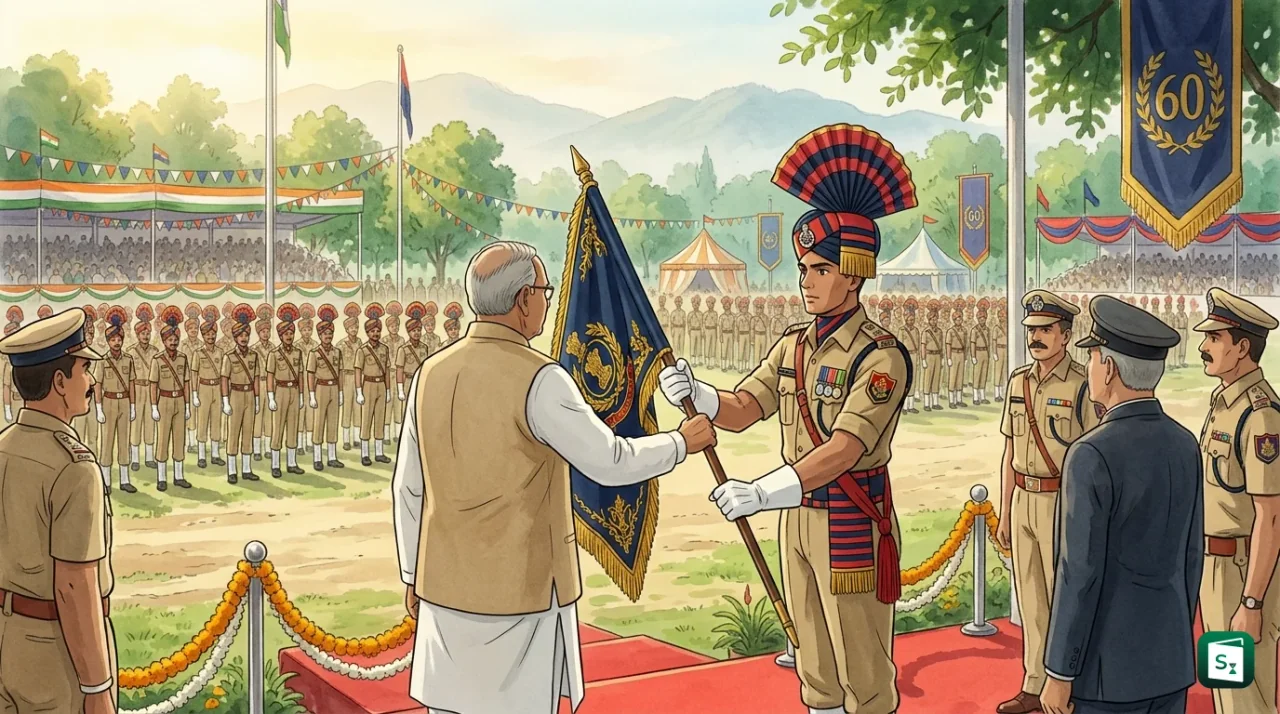
Union Home Minister Amit Shah presented the President’s Police Colour to the Chandigarh Police on 1 November 2026 at Police Lines in Chandigarh. The award honours 60 years of service since 1966 and the force’s 145 medals at the All India Police Duty Meet.
What Is the President’s Colour Award?
The President’s Colour Award is the highest ceremonial honour for a military unit, training institution or state and Union Territory police force in India. It is also called the Nishan, which in Hindi is known as Rashtrapati ka Nishan. The honour is a special flag, not a medal for one person. It recognises the joint work of an entire force.
The word colour here means a flag. The flag has a golden border with the national emblem and the insignia of the receiving unit in the centre. It may also carry the motto and key achievements of the unit. After the award, every member of the force can wear a small replica emblem on the left sleeve of the uniform. The flag is paraded with full honour on Raising Day and other ceremonial occasions.
The tradition comes from old armies, where soldiers carried the royal flag or dhwaj as a rallying point in battle. Losing the flag meant disgrace, while capturing the enemy flag meant great honour. Under British rule, Indian regiments carried the King’s Colour. A day before India became a republic, on 25 January 1950, all 33 King’s Colours were laid up at the Indian Military Academy in Dehradun. The new republic replaced them with the President’s Colour.
The Indian Navy was the first service to receive the new honour from President Dr Rajendra Prasad on 27 May 1951. The Army and Air Force units, naval commands, fleets and training academies followed. For police forces, the honour marks long, disciplined and outstanding service in peace as well as in difficult security duties. Uttar Pradesh Police received it first among police forces in 1952, followed by Delhi Police in 1954 and Maharashtra Police in 1961. In recent years, Haryana Police in 2023, Chhattisgarh Police in 2024 and Goa, Bihar, Odisha, Sikkim and other state police forces have joined the list.
Chandigarh Police Honour on 60th Raising Day
The Chandigarh Police received the President’s Colour during its Diamond Jubilee and 60th Raising Day parade at Police Lines in Sector 26, Chandigarh. Union Home Minister Amit Shah took the salute from marching contingents and presented the Nishan to the force. Punjab Governor and Chandigarh Administrator Gulab Chand Kataria and Director General of Police Sagar Preet Hooda were present.
The Chandigarh Police was reorganised on 1 November 1966, when the Punjab Reorganisation Act carved Haryana out of Punjab. Chandigarh became a Union Territory and the joint capital of Punjab and Haryana. The force began with three police stations and about 1,647 personnel drawn from Punjab Police. Its first chief was V. K. Kalia, Senior Superintendent of Police. The post of Inspector General of Police was created in 1981, and the post of Director General of Police was created in 2017. Today the strength is more than 6,000 personnel.
The Home Minister said the honour recognises six decades of service, discipline and sacrifice. He paid tribute to personnel who lost their lives in the line of duty. He recalled the testing period of terrorism, when Chandigarh lay close to a disturbed region. The force protected the planned city at the foothills of the Shivalik Hills and helped keep peace in the wider tri city area with Punjab Police and Haryana Police.
How Chandigarh Police Has Modernised Policing
The Chandigarh Police now ranks second in India for response time. The average time to reach an incident spot is about 4 minutes and 33 seconds, while Quick Response Teams reach in about 10 minutes. To improve mobility, Shah flagged off 141 new vehicles, including motorcycles, pink scooters for women’s safety duties, Boleros, Ertigas, Scorpios and mini trucks. A total of 154 new vehicles were added in 2026. The Centre has also provided 2,152 Artificial Intelligence enabled CCTV cameras, in addition to about 2,130 cameras already in use.
Chandigarh was the first city to introduce the Beat Policing system after 2015. The city is divided into divisions and beats with round the clock staff, and many services are available through apps and the single emergency number 112. Citizens can get help without visiting a police station. Despite having one of the highest vehicles per person ratios in India, the city is known for smooth traffic movement.
The force has shown strong results under the three new criminal laws, the Bharatiya Nyaya Sanhita, the Bharatiya Nagarik Suraksha Sanhita and the Bharatiya Sakshya Adhiniyam. These laws, which replaced British era codes, were launched from Chandigarh. Since 4 August 2024, the police registered 8,206 first information reports and filed charge sheets online in 7,590 cases. The overall conviction rate has reached about 85 percent with an average disposal time of 140 days. In cases under the Narcotic Drugs and Psychotropic Substances Act (NDPS Act), the conviction rate stands at 93 percent.
Chandigarh Police Medals at All India Police Duty Meet
The Chandigarh Police has won 145 medals at the All India Police Duty Meet, including 35 gold, 38 silver and 72 bronze medals. This tally reflects steady success in professional police skills, not just one year’s result. The Duty Meet is an annual national competition where police teams test investigation, science, photography, computers, anti sabotage checks and dog squad work.
The 69th edition for 2025 was held in Nagpur in Maharashtra from 29 March to 3 April. Tamil Nadu Police was among the top teams there with 13 medals. The 68th edition was held in Ranchi in Jharkhand in February 2025 with teams from states, Union Territories and central units. Chandigarh’s large cumulative tally places it among the consistent performers in these meets.
The award ceremony also highlighted welfare steps for personnel. About 130 families of deceased personnel receive ₹8,000 per month as financial help. Educational and sports scholarships of about ₹2.25 crore are provided. The housing satisfaction rate for the force stands at 48 percent.
Run for Unity on 151st Birth Anniversary of Sardar Patel
Amit Shah flagged off the Run for Unity in New Delhi to mark the 151st birth anniversary of Sardar Vallabhbhai Patel. The run was held as part of Rashtriya Ekta Diwas, or National Unity Day, observed every year on 31 October. Shah also administered the Unity Pledge to participants. Delhi Lieutenant Governor Taranjit Singh Sandhu, Union Minister Mansukh Mandaviya, Delhi Chief Minister Rekha Gupta and Ministers of State for Home Nityanand Rai and Bandi Sanjay Kumar attended.
Sardar Patel was India’s first Deputy Prime Minister and Home Minister. He is called the Iron Man of India for uniting more than 550 princely states after Independence. Shah said Patel completed this task in 1,218 days and drew the map of united India. The government has observed Patel’s birth anniversary as Rashtriya Ekta Diwas since 2014. The Run for Unity was first organised in 2015 to spread the message of unity and integrity.
Patel was born on 31 October 1875 in present day Gujarat. He led the Bardoli Satyagraha in 1928, after which Mahatma Gandhi gave him the title of Sardar. He guided the integration of states such as Junagadh, Hyderabad, Travancore, Bhopal and Jodhpur. The Statue of Unity, the world’s tallest statue at 182 metres, stands in his honour at Kevadia in Narmada district of Gujarat on Sadhu Bet island in the Narmada river. It was inaugurated on 31 October 2018. Every year, a unity parade with state police and Central Armed Police Forces (CAPF) contingents is held at Ekta Nagar.
December 2029 Target for a Drug Free India
At the Run for Unity event, Shah set 31 December 2029 as the target to make India completely drug free. He described a Nasha Mukt Bharat, or drug free India, as the first step towards Viksit Bharat, or developed India. He said the goal is vital for youth and future generations. Chandigarh, with its high NDPS conviction rate, is expected to become the first drug free region.
Shah linked the target to recent internal security gains. He said the country became free from Naxalism on 31 March 2026 after sustained operations in affected districts. He listed the abrogation of Article 370, action against Naxalism and a unified tax system through the Goods and Services Tax (GST) as major milestones. He said a drug free India would be an even greater achievement for the nation’s future.
The drug free push builds on enforcement and prevention work by central agencies and state police forces. It includes action against trafficking networks, stronger investigation under the NDPS Act and awareness among students and young people. Chandigarh Police has increased convictions in NDPS cases and action against gangs and traffickers. The 2029 date gives states and central bodies a clear deadline to measure seizures, convictions and rehabilitation work.
Key Takeaways
- The President’s Police Colour was presented to the Chandigarh Police on 1 November 2026 at Police Lines in Sector 26 during its 60th Raising Day.
- The President’s Colour, also called the Nishan, is a ceremonial flag first presented to the Indian Navy on 27 May 1951 by Dr Rajendra Prasad.
- The Chandigarh Police, reorganised on 1 November 1966, has a strength of over 6,000 personnel and a response time of about 4 minutes and 33 seconds.
- The force has won 145 medals at the All India Police Duty Meet, including 35 gold, 38 silver and 72 bronze medals.
- The Run for Unity marked the 151st birth anniversary of Sardar Vallabhbhai Patel on 31 October, observed as Rashtriya Ekta Diwas since 2014.
- The government set 31 December 2029 as the target for a completely drug free India as a step towards Viksit Bharat.