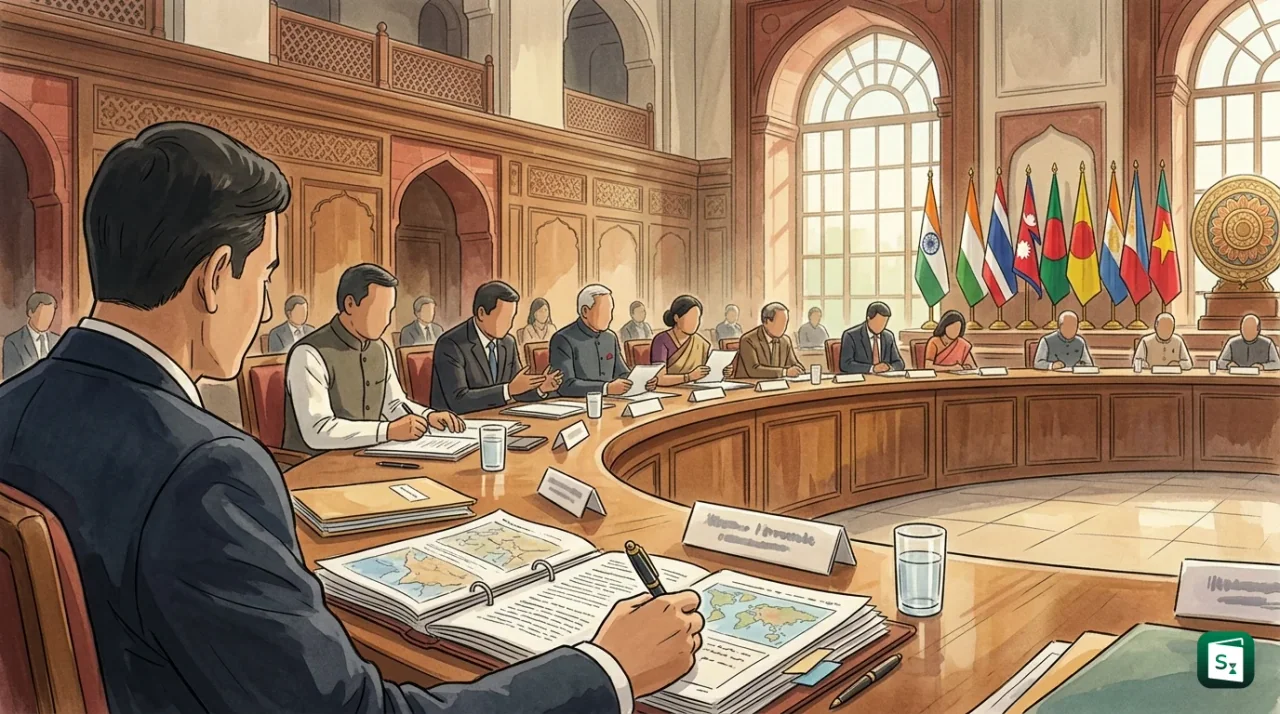
The first BIMSTEC Home Ministers’ Meeting was held in New Delhi on 13 October 2026, with Union Home Minister Amit Shah chairing the gathering of seven member states. The meeting ended with the unanimous adoption of the Delhi Declaration, a shared framework for regional security and cooperation. Member countries also approved five regional security initiatives, including a convention against trafficking in persons and a plan of action on drug control.
What Is BIMSTEC?
BIMSTEC is a regional grouping of seven countries that border or depend on the Bay of Bengal, created to link South Asia with Southeast Asia. Its full form is the Bay of Bengal Initiative for Multi-Sectoral Technical and Economic Cooperation. The grouping works through sector-led cooperation on trade, connectivity, security, energy, agriculture and disaster management.
The Full Form and Founding of BIMSTEC
BIMSTEC began on 6 June 1997, when Bangladesh, India, Sri Lanka and Thailand signed the Bangkok Declaration in Bangkok. The original group was called BIST-EC, short for Bangladesh-India-Sri Lanka-Thailand Economic Cooperation. Myanmar joined on 22 December 1997, and the name changed to BIMST-EC.
Nepal and Bhutan became full members in February 2004. At the first BIMSTEC Summit in Bangkok on 31 July 2004, the group took its present name. The founding aim was to promote economic cooperation among the countries of the Bay of Bengal region.
The region covered by BIMSTEC holds more than 1.7 billion people and a combined economy of about $4.7 trillion (as of 2025). That makes it one of the world’s largest regional markets by population.
BIMSTEC Member Countries
BIMSTEC has seven member states, drawn from both South Asia and Southeast Asia.
| Member state | Region | Year of joining |
|---|---|---|
| Bangladesh | South Asia | 1997 (founding member) |
| India | South Asia | 1997 (founding member) |
| Sri Lanka | South Asia | 1997 (founding member) |
| Thailand | Southeast Asia | 1997 (founding member) |
| Myanmar | Southeast Asia | 1997 |
| Nepal | South Asia | 2004 |
| Bhutan | South Asia | 2004 |
The grouping is often seen as a bridge between the two regions. Its members share the Bay of Bengal, a water body that carries a large share of regional trade and connects major ports in India, Bangladesh, Myanmar, Sri Lanka and Thailand.
Where Is the BIMSTEC Secretariat Located?
The permanent BIMSTEC Secretariat is in Dhaka, Bangladesh. The decision to base it in Dhaka was taken at the 3rd BIMSTEC Summit in Nay Pyi Taw, Myanmar, in March 2014. Bangladesh’s then Prime Minister Sheikh Hasina inaugurated the Secretariat on 13 September 2014.
The Secretariat handles the day-to-day coordination of the grouping, while real decision-making power stays with the member states. India contributes about 32 percent of the Secretariat’s expenditure, the largest share among members.
The First BIMSTEC Home Ministers’ Meeting in New Delhi
The first BIMSTEC Home Ministers’ Meeting (HMM) took place in New Delhi on 13 October 2026. Union Home Minister Amit Shah chaired the meeting, and the Union Home Secretary led the preceding meeting of senior officials. Delegations from all seven member states, Bangladesh, Bhutan, India, Myanmar, Nepal, Sri Lanka and Thailand, took part.
The Home Ministers’ track is not a new idea. The 4th BIMSTEC Summit in Kathmandu in August 2018 had decided to hold meetings at the level of Home Ministers, in addition to the existing meetings of National Security Advisers and Security Chiefs. The 6th BIMSTEC Summit in Bangkok on 4 April 2025 formally welcomed the creation of the HMM mechanism to give strategic direction to security cooperation.
India’s Ministry of Home Affairs hosted the event. A meeting of senior officials came first and reviewed the security work already done under BIMSTEC. The ministerial meeting then set out the future course of action for the grouping.
In his address, Amit Shah said that the security of one member state strengthens the security of the entire region. He described BIMSTEC as an essential platform for regional integration, economic cooperation and collective security.
Five Regional Security Initiatives Approved in Delhi
Member states approved five regional security initiatives at the meeting. Each targets a different part of the region’s security challenge, from human trafficking to disaster response.
| Initiative | Core purpose |
|---|---|
| BIMSTEC Convention against Trafficking in Persons | Prevent human trafficking, criminalise the offence, and protect and rehabilitate victims |
| BIMSTEC Plan of Action on Drug Control | Combat illicit trafficking of narcotic drugs, psychotropic substances and precursor chemicals |
| Memorandum of Understanding (MoU) on Capacity Building to Combat Money Laundering and Terror Financing | Train experts, share best practices and cooperate on financial intelligence, asset recovery and countering terror financing |
| BIMSTEC Plan of Action on Illicit Financial Flows and Their Prevention | Identify the sources, risks and channels of illegal money flows among member states |
| Plan of Action on Natural Disasters in the Bay of Bengal Region | Coordinate risk planning, joint exercises, early warning systems, disaster mapping and tsunami risk reduction |
The trafficking convention is the most wide-ranging of the five. It asks member states to prevent human trafficking, make the offence a crime under domestic law, and protect and rehabilitate victims. The approach is victim-centric, so punishment for traffickers goes together with support for survivors.
The disaster plan connects the group’s security work with its geography. The Bay of Bengal is one of the world’s most cyclone-prone regions, and a single storm can hit several member states at once. The plan therefore covers shared early warning systems, joint exercises and disaster mapping.
These initiatives sit on top of older legal instruments. The BIMSTEC Convention on Combating International Terrorism, Transnational Organised Crime and Illicit Drug Trafficking, signed in 2009, came into force in March 2021. The BIMSTEC Convention on Mutual Legal Assistance in Criminal Matters was signed at the 5th BIMSTEC Summit in Colombo in March 2022.
The Delhi Declaration: Core Commitments
All seven member states adopted the Delhi Declaration at the end of the meeting. It commits them to build a connected, secure, resilient, developed and prosperous BIMSTEC region. The declaration treats security as a shared responsibility rather than a purely national one.
What the Delhi Declaration Says on Terrorism
The declaration reiterates the members’ determination to prevent, combat and eliminate terrorism and violent extremism in a comprehensive and sustained manner, in line with the UN Charter and international law. It expresses solidarity with the victims of terrorist attacks in member states and calls for those responsible to be brought to justice.
It lists the threats that the group will treat as priorities: cross-border terrorism, terror financing, radicalisation, drug trafficking, human trafficking, cybercrime and organised crime. To deal with them, the members agreed to strengthen information sharing, mutual legal assistance, extradition and capacity building. They also promised to implement existing agreements and plans of action more effectively.
Protecting Victims Forced into Online Scams
The declaration gives special attention to a newer form of exploitation. Transnational crime groups are using technology to traffic people and then force them to run online fraud and scam operations. Victims are held in debt bondage and pushed into what the declaration calls forced criminality.
The declaration therefore calls for protecting victims of trafficking who are caught in online scam networks. This connects the anti-trafficking convention with the group’s cybercrime work.
Five Areas India Flagged for Cooperation
Amit Shah identified five priority areas for BIMSTEC security cooperation: drug control; counter-terrorism and legal cooperation; the repatriation of fugitive criminals; cyber-security and cybercrime investigations; and institutional cooperation and capacity building.
India also offered to share its expertise in police training, counter-terrorism operations and forensic investigations. The declaration appreciated India’s leadership in strengthening regional security cooperation.
India’s Leadership and the Jamnagar Disaster Management Centre
India used the meeting to push disaster cooperation, which Amit Shah described as one of his highest priorities. He recalled that Prime Minister Narendra Modi had proposed a BIMSTEC Disaster Management Centre at the 6th BIMSTEC Summit in Bangkok in April 2025. The centre is now planned for Jamnagar in Gujarat.
Jamnagar sits on the Saurashtra coast of Gujarat, facing the Arabian Sea. The location matters because cyclones in the Bay of Bengal and the Arabian Sea are among the most destructive in the world. A regional centre on this coast can support joint training, early warning and emergency response. The city also hosts one of the world’s largest oil refining complexes, which raises the economic stakes of disaster preparedness.
The proposed centre will work alongside the BIMSTEC Centre for Weather and Climate in Noida, which shares regional weather data. Shah urged member countries to take an active part in making the Jamnagar centre operational. India presents itself as the region’s first responder in disaster management, a role that fits its geography and its large pool of disaster response institutions.
The BIMSTEC Charter, Chairmanship and Sectoral Cooperation
The BIMSTEC Charter gives the grouping a formal legal and institutional framework. It was adopted at the 5th BIMSTEC Summit in Colombo in 2022 and entered into force on 20 May 2024. The Charter replaced the loose arrangement of the early years with defined roles for summits, ministerial meetings and the Secretariat.
BIMSTEC works through sector-led cooperation, in which one member state takes charge of each sector and drives the agenda. The Charter organises this work into seven pillars. India leads the security pillar, which covers counter-terrorism, transnational crime, disaster management and energy security.
| Pillar | Lead country |
|---|---|
| Trade, Investment and Development | Bangladesh |
| Environment, Climate and Blue Economy | Bhutan |
| Security | India |
| Agriculture and Food Security | Myanmar |
| People-to-People Contact | Nepal |
| Science, Technology and Innovation | Sri Lanka |
| Connectivity | Thailand |
The chairmanship of BIMSTEC rotates among members in alphabetical order. Bangladesh has held the chair since the 6th Summit in April 2025. No summit has been scheduled for 2026. Bangladesh is expected to host the next summit in 2027, which will also mark the grouping’s 30th anniversary.
The Secretary General is Ambassador Indra Mani Pandey of India, who took office in 2023. He heads the Dhaka Secretariat and coordinates the group’s work.
Centres of Cooperation Across Member States
BIMSTEC has set up dedicated centres to support its sectoral work. India hosts two of them, and a third is planned.
| Centre | Location | Status |
|---|---|---|
| BIMSTEC Centre for Weather and Climate | Noida, India | Operational |
| BIMSTEC Energy Centre | Bengaluru, India | Operational |
| BIMSTEC Cultural Industries Observatory | Thimphu, Bhutan | Operational |
| BIMSTEC Technology Transfer Facility | Colombo, Sri Lanka | Operational |
| BIMSTEC Disaster Management Centre | Jamnagar, India | Proposed |
BIMSTEC vs SAARC: How the Two Groupings Differ
BIMSTEC and the South Asian Association for Regional Cooperation (SAARC) are often compared because both are regional groupings centred on South Asia. Their membership and working style, however, differ sharply.
| Feature | BIMSTEC | SAARC |
|---|---|---|
| Founded | 6 June 1997, Bangkok Declaration | 8 December 1985, Dhaka |
| Members | 7 | 8 |
| Region covered | South Asia and Southeast Asia | South Asia |
| Secretariat | Dhaka, Bangladesh | Kathmandu, Nepal |
| Working style | Sector-led, project-focused cooperation | Broad regional cooperation |
| Member list | Bangladesh, Bhutan, India, Myanmar, Nepal, Sri Lanka, Thailand | Afghanistan, Bangladesh, Bhutan, India, Maldives, Nepal, Pakistan, Sri Lanka |
BIMSTEC leaves out Pakistan and Afghanistan, two countries whose disputes have repeatedly stalled SAARC. Including Myanmar and Thailand gives BIMSTEC a direct link to Southeast Asia.
SAARC has not held a summit since 2014, when leaders met in Kathmandu. BIMSTEC, by contrast, held its sixth summit in Bangkok in 2025. Its smaller and more cohesive membership has made decisions easier to reach.
BIMSTEC officials reject the idea that the group exists as a substitute for SAARC. Secretary General Indra Mani Pandey has argued that comparing the two is misleading, because each organisation has its own history and mandate. The practical difference is that BIMSTEC now meets more regularly and has a narrower, more technical agenda.
Why BIMSTEC Matters for India
BIMSTEC sits at the junction of India’s Act East Policy and its Neighbourhood First approach. Four of its members share a land border with India, and all seven depend on the Bay of Bengal, a sea lane that carries a large part of India’s trade.
The security stakes are direct. India’s northeastern states border Myanmar, and the region is crossed by routes used for arms smuggling, drug trafficking and the movement of insurgent groups. Trafficking networks also lure Indian workers into cyber scam compounds in Myanmar. A regional framework for extradition, legal assistance and victim rescue therefore serves India’s own interests.
Connectivity is the economic side of the same coin. The India-Myanmar-Thailand Trilateral Highway aims to link Moreh in Manipur to Mae Sot in Thailand through Myanmar. The Kaladan Multi-Modal Transit Transport Project connects Kolkata to Sittwe port in Myanmar and onward to Mizoram by road. Both projects need stable borders and reliable security cooperation to work.
The Bay of Bengal also shapes India’s blue economy plans. Fisheries, port development, energy and disaster resilience all depend on cooperation with neighbouring coastal states. BIMSTEC gives India a platform to set rules and share costs in these areas.
The Way Forward
The Delhi Declaration sets the direction. The harder task is implementation, which has historically been BIMSTEC’s weak point. The grouping has produced many plans and declarations, but progress on the ground has often been slow.
The declaration lists several concrete next steps. Member states are expected to finalise the texts of conventions on Extradition, the Transfer of Sentenced Persons and Trafficking in Persons, along with a standard operating procedure for the rescue, repatriation and reintegration of trafficking victims. They also agreed to develop the BIMSTEC Drug Offences Monitoring Desk (BDOMD) and a regional information-sharing mechanism on trafficking in persons and smuggling of migrants.
The Jamnagar disaster centre will need funding, staff and a clear mandate before it can operate. India has invited member states to participate, and the centre’s value will depend on how many countries share data and join joint exercises.
Success will also depend on domestic politics. Some member states face internal instability, and cross-border cooperation can slow down when bilateral ties sour. BIMSTEC’s consensus-based model means that one reluctant member can hold up a decision. The grouping’s real test is whether the Delhi Declaration changes behaviour on the ground, not just the language of the next statement.
Key Takeaways
- The first BIMSTEC Home Ministers’ Meeting was held in New Delhi on 13 October 2026, chaired by Union Home Minister Amit Shah.
- Member states unanimously adopted the Delhi Declaration and approved five initiatives, including the BIMSTEC Convention against Trafficking in Persons and the BIMSTEC Plan of Action on Drug Control.
- The other three initiatives cover an MoU on capacity building against money laundering and terror financing, a plan on illicit financial flows, and a disaster preparedness plan for the Bay of Bengal region.
- BIMSTEC was founded on 6 June 1997 through the Bangkok Declaration and has seven members: Bangladesh, Bhutan, India, Myanmar, Nepal, Sri Lanka and Thailand.
- The BIMSTEC Secretariat is based in Dhaka, Bangladesh, and the BIMSTEC Charter entered into force on 20 May 2024.
- The proposed BIMSTEC Disaster Management Centre will be set up in Jamnagar, Gujarat, following Prime Minister Narendra Modi’s proposal at the 6th BIMSTEC Summit in Bangkok in April 2025.