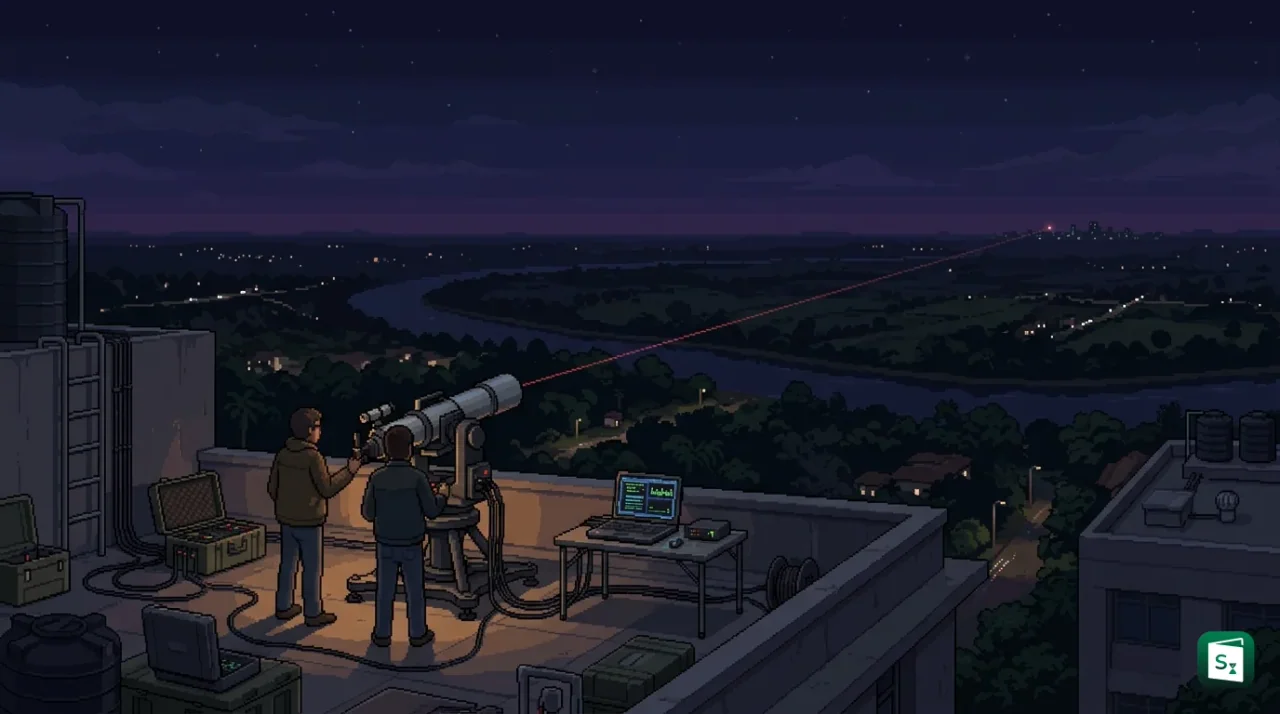
QNu Labs, along with the Bhaskaracharya National Institute for Space Applications and Geo-informatics (BISAG-N) and IIT Gandhinagar, has demonstrated India’s first free space quantum key distribution (QKD) link over 5.56 km. The system created secure encryption keys at 230 to 260 bits per second with a Quantum Bit Error Rate (QBER) of less than 5 percent. The keys were then fed into the Vedic Kavach platform for actual protected communication.
What Is Quantum Key Distribution?
Quantum Key Distribution (QKD) is a method to share secret encryption keys using single particles of light called photons. The security comes from quantum physics itself. Any attempt to copy or measure the photons changes them, so the sender and receiver can detect spying and discard unsafe keys immediately.
QKD does not send the message itself. It sends only the key, which is a random string of bits used to lock and unlock the message. The actual message then travels over a normal channel, but it is locked with this quantum generated key. The full form of QKD is Quantum Key Distribution, and it is often called QKD quantum key distribution in technical documents.
Quantum cryptography is the broader science behind this process. It uses the laws of quantum mechanics for secure communication. Quantum encryption is the practical use of those quantum keys to protect data. The safety does not depend on difficult maths puzzles. It depends on nature. If someone tries to intercept the photons, the error level rises and the users know the key is no longer safe.
How Quantum Key Distribution Works
QKD works by sending polarised photons one by one and checking how many arrive disturbed. The sender codes random bits into photon properties and the receiver measures them in randomly chosen settings. After the transfer, both sides compare a small sample over a public channel to calculate the Quantum Bit Error Rate (QBER) and keep only the clean, secret portion.
The most widely used method is the BB84 protocol. Charles Bennett and Gilles Brassard proposed it in 1984. In BB84, the sender uses two sets of polarisation bases to code 0s and 1s, and the receiver picks bases at random to read them. They later announce only their choice of bases, not the results, and keep only the bits where their choices matched. This matched set becomes the raw key.
Two quantum ideas make this safe. Quantum superposition means a photon can exist in more than one state at once until it is measured. Quantum entanglement means two photons can be linked so closely that action on one instantly fixes the state of the other. Because measurement changes the state, copying without disturbance is impossible. This is why QKD is secure.
The Quantum Bit Error Rate, shortened as QBER, is the share of mismatched bits in the test sample. A low QBER means a clean channel. A high QBER signals noise or spying. In this Indian trial, QKD teams achieved a QBER of less than 5 percent, which is within the accepted limit for generating usable secure keys.
India First Free Space QKD Link Over 5.56 km
QNu Labs established a free space QKD link over 5.56 km in open air, without using optical fibre. Free space means the photons travelled through the atmosphere between a transmitter and a receiver placed on separate buildings. This is the first such free space quantum secure communication demonstration reported in India.
The link used a Pointing, Acquisition and Tracking (PAT) system to keep the two ends locked. The PAT system continuously adjusts mirrors and sensors to correct for building vibration, wind and air movement. Stable pointing is the hardest part of free space QKD, because the light beam is very narrow and the single photon signal is very weak.
The trial produced secure keys at 230 to 260 bits per second (bps). The Quantum Bit Error Rate stayed below 5 percent through the run. The generated quantum keys were then integrated with the Vedic Kavach platform, which is QNu Labs quantum safe security system for encrypting real data traffic. This step showed that the keys were not only created in a lab test but were ready for practical use in networks.
QNu Labs and Partners Behind the Demonstration
QNu Labs is a Bengaluru based deep tech company working on quantum safe security products. The company builds Quantum Key Distribution systems, Quantum Random Number Generators (QRNG) that create truly random numbers from quantum processes, and the Vedic Kavach suite for quantum secure communication. QNu Labs has earlier supplied QKD systems over fibre for defence trials and has worked with Indian agencies on long distance links.
The Bhaskaracharya National Institute for Space Applications and Geo-informatics, known as BISAG-N, is an institution under the Ministry of Electronics and Information Technology. BISAG-N is headquartered in Gandhinagar, Gujarat, and works on satellite communication, geo spatial applications and secure networks. In this project, BISAG-N provided test infrastructure and system level support for the free space link.
The Indian Institute of Technology Gandhinagar (IIT Gandhinagar) is one of the second generation IITs, established in 2008 in Gujarat. Its researchers contributed academic expertise on photonics and quantum protocols. The partnership thus combined a private quantum firm, a national space applications body and a leading research institute.
What Is Quantum Communication?
Quantum communication is the transfer of information using quantum states of light, most often single photons sent through fibre or open air. It includes QKD for key sharing, quantum teleportation of states and future quantum networks. The goal is communication whose security can be checked through physics rather than trust in maths alone.
Quantum communication technology has three main forms. Fibre based QKD sends photons through underground optical fibre and suits cities. Free space QKD sends photons through air between rooftops or hilltops and suits last mile and mobile links. Satellite QKD sends photons between ground and space and suits very long distances.
China Micius satellite, launched in 2016, proved satellite QKD first by linking ground stations over 1,200 km. India is building the same ladder in stages. Fibre trials came first. The present 5.56 km free space link is the next step. Satellite links and a wider quantum communication network are the later stages.
National Quantum Mission: The Policy Context
The National Quantum Mission (NQM) is India central programme to build strength in quantum science and technology. The Union Cabinet approved the mission in April 2023 with an outlay of ₹6,003 crore for the period 2023 to 2031. The Department of Science and Technology is the nodal department for its execution.
The mission has four verticals, which are quantum computing, quantum communication, quantum sensing and metrology, and quantum materials and devices. Under quantum communication, the stated aim is to develop satellite QKD over 2,000 km within India, intercity QKD over 2,000 km using fibre and free space links, and multi node quantum networks. Four Quantum Technology Innovation Hubs have been set up in leading institutes to drive this work.
The QNu Labs demonstration fits directly into this roadmap. It shows indigenous ability in free space QKD, PAT control, low QBER operation and integration with Indian encryption platforms. Such milestones help move the mission from lab research to field ready quantum secure communication networks, including the long term goal of a 1,000 km scale quantum network often discussed in policy documents.
Significance for Secure Communication and Defence
Quantum technology in defence is a major driver for this work. Armed forces, space assets, power grids and banks need keys that remain safe even when powerful quantum computers arrive. Classical encryption like RSA depends on hard maths problems. A large quantum computer could solve those problems fast. QKD does not face this risk in the same way, because its safety rests on physics.
Free space QKD fills a clear gap. Fibre is costly to lay in mountains, deserts and border areas. Free space links can connect hilltop posts, ships and temporary command centres quickly. They are also the base for satellite quantum communication, where the ground station must track a fast moving satellite with extreme precision. A stable PAT system over 5.56 km is therefore a building block for both tactical links and future space links.
The table below places the main secure communication options in simple terms.
| System | How It Protects Data | Strength | Limitation |
|---|---|---|---|
| QKD | Shares keys through photons, spying is detected by physics | Future safe, detects interception | Needs special hardware and clear line of sight or fibre |
| Post Quantum Cryptography (PQC) | Uses new maths problems that quantum computers find hard | Works on present computers and networks | Security still rests on unproven maths hardness |
| QKD and PQC Hybrid | Uses quantum keys inside PQC software | Adds two layers of safety | Higher cost and complexity |
| Classical RSA and ECC | Uses factoring and elliptic curve maths | Simple and widely used today | Vulnerable to future large quantum computers |
For India, the demonstration also supports self reliance in critical technology. Indigenous QKD systems, Indian random number generators and Indian integration platforms like Vedic Kavach reduce dependence on imported security hardware. As quantum communication in India expands from city fibre trials to intercity and satellite stages, field proven PAT control and steady key rates will decide how fast secure networks can scale.
Key Takeaways
- QNu Labs with BISAG-N and IIT Gandhinagar demonstrated India first free space QKD link over 5.56 km.
- The link used a Pointing, Acquisition and Tracking (PAT) system and held the Quantum Bit Error Rate below 5 percent.
- Secure keys were generated at 230 to 260 bits per second and integrated with the Vedic Kavach platform.
- The BB84 protocol, proposed in 1984 by Bennett and Brassard, is the standard method behind most QKD systems.
- The National Quantum Mission, approved in April 2023 with ₹6,003 crore till 2031, targets satellite and intercity QKD over 2,000 km.