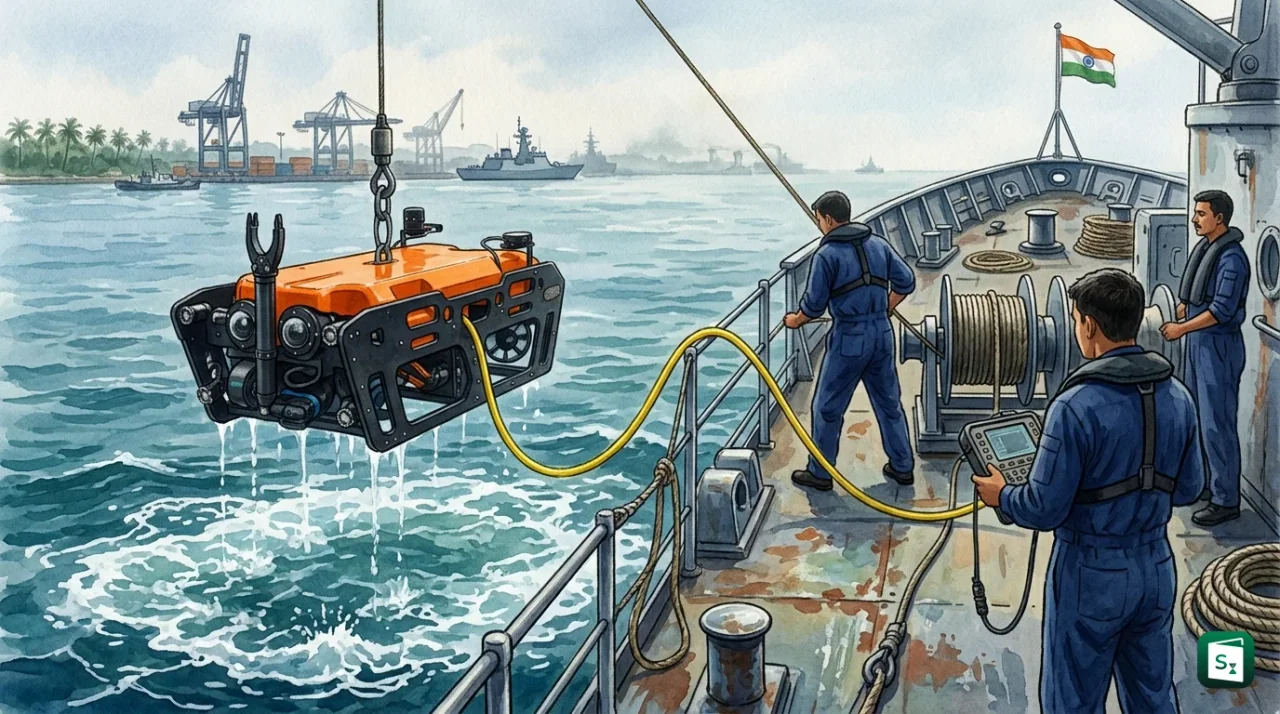
Kochi-based EyeROV has delivered two EyeROV TROUT military-grade remotely operated vehicles to the Indian Navy in early October 2026. The delivery is the first time an indigenously designed, developed and manufactured military-grade underwater ROV has entered naval service in India. The two systems form part of a five-system order worth around ₹47 crore placed under the defence innovation ecosystem.
What Is a Remotely Operated Vehicle?
A remotely operated vehicle is an uncrewed underwater robot that is controlled in real time by a human operator on a ship or on shore. The vehicle stays linked to its control station through a tether or umbilical cable that carries power, control commands, video and sensor data. This live link allows the pilot to steer the vehicle, watch high quality video and operate tools even in deep, dark or hazardous water.
The term ROV is the short form of Remotely Operated Vehicle, while ROUV and remotely operated underwater vehicle mean the same class of machine. An underwater drone is the popular name for the same idea, though navies and industry prefer ROV for tethered systems. The EyeROV TROUT belongs to this tethered category and is rated to work at depths of up to 300 metres.
An ROV is used for observation, inspection and physical work that is risky or impossible for divers. Common naval and civilian tasks include ship hull inspection, pipeline and dam survey, port security checks, search and recovery, mine related observation, and scientific study. Military-grade versions add rugged construction, precise navigation and payloads such as sonar, cameras and robotic arms to work in poor visibility and strong currents.
What Is EyeROV TROUT and Why Is Its Delivery Historic?
The EyeROV TROUT is a military-grade underwater remotely operated vehicle designed, developed, manufactured and qualified in India for naval operations. The Indian Navy placed an order for five TROUT systems and EyeROV delivered the first two systems in early October 2026. Company and official records place the total contract value at around ₹47 crore, signed in September 2025.
The delivery is historic because no military-grade ROV built in India had earlier entered naval service. Earlier systems used in the country were largely imported. TROUT changes that position by providing a homegrown platform that has cleared military standards for environmental strength, operational resilience and performance.
TROUT was developed under the iDEX DISC 7 SPRINT Challenge. iDEX stands for Innovations for Defence Excellence, a Ministry of Defence initiative that funds startups and innovators to build defence technology. SPRINT is the Indian Navy led drive to induct at least 75 indigenous technologies. The Indian Navy acted as the nodal agency for the TROUT project and supported design, integration and validation of the complete system.
Before delivery, TROUT completed extensive field trials and system level validation. The trials tested manoeuvrability, deep dive behaviour, station keeping in strong underwater currents, detection ability, navigation accuracy, endurance and operator control. The system has been engineered to meet Environmental Stress Screening (ESS) requirements under Directorate General of Quality Assurance (Naval) policies and has completed type testing to confirm that the design performs as specified.
Key Features and Technical Capabilities of TROUT
The EyeROV TROUT is built for tough open water missions that need power, stability and sharp imaging. The vehicle offers six degrees of freedom (6 DoF) movement, which means it can move forward and back, sideways, up and down, and also rotate in all directions. This control helps it hold position near ship hulls, piers and seabed structures even when currents push against it.
TROUT has a top speed of more than 3 knots and operates on a 400 metre neutrally buoyant tether. Neutral buoyancy means the cable neither sinks nor floats sharply, so drag on the vehicle stays low. The control station uses a sunlight readable display, joystick controller and the company’s i-Control Hub software, which combines live video, depth, heading and navigation data on one screen.
| Feature | Specification in TROUT |
|---|---|
| Depth rating | 300 metres |
| Primary camera | 4K camera with 10x optical zoom |
| Secondary camera | Full HD camera with 120 degree wide angle and tilt |
| Lighting | 6000 lumen LED system for dark and murky water |
| Speed and control | 3 plus knots, 6 DoF manoeuvrability |
| Tether | 400 metre neutrally buoyant tether |
| Payload capacity | 5 to 7 kg for mission sensors |
TROUT supports modular payloads for different naval tasks. These include imaging sonar for clear pictures in zero visibility, side scan sonar for seabed mapping and object detection, Doppler Velocity Log (DVL) for accurate speed and position tracking underwater, and an ultrasonic thickness gauge to check the health of metal structures. A 3 DoF robotic arm with grabber, rope cutter and recovery jaws, along with a single function gripper, allows object recovery, line attachment and removal of entangled material. Together, these tools support inspection, surveillance and reconnaissance, search and recovery, detection and robotic intervention without sending divers into danger.
How Does an ROV Work?
An ROV works through a continuous two way link between the submerged vehicle and the operator. The operator sends steering and tool commands down the tether, while the vehicle sends up live video, sonar images and navigation readings. Electric thrusters provide thrust in different directions, and onboard lights, cameras and sonars collect information that radio waves cannot carry through seawater, which is why a physical cable is used instead of wireless control.
Power can come through the tether from the surface or from onboard batteries, depending on the design. Pilots watch depth, compass heading, position and camera feeds on the control screen and adjust thrust to fight currents or hold a steady hover. When a target is found, the pilot can zoom the camera, switch on sonar, record data or use the manipulator arm to touch, cut or lift the object. The tether length and depth rating decide how far and how deep the vehicle can safely operate from the launch boat or harbour station.
EyeROV and IROV Technologies: The Kochi Developer Behind TROUT
EyeROV is the brand name of IROV Technologies Pvt Ltd, a marine robotics and artificial intelligence company based in Kochi, Kerala. The company was founded in 2016 by Johns T. Mathai and Kannappa Palaniappan P, both engineering graduates with later specialisation at the Indian Institutes of Technology at Delhi and Madras. The head office is located at Maker Village in the Kerala Technology Innovation Zone, Kalamassery, Kochi.
EyeROV built India’s first commercial underwater drone for inspection and now offers a small family of systems. The EyeROV TUNA is a compact observation class vehicle for confined spaces such as pipelines, tunnels, dams and tanks, while TROUT, also referred to in some company material as SAGARA class technology, is the larger military-grade platform for open sea, offshore and defence use. The company also works on unmanned surface vehicles and AI based analytics for 3D reconstruction of submerged structures.
EyeROV reports more than 100 underwater deployments across India, West Asia and Europe and a customer base of over 80 organisations, including the Defence Research and Development Organisation (DRDO), the Indian Coast Guard and the Council of Scientific and Industrial Research (CSIR). The company won the National Startup Award in 2022 and raised about $1.2 million (around ₹10 crore) in a pre-Series A round in 2024 led by Unicorn India Ventures. The Navy contract has placed the Kochi startup among the prominent deep tech suppliers in indigenous defence production.
ROV vs AUV vs UUV: Understanding Unmanned Underwater Systems
Unmanned underwater systems are often grouped under the broad term Unmanned Underwater Vehicle (UUV). This family has two main branches. A Remotely Operated Vehicle (ROV) is tethered and piloted live by a human. An Autonomous Underwater Vehicle (AUV) is untethered and follows a pre-programmed mission on its own, surfacing later to share collected data.
The difference matters for naval planning. An ROV gives instant video and allows the pilot to react to surprises, stop, zoom in or use an arm. This makes it ideal for close inspection, identification and intervention. An AUV is better for covering large areas on its own, such as seabed mapping, route survey and long ocean data collection, because it does not need a ship to stay connected throughout.
| Feature | ROV | AUV |
|---|---|---|
| Control | Piloted live in real time | Follows pre-set plan, limited operator input |
| Tether | Yes, cable to surface station | No, operates untethered |
| Feedback | Live video and sensor data | Data analysed after recovery or via limited acoustic link |
| Best use | Inspection, intervention, recovery, mine observation | Wide area survey, mapping, ocean data collection |
| Strength in currents | Better stability with pilot control and tether power | Currents can push vehicle off path |
| Example in Indian context | EyeROV TROUT for Navy | DRDO High Endurance AUV, Neerakshi mine detection AUV |
Hybrid designs that can work in both modes are now emerging. TROUT itself includes autonomous features such as station keeping, waypoint navigation and survey support, while retaining full pilot control for delicate tasks. Terms such as water drone, underwater UAV and underwater ROV all point to the same UUV family, with the tether and level of autonomy deciding the exact category.
Strategic Importance for the Indian Navy
The Indian Navy needs reliable eyes under water for harbour safety, ship maintenance and coastal awareness. TROUT directly supports underwater inspection of hulls and jetties, surveillance and reconnaissance around ports, search and recovery of lost objects, and protection of underwater infrastructure such as pipelines and cables. The vehicle can enter low visibility zones and strong current areas where diver operations are unsafe or slow.
Mine related tasks add another layer of value. The Navy currently operates without a large modern minesweeper fleet and is building unmanned options for mine detection and clearance. While dedicated mine countermeasure vessels and autonomous vehicles handle wide searches, a tethered ROV like TROUT can move close to a suspect object, identify it with cameras and sonar, and assist in controlled handling. This reduces risk to personnel and keeps larger ships at a safe distance.
Indigenous supply also improves readiness. Local design means faster repair, easier integration of new sensors, trained Indian operators and pilots, and freedom from import delays. As underwater threats grow and global navies expand large unmanned submarines for long surveillance, small and agile systems like TROUT give the Navy a practical tool for daily harbour work as well as emergency response.
Make in India Defence and the iDEX Ecosystem
The TROUT delivery reflects the wider push for self reliance in defence manufacturing. Make in India in defence aims to design and build critical equipment within the country, while Atmanirbhar Bharat stresses reduced import dependence and stronger domestic supply chains. Underwater robotics has been one of the import heavy areas, so a qualified Indian ROV marks a clear gap being closed.
The iDEX framework, launched in 2018 by the Defence Innovation Organisation, connects startups with the armed forces as buyers and test partners. Projects move from prototype grants to field trials and then to procurement orders. TROUT followed this path from innovation challenge to a five system naval order. A parallel example is the September 2025 order for Odisha based Coratia Technologies for its Jalasimha underwater vehicles, which shows that more than one Indian startup is now supplying homegrown underwater systems to the Navy.
The next steps will be closely watched. Successful operation of the first two TROUT units will guide delivery of the remaining three systems, crew training for ROV pilots, maintenance support and possible follow on orders. Performance feedback from harbour trials, endurance records and sensor upgrades will decide how quickly similar indigenous underwater drones become a standard part of naval toolkits.
Key Takeaways
- EyeROV TROUT is India’s first indigenously built military-grade ROV, with two systems delivered to the Indian Navy in October 2026.
- The delivery is part of a five-system order worth around ₹47 crore placed with Kochi-based IROV Technologies Pvt Ltd.
- TROUT was developed under the iDEX DISC 7 SPRINT Challenge with the Indian Navy as the nodal agency.
- TROUT is rated for 300 metres depth, offers 6 DoF manoeuvrability, 3 plus knots speed, and a 400 metre tether with 4K camera and 6000 lumen lighting.
- EyeROV, founded in 2016 in Kochi by Johns T. Mathai and Kannappa Palaniappan, operates from Maker Village, Kerala Technology Innovation Zone.
- An ROV is tethered and piloted live, while an AUV works untethered on a pre-programmed path, with both grouped as UUVs.