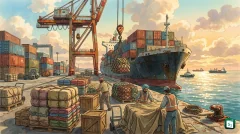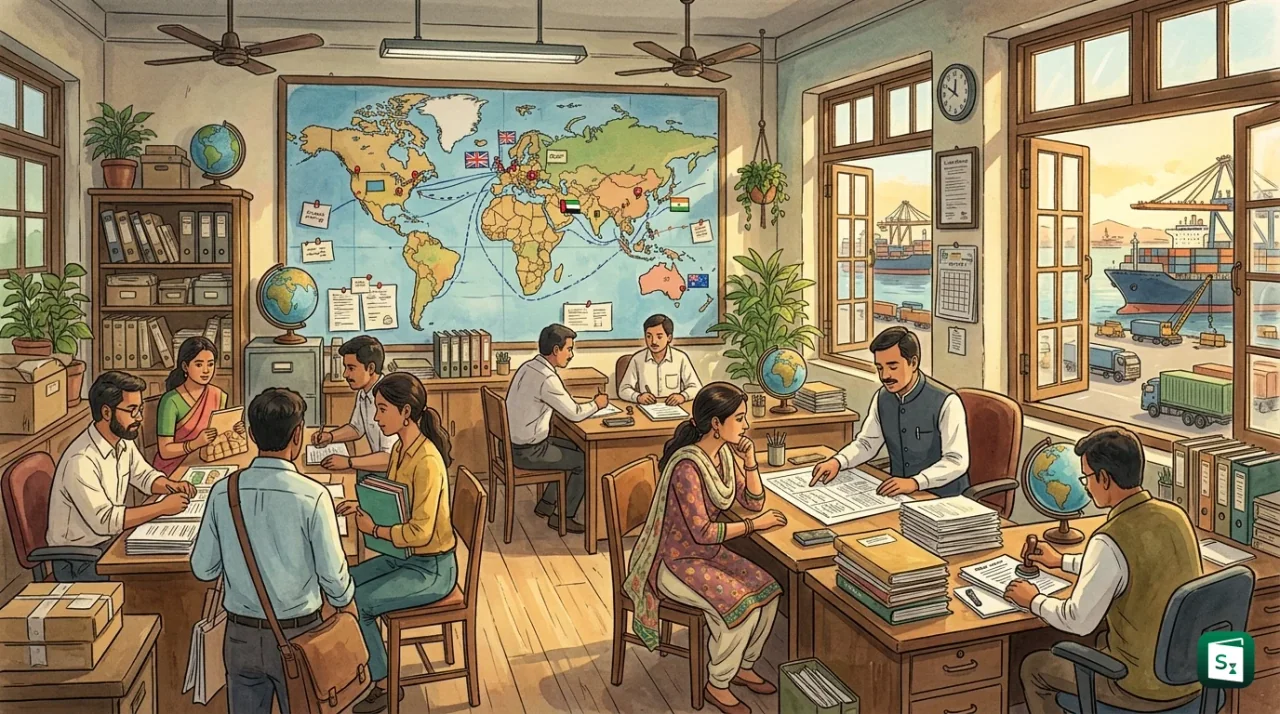
The Department of Commerce has set up a dedicated FTA Utilisation Cell to help Indian businesses actually use the free trade agreements India has signed. The cell will guide exporters on tariff benefits, paperwork and market access. It comes at a time when Indian goods have secured largely zero tariff entry into 32 countries across Europe, West Asia and the Indo Pacific.
What Is an FTA Agreement and How Does It Work?
A Free Trade Agreement (FTA) is a treaty between two or more countries to reduce or remove duties and non tariff barriers on trade between them. FTA full form in trade and customs simply means Free Trade Agreement. The partners exchange tariff schedules that list which goods get zero or lower duty and over what time period.
How an FTA works in practice is simple. If India has an FTA with the UAE, an Indian textile exporter pays the concessional FTA duty in the UAE instead of the normal Most Favoured Nation duty. To claim this lower duty, the exporter must prove the goods genuinely originate in India. That proof is called a Certificate of Origin, and it is checked by customs in the importing country.
FTAs differ from looser arrangements. A Preferential Trade Agreement (PTA) cuts duties on only a limited list of goods, while an FTA covers most goods. A Comprehensive Economic Partnership Agreement (CEPA) or Comprehensive Economic Cooperation Agreement (CECA) goes further and also covers services, investment, standards and customs cooperation. Most of Indias recent deals, such as those with the UAE, Australia and the European Free Trade Association, are CEPA type agreements even when they are described in short as FTAs.
FTA Utilisation Cell: Mandate and Core Functions
The FTA Utilisation Cell has been set up by the Department of Commerce, which functions under the Ministry of Commerce and Industry. The Ministry is headed by the Union Minister for Commerce and Industry (as of October 2026) and the Department is the nodal arm for foreign trade policy, trade negotiations and export promotion. The cell acts as a single helpdesk where entrepreneurs and small businesses can understand what each trade deal offers for their specific product.
The cell will explain tariff schedules in plain terms, such as which product lines get zero duty from the first year and which open up in stages over five or ten years. It will guide firms on rules of origin, product standards, labelling and registration requirements in partner markets. It will also collect feedback on problems exporters face at foreign ports, so negotiators and customs officials can take up those issues with partner countries.
This support matters because FTA benefits are not automatic. An exporter must classify the product under the correct Harmonised System code, obtain a Certificate of Origin from an authorised agency in India, and mention the FTA claim in the shipping bill and customs documents. Many small exporters miss these steps and end up paying full duty. The cell aims to close that gap through outreach, training and coordination with export promotion councils, chambers and customs field offices.
India Has FTA With Which Countries? The 32 Country Access
India has free trade agreements with countries that together open access to 32 countries for largely zero tariff trade. The current list combines older regional pacts and the new generation of bilateral deals concluded with the European Free Trade Association (EFTA), UAE, Australia, Mauritius, Oman, New Zealand, the UK and the European Union. EFTA is a four member bloc of Switzerland, Norway, Iceland and Liechtenstein, while the European Union has 27 member states.
| Partner or Bloc | Type of Deal | Countries Covered | What It Opens Up |
|---|---|---|---|
| European Union | Free Trade Agreement | 27 member states including Germany, France, Netherlands and Spain | Large apparel, leather, gems, pharma and machinery market with phased zero duty on most lines |
| United Kingdom | Comprehensive Economic Agreement | 1 (UK) | Zero duty access for textiles, footwear, marine products and engineering goods |
| EFTA | Trade and Economic Partnership Agreement | 4 (Switzerland, Norway, Iceland, Liechtenstein) | Duty free goods access plus a commitment of $100 billion investment in India over 15 years |
| UAE | Comprehensive Economic Partnership Agreement, in force since May 2022 | 1 (UAE) | Gateway to West Asia with zero duty on most Indian exports and easier services access |
| Australia | Economic Cooperation and Trade Agreement, in force since December 2022 | 1 (Australia) | Zero duty on most tariff lines covering textiles, pharma, leather and farm goods |
| Mauritius, Oman, New Zealand | Bilateral trade agreements | 1 each, counted within the wider network | New zero tariff openings in Africa, Gulf and Pacific markets for Indian firms |
How many FTAs India has signed depends on how older pacts are counted. India also has long running agreements with ASEAN, South Korea, Japan, Sri Lanka, Malaysia, Singapore, Chile and Thailand along with the South Asian Free Trade Area (SAFTA). The figure of 32 countries in the latest announcement refers mainly to the fresh market access created by the newest set of deals, led by the 27 nation European Union bloc plus the UK, UAE, Australia, Oman and others.
The national trade deal landscape gives context to this push. Search interest surged in January and February 2026 around the India EU trade deal and the India US trade deal, reflecting active negotiations on both fronts. The India EU agreement is the largest in the set by market size. Early details indicate that India will get zero duty entry for labour intensive exports such as garments, while imports of cars, wine and some machinery from Europe will see duties fall in stages rather than at once.
FTA Certificate, Certificate of Origin and How Exporters Claim Benefits
An FTA certificate means the Certificate of Origin that proves goods were made or substantially processed in the exporting country. In customs, the FTA full form and the certificate work together. The agreement sets the duty cut, while the certificate lets the importer actually claim it. Without this document, customs in the partner country will charge the normal duty.
To get an FTA certificate in India, an exporter registers on the Certificate of Origin portal managed by the Directorate General of Foreign Trade, fills in product and invoice details, and applies to an authorised issuing agency. The agency verifies the origin criterion, such as change in tariff classification or minimum local value addition, and issues the certificate. The exporter then shares it with the foreign buyer, who presents it at import clearance.
The FTA utilisation rate measures how much of the eligible trade actually uses the concessional duty. It is calculated as the value of exports that claimed FTA benefits divided by the total value of exports eligible under that FTA. Indias utilisation has been modest in several older agreements because small firms found rules of origin complex and were unaware of exact tariff cuts. Benefits for exporters include lower landed prices, an edge over competitors from countries without a deal, and access to government procurement in some pacts. Benefits for importers include cheaper inputs and machinery, which helps control production costs and supports economic growth.
Why FTA Use Has Stayed Low and What Changes Now
India signs trade deals at the government level, but small and mid sized firms use them far less than large companies. Surveys of exporters have repeatedly pointed to three hurdles. First, lack of awareness about which product gets what duty cut under which deal. Second, tough paperwork around origin rules, standards and testing. Third, weak market contacts in new regions such as Central Europe or Oceania.
The Utilisation Cell directly addresses this gap. By working with the Central Board of Indirect Taxes and Customs (CBIC), which administers customs duties and was established as part of the Department of Revenue under the Ministry of Finance, the cell can simplify guidance on shipping bill declarations and origin procedures. By working with export promotion councils, it can run product wise clinics for textiles, engineering goods, electronics, marine products and services. Over time, an FTA utilisation dashboard can track use by sector and country, so policymakers know which deals need course correction.
For India, the stakes are high. Zero tariff access to 32 countries gives labour intensive sectors such as garments, leather, footwear, toys and processed food a chance to win orders that earlier went to Bangladesh, Vietnam or Mexico. It also helps India plug into European supply chains for automobiles, clean technology and precision goods. If utilisation rises, exports grow, jobs expand and the gains from years of tough negotiations reach factory floors and farm clusters instead of staying on paper.
Key Takeaways
- The Department of Commerce under the Ministry of Commerce and Industry set up the FTA Utilisation Cell to help Indian businesses use trade agreements.
- Indias new FTA network provides largely zero tariff access to 32 countries, including the 27 nation European Union, UK, UAE, Australia, Oman and New Zealand.
- EFTA is a four member bloc of Switzerland, Norway, Iceland and Liechtenstein linked to India through a Trade and Economic Partnership Agreement.
- An FTA certificate means the Certificate of Origin, issued through the Directorate General of Foreign Trade portal, which is mandatory to claim concessional duty.
- The FTA utilisation rate is the share of eligible exports that actually claim FTA duty benefits, and raising it is the main goal of the new cell.